Three years of large models: The rapid decline and transformation of a new AI profession
36Kr "Career Bonus" (ID: ZhiChangHongLi)
The rise of this profession began with the "stupidity" of AI.
Whenever we ask questions to AI, the interaction form presented on the screen is just the Q&A process between users and large models. But behind this, the algorithm is like a knowledgeable child who lacks an understanding of the world. It needs someone to help interpret the requirements and guide it to give appropriate answers.
The key promoter of this process is the Prompt Engineer.
In 2022, ChatGPT was launched, and tens of millions of users flocked to the platform to interact with it. On social media, people shared snippets of their conversations with GPT, accelerating the popularization of the understanding that "good prompts can unlock the potential of AI".
Long before ChatGPT, Riley Goodside started sharing his interaction results with language models (especially GPT - 3) on Twitter (now X). Some in the industry call him one of the pioneers of "Prompt Engineering as a discipline".
Techniques promoted by Riley, such as Reflection Prompt (letting the model review and improve its own answers), Role - based Prompt (having the model generate content in a specific style by setting an identity), Chain of Thought, and Tree of Thought, have pushed prompt engineering from "mysterious tuning" to "systematic design".
Riley and some practitioners popularized the profession of "Prompt Engineer". After the birth of ChatGPT, Alexandr Wang, the founder of Scale AI, said that Riley would be the first person in history to be hired as a Staff Prompt Engineer. [1]
In 2023, the prompt engineer was once the sexiest profession in the technology industry. Without a technical background, just by chatting with AI, one could earn an annual salary of nearly one million yuan (RMB). Anthropic offered an annual salary of $335,000 in San Francisco to recruit a "Prompt Engineer & Librarian", without requiring a computer background and with no major restrictions, as long as the candidate "loved solving difficult problems". A survey by the career consulting platform ResumeBuilder showed that nearly 29% of companies planned to hire prompt engineers in 2023, and about 25% of these companies expected a starting salary of over $200,000 per year (about 1.426 million yuan RMB).
However, in early 2025, Sean Grove, a top researcher at OpenAI, dropped a bombshell at a closed - door meeting: "Prompt engineering is dead."
Overnight, the AI prompt engineer became the "shortest - lived profession in history". In the first half of 2025, a Microsoft survey involving 31,000 employees showed that the prompt engineer had become the second - least - wanted new position within the company in the next 12 to 18 months.
Why did a position once regarded as the "sexiest profession in the future" quickly become the "shortest - lived profession in history"? Has the prompt engineer really become a worthless position that companies least want to recruit?
[1] Scale AI is an AI data infrastructure provider founded in 2016 by Chinese - American founders Alexandr Wang and Lucy Guo. By providing high - quality training data and supporting platforms, it helps governments and enterprises quickly build, evaluate, and deploy machine - learning and generative AI models. In June 2025, Meta acquired a 49% stake in Scale AI for $14.3 billion and appointed founder Alexandr Wang as the Chief AI Officer. The two sides will cooperate deeply in the fields of general artificial intelligence and super - intelligence.
The Wild West Era: The Myth of a Six - Figure Salary without a Degree ╱ 01
Market Evolution: AI Agent Designers and Product Managers with AI Development Knowledge ╱ 02
Survival Guide: Composite Talents Who Can Master AI in Vertical Fields ╱ 03
The Wild West Era: The Myth of a Six - Figure Salary without a Degree
In 2023, a large number of prompt engineer positions emerged. The US magazine Time reported that at that time, Anthropic (the parent company of Claude) was recruiting a "Prompt Engineer & Librarian" in San Francisco, with a maximum annual salary of up to $335,000, equivalent to an annual income of about 2.4 million yuan RMB. [2]
At that time, the job content of prompt engineers was still relatively simple. The automation document review tool Klarity only required the candidate for this position to "prompt and understand how to use AI tools to generate the best output", and offered an annual salary of up to $230,000.
On the other side of the ocean, along with tens of millions of users, Xiuda also flocked to ChatGPT.
"As a student from a third - tier college, we already have no advantage in job hunting." During his four - year college, Xiuda, majoring in Aircraft Manufacturing Engineering, early discovered his own deficiencies in job hunting. He continuously broadened his capabilities through self - study, internships, and entrepreneurship, trying to make up for his educational background shortcoming.
AI brought new opportunities to Xiuda.
When ChatGPT became extremely popular, Xiuda, who liked to try new things, didn't want to miss it. After "breaking through thorns and thistles" to reach GPT, he was deeply immersed in the novelty of interacting with AI, and ChatGPT gradually became Xiuda's closest mentor. To improve the efficiency of his entrepreneurship, he self - learned prompt skills and created some prompt works out of interest.
What made Xiuda realize the importance of prompts was the advice ChatGPT gave him when he was disheartened after a failed entrepreneurship.
At that time, Xiuda encountered a bottleneck and didn't know whether to keep struggling on the ship lost in the "navigation route" or to go to an enterprise to gain experience. Having nowhere to pour out his feelings, he collected prompts about "making decisions" from other experts online and input them all at once to AI according to his own situation. The answer from AI helped him clarify the answer in his heart.
As mentioned above, the recruitment information of Anthropic for prompt engineers required applicants to "have a creative hacker spirit and love solving difficult problems". With his love for AI, Xiuda, whose resume was previously ignored, got an internship offer from a big company that he never dared to dream of. One year later, he successfully joined another leading company as a "Prompt Engineer".
Liu Hai, who graduated from a junior college, had a similar experience to Xiuda. In a post sharing his experience and understanding of the responsibilities of a prompt engineer on social media, Liu Hai mentioned that after taking this position, his salary was indeed slightly higher than that of ordinary programmers. [3] Relying on his proficient mastery of AI technology and prompt skills, Liu Hai got a monthly salary of 10,000 yuan in a startup company.
Prompt engineers are generally divided into junior and senior levels (but this classification is still to be discussed, which will be elaborated on later). Junior prompt engineers have a monthly salary of 10,000 - 15,000 yuan, and the annual salary of senior prompt engineers ranges from 300,000 to 800,000 yuan, depending on whether their responsibilities are more inclined to product management or technical/Agent development.
But behind the high salary in the early stage of the profession, the responsibilities were not clear. Liu Hai mentioned that during a certain period, some company bosses were amazed by the effects of technologies such as ChatGPT, AI image generation, and digital humans, and wanted to integrate AI into their companies. As a result, the role of early AI prompt engineers was similar to that of corporate AI consultants.
Some practitioners proposed that the root cause of the high salary of prompt engineers was that the HRs who were recruiting also couldn't clearly define the role and salary of this position, and it largely depended on the value of the job seekers themselves.
[2] Data source: The AI Job That Pays Up to $335K---and You Don't Need a Computer Engineering Background, TIME
[3] Reference material: Insights and Experience Sharing of "AI Prompt Engineer", author Liu Hai.
Market Evolution: AI Agent Designers and Product Managers with AI Development Knowledge
"In 2024, one might be able to learn some knowledge and skills from documents such as Learning Prompt, LangGPT, and way to agi, build a few products and agents on platforms like Kouziz or iFlytek, and still find a good job as a prompt engineer. Now, it can only be said to depend on fate." Xiuda told "Career Bonus".
The narrowing path to enter the industry is closely related to the continuous expansion of the responsibilities of prompt engineers as the capabilities of models improve. Currently, there are two types of prompt engineers in the market: full - time and outsourced.
According to Xiuda's sharing, the general work process of a big - company AI prompt engineer is as follows:
Receive requirements - understand product requirements - run the minimum MVP - obtain project industry know - how - design technical solutions - formulate evaluation criteria and evaluation sets - write prompts + test and iterate - deliver results.
When prompt skills appear as a single - point technique, the value of such talent to enterprises is not high. Outsourced prompt engineers are an example. The requirements received by outsourced engineers are already determined, and they only need to complete the "writing prompts" part.
Full - time prompt engineers need to understand the requirements of product managers and have certain requirements for product and user insights. They need to run the minimum MVP through experiments based on the understood product requirements (using the least resources and the fastest speed to create a minimal product prototype with "verifiable value"), and even build Agent workflows.
Writing prompts for large models essentially requires prompt engineers to refine their understanding and methodology of the project industry and process. If they encounter an unfamiliar industry, full - time prompt engineers have to "try every means" to obtain industry know - how. For example, if a project plans to create a text - polishing agent, some prompt engineers will order cases from professional text - polishing workers on Xianyu, observe their habits in text - polishing work, and extract know - how.
Some enterprises also tend to recruit fresh graduates to be prompt engineers.
"In the field of AIGC/Prompt, there are more and more professional young people (college students). Compared with those with work experience, college students have no employment pressure. They will search for information online by themselves and spend more time practicing the design and application of prompts." An enterprise HR told "Career Bonus".
Due to the instability of large - model interactions, full - time prompt engineers also need to create evaluation sets for new products based on interviews with product managers and users. Only after the product passes the evaluation criteria can the prompt work be delivered. For different projects, prompts can be short or long. Short prompts can be written in dozens of words, while long ones may even require tens of thousands of words.
Testing is the most time - consuming task in prompt engineering. Xiuda shared that each step of testing and iteration requires at least hundreds of experiments, and sometimes a script needs to be written to run them.
36Kr "Career Bonus" (ID: ZhiChangHongLi)
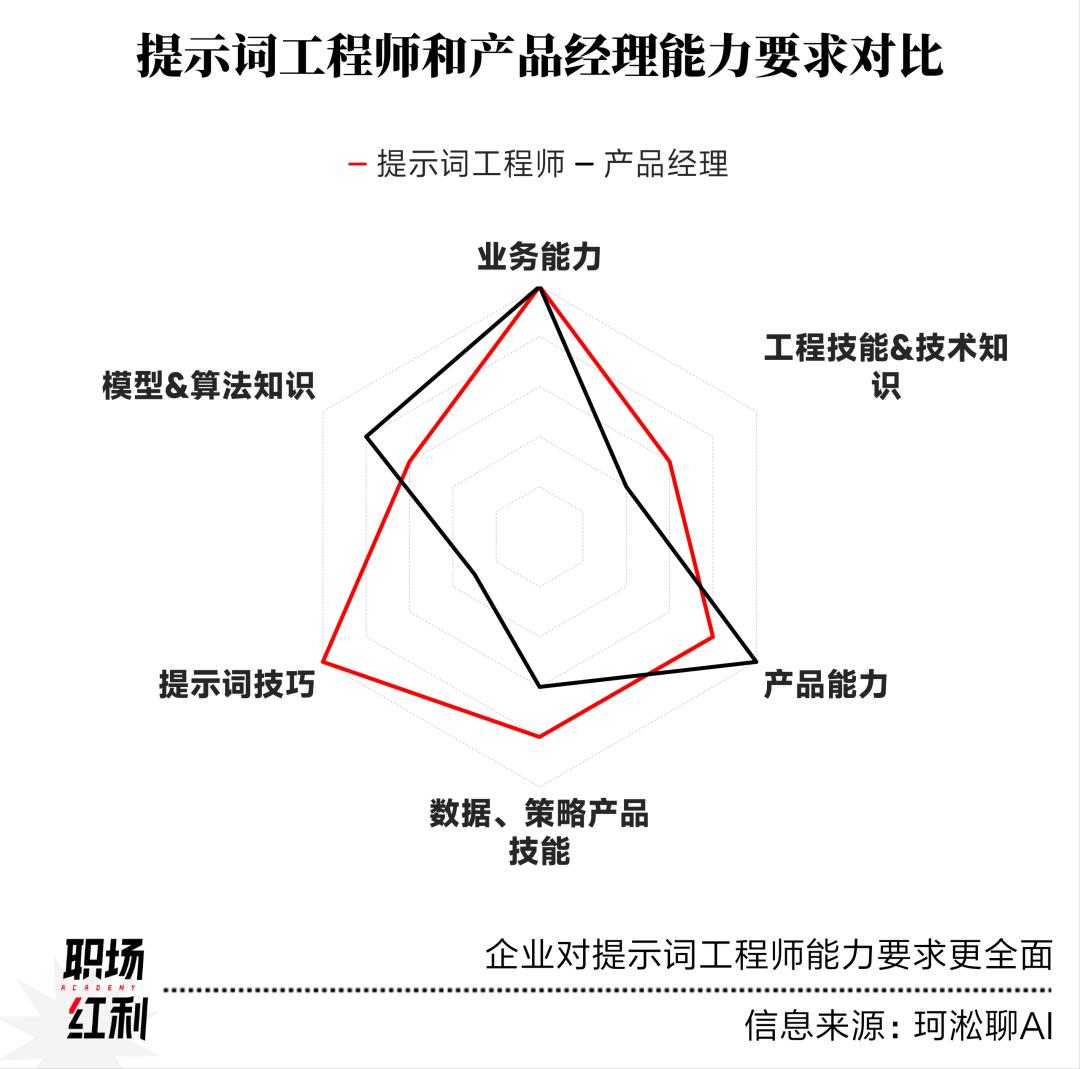
Full - time prompt engineers also need to have a certain understanding of technology and be able to design technical solutions. This position no longer has no requirements for a technical background: there is a certain threshold for liberal - arts students; for those with a technical background, they also need to have the ability to understand products and have user insights.
After the evolution of AI, the market's requirements for AI prompt engineers have risen from "writing systematic prompts and having product awareness" to "understanding technology, being able to build workflows, and connecting multiple AIs to form an Agent". Therefore, some current AI Agent Designer positions are also an extension of prompt engineers.
In startup companies, the responsibilities of prompt engineers are often taken on by product managers, and occasionally by technical staff. The advantage of this division of labor is that it combines product management and execution. The person putting forward the requirements understands better how to achieve them and can run the product MVP at the fastest speed, which is more efficient.
Enterprises essentially need a product manager who understands AI development rather than just an engineer who can write prompts.
Survival Guide: Composite Talents Who Can Master AI in Vertical Fields
There is a set of data widely circulated on social platforms: On the foreign recruitment platform (Indeed), the number of searches for prompt engineers has experienced a roller - coaster - like change.
In January 2023, there were only 2 searches for prompt engineers per million searches.
In April 2023, this number soared to 144 searches per million searches.
Now it has returned to normal, generally remaining at 20 - 30 searches per million searches.
A recent Microsoft survey involving 31,000 employees showed that the "prompt engineer" has become one of the "least - wanted new positions" within the company in the next 12 to 18 months.
"This is just a transitional position," said Wang Dan, who has been working in prompt engineering for 3 years.
In Wang Dan's view, who works as a prompt engineer in a startup company, if we regard the responsibilities of prompt engineers as a spectrum, the two ends of the spectrum are product managers and technical staff, and prompt engineers are more of a transitional position. Therefore, the salary of prompt engineers is also linked to their responsibilities: prompt engineers whose responsibilities are closer to those of product managers (leaning towards strategic product managers) have a salary level similar to that of product managers; those whose responsibilities are more inclined to technical development have a salary comparable to that of pure technical staff.
It is certain that enterprises need composite talents with prompt skills. As enterprises develop, the requirements for the level of prompt engineers will also increase.
Usually, in a project where the ratio of product managers, front - end developers, and back - end developers is 1:1:1, enterprises need to recruit a prompt engineer to cooperate with product managers and back - end developers. An employee from a big company told "Career Bonus" that in a project team of about 30 people, there are 1 - 2 prompt engineers. In big companies, in teams with more complex projects, there are no more than 10 prompt engineers.
Data from Liepin shows that currently, 70% of the high - paying prompt engineer positions are concentrated in vertical fields such as healthcare, government affairs, and finance, and generally require "1 to 3 years of industry experience + programming foundation". The prompt engineer position is evolving from a "generalist" role to an "expert" role.
Sander Schulhoff, the world's first author of a "Prompt Guide", insists: "Prompt engineering is far from outdated. Instead, it is more important than ever." [4] The difference is that in the past, it was "professional magic", and now it is "office common sense". In specific scenarios such as building Agent architectures and designing technical architectures, the experience of prompt engineers is still irreplaceable - product managers may misjudge the capabilities of models due to lack of experience.
"To some extent, the emergence of large models is similar to the reinvention of the computer. Instead of focusing on how long the position can last, it's better to immerse yourself in the process of interacting with intelligence and accumulating experience," summarized practitioner Aim.
