Using AI to make pets speak human language is becoming a business.
Although there is a language barrier between humans and cats and dogs, we are enthusiastic about trying to communicate with them.
A short video teaching a cat to recognize carrots and tissues once went viral on the Internet. A phrase "Zheng Bang" from the cat's owner became a popular internet meme, and the "carrot-tissue cat" became a meme in online chats. Recently, a "cat language" APP that can summon cats with a single click has gained popularity on social media and ranked first on the APP paid list.

Carrot-tissue cat Meme/Cat language APP (charged 1 yuan)
The AI wave has made a bigger splash in this field, and the capital market has also recently shown concentrated optimism about this track. Traini, a pet intelligent technology company founded by a Chinese team, recently announced the completion of a new round of financing of over $7.5 million. The investment list includes the vice president of NVIDIA, core technical members of Anthropic, and Hong Feng, the co-founder of Xiaomi. In the nearly one year before, the company's iOS application launched functions such as dog barking recognition and photo-to-text-and-voice conversion, and has attracted more than 200,000 registered users.
After receiving the financing, Traini will launch an AI intelligent collar that can enable real-time voice conversations through its self-developed model - with the collar on, dogs can "speak human language".
SATELLAI, a Shenzhen-based company, has launched its first AI pet intelligent collar, the SATELLAI Collar. It not only covers basic safety functions but also emphasizes the monitoring of pet behavior status. On January 7 this year, the company announced the completion of tens of millions of RMB in Series A financing. The new funds will be used for the in-depth research and development of multi-modal AI technology.

Traini collar/SATELLAI collar | Image source: Internet
Can we really communicate with pets without barriers in the future through AI? Is this just a fantasy of anthropocentrism? If it is a pipe dream, why do practitioners keep investing their trust and money?
AI translation of dog language cannot be falsified
It is not a new thing for humans to try to understand animal languages. Biologist Slobodchikoff is the earliest person traced through the Internet who tried to develop an animal language conversion system.
He has studied prairie dogs for more than 30 years and found that they have a complex vocal communication system and can even distinguish the types of predators and describe the colors of human clothes. So he developed an algorithm to convert the sounds of prairie dogs into English.
In 2018, Professor Slobodchikoff founded the Zoolingua company, hoping to extend the research to household pets such as cats and dogs. In addition to himself, the team includes an animal behavior coordinator with more than 30 years of animal training experience and a COO with more than 20 years of experience in non-profit management and animal welfare communication. People can't help but have certain expectations for this star research team led by the old gentleman. However, it's unclear why, after 8 years, the official website still doesn't show that they have launched any products.
Actually, before the popularization of AI models, there were already various mini-programs with functions like "cat language translation" and "dog language translation" on the market.
There are many evaluations of such mini-programs on social platforms. Some users are amazed at the magic of these translation software. However, some users spent money to buy translation software and found that even when the pet made no sound, the software could still "recognize the semantics". In the end, they could only use the software they subscribed to as entertainment and not as a scientific judgment of the pet's emotions and health.
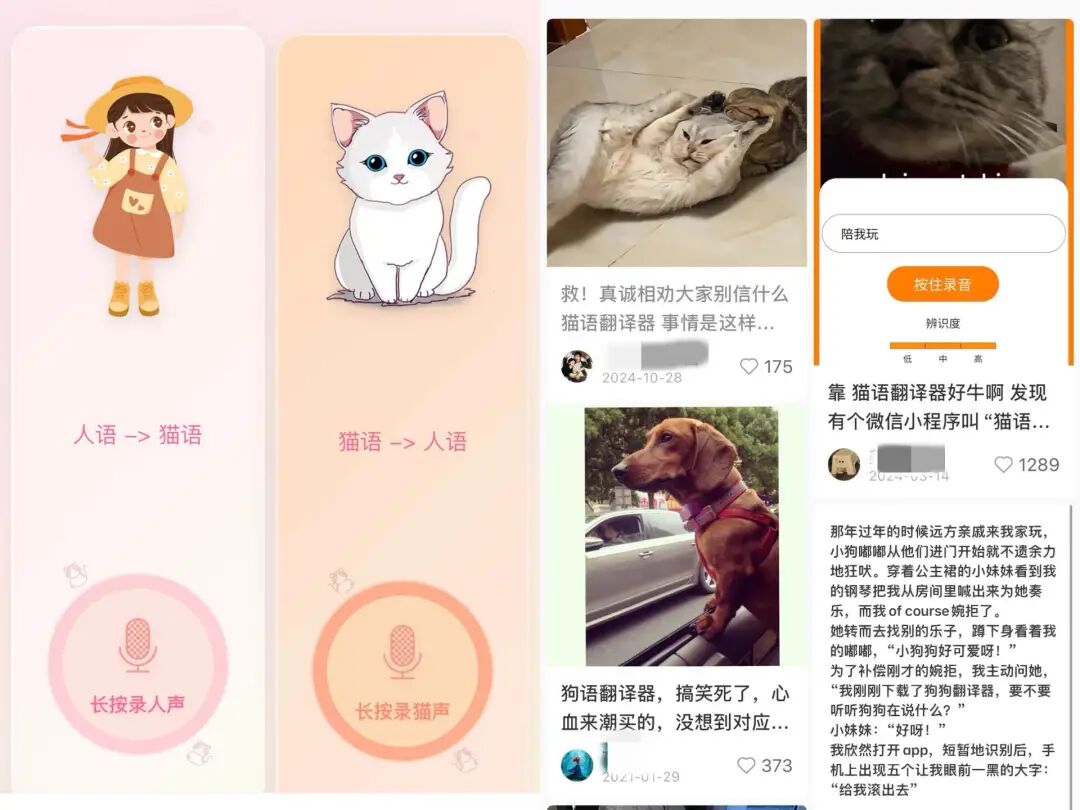
Cat language translation mini-program/Social media evaluation | Screenshot
The "cat language" APP can play "cat language" sounds, such as calling, coquettish, warning, and sleep-aiding audios. Developer Mr. He said that he didn't initially think about translating cat language but just wanted to help people communicate with cats.
The underlying logic of this APP to communicate with cats is to regard the person making the sound as another cat. For example, the button representing "drinking water" is a set of sounds: the sound of a cat drinking water and the meowing to call the cat. After pressing the button, it's as if another cat is drinking water by the water dispenser and calling its companion. Mr. He's method of collecting data is also based on his own cat. The actual meanings represented by cat language are mostly obtained by observing his own cat.
With the popularity of large AI models, some people in the industry have started to introduce "semantic analysis" to the sounds made by pets.
Traini launched the natural language behavior analysis model PetGPT in 2023. Last year, Baidu applied for a patent for an "animal language conversion method", and Google released a "DolphinGemma" large AI model, claiming that it can achieve real-time underwater communication with dolphins.
The basic principles of these AI language analysis models are similar. Taking Traini as an example, the team proposed the "human-pet sound spectrum comparison method", which maps the sound spectrum of a pet's vocalization to the sound spectrum of human speech when expressing similar emotions, so as to match behavior signals to emotional labels. The training data comes from self-built pet behavior communities, public data sets, and behavior samples collected through cooperation between the team and pet hospitals and other channels.
In addition, the pet medical brand Chongzhiling released "Chong Sheng Wan Xiang", claiming that this model is based on 36 million clinical data and can output emotional states and health diagnoses. Baidu's submitted patent related to animal language conversion also focuses on the collection of sound, behavior, and physiological data, as well as the emotional recognition engine and semantic mapping. The intelligent collar of Shenzhen-based pet intelligent technology company SATELLAI is equipped with the Petsense™ AI model, which can generate emotional trend reports based on data such as heart rate and activity level.
Multi-modal recognition is also a common technical setting for such models. In a public interview, Sun Linjia, the founder of Traini, said that it is difficult to achieve high accuracy only by relying on animal calls. Combining their body language and expressions for judgment will result in higher accuracy. Traini claims to be able to recognize 12 core emotions, and currently, the accuracy of translating canine behavior into human language among 120 dog breeds reaches 81.5%.
But the confusing question is, how can we judge whether the translation result is what the dog really wants to express? Who defines the accuracy? Is it the cats and dogs, or the algorithm?
First of all, whether dogs really have their own language system is indeed a long-term scientific issue. Juliane Kaminski, the director of the Canine Cognition Center at the University of Portsmouth in the UK, who studies human-dog interaction, once said that she would not call dog barks a language in the scientific sense. It is more like a basic signal, "expressing what they want and how they feel."
The founder of Traini also said that dogs cannot process abstract concepts like humans and cannot understand "schoolbags" which are not in their expression system, unless they form a reflex after long-term training. This is also the reason why they don't plan to "translate" human language to dogs for the time being - the challenge for the startup is significantly greater.
The root of the dilemma is that this system cannot be falsified. The prediction of health changes can still be verified through medical treatment or experiments, but when the APP translates it as "I want to sleep", even if the dog is just a little bored, it won't jump out to refute. From the consumer's perspective, when buying a product to interpret pet language, it's really impossible to determine the scientific nature of the product, so they can only regard it as an entertainment product.
The real moat is pet data
A simple entertainment scenario is naturally not enough to support multiple rounds of financing exceeding 50 million. By carefully studying Traini's product development process and future plans, it's not difficult to find that language translation is just an entry point.
CEO Sun Linjia mentioned Traini's future business concept in a public interview. Currently, the software allows users to upload dog barks, photos, or videos. A small model on the device side comprehensively judges the voice, expression, and movement, and charges according to a monthly subscription package. However, Sun Linjia believes that the C-end application doesn't necessarily need to be profitable. If a flywheel effect is formed through user data to continuously optimize the model's capabilities, the company tends to achieve commercial realization on the B-end.
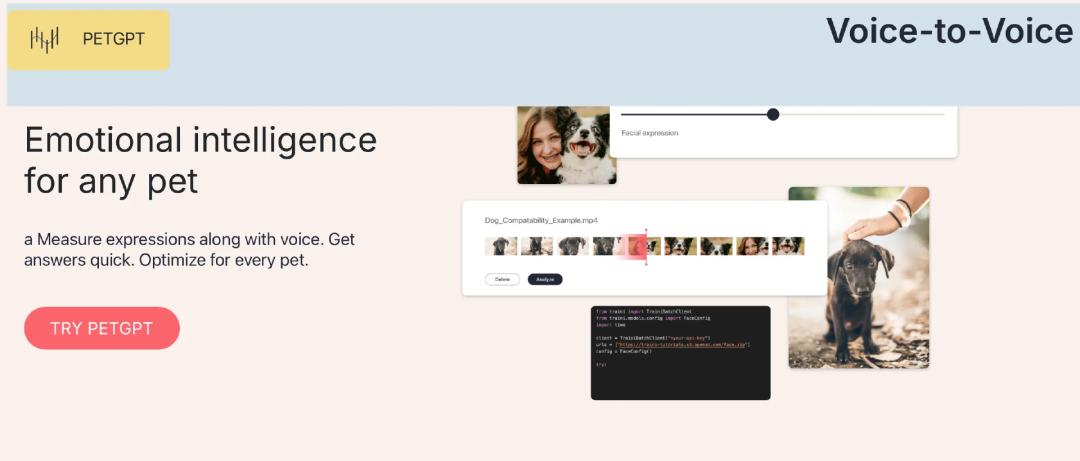
Screenshot of Traini's official website
In other words, what's important is not the translation function, but the data uploaded by users.
In 2024, Traini launched the T-Agent system, which can autonomously identify a dog's needs by analyzing its behavior. It's not hard to imagine that when the AI determines that a dog has been very active and excited recently, the system will automatically pop up a window suggesting the owner to buy a suitable dog food for the pet's current physical condition. Currently, Traini has established cooperation with 40,000 pet stores in the United States.
After the latest round of financing, Traini's next plan includes accelerating the mass production of its first AI intelligent collar. This collar is embedded with generative AI capabilities. By collecting physiological signals such as heart rate and comprehensively analyzing the dog's barks, the dog can present human-like expressions (text or voice), including emotional changes and possible needs.
It's not hard to imagine that such wearable devices can collect information about pet dogs in a way similar to how Apple Watches collect user information - one is worn on the wrist, and the other is hung around the neck.
Hardware is of course more conducive to collecting information. In addition to real-time communication behavior, they can record the pet's location and physiological indicators around the clock. These long-term accumulated data can not only be used to analyze the pet's health status but also participate in decision-making when buying pet supplies and insurance.
The team of SATELLAI comes from Huami Technology, which has a background in making smart wearables. Their ideas on hardware also overlap. They directly made the collar into a "pet version of Apple Watch", with functions such as Beidou satellite positioning, heart rate monitoring, and sleep analysis. This collar can deeply learn and analyze heart rate, step count, and sleep data, and output pet health warnings and behavior reports. Qi Algorithm, a domestic technology company focusing on pet health large models, has also launched the "Paqi Pet" pet health tracking collar, which is equipped with positioning, health, and voice translation functions.
Most of the results of this data converge in two directions, which are also the directions with the highest unit prices in pet consumption - medical care and insurance. For example, SATELLAI has cooperated with the North American insurance agency Fetch Pet Insurance; Chongzhiling has cooperated with the Xinruipeng Pet Medical Group to provide AI-assisted diagnosis to 2,000 offline hospitals; Qi Algorithm's pet doctor Agent has also been put into use in more than 50 pet hospitals in four cities.
The mystery of the small collar translator is gradually becoming clear. Language translation may be the entry point to attract attention, but the real implementation depends on "risk identification". Even the original intention of Baidu's relevant patent research and development was to reduce the risk of dogs hurting people by identifying canine emotional fluctuations in advance.
For pet owners, 24/7 recording may mean companionship and safety. But for enterprises, it means rich data. Emotional communication is packaged as part of AI capabilities. It is obviously more communicable and easier to attract public attention, but the data assets are what really support the valuation of the business model. Whether the puppy's heart is beating fast or whether it has an anxiety tendency, there are monetization needs hidden behind these.
After the analysis, let's look at the real market reaction. In early 2025, SATELLAI's collar was launched on Amazon. In just three months, its sales exceeded millions of dollars. Moreover, the $499 for the hardware is just the first expense, and each user then has to pay a monthly software subscription fee of $9.9.
Compared with the situation of the above model startup companies, the reaction of domestic established pet intelligent hardware manufacturers is relatively slow.
Searching for keywords such as "dog language translator" and "pet translator" on e-commerce platforms, most of the translator hardware that appears are communication buttons. In addition, there is a type of hardware that is not in the form of a collar but a dog muzzle that looks like a "sausage mouth". The price of these muzzles is about 1,000 yuan, and they are labeled as intelligent pet entertainment toys. However, each similar product has "0 people paying", so it seems that netizens, like me, just take it as a joke and dare not try it casually.

Screenshot of e-commerce platform
In terms of technology, domestic manufacturers' pet intelligence still stays at basic functions such as positioning and step counting, lacking real capabilities such as emotion recognition or health prediction. Xiao Pei Pet is relatively advanced in adopting AI. All of its products, including intelligent feeders, water dispensers, cat litter boxes, and intelligent collars, have been connected to AI algorithms to refine daily pet care. Duonis, the "first stock in pet intelligent hardware", lags behind in the layout of large AI models and mainly relies on traditional algorithms, such as using sensors for positioning. However, it cannot be ignored that China's pet economy has expanded rapidly in recent years, and the market scale is expected to exceed one trillion yuan in a few years. The evolution of technology in the future will further raise the industry ceiling.
Conclusion
Human beings' desire to understand animals has never stopped. In the 1970s, the record "Songs of the Humpback Whale" was a bestseller, which promoted the environmental protection movement. The emotional connection between humans and animals has always had a moving power.
The prosperity of the contemporary pet economy is based on the change in people's emotional structure. For the younger generation living in big cities, atomic loneliness has become a problem for most people. People choose to regard pets as family members and are willing to pay for their safety and health. Compared with high-frequency needs such as positioning, health, and risk warning, emotion recognition and communication are more of an added value.
In this case, the core function of the AI collar is not to decipher the language of pets but to relieve the anxiety of pet owners. As an always-on monitoring system, AI can let owners ensure that they don't miss any detailed changes in their pets. As for the scientific value of this system itself, it's actually not that important.
