Observing the Industry Landscape through the Transformation of xAI Co-founders: Insights into Talent Entrepreneurship at Global Leading AI Companies
In just two days, xAI was in an uproar.
From February 10th to 11th, 2026, two co-founders, Yuhuai Tony Wu and Jimmy Ba, announced their departures one after another. In response, Yuhuai Tony Wu wrote on X, "A new chapter in my life is about to begin. This is an era full of infinite possibilities: a small team equipped with artificial intelligence can move mountains and fill seas, redefining that everything is possible."
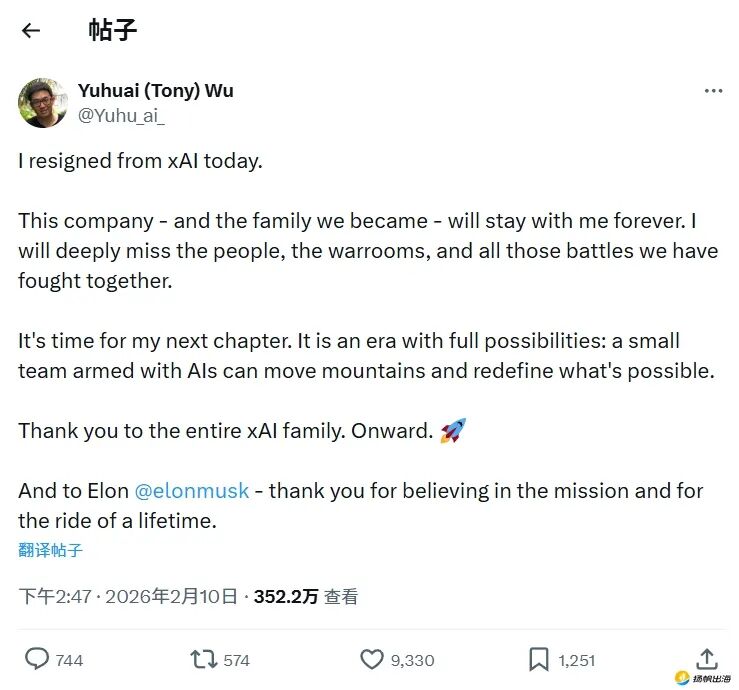
Yuhuai Tony Wu's post about leaving xAI. Image source: X
After this text was published, it attracted the attention and sparked heated discussions across the industry, as it can almost be regarded as an entrepreneurial declaration. Especially at the beginning of 2026, the open-source intelligent agent project OpenClaw suddenly became extremely popular in the global developer community. Compared with the large model competition dominated by tech giants, OpenClaw represents another path: a product direction driven by small teams, centered around AI agents, and emphasizing execution ability and tool integration.
When "small teams + AI" and "intelligent agent ecosystem" became the focus of discussions simultaneously, Yuhuai Tony Wu's statement was naturally interpreted as a signal of a certain trend.
Then, Jimmy Ba, who announced his departure the next day, first expressed his gratitude to his xAI teammates on the X platform and finally emphasized, "2026 will be a crazy year, probably the busiest (and most decisive) year for our humanity in the future."

Jimmy Ba's post about leaving xAI. Image source: X
Since its establishment in 2023, the original 12 - member founding team of xAI has been reduced by half. Core technical figures such as Igor Babuschkin, Christian Szegedy, and Greg Yang have left one after another. As the backbone of xAI, they have unique insights into the boundaries of model capabilities, the cost structure of computing power, and the rhythm of application implementation.
In the past few years, in leading AI companies like OpenAI, key technology decision - makers have continuously left the established systems and turned to their personally invested entrepreneurial directions. This flow from large organizations to startup teams has become an important clue in the development of the AI industry.
Based on this, YFCHUHAI sorted out and summarized the entrepreneurial directions of important AI talents leaving companies such as OpenAI and Google. By observing the choices of these core figures, we can see the past changes in the AI industry and the possible breakthrough directions in the future.
OpenAI: From Model Platforms to Intelligent Systems
The "Most Luxurious" Startup Team in History
In the past two years, talents from OpenAI's core team have successively "left" and have gathered into an entrepreneurial force that has attracted much attention in the industry. From co - founders, chief technology officers, to research leaders and core scientists, a group of key figures involved in the research and development of GPT - 4 and subsequent models have left their original organizations one after another.
Their entrepreneurial directions cover multiple aspects, including basic model research and development, AI search, general intelligent systems, and AI security.
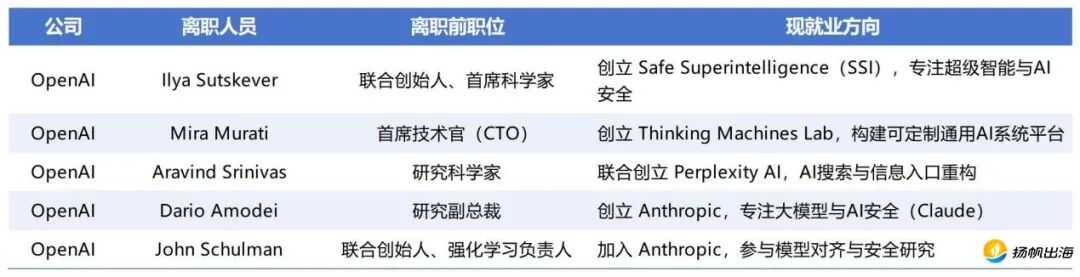
Employment trends of some OpenAI departures. Charting: YFCHUHAI
The following will be sorted out project by project.
1. Superintelligence and AI Security
In 2024, after leaving OpenAI, co - founder and former chief scientist Ilya Sutskever founded the safe artificial intelligence startup Safe Superintelligence (hereinafter referred to as "SSI"). As an important figure in the field of deep learning, Sutskever holds a different view on the current development path that relies on continuously expanding quantitative computing power to improve AI capabilities. He believes that the purely computing - power - driven approach is difficult to fully address fundamental issues such as AI security and alignment.
Specifically, SSI focuses on the long - term research goal of building "safe superintelligence". The company's official website and co - founders have emphasized in public that they will only work around this core direction and will not pursue products such as search engines, painting tools, or video generation like general AI platforms.
In terms of the technical route, SSI emphasizes the concept of "intrinsic AI security". It hopes to embed security goals as early as possible in the system training and design stages, rather than patching potential risks through external strategies or interventions after the model is completed.
Although SSI has not released any commercial products or public APIs yet, it has received support from two rounds of financing. In September 2024, SSI completed a financing of approximately $1 billion, valuing the company at approximately $5 billion. Investors included institutions such as a16z and Sequoia Capital. Subsequently, in 2025, SSI completed another financing of approximately $2 billion, and its valuation increased significantly to approximately $32 billion. Alphabet (Google's parent company) and Nvidia participated in the investment.
2. AI System Platforms and Human - Machine Interaction
The entrepreneurial project of OpenAI departures that is also eye - catching in terms of financing is Thinking Machines Lab (hereinafter referred to as "TML"). Similar to SSI, although it has not launched an official product, it has won the favor of top - tier capital due to the technical accumulation of its core team and its clear positioning, and has become one of the focuses in the field of AI startups.
In September 2024, former chief technology officer Mira Murati left OpenAI and founded TML in February 2025. It is reported that Murati worked at OpenAI for six years, held key positions in product and technology management, and played a key role in the release and iteration of core products such as ChatGPT, DALL·E, and Codex.
In July 2025, Mira Murati posted on X that TML had completed a $2 - billion seed - round financing led by a16z, valuing the company at approximately $12 billion. Institutions participating in this round of investment also included Nvidia, Accel, Cisco, and AMD.
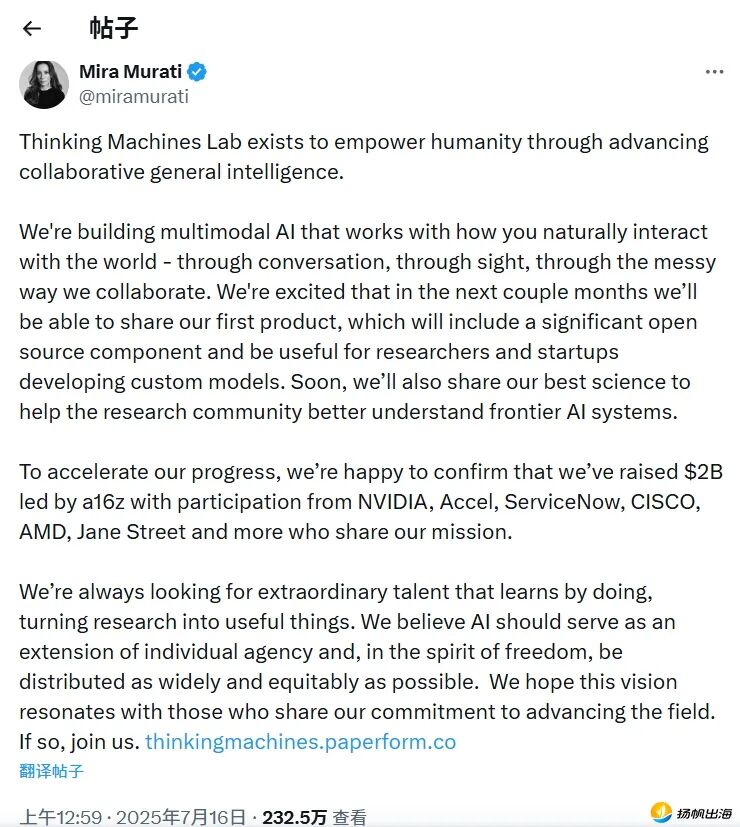
Mira Murati's post announcing the financing situation. Image source: X
As of now, TML has not publicly released an official product. Its positioning focuses on building a more comprehensively understood, customizable, and practical intelligent system. Its core vision is "to enable everyone to obtain the knowledge and tools they need so that AI can serve their personalized needs and goals". The company emphasizes externally that by integrating basic model capabilities, reasoning architectures, and tool capabilities, the AI system can be more easily understood and adjusted in practical application scenarios and promote the development of human - machine collaboration methods.
It is worth noting that TML's core team is highly competitive. Among the initial approximately 30 core members, two - thirds are from OpenAI, and more former OpenAI executives have since joined as advisors, including former chief research officer Bob McGrew.
3. AI - Powered Browser, Reconstructing the Search Entrance
Different from the above two projects, Perplexity AI was founded in 2022 and is one of the earlier - generation AI entrepreneurial achievements. It is also one of the first projects among the entrepreneurial projects of OpenAI departures to achieve product implementation and form market influence. Its core direction is to build an AI search tool, break the traditional search model, and reconstruct the search entrance.
Its founder, Aravind Srinivas, worked at the OpenAI laboratory for one year, was deeply involved in the research and development of large - model - related technologies, and accumulated solid technical experience. Then he co - founded Perplexity AI with the team.
Different from the "listing information" model of traditional search engines, Perplexity AI focuses on "directly providing accurate answers". By integrating web search results and large - model reasoning capabilities, it improves the efficiency of information acquisition. The company's core product is an AI search engine based on large models, as well as the subsequently launched AI - native browser "Comet".
In terms of financing and market layout, Perplexity AI has received support from multiple top - tier capitals. In addition to Jeff Bezos and Nvidia, well - known venture capital institutions such as a16z have also participated in the investment.
4. The "Dream Team" with the Highest Valuation, Engaging in Direct Competition in the Large - Model Field
Among the entrepreneurial projects of OpenAI departures, Anthropic is quite special: it is one of the few companies that focuses on large - model research and development and engages in direct competition with OpenAI.
Anthropic was founded in 2021, earlier than the three projects mentioned above. It was co - founded by the Dario Amodei siblings, who left OpenAI, and other former executives. The core team is all from OpenAI and has the same AGI exploration direction as OpenAI, but the commercialization path is significantly different.
In 2024, co - founder John Schulman of OpenAI briefly joined Anthropic. Before that, he led the post - training of the core model and AI security research at OpenAI. He only worked at Anthropic for about six months before leaving.
The Claude series is a complete set of large - language - model products created by Anthropic. Through continuous iteration, it has continuously enhanced its reasoning ability, long - context processing, coding, and knowledge - work capabilities. In terms of commercialization, Anthropic does not take the consumer - end route. Instead, it focuses on providing AI model tools for developers and enterprises and has achieved remarkable results. At the same time, it has launched relevant software engineering tools and vertical - industry plug - ins to deepen the enterprise - service ecosystem, and its attractiveness to the enterprise end has been continuously increasing.
In terms of financing, in March 2025, after completing its Series E financing, Anthropic was valued at $61.5 billion. In 2026, it is seeking financing at a valuation of approximately $350 billion and plans to go public.
Google/DeepMind: From the Algorithm Layer to the Execution Layer
If the entrepreneurship of the OpenAI group mainly continues the expansion of model systems and system - platform capabilities, then the entrepreneurs from Google Brain and DeepMind clearly present another path - transforming algorithm advantages into executable capabilities.
For a long time, DeepMind has accumulated a profound technical foundation in reinforcement learning, structured reasoning, multi - modal understanding, and complex - system modeling; Google Brain is also one of the birthplaces of the Transformer architecture. This technical culture determines the betting directions of the departing entrepreneurs: they are more concerned about how intelligent agents act, reason, and be embedded in real - task processes.

Employment trends of some Google/DeepMind departures. Charting: YFCHUHAI
The following will be sorted out project by project.
1. AI with a More Human - Like Conversation Style
Mustafa Suleyman is one of the co - founders of DeepMind and has long been in charge of productization and application directions. After leaving Google in 2022, he founded Inflection AI and launched the AI assistant Pi, which features personified interaction, in 2023.
Pi emphasizes the continuity and natural communication experience of conversations, aiming to provide an interaction experience closer to human conversation styles. Its core design goal is not the scope of knowledge coverage but the coherence of conversations, tone control, and emotion - understanding ability. The product emphasizes "companion - style interaction" and encourages users to establish continuous and long - term conversation relationships.

In terms of financing, Inflection AI is also one of the AI startups with the largest financing scale in recent years. In 2022, it completed a financing of approximately $225 million. Then, in June 2023, it completed a financing of approximately $1.3 billion. Investors included Microsoft, Nvidia, etc., and the company's valuation once reached approximately $4 billion.
In 2024, Microsoft announced that it would "acquire" the core team of Inflection AI in a form worth approximately $650 million and obtain the authorization of its model technology. Suleyman then joined Microsoft as the person in charge of AI business.
2. AI Agent: Enabling the Model to "Reach the World"
David Luan was the research leader at Google Brain and also participated in the early research of OpenAI's GPT - 3. In 2022, he founded Adept AI and proposed to build "a general intelligent agent for operable software".
Different from the popular text - generation and interaction capabilities at that time, the core goal of Adept AI is to enable AI to directly use software. Its technical path is to combine language models with interface - understanding capabilities and API - calling capabilities, so that AI can perform specific tasks in browser and enterprise - software environments