This person has rewritten China's AI narrative twice.
During the Spring Festival for two consecutive years, while everyone was scrambling for red envelopes, Feng Ji, the founder of Game Science and the producer of "Black Myth: Wukong", posted a Weibo respectively.
The first one was on January 26, 2025. He evaluated DeepSeek R1 and directly called it a national - level scientific and technological achievement.
The second one was on February 9, 2026. After experiencing ByteDance's Seedance 2.0, he exclaimed that it was the strongest in the world, without a doubt, and asserted that the childhood era of AIGC was over.
The two Weibo posts, with an interval of one year, went viral twice.
How did a game producer suddenly become a prophet of China's large - scale models? And even rewrite the narrative direction of China's AI twice?
This is not because he understands technology, but because as a creator, he understands narrative and key nodes very well, which enabled him to dispel the mystery of China's large - scale models in the global market twice at critical moments.
These two instances of dispelling the mystery correspond exactly to two iterations and changes in China's large - scale model track. One is from thinking to creation, and the other is from catching up to running side by side.
1. Why did Feng Ji hit the key nodes every time?
On January 26, 2025, not long after DeepSeek R1 was launched, Feng Ji posted that Weibo. He used a term: a national - level scientific and technological achievement.
This evaluation is very weighty. But more importantly, he dissected the value of DeepSeek from six dimensions: powerful, inexpensive, open - source, free, network - connected, and domestic.
Actually, he wasn't praising the technology. What he really emphasized was AI equalization, making it accessible to everyone.

He wrote a passage in his Weibo like this:
Imagine that you know the top experts in every field, and they are all your online friends available at any time. Take all the questions you might need to ask others and ask it first. Whether it's constructing a complex function, figuring out which nearby swimming pool is the best, checking for legal pitfalls in a contract, making the newly written lyrics more rhyming, or helping your parents confirm whether a certain health product is really effective.
This passage is more persuasive than any lofty technical parameters.
Because he translated DeepSeek from a toy in the tech circle into a tool for ordinary people. He told everyone that it's related to your life and you should use it.
The last sentence was even more direct. He hoped that DeepSeek R1 would dispel the mystery of the most advanced AI at present and make AI gradually become like water and electricity in your life.
This was Feng Ji's first instance of dispelling the mystery, which happened to be the moment when China's large - scale models needed to build confidence.
One year later, on February 9, 2026, on the eve of the Spring Festival, the red - envelope wars among several manufacturers were in full swing.
Feng Ji posted another Weibo, this time about ByteDance's Seedance 2.0.
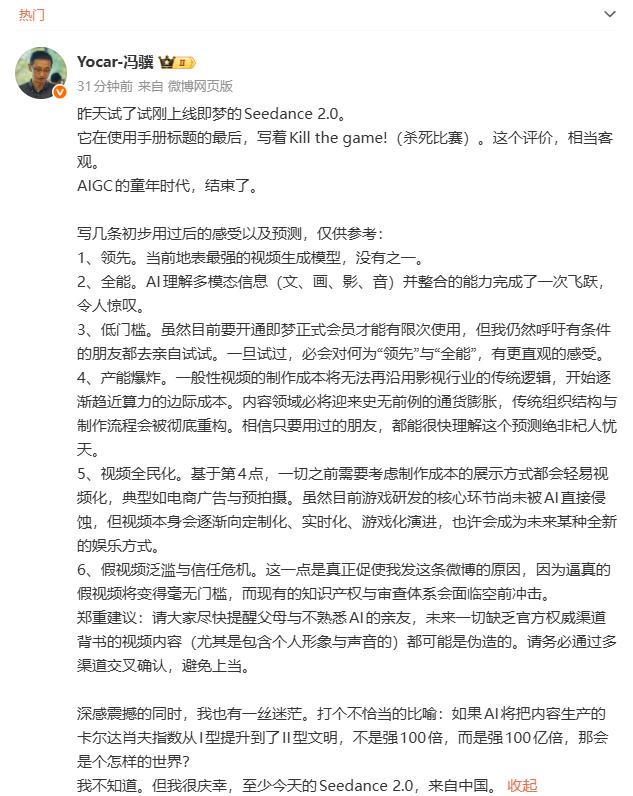
His evaluation was equally direct: the strongest in the world, without a doubt. More importantly, he gave a judgment: the childhood era of AIGC is over.
This judgment can almost be said to define a watershed.
Before this, AIGC could create some interesting things, but there was still a gap from commercialization and real productivity tools. The emergence of Seedance 2.0 made Feng Ji see the sign of maturity. The technical maturity, generation quality, and controllability all reached the standards for practical use.
Feng Ji's Weibo redirected everyone's attention from the red - envelope wars back to technological breakthroughs.
Moreover, this time it's not about catching up, but running side by side or even leading. Even Musk commented on Seedance 2.0 on X, indicating that China's large - scale models are not developed in isolation and have entered the global competition arena.
2. Not a technical expert, but a narrative expert
Feng Ji's two endorsements have several common points.
First, the timing is precise. Both were when the products were just launched and the market was still on the sidelines. When DeepSeek first came out, many people were still doubting whether it was really that powerful. When Seedance 2.0 was just released, people were still comparing it with Sora and there were even many doubts. Feng Ji's evaluation gave a clear judgment, and the key is that he dared to make this judgment.
Second, the perspective is down - to - earth. He doesn't provide a technical interpretation, but views from a creator's perspective. He doesn't care about how these things are made, but what they can be used for and what problems they can solve. This perspective is more down - to - earth than technical parameters and easier to spread.
Third, the metaphors are vivid. Both comments produced catchphrases: national - level and the end of AIGC's childhood. These catchphrases and metaphors define the significance of the products and the stages of the industry.
It can be seen that besides the label of prophet, Feng Ji is more like an interpreter, who is very good at translating technological breakthroughs into language that ordinary people can understand and translating industry nodes into perceptible changes.
This ability is closely related to his identity as a creator and is even more important than predicting the future. Because what he defines is the present.
3. From DeepSeek to Seedance
The emergence of DeepSeek broke the fixed mindset that large - scale models equal burning money.
Before DeepSeek, the industry consensus was that to train a powerful large - scale model, one had to pile up computing power, burn money, and compete for resources. The training cost of OpenAI's GPT - 4 exceeded 100 million US dollars, and Google's Gemini also had huge investments.
But DeepSeek told everyone that algorithm innovation can reduce costs by an order of magnitude.
Its reasoning ability is comparable to OpenAI's O1, but its training overhead and usage fees are an order of magnitude smaller. More importantly, it chose to be open - source, making all its papers, codes, and training steps public.
This strategy was counter - intuitive at that time. Because large - scale models have always been regarded as core competitiveness, and each company chose to be closed - source to protect its technological moat.
But DeepSeek's logic is that only by being open - source can technology iteration be accelerated, and only by equalizing can AI be truly popularized. DeepSeek proved that China can not only compete in computing power but also in algorithms.
If DeepSeek was a breakthrough in thinking, then Seedance 2.0 is a breakthrough in creation.
Video generation has always been one of the most difficult tracks in the AIGC field. Because it not only has to generate images but also ensure temporal coherence, physical rationality, and character consistency. OpenAI's Sora shocked the world when it was released in 2024, but its subsequent iteration and commercialization were not as fast as expected.
The emergence of Seedance 2.0 gives China the strength to compete on the same stage in the video - generation track.
Feng Ji's evaluation was that it was the strongest in the world, without a doubt. Although this evaluation has a subjective component, in terms of actual effects, Seedance 2.0 is indeed excellent in terms of video - generation fluency, detail performance, Chinese understanding, and cultural details.
More importantly, its launch time was chosen on the eve of the Spring Festival, which was an excellent opportunity to show off its strength.
Not only ByteDance. On February 10, Alibaba's Qwen - Image - 2.0 and ByteDance's Seedream 5.0 preview version were launched on the same day, kicking off an AI image - generation war on the eve of the Spring Festival. Zhipu's new - generation flagship model GLM - 5 was also released around the same time.
This means that China's large - scale models are no longer making single - point breakthroughs but have entered a stage of all - round development.
If we look back two years, the development of China's large - scale models has evolved from initially catching up with OpenAI to filling in basic capabilities, then to DeepSeek's algorithm innovation. Today, Seedance 2.0 has gone viral again. China's large - scale models have their own unique advantages in specific scenarios.
4. AI popularization during the Spring Festival vs. global technological competition
The Spring Festival in 2026 was different from previous ones.
In addition to grabbing red envelopes, watching short videos, and paying New Year greetings, many people started using AI to write Spring Festival couplets, make New Year - greeting videos, inquire about Spring Festival customs, and even help their parents distinguish the authenticity of health products.
The usage of AI tools such as Doubao, Qianwen, and Yuanbao skyrocketed during the Spring Festival. The latest data shows that as of February 7, 2026, the daily active user (DAU) count of Qianwen reached 73.52 million, approaching Doubao's 78.71 million.
Judging from the discussion heat on social media and the Spring Festival marketing actions of various companies, AI is gradually becoming a popular tool.
This popularization is not driven by technology but more by scenarios. The Spring Festival scenario is naturally suitable for AI. It requires rapid content generation (Spring Festival couplets, greetings, videos), rapid information acquisition (customs, recipes, travel guides), and personalized services (sending different greetings to different people).
And AI happens to be good at these things.
More importantly, this popularization is widespread. It's not just young people in first - tier cities using it, but also middle - aged and elderly people in third - and fourth - tier cities. Because AI lowers the threshold of content creation, allowing people who don't know how to use PS or video editing to make decent New Year - greeting videos.
This is what Feng Ji meant by equalization.
But the accelerated popularization of AI during the Spring Festival is just one side. The other side is the global technological competition.
Musk reposted and commented on Seedance 2.0 on X: "The development speed is too fast!"
This incident itself is very interesting. Because it shows that China's technological breakthroughs have attracted the attention of the global tech circle.
In the past, Chinese companies continuously paid attention to what OpenAI was doing. Today, OpenAI is also paying attention to what Chinese companies are doing. The speed of technological iteration has changed from being measured in years to months, or even weeks.
More crucially, the strategies of China's large - scale models are different from those of the United States.
The US strategy is closed - source + high - price + technological barriers, trying to build a moat through technological leadership and commercial monetization. China's strategy is open - source + low - price + rapid iteration, trying to build an ecological advantage by lowering the threshold and accelerating popularization.
Feng Ji's Weibo actually also reminds everyone not to just focus on red envelopes but also pay attention to technology.
The red - envelope war is a traditional project in China's Internet industry. Every Spring Festival, various companies invest huge amounts of money to compete for user time and payment scenarios. This is a short - term traffic competition, an involution - style consumption war. While the technological war of large - scale models is a competition for long - term value, a marathon of technological breakthroughs.
Both wars are happening. But which one is more important?
In the short term, the red - envelope war can bring traffic and topics, but in the long term, technology is the real moat.
5. From big - factory monopoly to small - factory breakthrough
The evolution of technology has also accelerated the stratification of players.
In the past, large - scale models were the game of big factories. Because training large - scale models required huge computing power investments, and only big factories like Alibaba, Tencent, and ByteDance had the resources and capabilities to do it.
But the emergence of DeepSeek broke this logic. It proved that small factories can also break through. As long as the algorithm is innovative enough, the cost can be reduced by an order of magnitude. In addition to DeepSeek, there are also Zhipu, Yuezhianmian, and MiniMax. These small - scale companies have all made their own characteristics in the field of large - scale models.
This breakthrough of small factories stems from structural changes. Because of open - source, the technological threshold is lowered. Algorithm innovation also breaks the logic that computing power equals a barrier, and vertical scenarios allow small factories to find their own survival space.
In summary, China's large - scale models are forming a new division - of - labor mechanism.
Big factories provide computing power and infrastructure. Alibaba Cloud, Tencent Cloud, and Volcengine Cloud provide infrastructure for training and deployment, lowering the threshold for small and medium - sized companies.
Small factories focus on algorithm innovation and vertical scenarios. DeepSeek focuses on reasoning models, Zhipu focuses on enterprise services, and MiniMax focuses on voice and role - playing. Each has its own characteristics, not being large and all - encompassing, but small and refined.
The open - source community accelerates technological iteration and knowledge sharing. The open - source of DeepSeek and Alibaba's large - scale models has driven more companies and developers to participate, forming a positive technological cycle.
This division - of - labor mechanism is healthier and more competitive than big - factory monopoly. Because it allows more innovation, more trial - and - error, and more possibilities.
6. Feng Ji's prophecy is becoming a reality
A year ago, Feng Ji said that DeepSeek was a national - level scientific and technological achievement. At that time, many people thought this evaluation was too exaggerated.
One year later, looking back, this judgment is not exaggerated.
A few days ago, Feng Ji said that Seedance 2.0 marked the end of the childhood era of AIGC. This judgment is also becoming a reality. The technological maturity of video generation has reached the standards for commercialization. In games, film and television, and advertising, AIGC has started to be put into use. The threshold for creation is lowered, and ordinary people can also become creators.
Actually, what Feng Ji hit was not only the technological nodes but also the time windows. When DeepSeek was just launched, the market was on the sidelines. When Seedance 2.0 was being tested, the red - envelope war was in full swing. These two moments were when attention was scattered. And Feng Ji's evaluation refocused the scattered attention on technological breakthroughs.
Maybe we don't need a prophet. We just need more interpreters like Feng Ji, who can use language that ordinary people can understand to tell us what is happening and what is changing in the global large - scale model track.
[Beyond the Page] Words:
When a technological breakthrough occurs, what the public needs is not advanced parameters but an answer: What does this have to do with me?
Feng Ji used metaphors like water and electricity, the strongest in the world, and the end of childhood to translate technology into life scenarios and elevate China's AI narrative to a global perspective. This is confidence and courage.
Today, the speed of global AI technological iteration has exceeded the speed of public understanding. And those who can translate technical language into plain language determine the narrative power of this era.
China's AI is not short of technology, but lacks ways to be seen, understood, and spread.
This is what Feng Ji is doing.