Humanoid robots have realized their value from being a "futures" product.
Have you ever wondered what robot manufacturers that didn't make it to the Spring Festival Gala are up to?
For humanoid robots, the Spring Festival Gala has evolved from a simple stage performance to a typical media event. Through high - intensity concentration and exposure, it has quickly brought the once esoteric topic of embodied intelligence, which was previously on the technological frontier, into the public eye. On the Spring Festival Gala stage, robots whose technologies have been verified feasible under high - pressure circumstances have become a symbol of something that has "arrived".
The power of this media spectacle is immense. It has shaped a collective memory and, subtly, set a narrative path: a strong association between humanoid robots and performances.
As more and more companies start preparing for the next appearance on stage, a more industry - significant question emerges: Where can humanoid robots go if they are not in the spotlight?
From practical observation, "participating in the Spring Festival Gala or not" is becoming an implicit dividing line for different corporate paths. Outside of the Spring Festival Gala, some companies choose to delve deeper within the stage logic, releasing technological potential through more flexible performance forms while cultivating a commercial closed - loop with IP attributes. Others, however, simply bypass the performance narrative and place robots directly into the real world, answering the question of value through continuous operation.
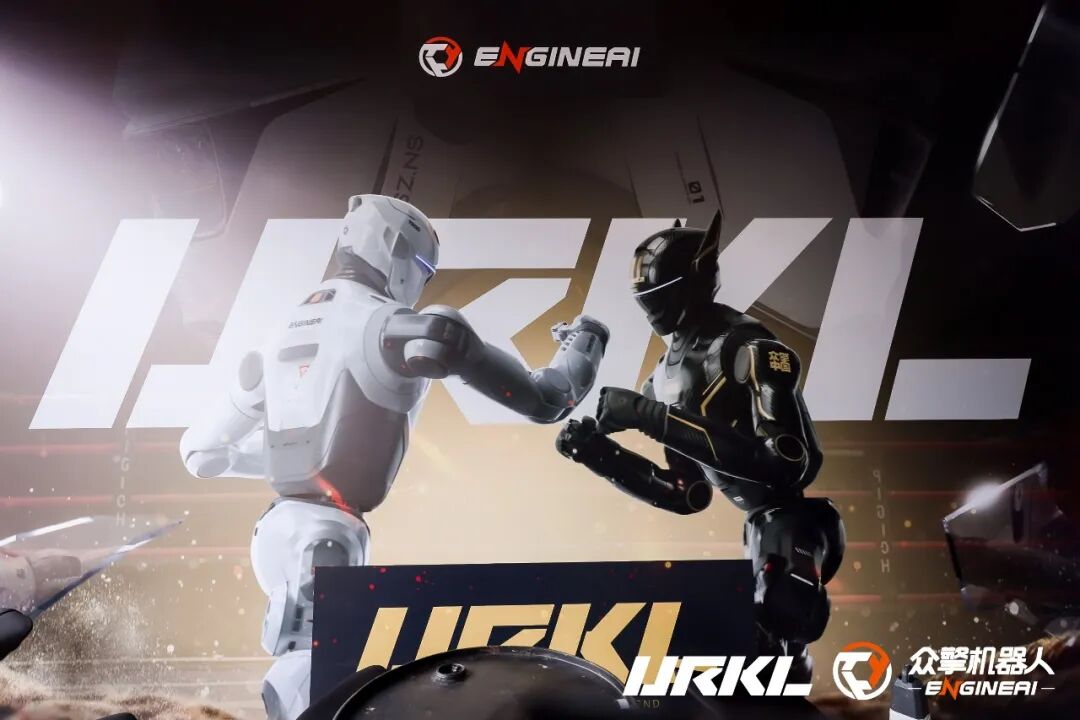
The former includes companies like ZhipuAI and Zhongqing. They have opened up free spaces outside the Spring Festival Gala stage. For example, on February 8th, ZhipuAI held the "Robot Fantastic Night", for the first time presenting robots as the main creators. More than two hundred robots gave birth to a performance IP exclusive to the robot world on their own stage. And on February 9th, Zhongqing held the press conference for the "Universal Robot Combat League (URKL)", trying to create a rare top - tier commercialized event IP in the robot industry. Both companies are fully unleashing their technological endowments in a performance for the audience.
The latter, like Zhipingfang, chooses to integrate into daily life, transforming its technological endowment into the "Intelligent Magic Cube" embedded in urban services. In a corner of the streets, it demonstrates the practical value in real - world scenarios.
Judging from the progress of each company on different paths, whether a robot participates in the Spring Festival Gala or follows the performance route is never an either - or choice, but rather a development narrative with different focuses. There's no need to be entangled about the field for releasing technological value. This path differentiation is essentially a different way to break through under a unified goal. The core fact that the industry should recognize is that regardless of the way they appear, robots have stepped out of future imagination and officially entered the stage of industrial implementation.
Robots are entering the moment of value realization
Looking back at the development of embodied intelligence, the biggest progress is that the industry has moved from a state of "anticipation first" to a new stage of "fulfilling expectations".
Previously, technological progress was real, but the commercial value mostly remained at the imaginative level. Humanoid robots were repeatedly described as the next super - terminal, but there was always a lack of sufficient and reusable real - world examples to support this judgment.
Currently, the commercial realization of humanoid robots with large - scale implementation can be roughly divided into two branches: "value presentation through performances" and "value realization through practical work".
Specifically, performances are not "idle running". In fact, they have formed a relatively mature business model: stage performances, brand promotion, and commercial performance rentals, which themselves constitute a business. More importantly, performances undertake the function of early - stage market education, allowing the public to intuitively perceive "what robots can achieve" for the first time. The existence of this stage is an inevitable step in the process of technological diffusion.
Therefore, we cannot deny the contribution of humanoid robot performances during the industrial evolution, but we also cannot only discuss this one form of value presentation.
From a longer - term perspective, the vision depicted by the industry does not stop at what is "visible". When the narrative of a trillion - level market is repeatedly mentioned, and when robots are expected to enter all industries and integrate into cities and families, performances alone cannot support the realization of this vision. Technology ultimately has to answer a more basic question: Can it really work continuously, transforming from a watched performance into a tangible productivity around us?
That is to say, outside of performances, another baton is firmly held by humanoid robots that focus on "practical work".
Looking back at 2025, there are already many similar cases. Whether it's completing POC verification in factories or releasing practical value in commercial services, more and more humanoid robots have found their ecological niches in "value realization through practical work".
What's even more gratifying is that a new business format has emerged under this branch. It is not simply embedded in the production environment but grows new business models based on the technological characteristics of humanoid robots.
The "Intelligent Magic Cube", an embodied intelligence service space launched by Zhipingfang, is a classic example of this logic. The Intelligent Magic Cube is an "intelligent service terminal" that integrates robot productivity and high - frequency interaction. Its human - robot collaborative service model and highly modular design can flexibly configure functions such as coffee, ice cream, entertainment interaction, and light retail according to different scenario requirements, achieving a personalized service combination of "thousands of stores with thousands of faces" to meet the diverse needs of implementation scenarios. At the same time, the robot service process itself has the communication attributes of being watchable and shareable, naturally transforming the technological experience into social content and completing the market education of robots imperceptibly.
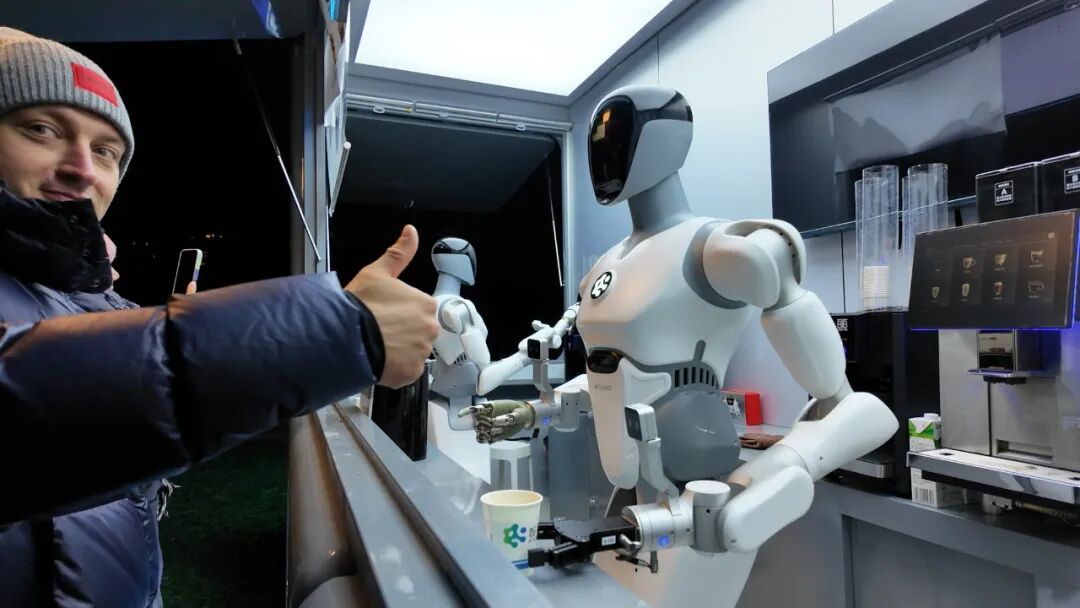
Currently, the Intelligent Magic Cube has been in normal operation in open urban spaces such as Shenzhen Talent Park, Shenzhen MixC, Coastal City, Beijing Chaoyang Park, and Hopson One.
According to the Embodied Intelligence Research Institute, the Intelligent Magic Cube has been in normal operation for a month. The robots in each store work continuously for 8 hours a day, stably making hundreds of cups of coffee and ice cream per day (an average of one cup within 2 minutes), and providing fully autonomous services to a large number of customers without any mistakes. To some extent, robots have entered and served daily life.
The operation data of the Intelligent Magic Cube constitutes the rarest value proof of embodied intelligence: robots have started to work continuously in the real world.
When robots create technological wonders on the stage and complete high - frequency services in real commercial scenarios, humanoid robots have finally moved away from the decoupled development model of technology and commercial implementation, and are now releasing technological value in real commercial scenarios.
Behind the value realization is a "trinity" system capability
Once robots enter real - world daily life, the evaluation criteria will change fundamentally. Multiple successes on the stage cannot offset a single failure in the real environment; a short - term amazing performance cannot replace the ability of long - term stable operation. What is being tested here is no longer a single - point technology but a whole set of system capabilities.
First is the coordinated maturity of the model and hardware.
At the model level, robots must have the ability to accurately understand the complex physical world and a high success rate in executing long - term tasks to meet the underlying requirements of "trustworthiness and reliability" in commercial scenarios. At the hardware level, they need to meet industrial - level reliability and large - scale mass - production standards to support high - frequency, long - term, and large - scale commercial implementation. These two aspects are not independently iterated but follow a symbiotic development path of mutual adaptation, mutual guidance, and mutual achievement.
This technical logic of software - hardware coordination is not just theoretical. The product practice of Zhipingfang is the most intuitive industrial evidence.
Taking Zhipingfang as an example, it has independently developed the world's first global whole - body VLA large model (GOVLA), creating a "general brain" for robots with the ability to understand the physical world and perform generalized operations. Relying on this model, the robot "Aibao" has a strong ability to generalize and transfer skills. After mastering the basic skills of coffee making, it can quickly adapt to different brands and models of commercial coffee machines and ice cream machines with only a small amount of learning or simple configuration, greatly expanding the value of scenario reuse.
At the same time, the large model endows it with the ability to plan long - term tasks in the whole process. It can independently complete the entire service closed - loop from identifying user needs, taking cups, operating equipment to making and delivering drinks without human intervention, achieving efficient, reliable, and error - free end - to - end services.
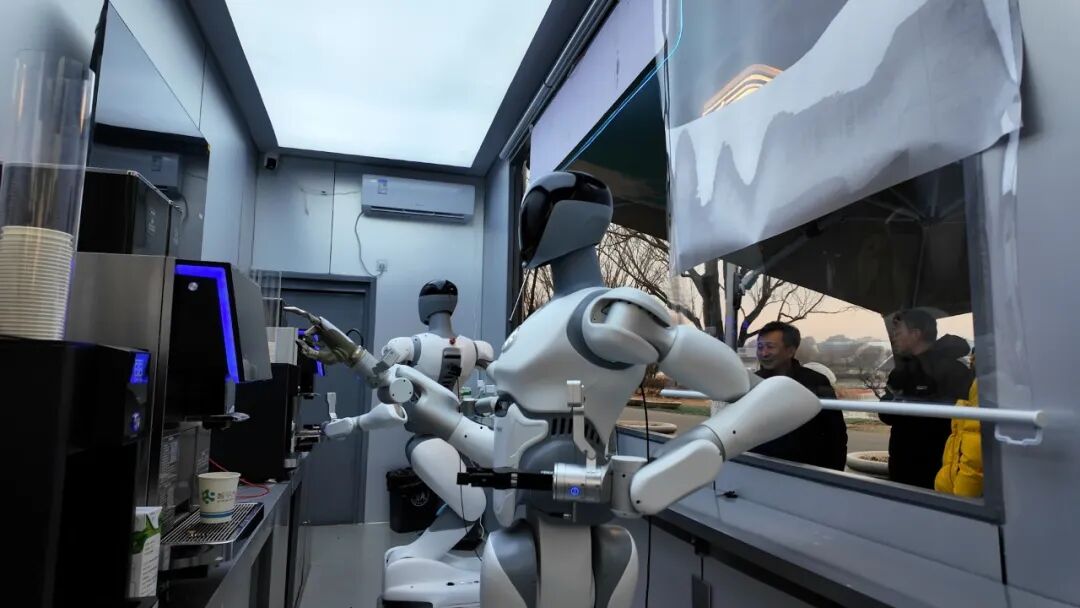
The release of the capabilities of the intelligent brain depends on a stable and reliable hardware body as a carrier. This is also the core reason why Zhipingfang has always adhered to the mass - production orientation in hardware R & D.
At the hardware level, the Aibao series of Zhipingfang has reached the industrial - level reliability standard with a 50,000 - hour failure - free operation performance of core components. With the support of in - depth software - hardware coordination, the robot achieves smooth and natural - connected movements through a whole - body control algorithm with over 34+ joints and a mass - producible body structure design. The entire operation process is both smooth and stable, presenting an operation texture close to that of a human.
Even with leading software - hardware coordination capabilities, it only means that the robot has the "technological qualification" for implementation. To truly run through a commercial closed - loop, it still has to cross a hurdle that is most easily overlooked but most fatal in the industry.
That is the scene understanding and implementation experience that technology startups fear the most.
From an industrial perspective, the current problem of "lack of scenarios" for robots is not the core issue. The real difficulty lies in the fact that many of the proposed scenarios are either highly homogeneous or do not address real pain points. At the same time, there is a huge gap between the theoretical application space and the actual operational complexity. Simply put, on the one hand, the scenarios are limited, and on the other hand, the gap between real scenarios and the laboratory is huge.
Dr. Guo Yandong, the founder and CEO of Zhipingfang, once pointed out that "as a company, the core proposition is not to strive for 100% generalization ability but to think about how to make the robot 'usable' when it can't reach 100%." Facing the common scenario implementation dilemma in the industry, Zhipingfang did not stop at laboratory verification but provided a feasible and verifiable solution with the "Intelligent Magic Cube" as the carrier.
The special feature of the "Intelligent Magic Cube" is that it is not a pilot project of a demo nature but has withstood multiple tests in an open environment, continuous operation, and high - frequency interaction. Robots not only have to face uncertain crowds and environmental changes but also maintain stable performance during continuous services. This operating state itself is a high - intensity verification.
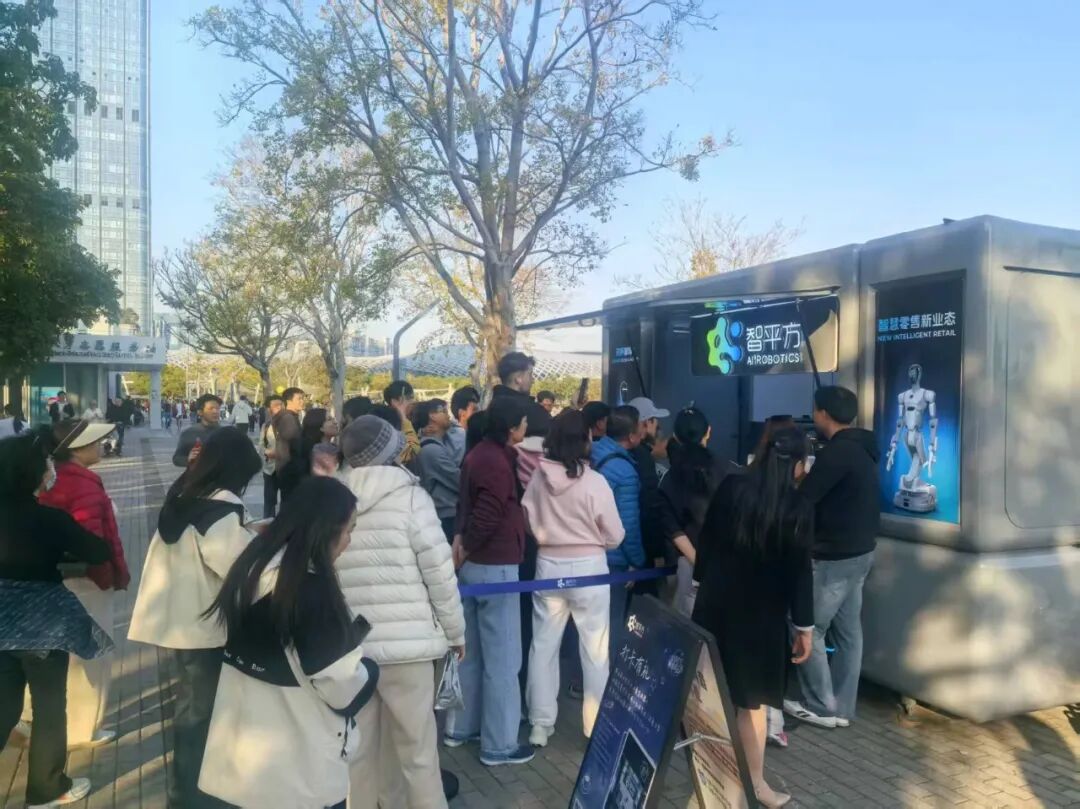
More importantly, this set of capabilities is replicable. Once a scenario is successfully implemented, the underlying system capabilities can be transferred to more complex, demanding, but also high - value fields.
Currently, this system has been verified on a large scale in the field of industrial flexible services, supporting a three - year commercial order cooperation of 1,000 units with Huike. The precipitated reusable methodology also gives Zhipingfang the confidence to "implement 1,000 Intelligent Magic Cubes nationwide in the next three years".
In the embodied intelligence track, the truly scarce thing is a proven business model
If we further explore the above - mentioned capabilities, we will find that the combination of "model × hardware × scenario" is not a simple addition but a closed - loop enhanced structure.
The idea is that high - value data is continuously generated in real scenarios, which in turn optimizes the model. The improvement of the model's capabilities allows robots to enter more complex real - world environments. Reliable and mass - producible hardware not only provides a physical carrier for the model but also ensures that this cycle can be replicated on a large scale and enter the next quantitative stage.
Only when all three elements are in place does it mean that a company has truly achieved a proven business model. And this is precisely the most scarce combination of capabilities in the current embodied intelligence industry.
We can think carefully. Many companies are still stuck in the mass - production stage. Even if their hardware performance is advanced, it is difficult to replicate. Some companies don't even have production lines or have such a low level of production line automation that it's almost like "manual production". At the same time, some models are still at the "demonstration - viable" stage, far from being "commercially viable". In addition, some companies are struggling with commercial implementation like looking for a nail with a hammer, finding it difficult to transform technology into commercial value.
In this context, Zhipingfang's path seems particularly "healthy". Dr. Guo Yandong had already judged in a previous interview that "starting from 2026, the core of competition lies in enabling stable hardware equipped with basic models to run through the commercial and data closed - loop in real scenarios." It doesn't wait for technology to be fully mature before implementation but continuously operates and corrects in a controllable but real scenario, allowing commercial verification and technological iteration to happen simultaneously. At the same time, relying on its self - built production line, Zhipingfang had an annual production capacity of one thousand units in 2025, achieving efficient ramping up from R & D prototypes to mass production, and plans to expand to a scale of ten thousand units in 2026 to ensure the stability and consistency of robot products.
From a longer - term perspective, the acceleration of mass production in 2025 and the continuous enhancement of model capabilities in 2026 are essentially to complement the previously missing business model. When technology crosses the gap and real scenarios feed back data, the "data flywheel" starts to turn, and the compound interest effect will appear.
In short, the Spring Festival Gala may still be a highlight moment, but it is not the end. Beyond the media event, those things that are embedded in daily life and may even become commonplace in the near future will also leave equally prominent marks of the era.
When people no longer gather around when buying coffee in the park and when robots are regarded as infrastructure rather than "novel devices", at that moment, embodied intelligence will truly complete the transformation from a "futures product" to a "spot product". And value is realized in the process of becoming commonplace.
This article is from the WeChat public account "Embodied Intelligence Research Institute", author: Peng Kunfang. It is published by 36Kr with permission.