Tsinghua-affiliated embodied brain company raises hundreds of millions of yuan in two months, leads in the number of connected household embodied devices, and enters the full-size robot track | Exclusive report by Yingke
Author | Huang Nan
Editor | Yuan Silai
Hard Kr exclusive learned that Qianjue Technology, an embodied brain enterprise, recently completed a Pre - A++ extended round of financing. So far, the Pre - A++ round of financing has been completed. The investors include Vertex Ventures, Wise Road Capital, Inno Angel Fund, Junshan Capital, Jimei Venture Capital, Nanchang Venture Capital, and Jingming Capital. Maple Pledge has long served as the private equity financing advisor.
The funds from this round will be mainly invested in the large - scale delivery of full - size robots, the construction of automated data pipelines, and the expansion of the core team. This is another round of financing completed by the company within two months.
As embodied intelligence enters the deep - water area of industrialization, the focus of the industry has quietly shifted from the competition of parameter scale to the control of multi - scenario penetration and implementation cost.
Traditional robots either rely on preset programming or need to transform the environment to work stably. The high cost and adaptation difficulties of hardware such as lidar make large - scale implementation extremely difficult. Since its establishment in 2023, Qianjue Technology has long focused on the research and development of the embodied world model and created an "embodied brain" product with a brain - like computing architecture. It can perform the full - closed - loop autonomous work of "perception - decision - action" without remote control and rule programming, achieving the first implementation of the world model in the family scenario globally.
Previously, the main implementation carriers of Qianjue Technology were mostly concentrated in semi - size embodied product brands such as small humanoid robots. Their core functions are mainly autonomous general perception and decision - making, and the number of connected household embodied devices ranks first in the industry. At the same time, a full - size robot business line has been added, which has now been applied in small batches in scenarios such as households and catering, and can perform tasks such as cleaning, service, storage, and health care.
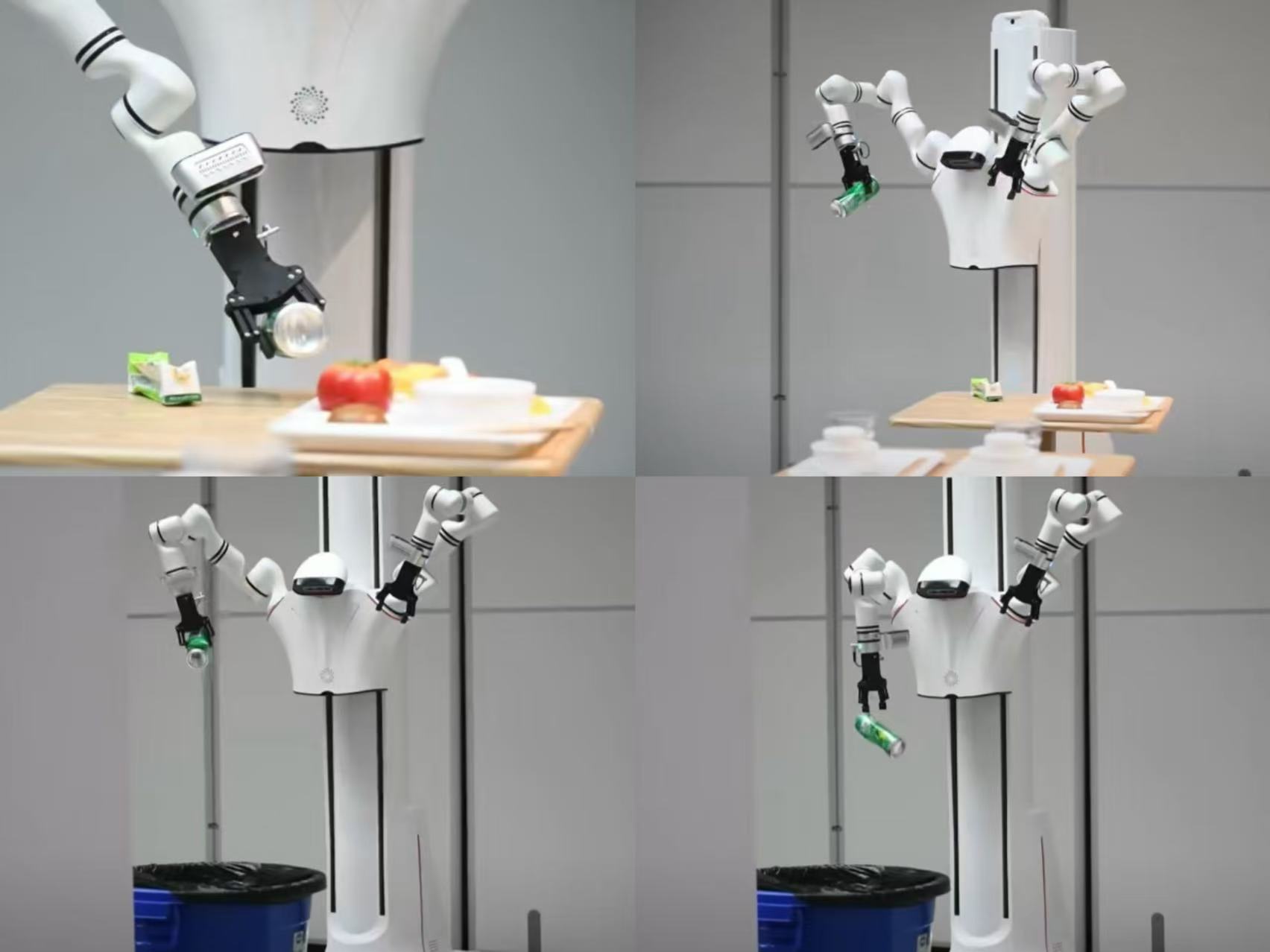
A robot equipped with Qianjue's brain - like large model autonomously performs a table - cleaning task (Image source/Enterprise)
Compared with small embodied devices, the requirements for operation refinement of full - size robots are significantly increased. The load and degrees of freedom of their mechanical arms are greatly increased, and the power supply system and the overall structure of the machine are also adjusted accordingly to support more complex two - hand cooperation tasks.
However, due to the configuration limitations of humanoid robots, the requirements for balance and computing power distribution are very strict, and it is often difficult to install traditional lidar. Therefore, Qianjue Technology has proposed a pure - vision - based spatial understanding and planning scheme, which can complete indoor spatial modeling and object relationship understanding, and fully replace lidar.
Different from the traditional scheme that relies on explicit 3D map construction in the past, the accuracy of this type of scheme highly depends on the radar and is easily interfered by reflective, transparent objects, and changes in lighting. Qianjue uses causal reasoning for implicit modeling. Through a single - frame image, it can "imagine" the structural characteristics of new scene components that may be seen after walking left, right, or forward, and integrate visual understanding and spatial modeling. This anthropomorphic paradigm based on the world model effectively makes up for the shortcoming of insufficient information in traditional pure - vision schemes.
Gao Haichuan, the founder of Qianjue Technology, told Hard Kr that the pure - vision scheme has lower cost, more flexible installation, and significantly improved robustness compared with lidar. Combined with Qianjue Technology's brain - like architecture that supports the free combination of different functional partitions, it can meet the operation requirements in core human life scenarios such as households, health care, and catering.
At present, when the industrial chain pattern of embodied intelligence is not yet finalized and the technical routes are still parallel, there are significant differences in the construction paths of data pipelines in the industry. In the past, the accumulated data was mostly structural data such as the position of objects, movement trajectories, and environmental geometric features in the objective world. Full - size robots are shifting the data focus to the body control data of the subjective world.
Gao Haichuan pointed out to Hard Kr that the data formats, annotation standards, and collection tools of different enterprises are different. The root cause is not the difference in technical capabilities, but the fundamental differences in the underlying architecture and ecological niche of the models.
However, despite the different forms of pipelines, as the embodied intelligence model fully shifts to the pre - training paradigm driven by the Scaling Law, the demand for training data in each sub - track is in an explosive stage. Whether it is perception, decision - making, or operation, the data gap is generally huge. This is not the structural dividend of a certain type of pipeline, but a common hurdle that the entire industry must cross in the transition from rule - driven to data - driven.
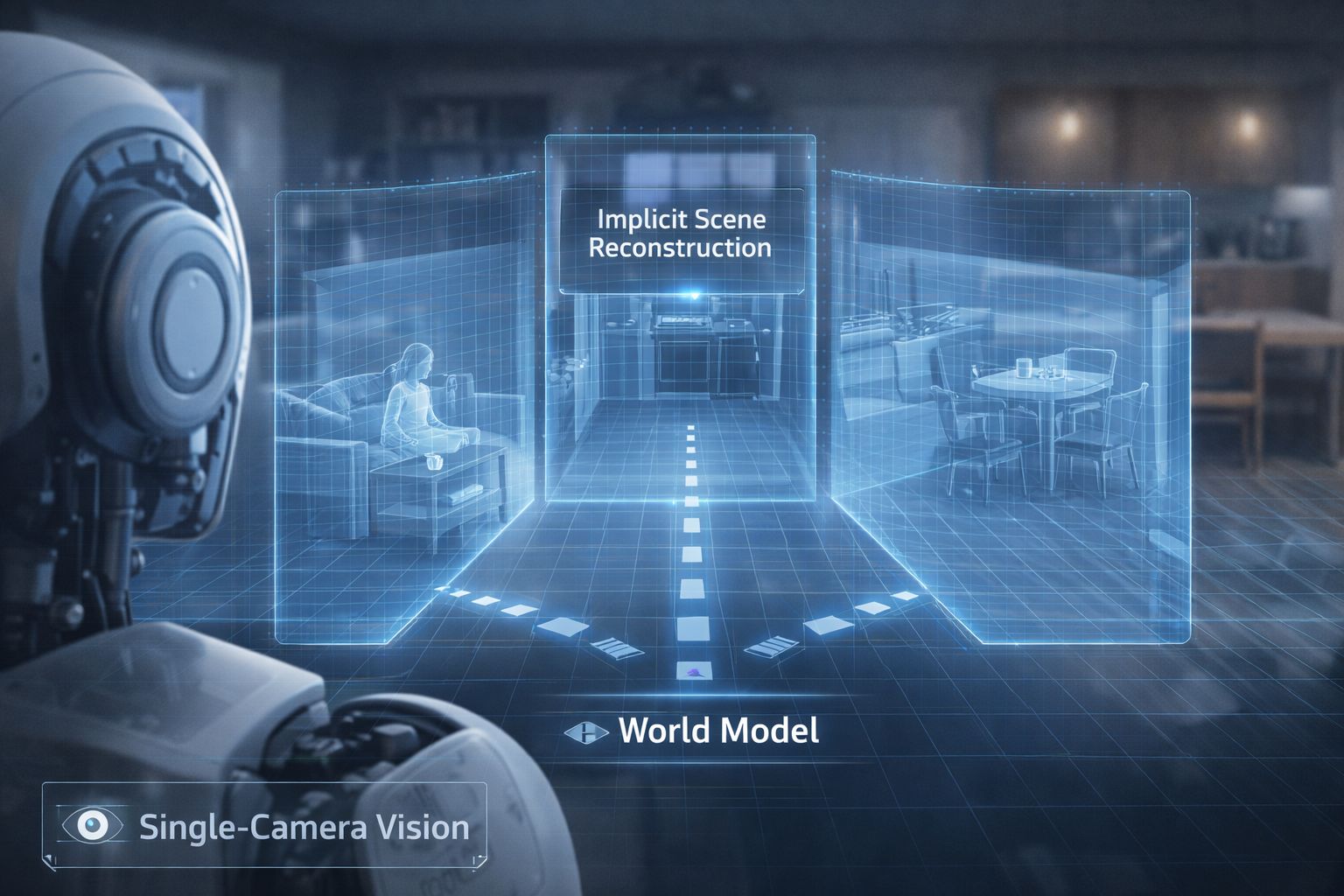
World model (Image source/Enterprise)
The core of Qianjue Technology's "brain - like" ecological model architecture does not pursue the performance limit of a single model. Instead, it disassembles robot intelligence into functional partition modules that can evolve independently and be freely combined. Spatial perception, task decision - making, motion control, and fine operation each form a unit, just like different cortical regions of the human brain performing their respective duties.
Under this architecture, Qianjue clearly defines its boundaries and establishes an automated training data pipeline. Once the system detects fluctuations in the average accuracy in a specific scenario, the pipeline can automatically collect data and quickly fine - tune and strengthen the corresponding perception module of the model, thus ensuring the performance robustness of the embodied brain in diverse real environments.
Returning to Qianjue's brain product, it focuses on the construction of the world model and the autonomous decision - making center, and opens the remaining capability modules to third - parties or is compatible with the customer's own models. Taking fine operation as an example, customers do not have to choose Qianjue Technology's force - control algorithm. Instead, they can embed their own force - control module and then superimpose other partition function modules of Qianjue's brain on it, realizing technical collaboration where both parties stick to their positions and take advantage of their strengths.
The core value of this loosely coupled design is that customers do not have to choose between "full - stack self - research" and "black - box delivery". They can call Qianjue's partition capability modules and retain self - developed or third - party modules, thus significantly reducing the technical coupling cost for enterprise customers and industrial chain manufacturers.
Hard Kr learned that in 2026, Qianjue Technology will focus on household and service robot scenarios, and accelerate the verification of real demand and commercial implementation of various product categories. The annual demand for full - size robots is growing rapidly. The company will take the existing orders as a starting point and continue to expand the delivery scale.
Qianjue Technology does not try to dominate the whole situation with a closed system, nor does it develop its own robot body. Instead, it uses a brain - like architecture to undertake the fragmented reality of industrial division of labor.
At present, this approach may seem scattered, but in fact, it points directly to the core proposition of the service robot market. At the critical window when the industry is moving from "able to run and jump" to "able to work and make economic sense", Qianjue Technology is completing the transformation from a technology narrative to a delivery narrative.