40 Billion Yuan in Fierce Pursuit: The Investment Battle of Embodied Intelligence in 2025
Near the end of 2025, Zhang Jinjian, the founding partner of Oasis Capital, had dinner with Su Hao, the co-founder of HillBot, an embodied intelligence startup that had just been established for one year.
Su Hao showed Zhang Jinjian some data and then put forward an idea: he believed that embodied intelligence was about to reach the "GPT-2 moment" in the first half of 2026.
This is not a consensus in the industry. Most interviewees believe that the industry has not even reached the "GPT-1 stage".
The embodied intelligence track became popular after the rise of large models and is closely related to them. Although it cannot be fully compared technically, investors are willing to use terms like "GPT-1" to try to locate the industry's development stage - which fundamentally affects their decisions on whether to increase investment, when to do so, and how much to invest.
"GPT-1 is about building a technical environment to verify its feasibility, while GPT-2 essentially proves that certain technical paths are viable," Zhang Jinjian defined the so - called "GPT moment" of embodied intelligence.
This positioning is very important. Suppose you invested in OpenAI during the GPT-3.5 and GPT-1/2 periods respectively. In 2026, the valuation increase you would get would be 30 times and about 100 times respectively.
Strangely enough, embodied intelligence is still far from reaching the GPT-3.5 stage, but it has emerged ahead of schedule just because Unitree Technology unexpectedly became popular on the Spring Festival Gala stage in 2025.
In the following year, the industry's investment and financing landscape changed dramatically - investors who had already entered the market continued to increase their investment, and those who had not yet made a move rushed in. They all hoped to find the "OpenAI" of the GPT-1 period.
From "Wait and see" to "Can't wait any longer"
At the beginning of 2025, investor Li Rui (pseudonym) visited Zhu Qiuguo, the founder of Deep Robotics, with his team. "The negotiation went well at that time. They said they must include us and also mentioned their resources to see how they could help in certain scenarios."
What Li Rui didn't expect was that Deep Robotics, which was still negotiable on the investment amount and price at that time, became one of the "Six Little Dragons in Hangzhou" after the Spring Festival of the Year of the Snake. This made it well - known outside the "small circle", and the roles of the buyer and the seller were reversed.
Li Rui was a little anxious at that time. He had contacted the company at the end of 2024 and took a fancy to Zhu Qiuguo's research background and quite approved of it. However, his leader thought the valuation was still a bit high at that time and was worried about the implementation prospects of embodied intelligence, so they finally chose a conservative approach.
Now that the situation has changed greatly, Li Rui had to go to Hangzhou again right after the Spring Festival. This time, he directly brought the risk - control team with him, hoping to conduct due diligence at the same time. Sure enough, Zhu Qiuguo was honest about his difficulty in allocating the investment quota. At this time, in addition to the old shareholders, many first - tier institutions, state - owned assets, and internet giants were vying for it.
"Fortunately, we finally managed to get a little quota, but it was really a tough negotiation."
There are many similar examples. Another investor in the AI field told Jiemian News that three years ago, there was an embodied intelligence project asking for a $50 million financing, but no one invested at that time, and the founder had to give up entrepreneurship and go back to work. By 2025, the same person came back again, and the valuation of the same project reached $400 million within half a year.
Still in the same year, he contacted a project with a valuation of $70 million. He thought the innovation was insufficient at that time and politely declined. Three months later, he casually talked with a friend and learned that the project was in the process of closing, and its valuation had soared to hundreds of millions of dollars.
"Putting aside the entrepreneurs and the projects themselves, this phenomenon itself shows the huge difference in different time points," said the aforementioned investor. According to IT Juzi data, the number of financing events in the embodied intelligence track increased from 105 in 2024 to 333 in 2025, and the financing amount expanded from 9.525 billion yuan to 40.599 billion yuan, a surge of 217% and 326% respectively.
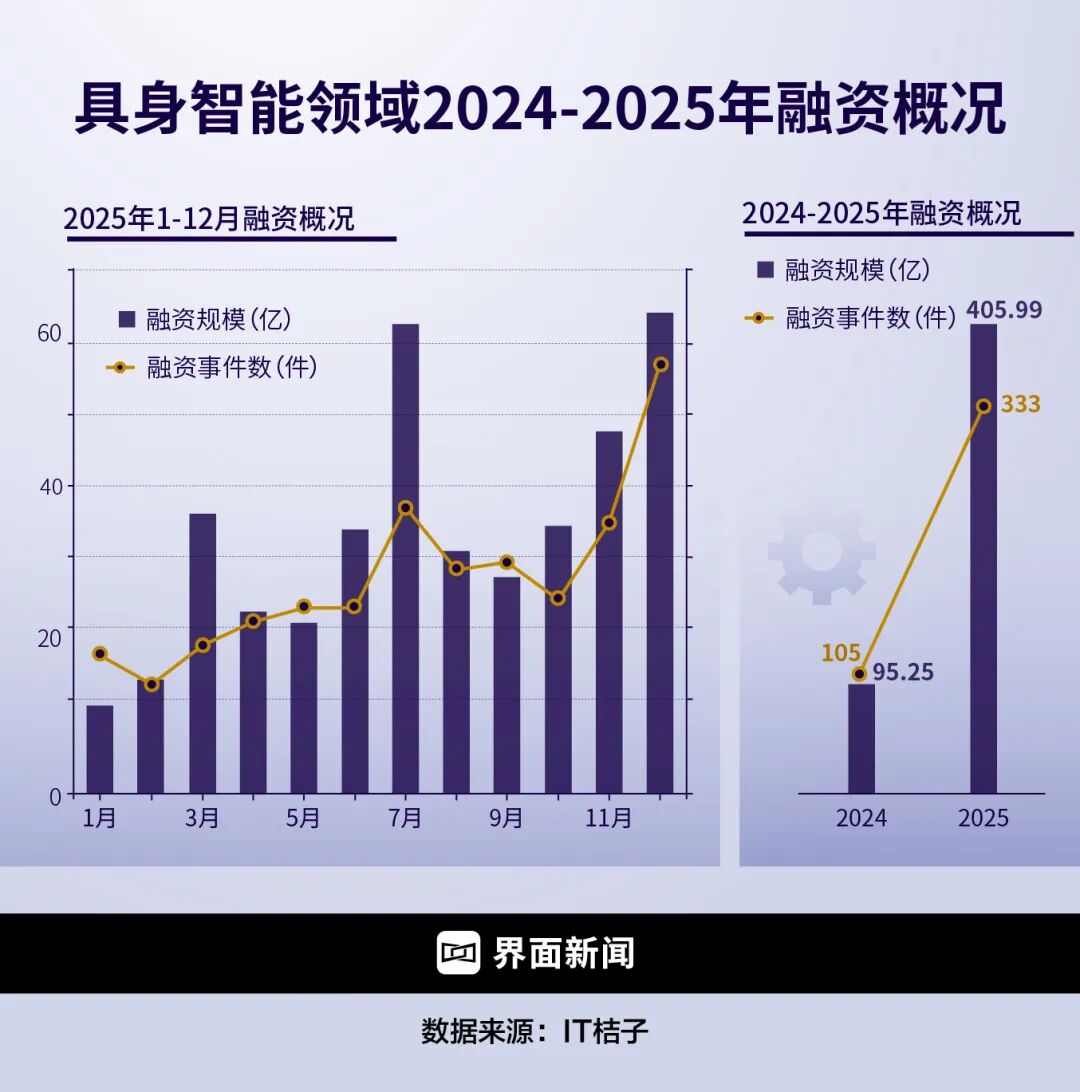
Data compilation: Wang Qiang; Chart drawing: He Miao
On the one hand, projects have become popular. On the other hand, the continuously rising valuations and the hard - to - define valuation models are also issues.
In 2025, the two major trends in the financing of embodied intelligence projects were the increase in the valuation of early - stage projects and the accelerated rise in the valuation of growth - stage projects.
Tash Robotics refreshed the industry record in the angel round - within less than half a year of its establishment, it successively completed angel and angel + round financings of $120 million and $122 million respectively. Companies such as Zibianliang, Xinghaitu, Zhipingfang, and Qianxun Intelligence all raised hundreds of millions of yuan in the pre - A and A rounds. In the past, this would have been the overall valuation of a company in the same round.
Qin Chuan, a partner in the investment banking business of China Renaissance, roughly estimated that the average increase in the single - round valuation of projects in the past year ranged from 50% to 100%. For a hot track, he believes this pace is actually relatively reasonable. "There are indeed periodic leaps in valuations in the market, such as 2 billion, 3 billion, 5 billion yuan, and $1 billion is a threshold, often corresponding to higher technological and commercialization thresholds.
However, there may be some irrational factors. The aforementioned AI investor pointed out that "some investors didn't participate in such projects in the past two years, so they are in a hurry this year and are willing to give a very high valuation." In addition, a star company got a high valuation in the early rounds because one of the investors "liked the team so much" and increased the offer several times, which was criticized by peers for being a bit "over - excited".
Both FAs and VCs agree that there is currently no reasonable valuation model for the embodied intelligence industry. It's more like a kind of "mystery". Most of the time, for an investment institution, besides the previous round's valuation and recent business progress, the project's valuation more depends on how much another institution is willing to pay.
Will this lead to over - inflated valuations?
Qin Chuan told Jiemian News that whether these valuations can be sustained generally depends on two things: one is whether the industry will have a major technological breakthrough, and the other is whether it can continuously achieve larger - scale commercialization. If so, this valuation logic can continue.
"Just like the six major players in the large - model field, $1 billion seemed like an astronomical figure at that time, but now looking back, it seems very cheap," said the aforementioned investor. AI investor Wang Jie also believes that the so - called "bubble" can only be judged in retrospect. For example, according to the market scale in ten years, was the resources invested in the first, second, and third years of the industry's rise too much or too little?
Ye Qian, the co - president of First Journey Holdings, has a clear and relatively positive attitude. "Valuation is an art. Don't be led by the valuation, but also don't think that a high valuation is completely unreasonable," he said. "Sometimes, the valuation of a technology company is a prediction of its future value.
Nothing much has changed, except for the sense of money
Many investment institutions were cautious in 2024 and aggressive in 2025. This has little overall impact on their investment layouts, but they have to bear higher costs.
An internet strategic investment institution approved of basically the same projects in 2024 and 2025, but only made investments in 2025. It invested in the same companies, but the valuations had increased by four or five times. "It didn't invest in 2024 because it was waiting and didn't see the 'beta' (the sensitivity of asset returns to overall market fluctuations) of the industry. It invested in 2025 because it couldn't wait any longer," said a person familiar with the matter.
There are many reasons for caution. Limited technological breakthroughs, unclear implementation prospects, and high - perceived valuations are some of them. Another objective reason is that among the previous generation of robot companies, there were few successful examples of smooth commercialization paths.
Yang Ye (pseudonym), an investor with a state - owned enterprise background, mentioned that his institution had invested in robot and industrial robotic arm projects in the early stage. "Both companies were struggling." He pointed out that one of them was constantly adjusting its direction. Some directions generated revenue but not enough to meet the listing standards, which made the leaders more concerned about embodied intelligence projects.
However, this does not represent the entire industry landscape. Among the relatively aggressive group, it is not surprising that first - tier US - dollar funds have become the main force in the early - stage investment of the industry. What surprised Yang Ye is that some state - owned assets have made better investments than market - oriented institutions.
Wuxi has a developed automobile industry chain, which is highly compatible with the robot industry chain. Wuxi Venture Capital Group Co., Ltd. made a strategic investment in Xinghaitu together with Mihoyo and Hillhouse Capital in 2024 when the company had only been established for one year. Zhuhai Science and Technology Industry Group has successively invested in companies such as Zhipu Robotics, Ubtech, and Qianxun Intelligence in the past few years, and its layout of the upstream and downstream industries is relatively complete. In addition, state - owned assets in Shanghai, Beijing, and Shenzhen have also made relatively rapid investments.
This can be attributed to policy factors to a certain extent, but Yang Ye believes that after several waves of hard - technology capital tides, the initiative and efficiency of state - owned assets in investment strategies have been significantly improved compared with the past. For example, Zhuhai Science and Technology Industry Group was the fourth - largest shareholder of Insta360 before its listing and witnessed the transformation of a hard - technology company from a valuation of billions to nearly hundreds of billions. It has enough motivation to continue to bet on new directions.
"So for the government, as long as it has the money, it can boldly try new things because once it succeeds, it will become a large - scale industry," Yang Ye added. There is a state - owned institution that can directly decide to invest after meeting the founder, which was rare in the past.
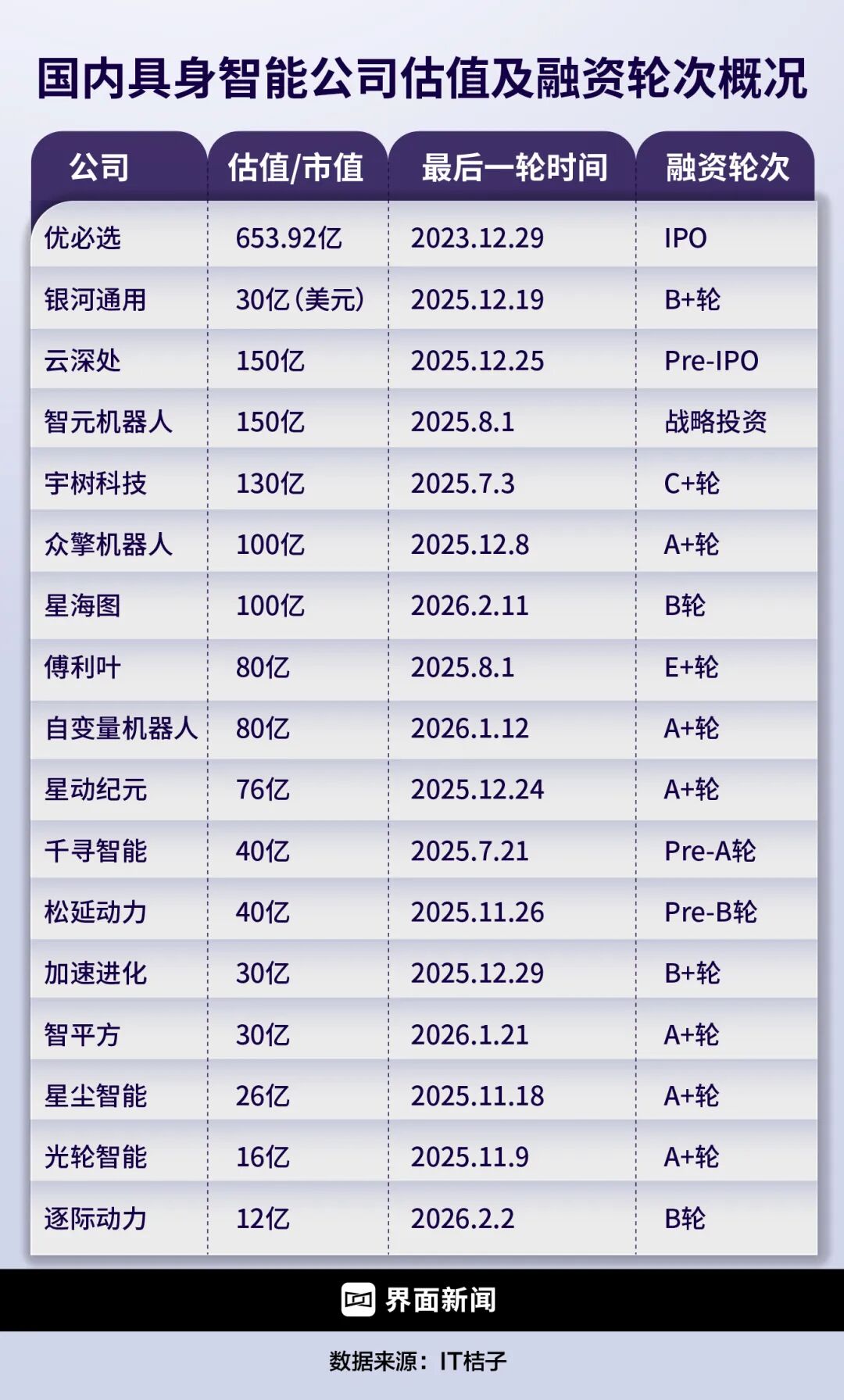
Data compilation: Wang Qiang; Chart drawing: He Miao
In Yang Ye's view, although the industry seems to have undergone tremendous changes, in fact, they are mainly concentrated on the capital side. The progress from technology to commercial implementation is far from his expectations.
From a technical route perspective, although the concept of the VLA (Vision - Language - Action) model is very popular, he believes it still seems risky at this stage. "It is still far from the generalization ability that people expect, and its ceiling may not be as high as imagined." He prefers to compare the current VLA with the BERT at that time (a pre - training - fine - tuning paradigm proposed by Google in 2018 based on Transformer, with generalization ability inferior to GPT).
Zhang Jinjian has a similar feeling. "I think what we saw in 2025 did not deviate from the main context of the past two years."
Even one or two months before the explosion of embodied intelligence, the industry experienced a small downturn around the 2024 WRC (World Robot Conference). Qin Chuan recalled that at that time, many people had high expectations for embodied intelligence. After watching the demos at some exhibitions, they felt that it was still a long way from the final goal.
The risk of this is that some embodied intelligence companies insist on considering commercialization only after technological breakthroughs. But when the VLA technology encounters long - term bottlenecks, startups may have to choose to implement first. "But then you will find that the diffusion speed of technological dividends is also very fast," Yang Ye said. In the face of the common bottlenecks in the industry, companies with leading technologies will soon be caught up by laggards.
The outcome of this effect was very obvious during the AI 1.0 period - at that time, more commercial dividends were not captured by the so - called "Four Little Dragons in AI" but by companies like Hikvision and Dahua Technology.
"A Prescribed Topic Composition"
"Now is a very crazy period of 'prescribed topic composition'. Everyone just puts the standards of Hong Kong Stock Exchange's Chapter 18C here," Yang Ye said.
"Hong Kong Stock Exchange's Chapter 18C" is a listing policy specifically established for specialized technology companies with potential but limited profitability. The minimum market value requirement for commercialized companies at the time of listing is HK$4 billion, and for non - commercialized companies, it is HK$8 billion. Many AI companies have completed the transformation in the capital market through this policy.
The Hong Kong stock market trend in the past year has given hope to the primary market. From this perspective, the tacit understanding between investors and entrepreneurs is to follow the steps and get the company listed first. This does not go against the company's pursuit of its mission, vision, and values. After the goals are the same, both sides will have more clear paths to work together.
For example, Yang Ye believes that the biggest test for mid - tier companies in 2026 is their ability to cover the capital side. Investors had better help the team reach more types of investors and try to secure some powerful investment institutions in the mid - early stage, including but not limited to first - tier VCs, internet giants, and manufacturing giants.
Investors also have a preference for the background of founders who are more suitable for this "prescribed topic composition", such as those from the autonomous driving field.
These people have experienced the influx of capital, mobilized a large amount of resources, and explored how to move from the laboratory to mass production. Talents in intelligent driving who have come from companies such as Huawei, Baidu, Li Auto, XPeng, Horizon Robotics, Momenta, and WeRide are highly concerned. Many projects are intercepted by investors even before they are publicly known. However, some investors believe that "these two technologies are not that closely related."
Regardless of whether they pursue short - term listing or not, Zhang Jinjian believes that the main tasks of competition for embodied intelligence companies in 2026 remain unchanged: "One is to'snatch' money, and the other is to'snatch' talent."
In the process of finding talent and funds, commercial orders and revenue scale are one of the most effective ways for enterprises to prove their strength, and strong marketing and brand promotion are considered useful.
The Spring Festival Gala in 2025 did bring substantial benefits to the industry through national - level exposure. "After the wave of attention at the beginning of the year, the procurement of robots by central and local state - owned enterprises increased," said an industry insider to Jiemian News. The revenue of a leading robot company in the first half of 2025 increased by 300% year - on - year.
As a result, embodied intelligence companies became the absolute protagonists in various technology exhibitions in 2025. From WAIC, WRC to CES in early 2026, this trend will continue until the Spring Festival Gala in 2026.