40 Milliarden Euro im heftigen Wettlauf: Die Investment-Schlacht um Embodied Intelligence im Jahr 2025
Near the end of 2025, Zhang Jinjian, the founding partner of Oasis Capital, had dinner with Su Hao, the co - founder of the one - year - old company HillBot in the field of Embodied Intelligence.
Su Hao showed Zhang Jinjian some data and then put forward an idea: He believed that Embodied Intelligence would reach the "GPT - 2 moment" in the first half of 2026.
This is not a consensus in the industry. Most interviewees believe that the industry has not yet reached the "GPT - 1 moment".
The field of Embodied Intelligence became popular after the rise of Large Language Models and is closely related to them. Although it is not completely comparable technically, investors like to use expressions such as "GPT - 1" to determine the development stage of the industry - which basically influences their decision on whether, when and how much to invest.
"GPT - 1 creates a technical environment to check whether something is feasible. GPT - 2 essentially proves that certain technical paths are feasible." Zhang Jinjian thus defined the so - called "GPT moment" of Embodied Intelligence.
This classification is very important. If one had invested in OpenAI during the GPT - 3.5 and GPT - 1/2 periods, one would have achieved an estimated increase of 30 - fold and about 100 - fold respectively in 2026.
Strangely enough, Embodied Intelligence has not yet reached the "GPT - 3.5 moment", but due to the unexpected popularity of Unitree Technology at the 2025 Spring Festival Gala, it has already emerged ahead of schedule.
In the following year, the investment and financing landscape of the industry has fundamentally changed - the investors who had already invested increased their investments, and those who had not yet invested rushed to participate. Everyone hopes to find the "OpenAI" in the "GPT - 1 era".
From "Waiting" to "Can't Wait Anymore"
At the beginning of 2025, Li Rui (pseudonym), an investor, visited Zhu Qiuguo, the founder of Deep Robotics, with his team. "We had a good talk at that time. They said they would definitely take us along and also presented their resources to see how they could help us in certain scenarios."
Li Rui did not expect that Deep Robotics, which could still negotiate the investment amount and price at that time, would turn into one of the "Six Little Dragons of Hangzhou" after the Spring Festival of the Year of the Snake. As a result, it has stepped out of the "niche circle" and become well - known. The roles of buyers and sellers have thus changed.
Li Rui was a little worried at that time. He had got to know the company at the end of 2024 and was impressed by Zhu Qiuguo's research background and thought he was very good. But his superiors thought the company's valuation was still a bit high at that time and had concerns about the implementation possibilities of Embodied Intelligence. Finally, they decided on a conservative strategy.
Since the situation has fundamentally changed, Li Rui had to travel directly to Hangzhou after the New Year. This time, he brought his risk management team directly to conduct due diligence. In fact, Zhu Qiuguo has revealed his difficulties in dividing the investment quotas. Besides the old shareholders, there are already many top institutional investors, state investors and Internet giants vying for an investment.
"Fortunately, we finally got a little (investment quota), but it was really a 'tenacious struggle'."
There are many similar examples. Another investor in the field of artificial intelligence told a reporter from Jiemian News that a project in Embodied Intelligence had demanded $50 million for financing three years ago, but no one had invested at that time. The founder finally had to give up the startup and went back to his job. In 2025, the same man came back, and the same project reached a company valuation of $400 million within six months.
In the same year, he got to know a project with a valuation of $70 million. He thought the innovation ability was not sufficient at that time and rejected it. Three months later, he happened to talk to a friend about it and learned that the project was just in the liquidation phase and the valuation had already risen to several hundred million dollars.
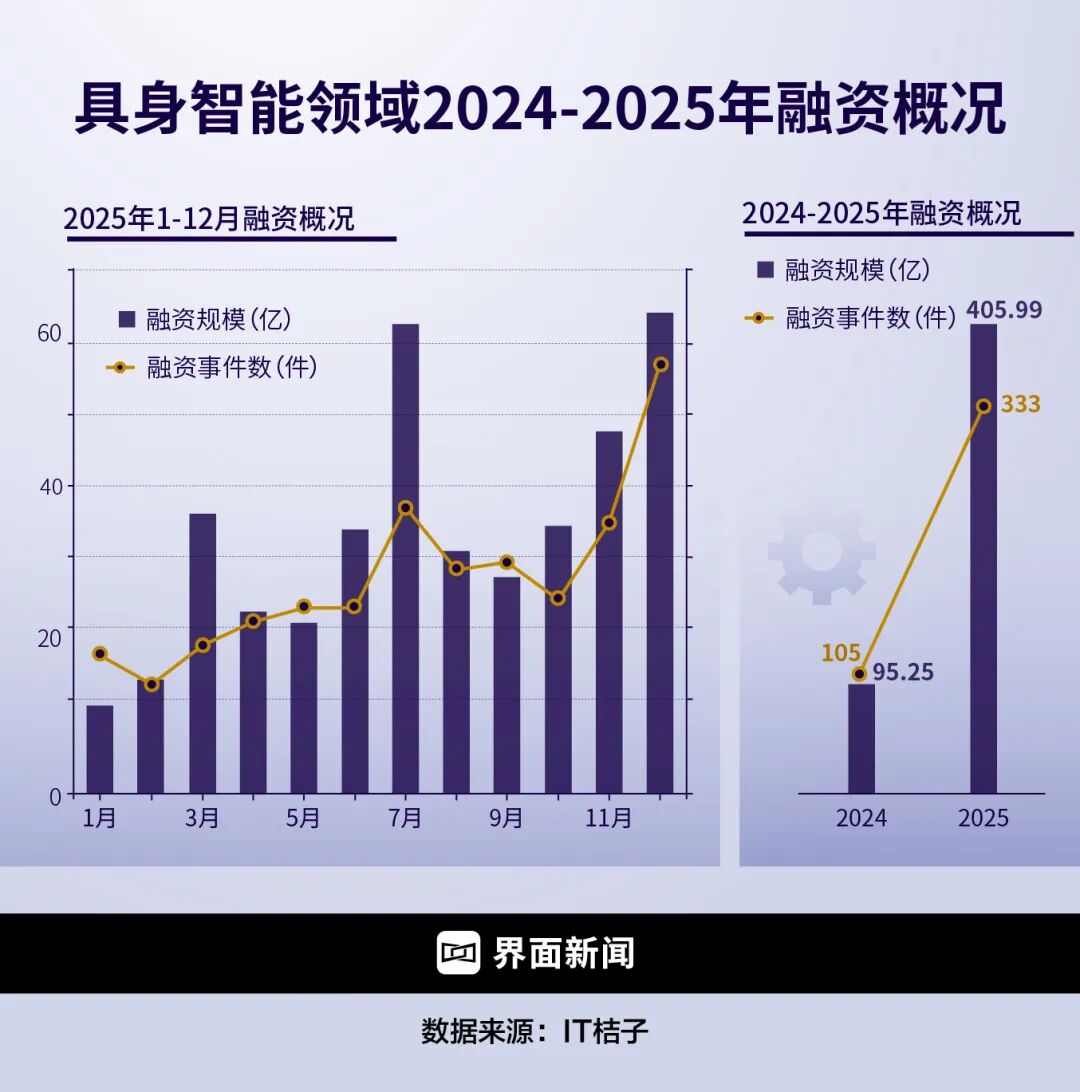
"Apart from the founders and the projects themselves, this phenomenon itself shows the extreme difference in time." The investor said. Data from IT Juzi shows that the number of financing events in the field of Embodied Intelligence increased from 105 in 2024 to 333 in 2025, and the financing volume increased from 9.525 billion yuan to 40.599 billion yuan, corresponding to an increase of 217% and 326% respectively.
Data processing: Wang Qiang Graphic: He Miao
On the one hand, the projects are becoming more popular, on the other hand, there are the constantly rising company valuations and the difficult - to - define valuation models.
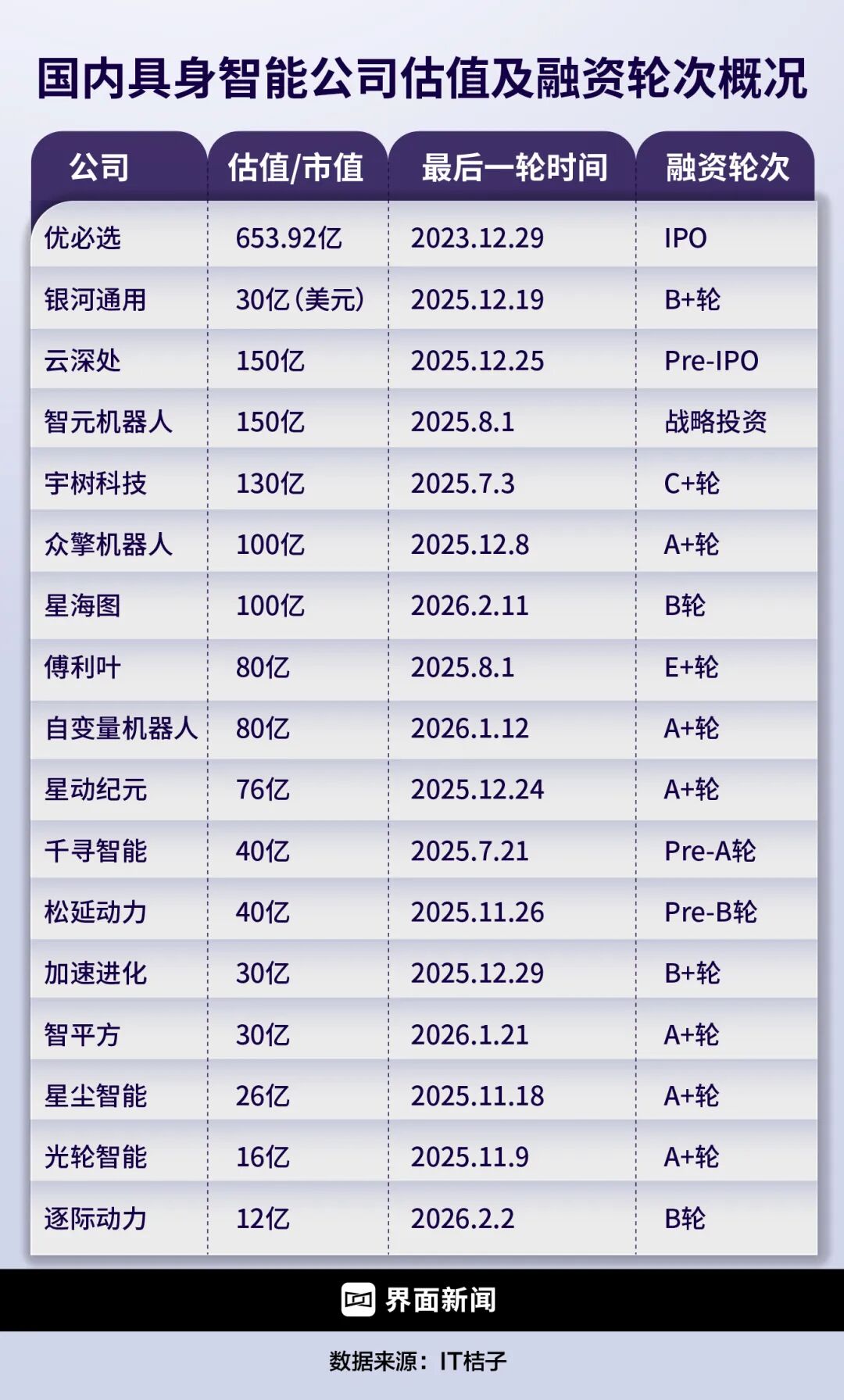
In 2025, there were two trends in the financing of projects in Embodied Intelligence: the valuations of early - stage projects became higher, and the valuations of projects in the growth phase rose faster.
Tash Robotics has already set a record in the entire industry in the angel round - less than six months after its establishment, it successively raised $120 million and $122 million in the angel round and the angel + round. Companies such as Zibianliang, Xinghaitu, Zhipingfang and Qianxun Intelligence have all raised hundreds of millions of yuan in the Pre - A and A rounds. This would have been the entire valuation of a company in the same round in the past.
Qin Chuan, a partner in the investment banking department of China Renaissance, roughly estimated that the valuation increase per round last year averaged between 50% and 100%. For an emerging field, he actually thinks this rhythm is relatively reasonable. "There are actually temporary leaps in company valuations in the market, for example, from 2 billion, 3 billion, 5 billion yuan. $1 billion is a threshold that is often associated with higher technical and commercial barriers.
But it cannot be ruled out that there are some irrational factors. The above - mentioned investor in the field of artificial intelligence said: "Some investors have not participated in such projects in the past two years, so they are in a hurry this year and are willing to accept a very high company valuation." In addition, a star company in the early round received a very high valuation because one of the investors "was so enthusiastic about the team" that he increased the investment amount for several rounds, which was regarded as a bit "exuberant" by his colleagues.
Both financing advisors and venture capitalists agree that there is currently no appropriate valuation model for the Embodied Intelligence industry. It seems to be more of a kind of "esoteric science". Often, the company valuation for an investment company, apart from the previous valuation and the latest business developments, depends more on how much money another company is willing to invest.
Can this lead to an overvaluation of companies?
Qin Chuan told a reporter from Jiemian News that the continuation of these valuations overall depends on two things: First, whether the industry will experience a major technological breakthrough, and second, whether greater commercial implementation is permanently possible. If so, this valuation logic can continue.
"Like the 'Six Little Dragons of Large Language Models', at that time, $1 billion seemed like an insane price, but in retrospect, it seems very cheap now." The above - mentioned investor said. The AI investor Wang Jie also believes that the so - called "bubble" can only be judged in retrospect. For example, if we consider the market significance in ten years, were the invested resources in the first, second and third founding phases of the industry too much or too little?
Ye Qian, the co - president of First Journey Holdings, has a clear and relatively positive attitude. "Company valuation is an art. One should not simply be guided by the valuation, but also not think that a high valuation is completely inappropriate." He said: "Sometimes the valuation of a technology company is a prediction of its future value.
No Big Changes, Except in Chasing Money
Many investment companies were cautious in 2024 and aggressive in 2025. This has little overall impact on their investment strategy, but they have to bear higher costs.
An Internet strategic investor found essentially the same projects attractive in 2024 and 2025, but only invested in 2025. It has invested in the same companies, but the company valuations have increased four - to five - fold in the meantime. "In 2024, we didn't invest because we were waiting and didn't wait for the 'beta' (the sensitivity of asset returns to general market developments) of the industry. In 2025, we invested because we couldn't wait anymore." An insider said.
There are many reasons for the caution. On the one hand, there are only limited technological advances, one cannot see the implementation possibilities and the company valuations seem too high. Another objective reason is that there were only a few examples of successful commercial implementations in the previous generation of robotics companies.
Yang Ye (pseudonym), an investor with a state - owned background, said that his company had invested in robotics and industrial robot projects in the early stage. "Both companies had difficulties." He said that one of the companies constantly changed directions. Some directions brought in revenues, but not enough to meet the listing criteria. This has put more pressure on the superiors when making decisions on investing in Embodied Intelligence projects.
But this does not represent the entire industry landscape. Among the more aggressive investors, it is not surprising that the top - dollar funds have become the main investors in the early stage of the industry. Yang Ye was surprised that some state investors have invested better than commercial investors.
Wuxi has a strong automobile industry, which matches well with the robotics industry. Wuxi Innovation Investment Group invested in Xinghaitu together with Mihoyo and Hillhouse Capital in 2024 when the company was only one year old. Zhuhai Science and Technology Industry Group has successively invested in Yuanzhi Robotics, Ubtech and Qianxun Intelligence in recent years and has also built a relatively comprehensive network of the entire value - creation chain. In addition, state investors in Shanghai, Beijing and Shenzhen have invested relatively aggressively.
This can be partly attributed to political factors, but Yang Ye is convinced that after several waves of investment in hard tech, state investors have made their investment strategies more active and efficient than in the past. For example, Zhuhai Science and Technology Industry Group was the fourth - largest shareholder of Insta360 before its listing and witnessed the development of a hard - tech company from a valuation of several hundred million yuan to nearly 100 billion yuan. This gives it enough motivation to invest in new directions.
"So as long as state investors have the money, they can bravely make trial - and - error attempts, because if it works, it will become a large industry." Yang Ye added that a state - owned investment company directly decided to invest after a meeting with the founder, which was very rare in the past.
Data processing: Wang Qiang Graphic: He Miao
In Yang Ye's view, it seems as if the industry has fundamentally changed, but in fact, the changes mainly focus on the capital side. Neither the technological progress nor the commercial implementation meets his expectations.
Considering only the technical paths, although the concept of the VLA (Vision - Language - Action) model is very popular, he still thinks the current situation is risky. "There is still a great lack of the generalization ability that people expect. The upper limit may not be as high as people think." He prefers to compare the current VLA with the then BERT (a pre - training - fine - tuning paradigm developed by Google in 2018 based on the Transformer model, whose generalization ability is lower than that of GPT).
Zhang Jinjian has similar feelings. "I think what we saw in 2025 has not deviated from the mainstream of the past two years."
Even a few months before the rise of Embodied Intelligence, the industry experienced a small trough around the time of the WRC (World Robotics Conference) in 2024. Qin Chuan remembered that many people came with overly high expectations for Embodied Intelligence. After seeing the demos at some exhibitions, they found that it was still a long way to the end goal.
The risk here is that some companies in Embodied Intelligence only want to think about commercial implementation after a technological breakthrough. But if the VLA technology should be stuck at a bottleneck for a long time, startups may have to promote implementation first. "But then one will find that the technologies spread very quickly." Yang Ye said that in the common bottleneck situation of the industry, the technologically leading companies can be quickly caught up by the laggards.