2026 Landscape and Trends | (Part 2): Automobile Manufacturers Lose Pricing Power
On January 30th, Tesla announced that the production lines for Model S and Model X at its Fremont factory in California would soon cease production and be converted into a factory for manufacturing Optimus, the humanoid robot.
Less than a week later, on February 5th, Li Xiang was smiling and enthusiastically talking at a dinner party, saying, "The whole company is using Open Claw, and even the finance department has significantly improved its efficiency. We are also building silicon-based family members." Then, at an extremely high speed, he talked about the advantages, disadvantages, and origins of Claude Code, Deepseek, and Qianwen as if he were very familiar with them. The proportion of the conversation about AI far exceeded that about cars.
On the sidelines of Tesla and Li Auto, Toyota is developing the T - HR3 mapping robot overseas, and XPeng is working on humanoid robots and flying cars at home... Behind this disruptive transformation, on one hand, there is innovation and transformation; on the other hand, automobile manufacturers are trapped in a profit pitfall. They are all desperately seeking new business growth points and new narratives to support their stock prices.
With Tesla's net profit in 2025 decreasing by 46% year - on - year and its operating profit margin dropping from 7.2% in 2024 to 4.6% (the profit margin of American automobiles is about 7 - 8%), even a powerful company like Tesla can only barely have a profit margin 0.5% higher than that of the extremely competitive Chinese automobile industry in the fierce tide of electrification and intelligent competition. This cannot support Musk's ambition.
From 2021 to 2025, the spiral decline of profits in the Chinese automobile industry has troubled almost every domestic automobile manufacturer. The superposition of five core factors - the white - hot price war, the rigid increase in costs, the imbalance in the profit distribution of the industrial chain, overcapacity, and the pain of electrification transformation - has formed a strange industry cycle where production increases but revenue does not.
The root cause is that automobile manufacturers have lost their pricing power. Even leading new - energy vehicle manufacturers such as Tesla and "Wei Xiaoli" (NIO, XPeng, and Li Auto) are not immune. In the past, the figures vying for automobile pricing power were Bosch, ZF, Denso, MOBIS, and Star Automotive... Today, they have become CATL, Huawei, and NVIDIA. Tomorrow, the names of OpenAI, Unitree, and xAI may be added.
In the automobile industry, there has never been a shortage of sharp blades emerging unexpectedly. Only those who can survive until the end can be the real protagonists of the heroic epic.
01
Triple Negative Factors Pierce the Profits of the Automobile Industry
"In 2025, the revenue of the automobile industry was about 11.18 trillion yuan, a year - on - year increase of 7.1%. The profit margin was locked at 4.1%, which was also continuously lower than the 5.9% level of downstream industries."
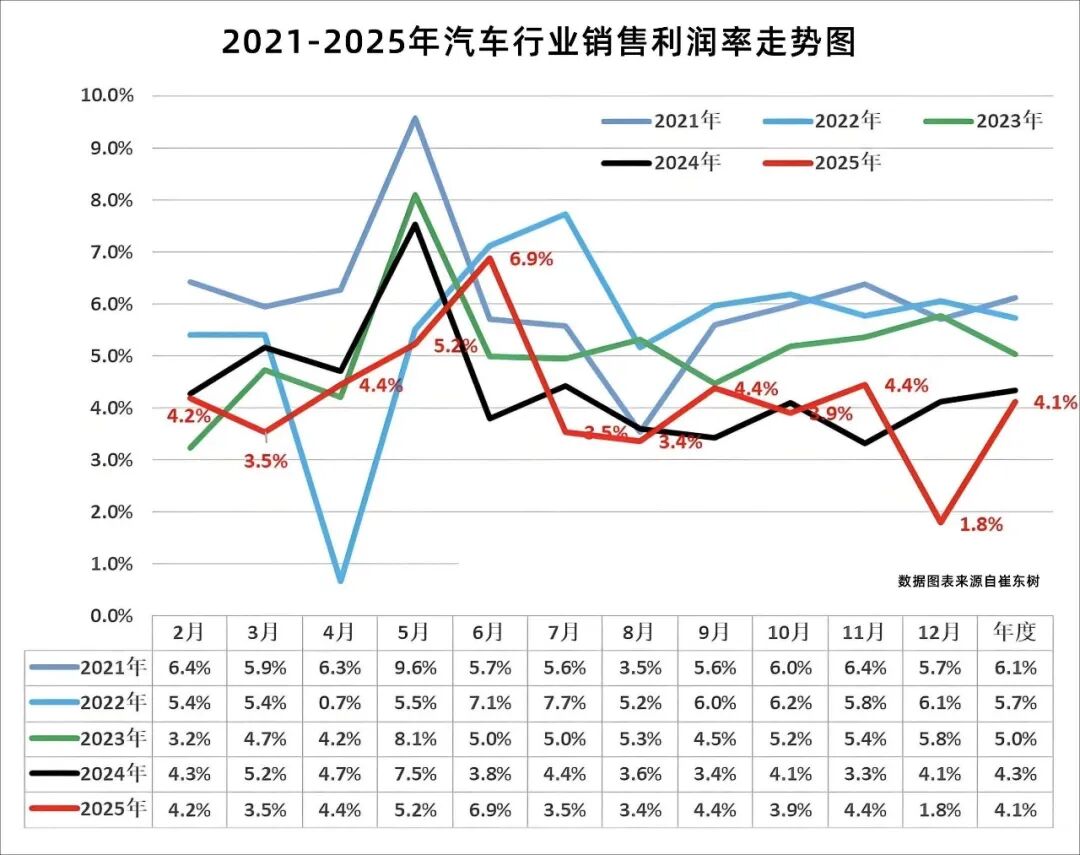
On January 25th, the profit data of the automobile industry in 2025 released by the China Passenger Car Association hit a ten - year low since 2015. This was significantly lower than the 5.5% profit margin of the equipment manufacturing industry. In December alone, the profit margin further dropped to a historical extreme of 1.8%, and the industry was trapped in a dilemma where production increased but profits did not. In detail, in December, the industry's revenue decreased by 0.8% year - on - year, while costs increased by 0.8%. This positive - negative "scissors gap" ultimately led to a freezing - point profit margin of 1.8%.
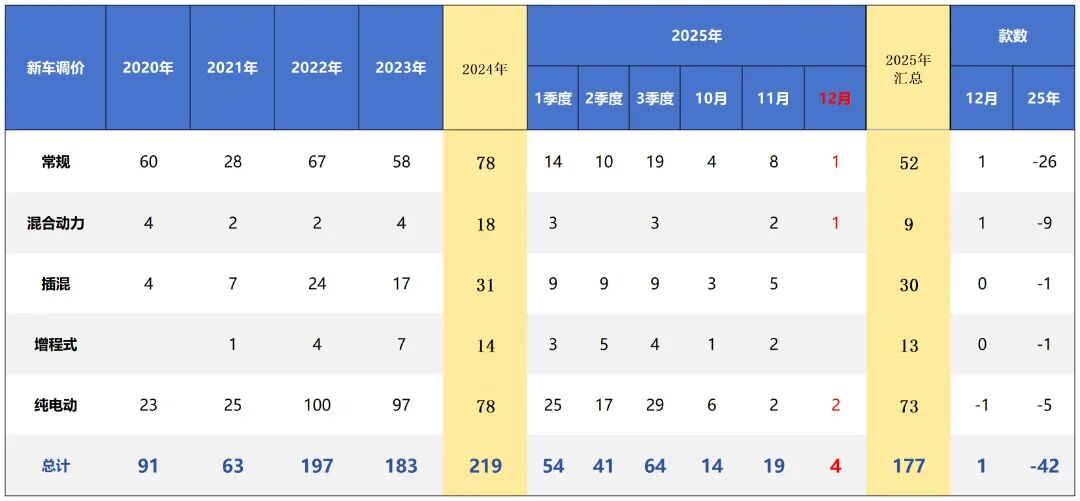
Since Tesla took the lead in significantly reducing prices in 2022, the price war has spread from the new - energy vehicle sector to the fuel - powered vehicle market, forming a red - ocean competition for all product categories and price ranges. In 2025, 177 models officially reduced their prices. The average price of new - energy vehicles decreased by 11% throughout the year, and the decline rate rose to 14.7% during the peak season in December. The price of fuel - powered vehicles decreased by 8.9% throughout the year. The policy withdrawal intensified year - end promotions, and some models had a maximum price cut of 90,000 yuan. The continuous decline in terminal prices directly eroded the gross profit margin.
Three negative factors have pierced the profit margin of the automobile industry:
The growth rate of costs exceeds that of revenue: In 2025, the industry's revenue increased by 7.1%, but costs increased by 8.1% year - on - year. The revenue per vehicle in the industrial chain decreased by 16,000 yuan year - on - year, and the gross profit was continuously squeezed. The price of upstream lithium carbonate increased by 83% in 2025 year - on - year, and the core costs of power batteries and other components increased significantly.
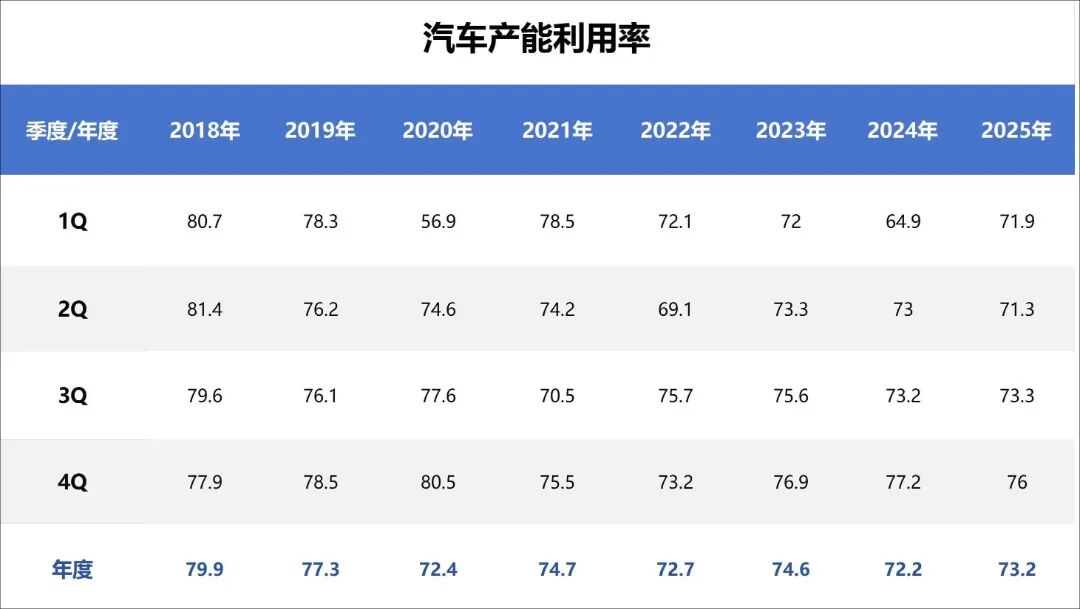
The capacity utilization rate is lower than the healthy threshold: In 2025, the overall capacity utilization rate of the automobile industry was 73.2%, continuously lower than the healthy line of 75%. The capacity utilization rate of joint - venture automobile companies was only 40% - 60%, and that of marginal automobile companies was as low as less than 10%. The efficiency of fixed - cost allocation was low, and high inventories pushed up promotion costs.
The transformation investment is in a period of high input and low return: The automobile industry has carried out high - intensity R & D in areas such as three - electric systems, intelligent driving, and intelligent cockpits. Coupled with the construction of overseas factories and the layout of charging and swapping facilities, depreciation, amortization, and current expenses have continuously increased. Profits have been largely converted into long - term technological assets and have not yet formed a profitable return.
In the Chinese automobile market in 2025, behind the prosperity lies division. The average profit margin of 4.1% reflects a sharp contradiction: when the glory of being the world's number one meets the lowest profitability in history, what is the price behind this halo?
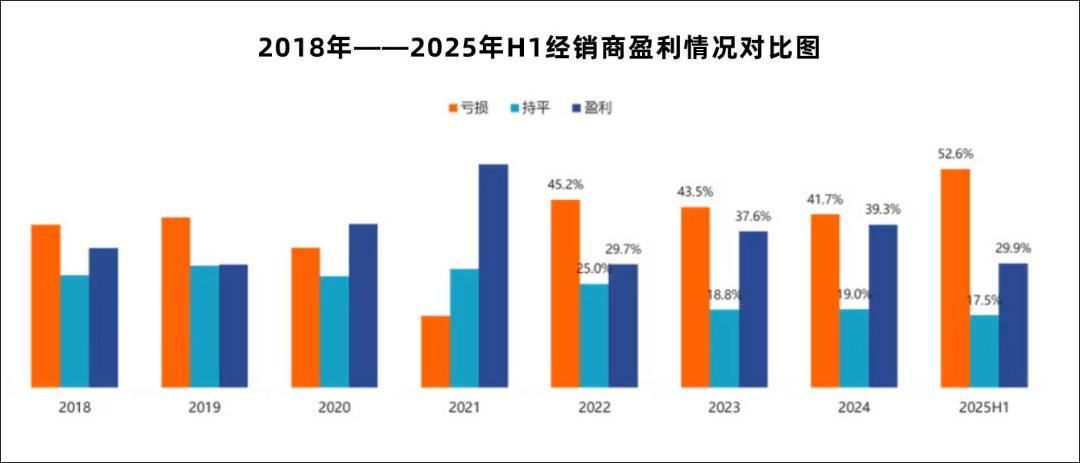
First and foremost are the dealers. In 2025, the Chinese automobile dealer industry faced the most severe loss - making wave in nearly eight years. Data shows that in the first half of the year, the loss - making proportion of dealers reached 52.6%, an increase of 10.9 percentage points compared with 2024. Only 29.9% achieved profitability. The loss - making rate in the first three quarters further climbed to 55%, and it is estimated that over 58% of dealers will lose money throughout the year, and about 2,000 4S stores will withdraw from the market.
Suppliers present a pattern of "polarization and overall mild improvement", in sharp contrast to the overall losses of downstream dealers. The revenue of listed supplier companies in the first half of 2025 increased by 15.7% year - on - year, with a gross profit margin of 18.2%, basically on the same level as the 18.64% of global suppliers, and a net profit margin of 6.1%. The core characteristics are that upstream chips and new - energy core components have rich profits, while mid - stream traditional auto parts are severely squeezed by the price war. Leading enterprises become stronger with their scale and technological advantages.
In the fuel - powered vehicle era, Chinese automobile original equipment manufacturers (OEMs) firmly occupied the core of the industrial chain with their hardware manufacturing advantages, brand accumulation, and channel control, and dominated terminal pricing power and profit - distribution rules. Upstream suppliers only needed to complete the production of auto parts according to the OEMs' design drawings, and their profit distribution was firmly locked at the end of the industrial chain, with the gross profit margin remaining at a low level for a long time.
However, with the wave of electrification and intelligentization sweeping across the industry, the core value of the automobile industry has shifted from hardware manufacturing to software - defined vehicles. Intelligent driving and intelligent cockpits have become the key to determining product competitiveness and terminal pricing. Upstream suppliers that master core technologies have witnessed an explosive increase in their voice.
Roland Berger releases the "White Paper on the Competitiveness of Core Enterprises in the Global Automobile Supply Chain" every year. Taking the 2025 edition released last year as an example, the net profit margin of China's top 100 auto parts enterprises in 2024 was 8.5%, with the new - energy sector leading the way with 19%. In contrast, the engine sector had only 5%.
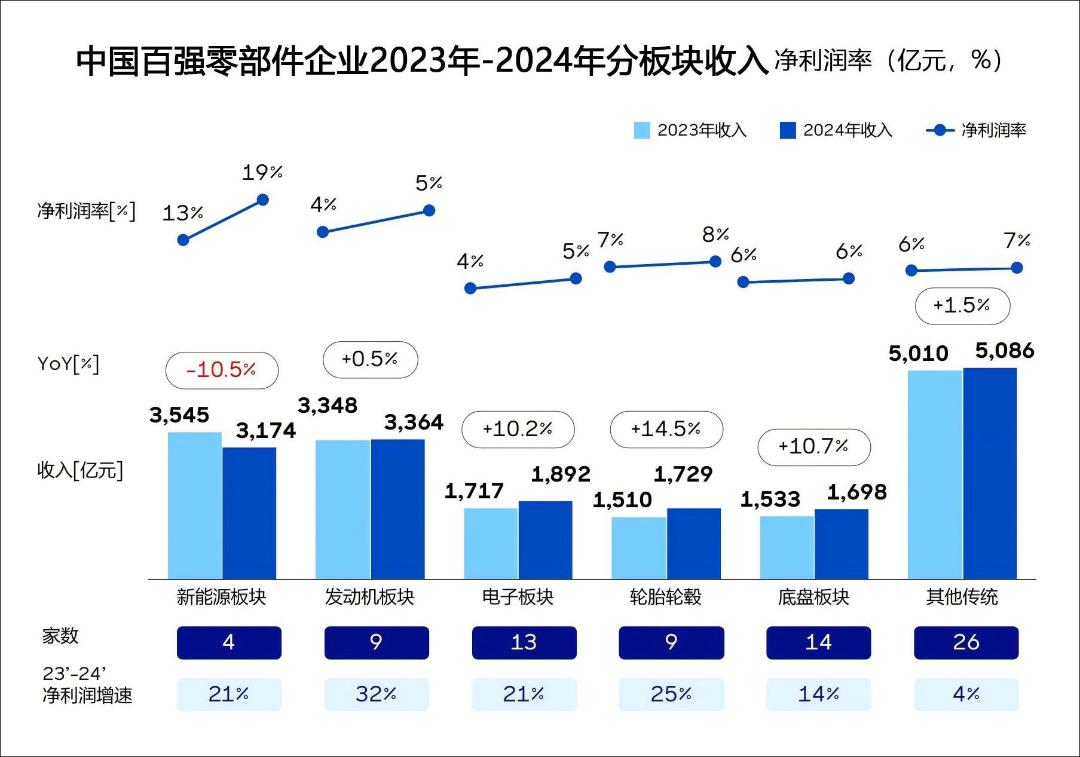
This is a profound reconstruction of the interest chain in the automobile industry over the past 100 years. The new automobile era has changed everything, and the profitability of the industrial chain has gradually shifted to the power - battery industry represented by CATL and intelligent - solution providers represented by Inceptio.
Intelligent enterprises build core barriers with software, chips, and computing power, and battery giants control the cost lifeline. Coupled with the continuous dilution of the value of the OEM manufacturing link, the pricing dominance of traditional OEMs has gradually declined, and they have fallen into a double dilemma of increasing revenue but not profit and being technologically tied. The essence of this power transfer is the fundamental reconstruction of the value chain in the transformation of the automobile industry from a mechanical product to an intelligent mobile terminal.
02
ICT Disrupts Automobile Pricing Power
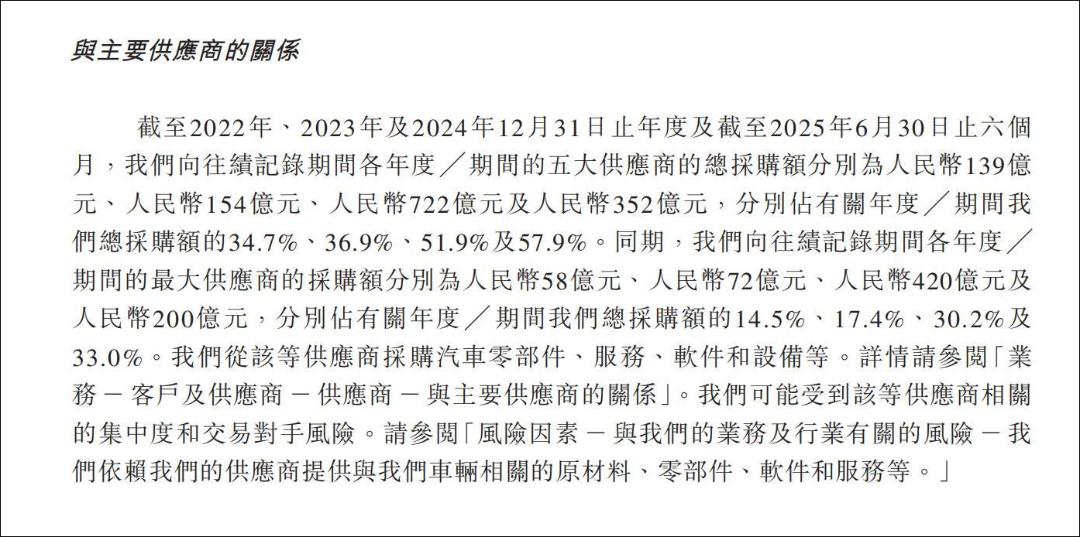
At the beginning of 2026, a set of data disclosed in SERES' Hong Kong stock prospectus shocked the industry: in the first half of 2025, SERES paid Huawei 20 billion yuan in procurement fees. During the three - and - a - half - year cooperation period, SERES cumulatively paid 75 billion yuan in procurement fees, accounting for more than 30% of its total revenue. This figure far exceeds the procurement proportion of traditional automobile companies from a single supplier.
Which Huawei businesses will charge SERES?
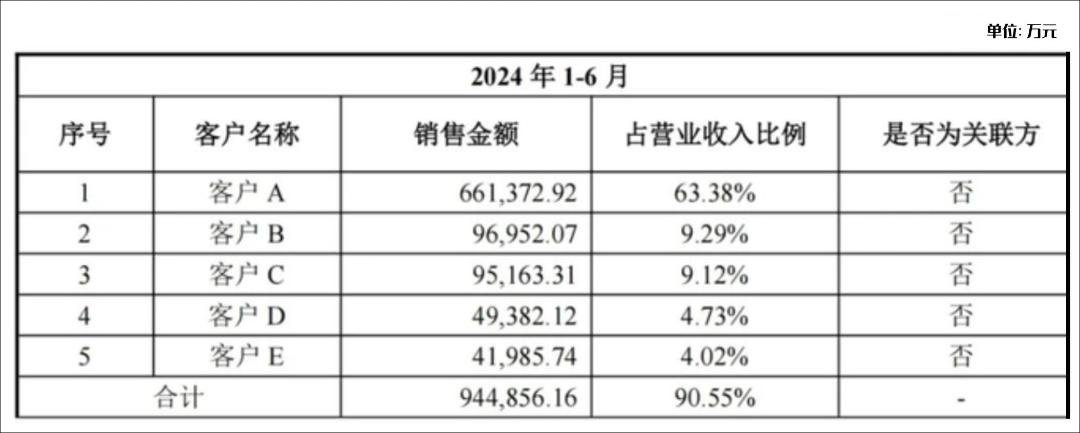
The sectors related to automobile brands such as SERES include terminal business (HarmonyOS Smart Mobility), intelligent automobile solutions business (hereinafter referred to as "Automotive BU")/Inceptio (intelligent technology), digital energy business (electric drive), and cloud - computing business (cloud). According to the independent financial report of SERES' investment in Inceptio in 2024, in the first half of 2024, the largest customer of Inceptio was inferred to be SERES, contributing 6.61 billion yuan in sales.
This means that in 2024 alone, Automotive BU took tens of billions of yuan from SERES. HarmonyOS Smart Mobility and other Huawei businesses shared the rest of the 42 billion yuan in 2024, including a 10% share of the vehicle's selling price (including a 2% technology licensing fee and an 8% sales service fee).
From the perspective of per - vehicle, based on the delivery of 147,000 AITO vehicles in the first half of 2025, 136,000 yuan of each vehicle sold by SERES flowed to the Huawei system. For the flagship AITO M9, if brand and patent licensing fees are included, the cost per vehicle flowing to Huawei is as high as 220,000 yuan.
No wonder SERES has a high gross profit margin of 29.4%, but in 2025, it is roughly estimated that the net profit per vehicle is about 19,000 - 20,000 yuan (with AITO's sales volume of 430,000 vehicles, the net profit is expected to be about 8.1 - 8.8 billion yuan). Based on the revenue forecast of 170 - 180 billion yuan, the net profit margin is pulled down to about 5%.
As the story of SERES' counter - attack with the help of Huawei is finalized, new questions arise along with the disputes over credit and profit - sharing: Is this the technological hegemony of technology giants or the necessary cost of the intelligent transformation of the automobile industry? Is it SERES' dependent survival or a win - win value cooperation between the two sides?
The answer inevitably lies in the shift of the value - distribution logic in the automobile industry. The functions and experiences of traditional automobiles are fixed at the time of factory delivery, while intelligent automobiles can continuously evolve through OTA upgrades. The software iteration ability directly determines the product's life - cycle value. Consumers' willingness to pay for intelligent experiences far exceeds their recognition of OEM brands. Unfortunately, currently, nearly 70% of OEMs rely on the intelligent driving and cockpit solutions of ICT enterprises such as Huawei, Momenta, Zhuoyue Technology, and Horizon, lacking the ability to be self - sufficient in core technologies.
"Software - defined vehicles" have broken the fixed attributes of traditional automobile hardware, making software the core element that determines product experience, iteration speed, and core competitiveness. "Chip - defined vehicles" provide the underlying carrier for software implementation, and the performance of automotive - grade chips directly determines the upper limit of software functions. "Computing - power - defined vehicles" further transform computing power into the core productivity of intelligent experiences. The scale and scheduling efficiency of computing power are directly related to the implementation ability of high - level intelligent driving and intelligent cockpits. The ecological closed - loop formed by these three factors, and the technology companies that master this closed - loop are deeply penetrating from the upstream and gradually seizing the industrial pricing discourse power.
Chips and computing power define vehicles, further tightening the technological shackles on OEMs. High - end automotive - grade chips (such as Or