Tesla's semi-trucks are finally on the road, but the timing couldn't be worse.
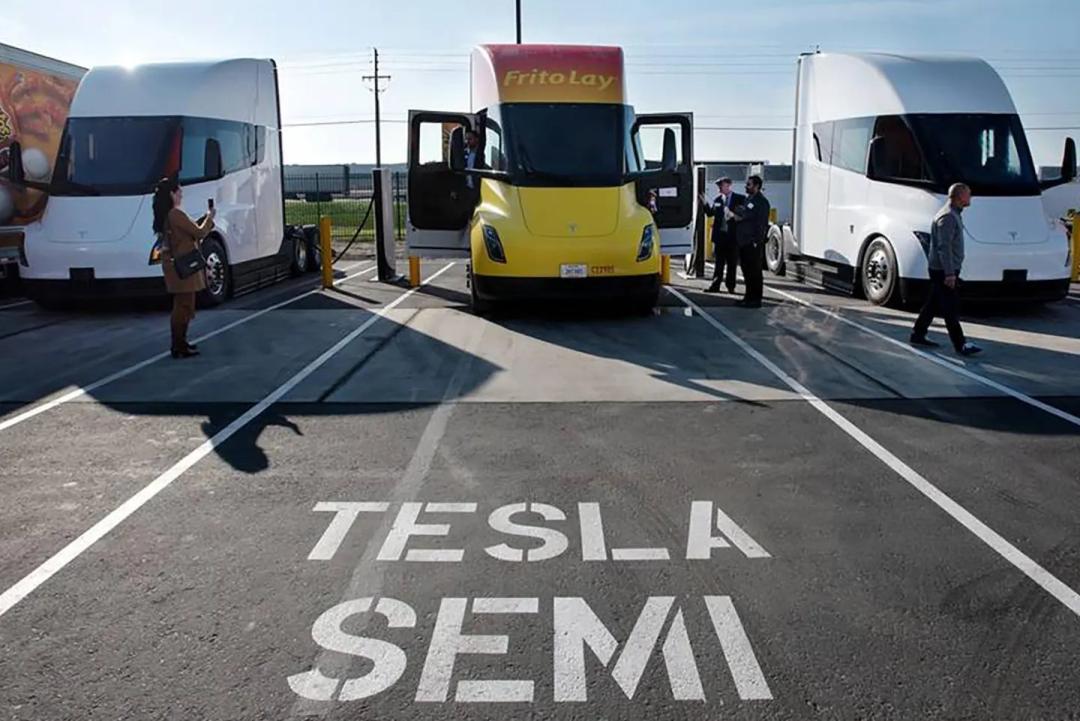
Tesla Semi trucks are charging at the Frito-Lay chip factory in Modesto, California. Photo source: TNS
Elon Musk's long-delayed "beast" is finally going into production, but the federal government's support for electric vehicles is waning, and rising electricity prices are undermining his claim that it will be "more cost-effective than diesel trucks."
During the last Tesla earnings conference call, Elon Musk talked at length about the electric vehicle manufacturer's transformation into a powerhouse in artificial intelligence and humanoid robots. He mentioned the upcoming Cybercab, a two-door electric vehicle he claims will be without a steering wheel and pedals (pending regulatory approval). He also mentioned that the company will discontinue the Model X crossover and the Model S sedan, the latter being the model that catapulted Tesla to fame.
What he didn't mention, and no one bothered to ask about, was the launch of Tesla's largest-ever vehicle: the electric Semi truck, which is planned to go into full production in the first half of this year. (In 2023, Tesla produced at least 200 for testing, but few details were released.) Given the timing, this isn't surprising. U.S. consumers may still purchase over 1 million new electric vehicles this year, but that number could see a double-digit decline from the 1.28 million in 2025, and the demand for Class 8 electric semi trucks will only be a fraction of that.
"It's a bit of an unknown, but we expect sales in 2026 to be very low - less than 1,400 units," Ann Rundle, vice president of trucking industry consulting firm ACT Research, told Forbes. "It's hard to sell them now because the Trump administration basically cut all relevant support."
According to the company's fourth-quarter earnings report, like Tesla's two-door Cybercab electric vehicle, the truck will go into production in the first half of this year. The report also showed a map of the "Megacharger" stations Tesla plans to build across the United States in 2026. These charging stations are specifically designed to accommodate the massive 990-kilowatt-hour battery packs of the Semi.
Jim Monkmeyer, president of the transportation services division of DHL, said that Tesla hasn't announced the truck's price, but it's already higher than the $180,000 range Musk promised in 2017. The courier company has been testing the Semi in its U.S. fleet and is eager to increase the number. "I can't tell you Tesla's price," he said. "But I can tell you that we're very excited to get these vehicles."
He added that DHL is also using electric trucks from companies such as Volvo and Navistar, each costing about $400,000. "This price will come down later - I think the price drop for Tesla will be particularly significant."
For early customers like DHL and PepsiCo, purchasing these trucks is part of a broader corporate strategy to reduce carbon and exhaust emissions. Pepsi has been operating at least 86 Tesla Semis in its California fleet, which are from the early limited-production batches. DHL aims to convert 30% of its fleet to electric by 2030. "We're not wavering on that goal," Monkmeyer said. "We want as many of these Tesla trucks as possible."
Monkmeyer said that DHL plans to use these trucks mainly for medium- and short-haul transportation, rather than long-haul freight routes of up to 500 miles. As for Pepsi, it's unclear whether the Semis in its California fleet are transporting Frito-Lay chips or heavier, more power-hungry sodas.
"It might be smarter to transport chips," Glen Kedzie, former vice president and environmental and energy legal counsel for the American Trucking Associations, told Forbes in 2022 when Tesla originally planned to start production in 2023. Musk told investors and analysts at the time that Tesla's goal was to supply 50,000 units of this model annually by 2024, but that plan was later postponed to 2026.
Selling to other well-funded large freight companies should help maintain the Semi's sales to some extent. However, smaller fleets may not be willing to take the risk of adopting this truck in the short term because, apart from the purchase or lease price, the operating costs of the Semi are far from as low as Musk originally promised. In 2017, Musk claimed that Tesla's entry into the commercial vehicle market would bring revolutionary changes to the trucking industry, with advantages including a 500-mile range on a single charge, rapid acceleration, low maintenance costs through high-tech monitoring tools, and most importantly, lower operating costs because electricity prices were lower than diesel fuel at that time.
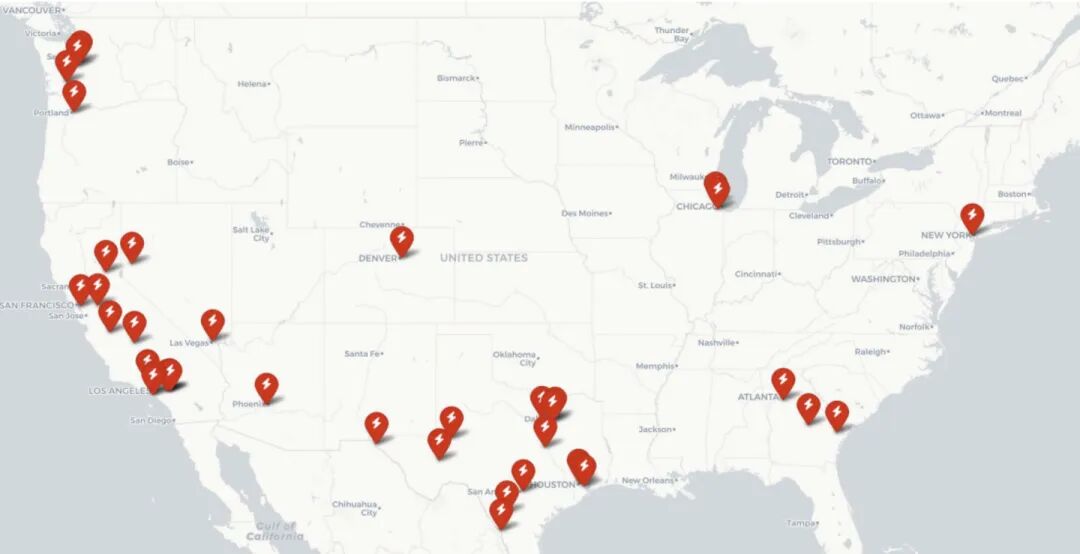
TESLA plans to build a network of Megacharger stations compatible with the Tesla Semi in 2026. Photo source: TESLA
At the 2017 launch event, Musk said, "Trucking, and the economics of trucking, are crucial issues. If your cost per mile is too high, the economics don't work. We've done a lot of research on this. When you factor in lease costs, insurance, maintenance, and all the other elements to get the actual total cost of transportation, you'll find that diesel trucks cost 20% more per mile to operate than the Tesla Semi."
That calculation may have held up at the time, but the situation has changed. Tesla's estimate was based on a comparison of $2.50 per gallon of diesel and 7 cents per kilowatt-hour of electricity. (One gallon of diesel is equivalent to 40 kilowatt-hours of electricity.) Nine years later, according to data from the Federal Reserve Bank of St. Louis, the average price of diesel in the United States is about $3.60 per gallon, but electricity prices have soared to 18.9 cents per kilowatt-hour. In California, electricity prices are even as high as 33 cents per kilowatt-hour. The increase in electricity prices is mainly due to the huge demand for electricity from data centers - including the data center operated by Musk's xAI - which offsets the potential fuel savings of the Semi.
"Putting aside the Trump administration's policies and the reduction in subsidies, the decline in international oil prices has also pulled down the price of diesel," said Ken Vieth, president and senior analyst at ACT Research. "Heavy-duty electric vehicles may still succeed in some niche markets, but it's clearly more difficult to make progress compared to the same period last year."
One niche market for heavy-duty electric trucks - including both pure electric and hydrogen fuel cell types - is short-haul transportation from large ports such as Los Angeles, Long Beach, and Oakland to nearby warehouses and distribution centers. Electric truck startup Nikola used to focus on this market, but it ran out of funds early last year and finally filed for bankruptcy in May. The company was unlucky as it coincided with the Trump administration taking office and federal policies no longer supporting clean energy, leading to a slowdown in the demand for electric trucks.
"What was once a tailwind has basically turned into a headwind - there are many reasons, including the lack of incentives, insufficient policy support, and companies not being as eager to shape their image as they were a few years ago," said Steve Girsky, managing partner of investment firm VectoIQ and the last CEO of Nikola. "Many European companies still want to build a green image, but I think many American companies are less enthusiastic in this regard."
Tesla is producing the Semi on a new assembly line at its massive Gigafactory in Nevada, which is its main battery factory in the United States. The exact time for the trucks to come off the production line wasn't announced in the earnings report, but there was a noticeable change in the factory's capacity table that Tesla releases each quarter. As of the third quarter of 2025, the annual production capacity of the Tesla Semi production line was marked as 50,000 units. Given that the sales of Class 8 heavy trucks in the United States in 2026 are only expected to be about 245,000 units, such production capacity seems significantly excessive.
However, in the recently released fourth-quarter report, the capacity data for this production line was completely blank.
This article is translated from: https://www.forbes.com/sites/alanohnsman/2026/02/05/teslas-semi-is-finally-hitting-the-road-the-timing-couldnt-be-worse/
This article is from the WeChat official account "Forbes" (ID: forbes_china). Author: Alan Ohnsman; Translator: Björn & Rach; Proofreader: Lemin. Republished by 36Kr with permission.