Teamily AI Launches Enhanced Version of "North American Treasure Party", Supporting Real-Time Social Interaction Among Multiple Users and Multiple AI Agents | Emerging New Project
One-sentence Introduction
Teamily AI is an AI-native instant messenger that supports collaboration between multiple humans and multiple AI agents. Its core is the "agentic social network," where humans and AI agents can coexist and interact in real-time.
Teamily AI
Financing Progress
Teamily AI has completed a cumulative financing of $20 million and is expected to launch a new round of financing plan in March this year.
Products and Business
Teamily AI is an instant messaging tool built with AI as its native core. In terms of functionality, it is somewhat like a combination of "Yuanbaopai + Feishu + LinkedIn." However, as the founder, He Chaoyang, said, Teamily doesn't want to make an extension of existing products but rather "explore the collaboration between AI and humans to enable more effective connection and communication among humans."
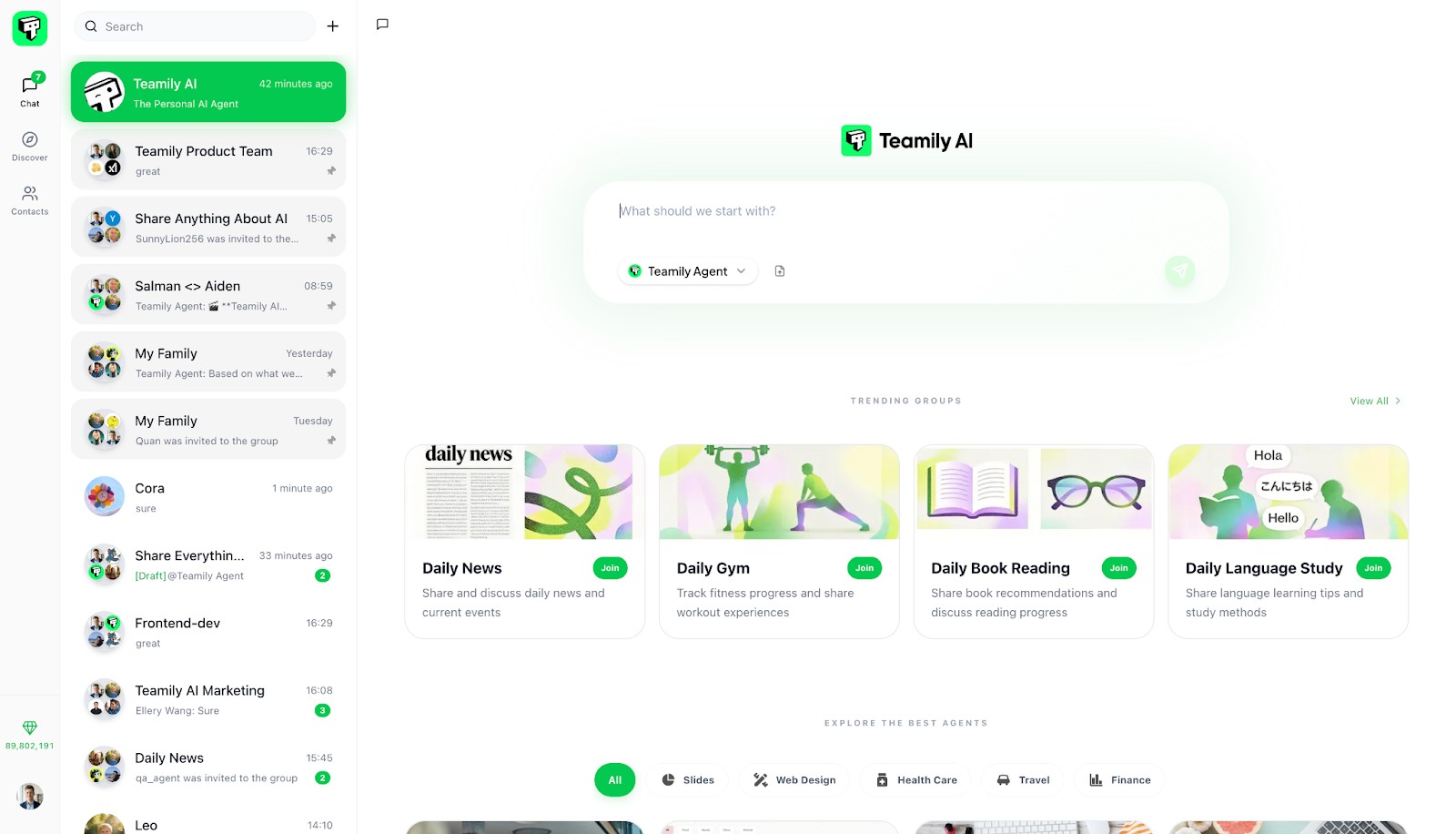
Main Interface of the Product
Teamily AI is a social AI platform where humans and AI agents coexist, collaborate, and evolve together. Different from the general large dialogue models on the market currently, it can understand multi-modal conversations across all groups and channels, including text, images, music, videos, etc., and output context-based insights, recommendations, and action plans to better serve cross-departmental collaboration scenarios.
The Cross-Group Memory Sharing function can break the information silos within the team by connecting AI memories between different channels, enabling seamless collaboration. The Universal Memory System searches, summarizes, and retraces all conversations between users, AI, and humans, ensuring that no information is missed.
Moreover, users can build their own agents similar to OpenClaw, allowing multiple AI agents and humans to coexist in a shared agent social network. He Chaoyang believes that in the future, everyone should have a "team of AI agents" rather than "one agent serving everyone." Each user will have a "group of agents" responsible for assisting in various scenarios such as work, life, socializing, and parenting. These agents will complete specific tasks according to the user's specific needs.
Furthermore, based on Teamily's Collective Intelligence ability, in group chats composed of multiple people and multiple agents, a group of people can help a group of agents become smarter. The more users interact with agents, the more intelligent the agents will become.
In terms of usage scenarios, Teamily AI can serve multiple scenarios for friends, families, colleagues, and the entire community.
For example, in a friend group, AI can generate a dinner plan or recommend a restaurant that satisfies everyone with different dietary preferences without repeated discussions. In a family group, parents and children can jointly describe a bedtime story theme, and AI can generate a story with pictures and texts, continuously remember the characters and the world view, and write new chapters every night. In a colleague group, the team of AI agents supports multi-task parallel processing, completing tasks such as market research, competitor analysis, and visual design, and sharing PRD context across groups to explain the origin and purpose of each requirement, so that there is no need to repeat what has been said.
Currently, Teamily AI mainly serves the North American market, with three pricing tiers: free, $19.9, and $199.9. In the free mode, users can use a limited number of conversations. In the future, Teamily may also explore the model of "watching ads to get new conversation times."
The previous version of Teamily AI had 3 million registered users, and the new version is currently accumulating seed users through an invitation code mechanism.
Core Barriers
Technically, Teamily has a Three-Layer Technical Architecture:
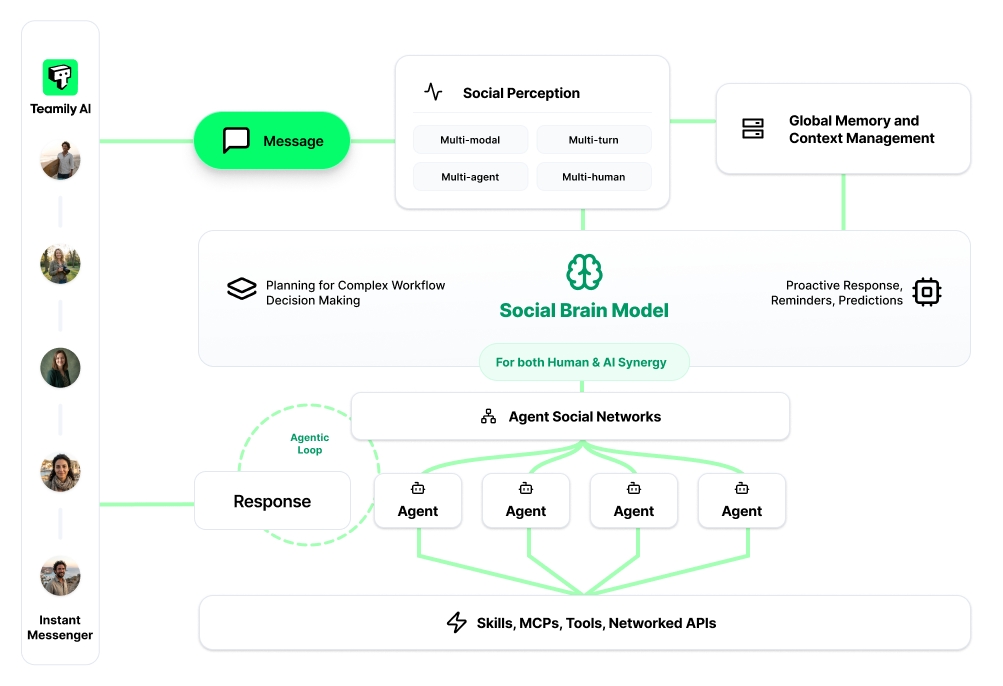
Three-Layer Technical Architecture of Teamily AI
Layer 1: Global Memory & Context Management: Basic layer; The system can understand the complete context of group conversations - including multi-modal, multi-round, and multi-participant communication content. It can perceive and retain all interaction content between you, AI agents, and real users, forming a unified and searchable memory layer, ensuring that no information is missed.
Layer 2: Social Brain Model: Proprietary LLM-based planning and prediction engine; The Social Brain Model analyzes user intentions, breaks down complex goals into executable plans, and intelligently assigns tasks in the agent social network - deciding what needs to be done, who should do it, and in what order.
Layer 3: Agent Social Network: Humans and AI agents are connected through a messaging application; This layer is where humans and AI agents coexist, and they are connected to each other through an instant messaging system. The Social Brain Model orchestrates both the AI agent team and real human members - assigning tasks, coordinating execution, and integrating results in real-time to achieve maximum productivity and seamless collaboration.
Overall, Teamily's core advantages lie in no need for platform switching, support for context inheritance, agents' ability to perform actions (such as sending emails and making reservations), and emphasis on security and ease of use.
He Chaoyang believes that compared with many giant companies trying to do AI social, the advantage of startups is that they can take a more radical and free attitude to try "multi-model coordination," while the products of large companies usually only support their own large models.
In addition, Teamily's core barrier also lies in its great emphasis on Universal Memory. "We are quite radical in the iteration of cross-group technology and have subversively designed IM (instant messaging)," said He Chaoyang. "It's unlikely that WeChat or Meta will be so radical in this area, and entrepreneurs have no burdens."
Finally, in terms of multi-task parallel technology, Teamily's team also has profound technical accumulation. "In an AI-native WhatsApp group chat, making 6 different types of Manus agents work simultaneously, interacting with social message cards, and supporting multi-person co-creation. Even if a large company tries to replicate it, it won't be able to do it in less than half a year," said He Chaoyang.
Team Introduction
The founder, Aiden Chaoyang He, obtained a doctorate from the Department of Computer Science at the University of Southern California. He has research experience in machine learning, cloud computing, and mobile computing, with a research focus on distributed machine learning and the efficient training and service deployment of large foundation models (LLM, Vision Transformer). He has published papers on these topics at conferences such as ICML, NeurIPS, CVPR, ICLR, AAAI, MLSys, and VLDB. He also has more than a decade of industrial experience in the fields of AI, cloud computing, and mobile operating systems. Previously, he served as an engineering manager and chief software engineer at Tencent and has worked at Google, Facebook, and Baidu.
Another founder, Salman Avestimehr, is an expert in the fields of machine learning, information theory, security/privacy, etc., with more than 20 years of R & D leadership experience in academia and industry. He served as a dean professor at the University of Southern California (USC) and was the first director of the USC - Amazon Center for Trustworthy Machine Learning. He also serves as a consultant for several technology companies, including Amazon/Alexa - AI. Salman Avestimehr received the Presidential Award for his profound contributions in information technology and is an IEEE Fellow. He obtained a doctorate from the Department of Electrical Engineering and Computer Science at the University of California, Berkeley (UC Berkeley/EECS) in 2008.
The team members graduated from well - known universities such as the University of Southern California, Stanford, Berkeley, the Massachusetts Institute of Technology, and Tsinghua University, and have previously been responsible for large model or To C product - related work at companies such as Apple, Amazon, Google, Tencent, and ByteDance.
Founder's Thoughts
- The essence of A to A (AI to AI, referring to direct communication between AI systems without human intervention) is to serve humans.
Teamily once tried to do pure A to A, but the team quickly realized that the core goal of the product should return to meeting user needs. In multiple scenarios such as family, social, and work, whether the product uses "a single agent" or "multiple agents" is not important. What matters is whether the product can truly meet the needs of users as humans. So Teamily finally decided to use the A to A network to achieve H to H (human to human, referring to communication between humans), that is, to create a human - centered social network where humans and agents coexist. Here, users can directly communicate with the super agent, and let the super agent summon multiple agents to complete tasks. Agents essentially serve humans.
Some pure A to A services have also been retained. For example, Teamily can help users create a relatively accurate digital avatar based on the global memory function, and then find soulmates among the digital avatars of other users. This is not only applicable to the dating scenario but also to finding work partners, interest partners in the community, etc.
Extending the idea of human simulation, we can simulate the interactive decisions of trillions of individuals, organizations, cultures, and countries in the whole world and society, giving rise to numerous application scenarios, such as simulated courts, simulated financial teleconferences, simulated speeches, simulated interviews, simulated actor performances, etc.
- Collective intelligence is the next frontier.
The collective thinking ability driven by AI will unleash huge human productivity. Teamily's goal is to help groups, communities, friends, families, and colleagues connect, collaborate, and create with AI - to accomplish things together in a better way.
Collective intelligence will bring an unprecedented leap in human productivity. When groups, communities, friends, families, and colleagues can "think together" with AI, rather than just communicate with each other, the upper limit of achievable capabilities will be significantly raised. The existence of Teamily AI is to make every connection smarter, every collaboration deeper, and every creation more powerful.
- Everyone should have a team of AI agents, not just a chatbot.
The future will not be "everyone has only one chatbot." The future is that everyone has their own team of AI agents - each agent is customized according to your unique needs, context, and goals. It's not a single assistant that you ask questions to, but a "smart collection" that understands you and works for you around the clock.
- Instant messaging tools are the natural place for humans and AI agents to coexist.
The most natural place for the human - AI agent network to reside is where the conversation itself takes place - in instant messaging tools. AI agents should not only exist in an independent tool or a separate tab but should participate in the conversation together with you and your friends in real - time chat.
- What Teamily is doing will not be overwritten by an upgrade of the existing large AI models, nor will it be left far behind by existing social giants.
In the B to B scenario, an upgrade of the large AI model may indeed make many entrepreneurs who develop around the large model lose all their previous efforts. However, in the B to C scenario, such a situation is unlikely to occur. A good To C product needs to be "designed for user needs," which is what large model manufacturers lack.
In addition, existing giant companies that master social products, such as Tencent, have not chosen to directly integrate AI into existing social products but instead develop a new product (Yuanbaopai). This is because the data storage methods, data structures, and product designs of existing social products such as QQ and WeChat are not designed for AI agents but for real people. A product that is compatible with both real people and AI agents requires new product design, model planning, and tool development, which gives startups a chance to stand on the same starting line as large companies.
Of course, for Tencent, which already has social relationships, cultural and entertainment content, and large models, the success of Yuanbaopai is just a matter of time. However, Teamily currently focuses on the North American market, and there is no "all in one" social application like WeChat in the North American market. Although Meta has acquired Manus, it is very likely that Meta will, like Tencent, design a new AI social application and launch it into the market instead of integrating it into existing social applications. So Teamily is not worried about competing with social giants.