The end of AI is light: How long can LITE and COHR, which have soared by 600% in a year, continue to rise?
Key Points
① In 2026, the global computing power infrastructure officially entered the communication era where "connectivity reigns supreme". As the scale of AI clusters expands to a larger level, the 1.6T data rate has made traditional copper cables hit a physical ceiling due to resistive heating effects. Optical - electrical conversion has risen from an alternative to the only solution. This "light - speed interconnection" revolution, forced by the iteration of large models, is initiating a more powerful value re - evaluation than the fiber - optic era in 2000.
② LITE achieved a leap from "component price differences" to "system premium" through vertical integration; COHR focused on its core assets by streamlining its business to capture the most lucrative profits in the AI field; the dark - horse AAOI has deeply bound itself with Microsoft through the cost - advantage of the LPO solution, showing high flexibility. Silicon photonics, CPO, and LPO are advancing on three fronts, with only one core goal: to eliminate energy consumption and latency and reshape the pricing power in the 1.6T era.
③ Different from the supply bubble in 2000, the infrastructure in 2026 is a rigid - demand construction forced by demand. Although valuation fluctuations and technological changes remain variables, the investment logic has undergone a qualitative change: the core is no longer how powerful the computing power is, but how high the connection efficiency is. Manufacturers with self - developed chip capabilities and orders from industry giants are taking over the torch from GPUs to light up the second - half dividends of the AI era.
Looking back from 2026, a profound power shift is taking place in the global computing power infrastructure narrative. If the period from 2024 to 2025 was the "GPU heyday" for NVIDIA and chip foundries, then 2026 officially kicked off the communication era where "connectivity reigns supreme".
With the full implementation of the Blackwell architecture and its subsequent high - performance clusters, the physical bottleneck of computing power has shifted from within the chips to the "light - speed interconnection" between chips and between racks.
The RockFlow research team has observed that optical up - and - comers represented by LITE, COHR, and AAOI are undergoing a value re - evaluation with stronger industrial support than the fiber - optic bubble in 2000. This is not just a simple hardware upgrade but a revolution related to bit - transmission efficiency and the limit of energy consumption.
In this article, the RockFlow research team will conduct an in - depth analysis of the panorama from the underlying technological revolution to the competition among industry giants.
1. Forced by Physical Limits - Why is the End of AI "Light"?
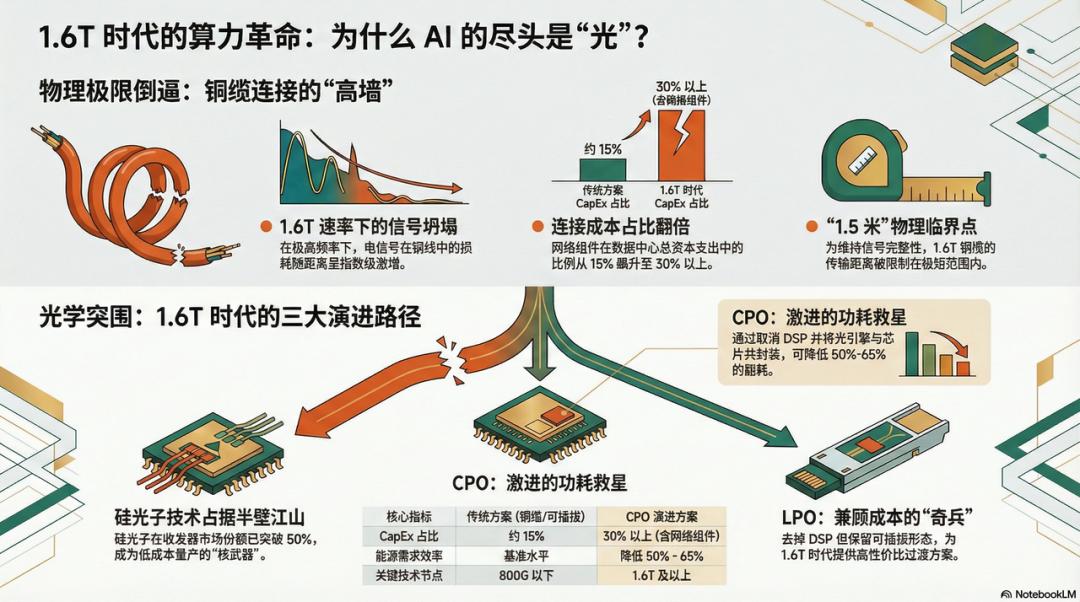
Inside the data center, a silent revolution is taking place. For a long time, copper cables have dominated short - distance data transmission due to their low cost and high reliability. However, when the signal rate crosses the 1.6T threshold, the resistance characteristics of copper have become an insurmountable physical barrier.
Basic physical principles tell us that at extremely high frequencies, the energy loss of electrical signals in copper wires increases exponentially with distance.
To maintain signal integrity, copper cables either need to be shortened to less than 1.5 meters or become extremely bulky. In ultra - large - scale AI clusters with hundreds of thousands or even millions of GPUs, this "short - board effect" can lead to huge power waste and heat accumulation.
At this time, optical technology (Optics) has changed from an "option" to the "only solution". In 2026, AI architects are no longer just discussing computing power; they are more concerned about "connection density".
According to Ciena's network topology model, the AI network is divided into vertical scaling (Scale - up), horizontal scaling (Scale - out), and cross - domain networks (Cross - domain). Vertical scaling solves the low - latency communication between GPUs within a rack, while horizontal scaling connects thousands of racks.
As the scale of a single architecture exceeds 100,000 GPUs, the proportion of connection components in the total capital expenditure (CapEx) of data centers has soared from 15% three years ago to over 30%.
2026 is the first year of mass production of 1.6T optical modules. Standing at this turning point, the divergence in technological paths will directly determine the premium power in the next five years.
1. Mainstreaming of Silicon Photonics
Silicon photonics technology was once regarded as the "future in the laboratory", but now it is dominating the transceiver market. Data from leading research institution Lightcounting shows that the market share of silicon photonics in the optical transceiver market has crossed the 50% mark.
Facing the large - scale procurement of 800G and higher - specification modules by giants like NVIDIA, with unit prices often reaching thousands of dollars, silicon photonics technology has become a nuclear weapon for manufacturers to reduce costs and improve mass - production yields.
2. Critical Point of CPO (Co - Packaged Optics)
Although traditional "pluggable" modules are flexible, they are approaching the ceiling in terms of power consumption. Broadcom and NVIDIA are competing to launch switch ASICs based on CPO technology.
The core logic of CPO is extremely radical: eliminate intermediate components such as DSP (Digital Signal Processing) and directly package the optical engine next to the GPU or switch chip.
This "space - for - efficiency" strategy can reduce energy demand by 50% - 65%. For data center operators driven crazy by grid capacity, this is not just a technological advancement but a "lifesaving straw".
3. The Surprise Troop of LPO (Linear - Driven Pluggable)
Meanwhile, manufacturers represented by MaxLinear (MTSI) and AAOI are promoting LPO technology. LPO attempts to reduce power consumption by eliminating DSP without changing the pluggable form.
This solution is a compromise between the present and the future, providing a more moderate option for manufacturers looking for a cost - effective transition solution in the 1.6T era.
2. The Five Swordsmen in Optical Communication - LITE vs COHR vs AAOI vs GLW vs VIAV
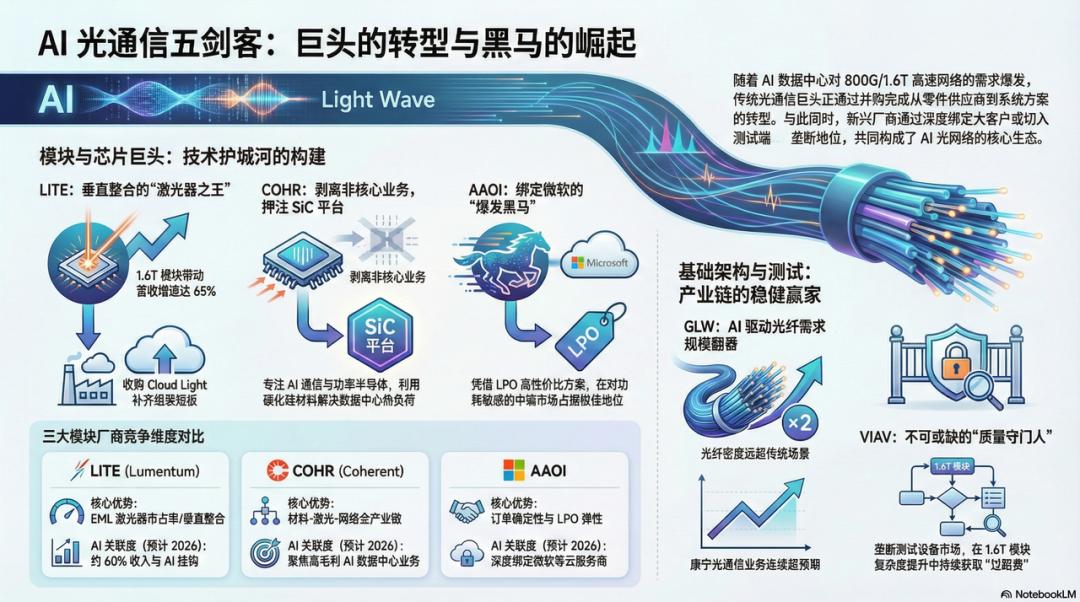
Established giants in the optical field are making a magnificent transformation from "component suppliers" to "solution providers" through precise asset divestment and mergers and acquisitions. New dark - horses are choosing to cooperate with cross - industry giants and occupy excellent ecological niches through cost - effective solutions.
LITE: "The King of Lasers", a Benchmark for Vertical Integration
Lumentum (LITE)'s acquisition of Cloud Light in 2023 was a textbook - style move. Previously, LITE was more regarded as a supplier of upstream laser chips (EML/CW), and Cloud Light filled its gap in transceiver assembly. Currently, its market share in 800G/1.6T EML lasers is its deepest moat.
By 2026, about 60% of LITE's revenue was related to AI infrastructure. The latest quarterly report shows that its revenue growth rate was as high as 65%. This explosive growth comes from its ability to directly deliver complete 1.6T modules to ultra - large - scale cloud service providers. Its profit source has shifted from meager "component price differences" to generous "system premium".
COHR: "The Great Integrator of Materials", Parallel Development in AI Communication + Power Semiconductors
Coherent not only manufactures optical modules but also deals with silicon carbide (SiC) and advanced laser materials. Currently, it is focusing on the parallel development of AI communication and power semiconductors.
Coherent (COHR), founded in 1971, is undergoing a surgical - like reform. After Jim Anderson took office as the CEO, he resolutely sold the non - core materials processing department to Bystronic in Switzerland.
The intention behind this move is extremely clear: concentrate all resources to capture the "fattest piece of meat" in the AI data center market. At the beginning of 2026, after this transaction was completed, COHR will free up funds to repay about $400 million in debt, significantly improving its leverage structure.
More imaginatively, COHR has launched a 300 - millimeter silicon carbide (SiC) platform specifically targeting the rapidly increasing heat load in AI data centers. This diversified layout across "materials - lasers - networks" gives it a deeper technological moat when facing low - cost Asian competitors.
AAOI: "The Bursting Dark - Horse", Benefiting from Both Microsoft's Dividends and LPO's Flexibility
Compared with the technological depth of the previous two, AAOI's winning factor lies in its deep binding with Microsoft and its early start on the cost - effective LPO solution. It is the most flexible player in the sector.
By winning large contracts from Microsoft, AAOI has solved the most critical problem of order certainty. In the competition for the 1.6T market, AAOI, with its flexibility in price and production speed, has become a typical example of second - tier manufacturers breaking through the encirclement.
Notably, AAOI's investment in the LPO solution has enabled it to occupy an excellent ecological niche in the mid - end market, which is sensitive to power consumption but not willing to immediately switch to the expensive CPO. This "pragmatic" approach has made its stock price performance extremely explosive from 2025 to 2026.
GLW and VIAV: Cross - Industry Competition, Silent Winners in the Testing Segment
The optical revolution is spreading to a wider range of fields.
Corning (GLW), an established giant founded in 1851, is doubling the size of the fiber - optic market through the demand for AI infrastructure. Its optical communication business has exceeded expectations for several consecutive quarters. The management firmly believes that AI requires several times the fiber - optic density of traditional data centers.
Meanwhile, VIAVI (VIAV), as the monopolist of testing equipment, has become the "quality gatekeeper" of the entire industrial chain. As the complexity of 1.6T modules increases, the pre - shipment testing process has become extremely critical. This model of "not participating in competition but only collecting tolls" has made it extremely resilient in sector rotations.
3. Review and Warning - Is This a Repeat of the 2000 Bubble?
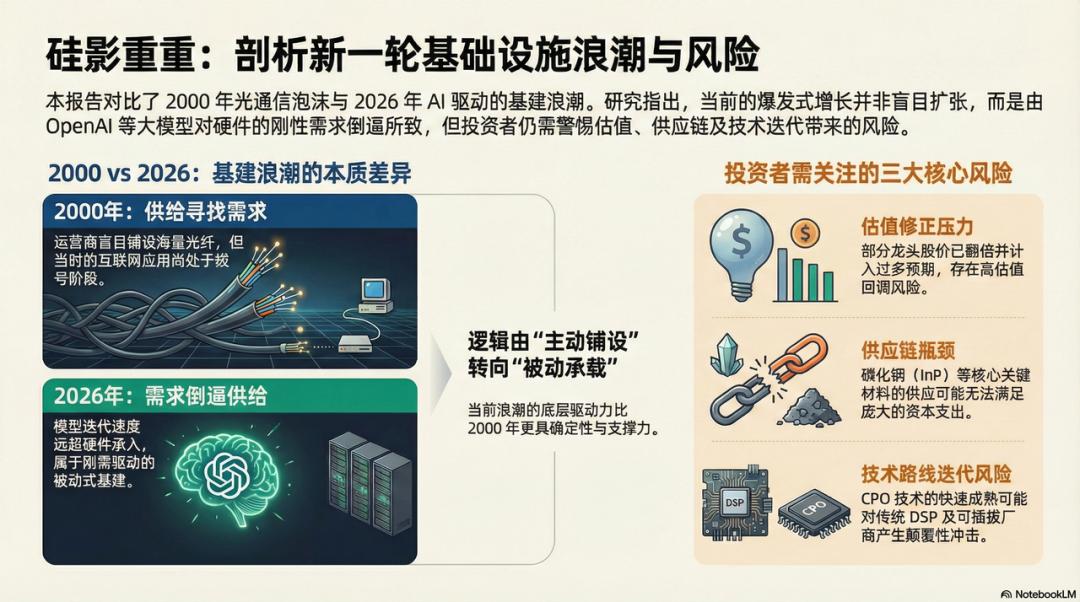
Investors with a knowledge of history will inevitably compare the current frenzy with the optical communication bubble in 2000.
However, the RockFlow research team believes that there are fundamental differences in the underlying logic between the two.
In 2000, it was "supply seeking demand" - operators laid a large amount of fiber - optic cables but found that Internet applications were still in the dial - up stage; in 2026, it is "demand forcing supply" - the model iteration speed of OpenAI and Google far exceeds the bearing capacity of hardware. This is an infrastructure wave driven by rigid demand and in a passive way.
Undoubtedly, risks still exist:
1. Over - valuation risk: The stock prices of COHR and LITE have doubled compared with last year, incorporating many expectations, so there is pressure for valuation correction;
2. Supply chain bottleneck: Can the supply of core materials such as indium phosphide (InP) keep up with larger capital expenditures?
3. Technological path risk: If the maturity speed of CPO exceeds expectations, traditional DSP suppliers (such as MRVL) and pluggable module manufacturers will face a catastrophic blow.
Conclusion: Seeking Certainty in the "Era of Light"
Optical investment in 2026 is no longer just concept hype. From COHR's strategic streamlining to AAOI's differential competition, from the expanding share of silicon photonics to the underlying reconstruction of CPO, the optical field is taking over the torch from GPUs and becoming the growth engine in the second half of the AI era.
For investors, the focus should shift from "who has the strongest computing power" to "who can connect the most computing power with the lowest power consumption".
The RockFlow research team believes that in this new battle, manufacturers with self - developed core laser chip capabilities, mastery of silicon photonics technology, and the ability to deeply integrate downstream large customers will reap the most generous Alpha returns in the industry.
This article is from the WeChat official account "RockFlow Universe", author: RockFlow, published by 36Kr with authorization.