Have sales of multiple joint-venture automakers rebounded? Has the bottom been reached?
Data from the Passenger Car Association shows that in 2025, the cumulative sales of mainstream joint - venture brands reached 5.77 million vehicles, and their share in the passenger car market dropped from 51% in 2020 to 24%.
In just five years, the market share has shrunk by half. It seems that joint - venture brands will never have a future.
However, when we carefully analyze the sales structure in 2025, we can find that joint - venture brands seem to have shown some signs of stabilizing after the decline.
Looking at the overall market, in 2025, the sales of mainstream joint - venture brands decreased by 530,000 vehicles compared with the previous year, which was the lowest in the past five years. The decline rate of sales narrowed from 15.7% last year to 8.4%.
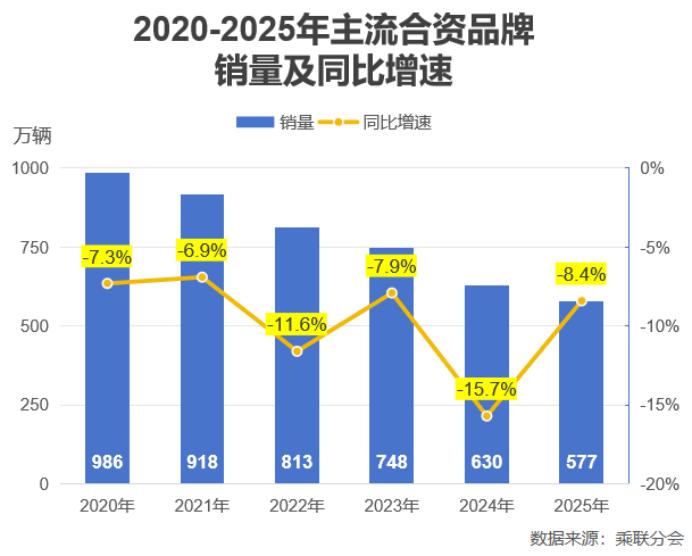
In addition to the overall recovery of the market, several joint - venture automakers such as FAW - Toyota, GAC - Toyota, Changan Mazda, and Beijing Hyundai achieved reverse - growth in sales last year, and the reasons for their growth were different. They have gradually found their own survival strategies.
Moreover, although SAIC - Volkswagen, FAW - Volkswagen, SAIC - GM, and Dongfeng Nissan did not achieve sales growth, the decline rates of their sales narrowed, and they stabilized their respective market bases.
The sales of Honda and Ford continued to decline, and there was no improvement in their new - energy transformation. But to some extent, this is a result of active choice. When the marginal return of efforts is very low, contraction may not be an unwise choice.
NO.1 Joint - venture brands stabilize, not entirely relying on new - energy
Facing the encirclement and suppression of domestic brands, rapidly promoting the new - energy transformation has become the top priority for joint - venture automakers.
In the past two years, everyone has been practicing a new joint - venture model - transferring the R & D leadership to the Chinese side, integrating local intelligent technologies, and adjusting the previously high - handed pricing strategies.
As long as the new joint - venture products do well in these aspects, they have achieved good returns in the past year. For example, GAC - Toyota's bZ3X, Changan Mazda's EZ - 60, Dongfeng Nissan's N7, and Buick GL8 Hybrid, etc.
For some small - scale joint - venture automakers, this return is even enough to reverse the trend of the past few years. For example, Changan Mazda, although it has a general presence in the market, according to Yiche data, in 2025, its cumulative domestic retail sales reached 87,000 vehicles, a year - on - year increase of 15.2%. Its monthly new - energy penetration rate once exceeded 60%.
In addition to Changan Mazda, Dongfeng Nissan and SAIC - GM have also seen relatively rich returns in the new - energy transformation.
In 2025, Dongfeng Nissan's cumulative retail sales reached 603,000 vehicles, showing a decline for the seventh consecutive year, but the year - on - year decline rate narrowed from 12.7% in 2024 to 4.5%. Its new - energy sales exceeded 50,000 vehicles, accounting for nearly 10% of the total sales, while this proportion was almost negligible in 2024.
On the SAIC - GM side, its cumulative domestic retail sales (including exports) last year were 562,000 vehicles. Compared with 673,000 vehicles in 2024, there was still a double - digit decline, but most of the decline occurred in the Chevrolet brand which was on the verge of withdrawal from the market.
The Buick brand, which has actively promoted the new - energy transformation in the past two years, saw its annual sales return to over 400,000 vehicles last year, achieving a year - on - year slight increase of 3%. In 2025, the Buick GL8 family added multiple versions of GL8 hybrid products such as GL8 Luxia and GL8 Avenir, regaining the title of the annual MPV champion. At the same time, since the launch of the Electra series, the progress in intelligence has been fully affirmed by users.
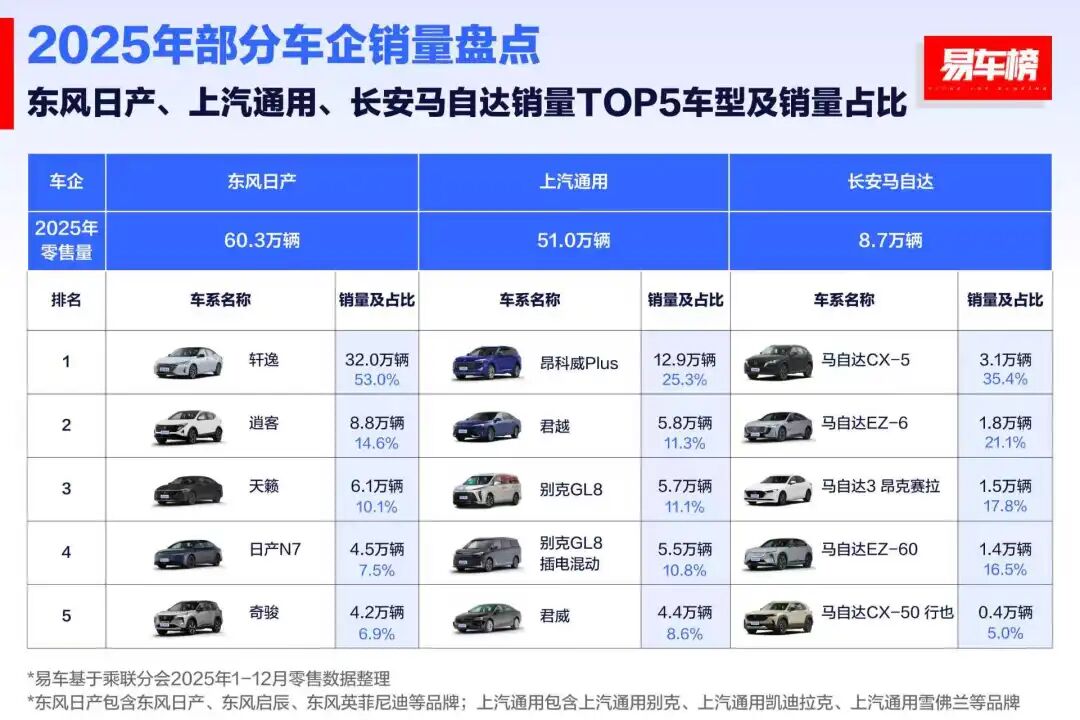
For some small and medium - scale joint - venture brands, new - energy products have become an important sales growth point. However, from the perspective of the entire market, the overall market share of joint - venture brands in the new - energy market decreased in 2025.
The new - energy sales of some joint - venture brands decreased instead of increasing in 2025, such as Volkswagen. In 2025, the cumulative new - energy sales of FAW - Volkswagen and SAIC - Volkswagen together were only 120,000 vehicles, a year - on - year decline of 40% compared with 200,000 vehicles in 2024.
It is worth noting that the significant decline in new - energy sales did not cause more serious damage to Volkswagen's performance. According to the officially announced data, Volkswagen Group delivered over 2.69 million vehicles in China last year, successfully achieving its annual target.
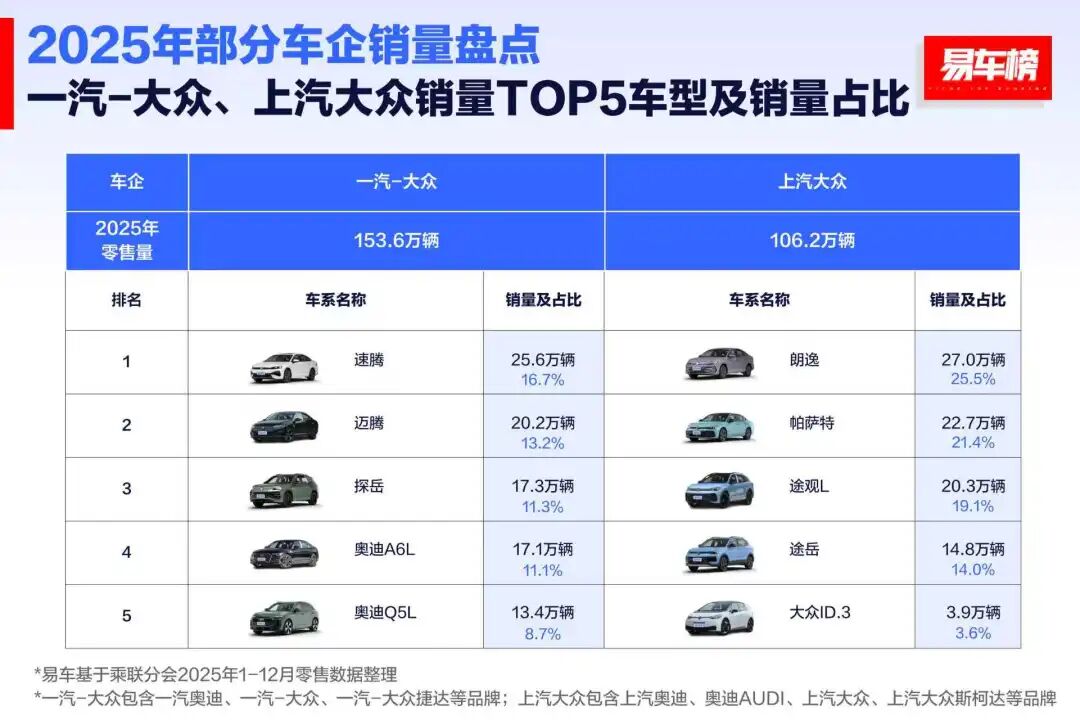
FAW - Volkswagen's annual cumulative sales exceeded 1.5 million vehicles, and the year - on - year decline rate narrowed to 4.5%, ranking first among joint - venture automakers in sales; SAIC - Volkswagen's decline was slightly larger, but it still successfully maintained its annual sales of over 1 million vehicles.
The reason why Volkswagen was able to stabilize its basic market despite the temporary ineffectiveness of its new - energy transformation is that its share in the fuel - vehicle market increased to a record - high 22%. Classic models such as SAIC - Volkswagen's Lavida, Passat, and Tiguan L, and FAW - Volkswagen's Sagitar, Magotan, and Tanyue all performed well in their respective market segments.
Some insiders pointed out that Volkswagen China's basic strategy in 2025 was actually: "Centering on profitability, first focus on the sales of fuel models with stronger profitability, and prepare for the launch of a new batch of locally - developed new - energy models."
To this end, SAIC - Volkswagen launched Pro versions for multiple fuel models, with the labels of "larger space, intelligent upgrade, and lower price" to meet the psychology of Chinese users of "getting more for the same price". FAW - Volkswagen adopted the strategy of "launching new models every month" to ensure the launch of multiple main models, bringing new changes in both popularity and product updates.
In 2026, FAW - Volkswagen, SAIC - Volkswagen, and Volkswagen Anhui will all welcome the first real year of new - energy products exclusive to the Chinese market.
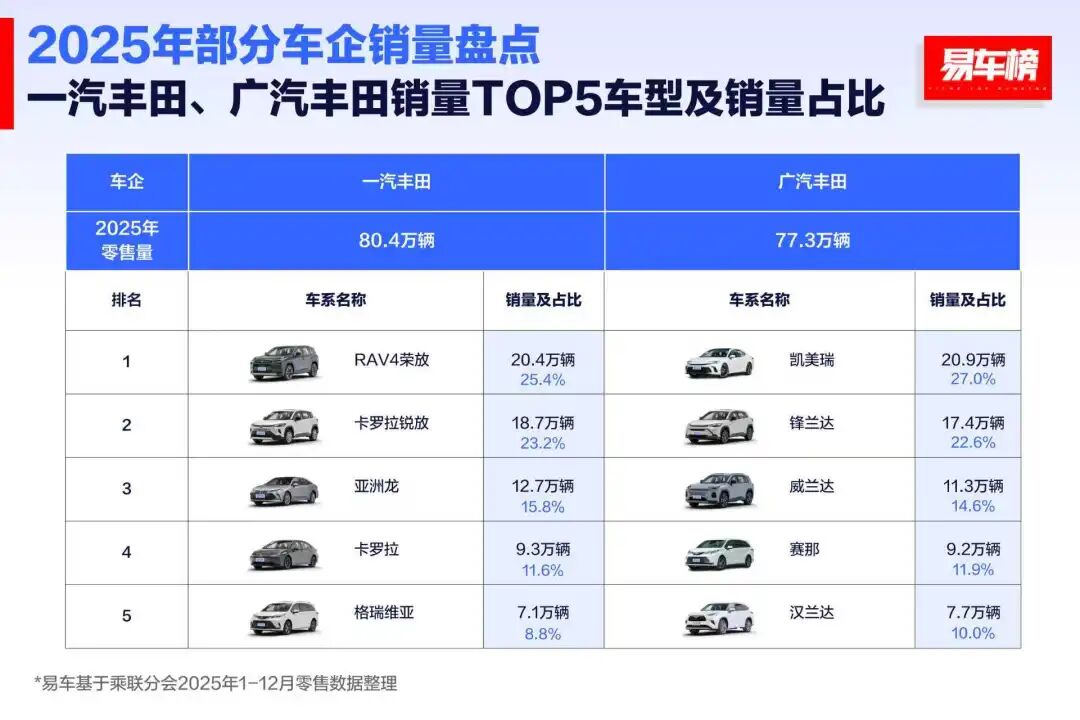
Compared with Volkswagen, Toyota's performance in 2025 was more outstanding. Data shows that the sales of FAW - Toyota and GAC - Toyota in 2025 were around 800,000 vehicles, with a slight year - on - year increase of 0.7% and 0.3% respectively. Toyota China's total sales in the Chinese market exceeded 1.78 million vehicles in 2025, ending the previous four - year downward sales trend.
Objectively speaking, Toyota made more achievements in the new - energy field than Volkswagen in the past year. The annual sales of GAC - Toyota's bZ3X exceeded 70,000 vehicles, making it a representative product among joint - venture brand pure - electric models. However, whether it is GAC - Toyota or FAW - Toyota, there are no new - energy vehicles among their top five best - selling models at present.
In the view of many industry insiders, Toyota's real strength lies in its balance. It can create some competitive models in each price range.
In the volume - selling market of 100,000 - 150,000 yuan, FAW - Toyota has the Corolla Cross, and GAC - Toyota has the Frontlander and Wildlander; in the mainstream market of 150,000 - 200,000 yuan, FAW - Toyota has the RAV4 and Avalon, and GAC - Toyota has the Camry; in the price range of 200,000 - 300,000 yuan, FAW - Toyota has the Granvia and Highlander, and GAC - Toyota has the Sienna and Highlander.
Compared with Volkswagen and Toyota, some joint - venture automakers with serious "weaknesses" do not have such good risk - resistance capabilities.
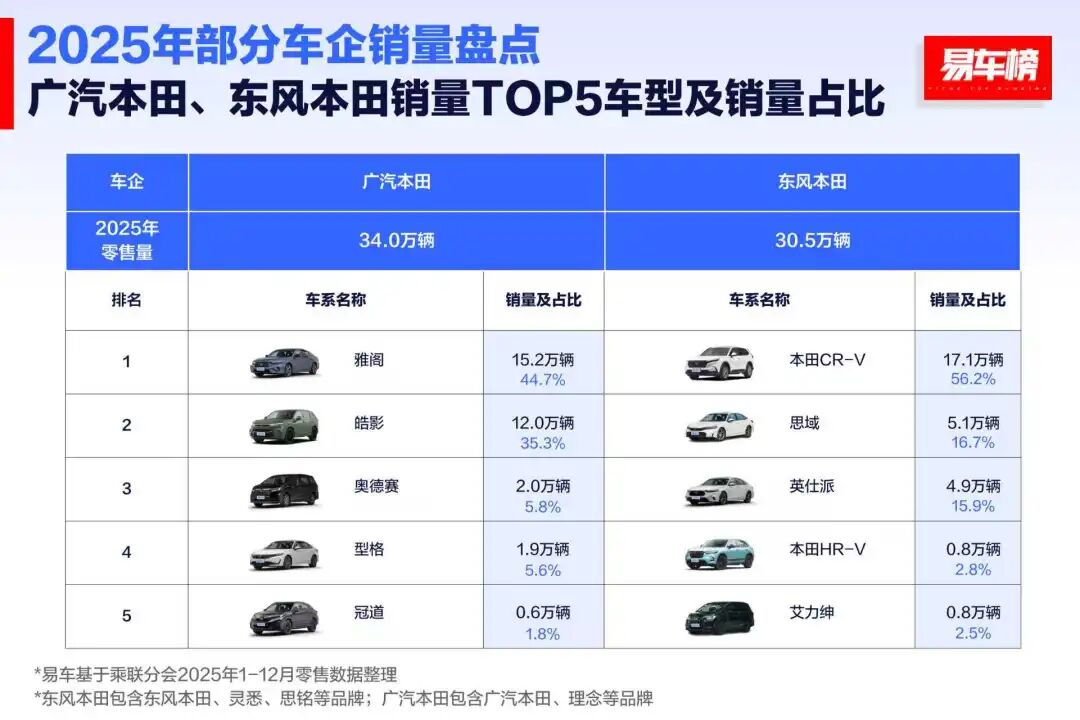
Take Honda for example. Currently, 80% of GAC Honda's sales are supported by the Accord and Breeze, and over 70% of Dongfeng Honda's sales come from the CR - V and Civic. In 2025, the sales of the two companies declined by 26.7% and 27.9% respectively.
It is almost impossible to seek new growth in fuel vehicles, so Honda's remaining hope lies in the new - energy transformation. However, neither Dongfeng Honda's S7 nor GAC Honda's P7 has shown sufficient competitiveness in terms of product and pricing.
Some people say that this is because Honda has not realized that the premium of joint - venture brands has become ineffective, but it is more likely that the Japanese shareholders are not willing to sacrifice profits to participate in the fierce competition in the Chinese market. In the next few years, active strategic contraction will become one of the main themes for Honda.
Before Honda, Ford has taken the lead in the path of contraction. Previously, Ford China established a wholly - owned subsidiary, Ford Sales and Service (Shanghai) Co., Ltd., to integrate the marketing, sales, and service business of Ford brand passenger cars and pickups in China. In addition, from a global perspective, Ford's electrification transformation pace has slowed down.
NO.2 Will joint - venture brands perform better in 2026?
Judging from the target sales announced by several major joint - venture automakers, everyone has a basically cautious and optimistic attitude towards 2026. Of course, there are also some very aggressive ones. For example, Dongfeng Nissan has set a target of selling 1 million vehicles this year, which is about a 40% increase compared with last year's actual sales.
At the product level, if 2025 was the first year of new joint - venture products, then 2026 will be a real year of new joint - venture products. FAW - Volkswagen, SAIC - Volkswagen, Beijing Hyundai, Dongfeng Nissan, SAIC - GM, etc. will intensively launch new new - energy products.
In addition, the joint - venture new - energy products that achieved certain results in 2025 were almost all entry - level products priced at around 100,000 yuan. And in 2026, joint - venture brands will also launch an attack on higher price segments.
On the Volkswagen side, the three companies will conduct their own explorations around different focuses.
SAIC - Volkswagen's ID.ERA 9X will enter the family - car market with the classic combination of extended - range and six - seat configuration; FAW - Volkswagen will launch plug - in hybrid versions for its two best - selling models, Magotan and Tanyue L, and also has two pure - electric products in the ID.AURA series; Volkswagen Anhui's focus is the Yuzhong 08, which completely subverts the original design style. It will be built on a vehicle platform deeply cooperated with XPeng and is known as the smartest Volkswagen vehicle ever.
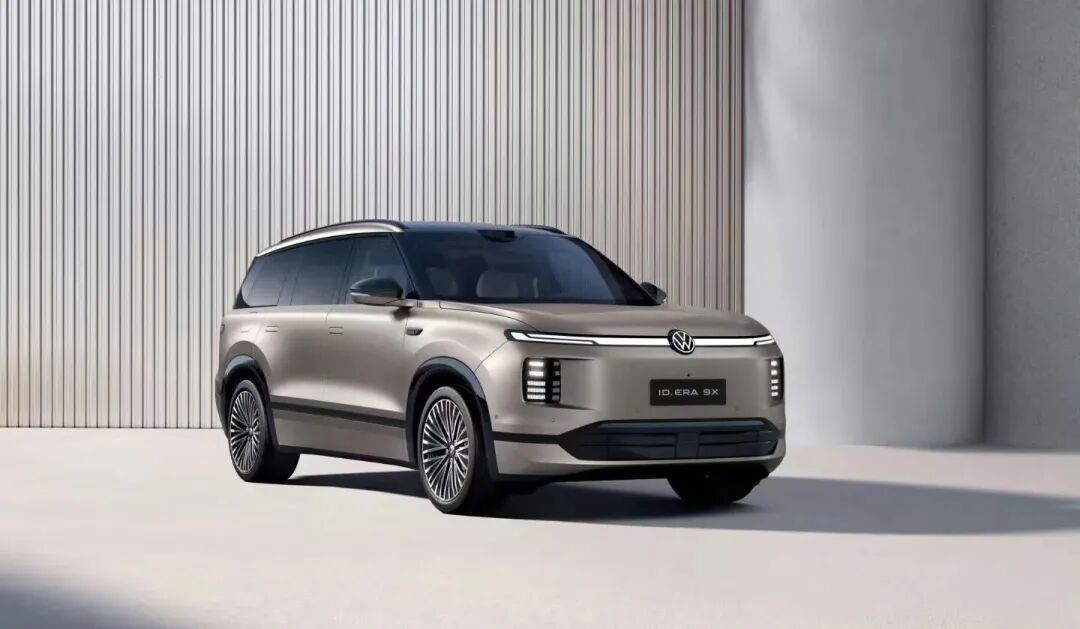
ID.ERA 9X
It is understood that Volkswagen deliberately adopted a mechanism similar to Tian Ji's horse - racing strategy in the Chinese market. FAW - Volkswagen, SAIC - Volkswagen, and Volkswagen Anhui all conduct their own technological R & D, and finally Volkswagen selects the strongest technology and shares it with the other two partners.
Dongfeng Nissan will enter the "8 - series" SUV market and launch the NX8. Features such as 800V 5C ultra - fast charging technology, extended - range and pure - electric dual - power, equipped with lidar, and high - level assisted driving will add many highlights to this joint - venture new - energy product. The N7 and N6 will also be upgraded, and these three new - energy products will become important growth points.
SAIC - GM's highlight is still on the Buick brand, which will launch the Electra E7 and the Electra E7 Avenir pure - electric version. Especially the Electra E7, which is of strategic significance to Buick, targets the 200,000 - yuan - level large five - seat SUV, and its 1,600 - km long - range plug - in hybrid directly addresses the pain points of users.
Generally speaking, these new products not only meet the trends of the new era but also try to maintain their respective brand characteristics. More importantly, they have made up for their intelligence capabilities. Behind them are a series of well - known intelligent suppliers such as XPeng, Horizon Robotics, Zhuoyue, Momenta, and Huawei.
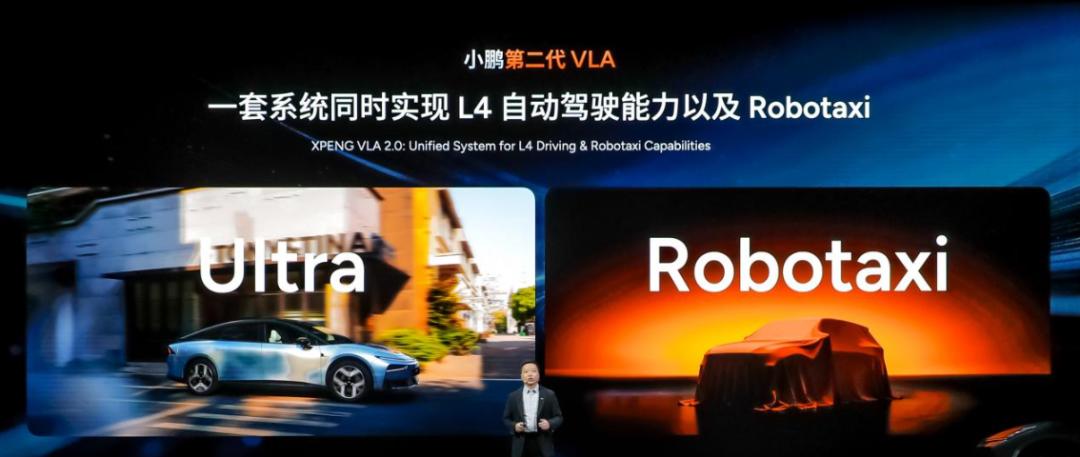
Currently, high - level assisted driving, AI cockpits, etc. are becoming capabilities that can be standardized and supplied. Objectively, this is a huge benefit for joint - venture brands.
Previously, Wu Yongqiao, the President of Bosch's Intelligent Driving and Control System in China, expressed a similar view. He said: "Electrification has become a standard