Xinghaitu Completes 1 Billion Yuan Series B Financing, Becoming the Fourth Embodied Intelligence Startup Valued at Over 10 Billion Yuan | Exclusive Report from Intelligence Emergence
Text by | Fu Chong
Edited by | Su Jianxun
According to exclusive information obtained by "Intelligent Emergence", the embodied intelligence startup "Xinghai Tu" has recently completed a Series B financing of 1 billion yuan.
As of this round, Xinghai Tu has raised nearly 3 billion yuan in total. After this round of financing, its valuation will enter the tens of billions level. Previously, only domestic embodied intelligence startups such as Unitree, Zhipu, and Galaxy Universal had valuations exceeding 10 billion yuan.
The investors in this Series B financing include industrial capital such as Jinding Capital, BAIC Capital Investment, Bihong Investment, as well as institutions like Zhengxin Valley Capital, Qianhai Ark, and Yifeng Capital. Old shareholders such as Cathay Capital, Meituan Longzhu, Today Capital, Xianghe Capital, and Hillhouse Ventures continued to make additional investments, either exceeding the quota or fully subscribing.
Since its establishment in September 2023, Xinghai Tu's list of investors has also included well - known investment institutions such as Meituan Strategic Investment, Ant Group, GSR Ventures, and IDG.
Regarding the progress of this round of financing, Gao Jiyang, the founder and CEO of Xinghai Tu, told "Intelligent Emergence" that as the industry begins to enter the stage of scenario implementation in 2026, Xinghai Tu's commercialization will also expand from the developer market to the productivity market.
As of now, Xinghai Tu has obtained orders in the thousands for developers and industrial customers.
Among them, the shipments in 2025 were mainly for the "developer" group. Xinghai Tu has about 150 developer customers, including three types: laboratories of university scientific research institutions, basic research departments of large enterprises, leading embodied startups, and R & D teams of large industrial groups. Representative customers of the company include relevant teams from Stanford, Huawei, BYD, etc.
In 2026, Xinghai Tu plans to focus on expanding the production application market, mainly targeting three types of scenarios: intelligent manufacturing, logistics, and commercial services.
It is worth noting that the industrial backgrounds of the investors in this round also overlap with the above - mentioned directions: BAIC Capital Investment, Bihong Investment of Geely Group, Jinding Capital, etc. are related to intelligent manufacturing and the automobile industry chain; the businesses of Meituan - affiliated shareholders are similar to the content of e - commerce logistics work.
Gao Jiyang believes that after the proof of concept (POC) in 2025, the industry will enter the "result verification" stage in the second half of 2026 - that is, achieving end - to - end manual substitution in specific tasks. On the basis of completing this stage, the industry will then enter the subsequent "efficiency improvement" and "ROI optimization" stages brought about by large - scale production.
"The prerequisite for embodied intelligence to achieve 'result verification' in 2026 is that the model capabilities begin to spill over to the productivity side." Gao Jiyang pointed out that since the second half of 2025, the number of open - source embodied models has increased by about five times, and the supply chain has gradually matured.
Data is another cornerstone of the embodied model. In 2025, Xinghai Tu accumulated about 100,000 hours of real - machine data through a data collection system combining self - building and outsourcing. Gao Jiyang believes that this volume is close to the total duration of human interaction with the physical world from birth to adulthood, so it is a key node for improving the capabilities of the embodied intelligence model.
During the 2025 World Robot Conference (WRC), in the report on Zhao Xing, the chief scientist of Xinghai Tu, titled "Exclusive Interview with Zhao Xing of Xinghai Tu: A Flashy Demo Does Not Equal Generalization Ability, and the Outcome of Embodied Intelligence Still Lies in the Data Volume", "Intelligent Emergence" discussed in detail the importance of diverse training data for promoting the task success rate (generalization ability) of the embodied intelligence model.
Currently, Xinghai Tu conducts data collection in five real - world scenarios: households, hotels, factories and warehouses, supermarkets, and restaurants, which also cover the target scenarios that Xinghai Tu is about to enter. In August 2025, Xinghai Tu open - sourced 500 hours of the above - mentioned real - machine data, and the download volume of this dataset has exceeded 500,000 times.
In 2026, Xinghai Tu plans to collect hundreds of thousands of hours of multi - scenario real - machine data and add new collection methods such as UMI on the basis of the original remote - operation solutions.
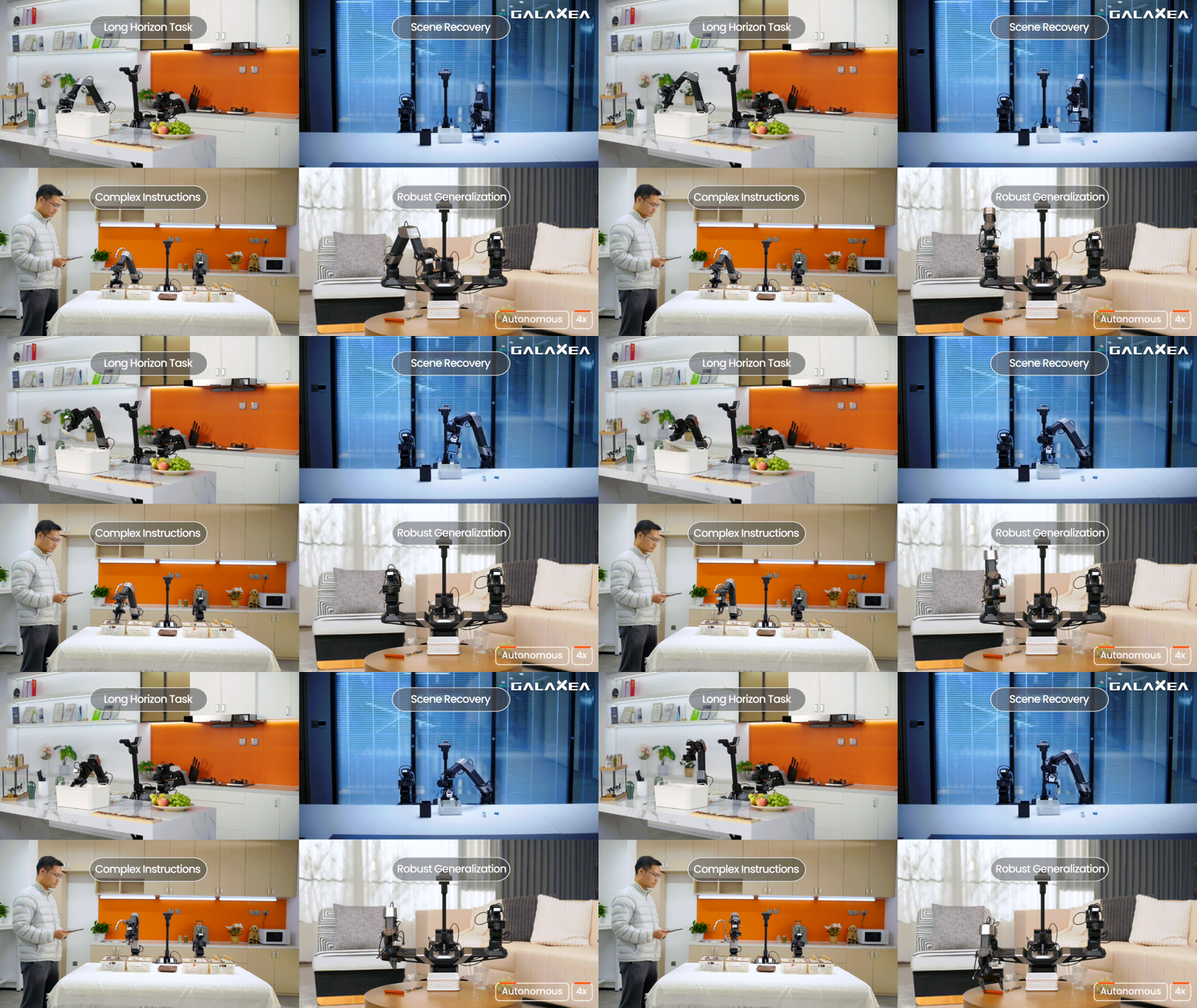
△ The R1 robot of Xinghai Tu is completing different tasks. Image source: Provided by the enterprise
However, for the real large - scale implementation of embodied intelligence, it still has to overcome the cost barrier of labor substitution.
In labor - intensive areas with concentrated manufacturing, labor wages are relatively low. Therefore, Xinghai Tu also plans to leverage the resources of its shareholders to explore opportunities for verifying the robot economic model in developed countries with high labor costs.
Among the shareholders in this Series B financing, Yifeng Capital was jointly initiated by Singbridge, a wholly - owned subsidiary of Singapore's Temasek Holdings, and United Overseas Bank. In addition, among Xinghai Tu's shareholders, IDG, Ant Group, and Hillhouse are all dual - currency capitals.
In terms of product and technology routes, Xinghai Tu adopts a hardware - software integrated strategy of "whole machine + intelligence", providing the ontology platform, pre - trained models, and post - training toolchains such as data collection, evaluation, fine - tuning, and deployment.
In terms of ontology, the company has launched the R1 series of wheeled dual - arm robots and said it plans to release dexterous hands and bipedal humanoid robots in May this year to expand its hardware categories.
In addition to self - research, Xinghai Tu is also deploying its ecosystem through investments.
The company has disclosed its investment in the data collection company Jianzhi Xinchuang. Gao Jiyang revealed that in 2026, the number of invested enterprises will be expanded to 15 - 20, mainly focusing on two directions: diverse data collection solutions and solution teams for vertical scenarios such as hotels and retail.
"Startups have limited resources. We will give priority to the key links that must be done and can be done; for directions that we are optimistic about but do not necessarily have to participate in directly, we will use investment to bind long - term partners." Gao Jiyang said.