BYD's sales decline, Geely overtakes: Has the automotive market changed in January?
At the beginning of 2026, the new energy vehicle market is like the changeable weather, with a mix of hot and cold.
As the exemption policy for purchase tax on new energy vehicles expired at the end of 2025, and combined with the concentrated promotions by car companies at the end of the year that pre - exhausted the demand, although the sales volume of most car companies in January increased year - on - year, there was a significant month - on - month decline.
In contrast, Geely, which adopts the strategy of "dual - wheel drive of gasoline and electric vehicles", performed more steadily. Its sales volume exceeded 270,000 vehicles in January, achieving both year - on - year and month - on - month growth, and for the first time in recent years, it overtook BYD in terms of sales volume. At the same time, many "old - fashioned" fuel vehicles sold well against the trend.
Despite the pressure in the domestic market, the overseas business of some car companies performed strongly. In January, BYD, Geely, Chery, and Great Wall had strong exports, becoming the most resilient growth poles in their performance.
The uneven market situation poses a new proposition to the industry. When the competition logic shifts from a single comparison of sales volume and price to a comprehensive competition of technology, high - end development, and globalization, where should new energy vehicle companies go?
The "late spring cold" in the car market
The differentiation between the hot and cold in the new energy vehicle market in January is an intuitive signal that the industry's structural adjustment has entered the deep - water zone.
Among them, the adjustment of the purchase tax exemption policy is a key variable. Starting from 2026, the purchase tax on new energy vehicles will be halved instead of being exempted. Therefore, before the end of last year, car companies launched limited - time discounts one after another. For example, if customers place an order before a certain time, the car companies will bear the cost of the purchase tax reduction. This triggered a wave of concentrated car - buying at the end of last year, directly causing the month - on - month sales pressure on most car companies in January.
Among them, BYD, which has fully bet on new energy, sold about 210,000 vehicles, a year - on - year decline of 30.11%, setting a rare year - on - year decline in recent years, and a month - on - month decline of 50%; Hongmeng Zhixing delivered 57,900 vehicles, a year - on - year increase of 65.6% and a month - on - month decline of 35.3%; NIO sold about 27,200 vehicles, a year - on - year increase of 96% and a month - on - month decrease of 43.5%. In addition, the delivery volumes of XPeng and Li Auto both decreased year - on - year and month - on - month in January.
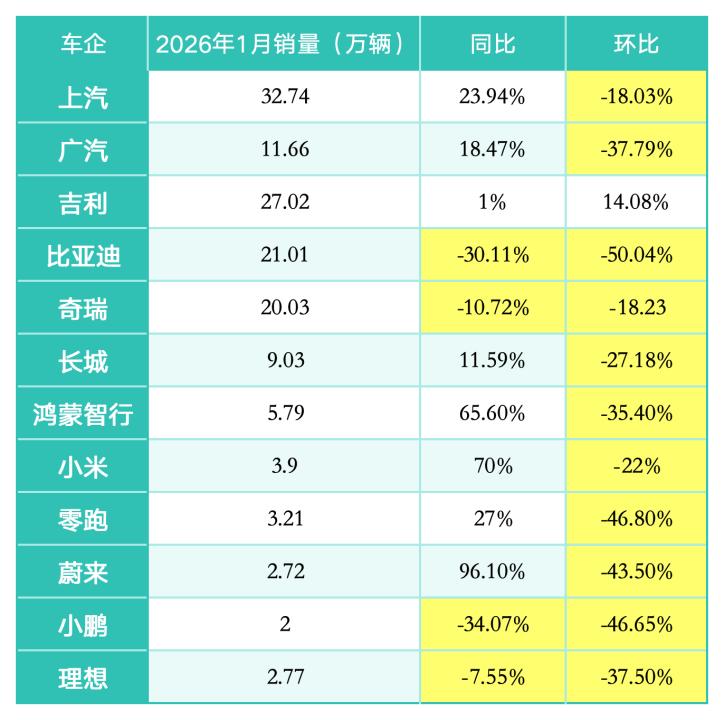
Data source: Car company sales bulletins/Leopard Change
The implementation rhythm of car - buying subsidies is another key variable affecting market sentiment. The inconsistent introduction and review progress of the old - for - new subsidy rules in different regions have made many consumers wait and see, further delaying the market recovery rhythm.
At the beginning of January, Ms. Ding in Wenzhou bought a IM LS6 and submitted a subsidy application on January 10. However, as of February 5, the review had not been approved. On social media, there are many people who feedback that the subsidy review speed is too slow. Some have even waited for several months and still haven't received the subsidy. The lag in the subsidy process has become a real bottleneck in policy implementation, reducing the car - buying experience.
As the industry's structural adjustment deepens, there have also been significant changes in the sales rankings among the "new forces". Among them, Xiaomi's sales volume exceeded 39,000 vehicles in January, topping the monthly sales champion of a single brand among the "new forces" for the first time. When interpreting the sales data for January, Lei Jun said that the sales volume was due to the thickness of order reserves and market recognition. The main delivery model was YU7, and the SU7 was in the stage of new - old replacement, with the new model to be launched in April.
Driven by both sales pressure and discount policies, in January, car companies launched ultra - long - term low - interest car - buying plans for up to 7 years, featuring low down payments and low monthly payments, further lowering the car - buying threshold. Taking Li Auto as an example, after several pure - electric vehicles suffered setbacks, its market performance in 2025 was not good. First, it lowered its annual sales target of 700,000 vehicles to 640,000 vehicles, but actually only delivered 406,300 vehicles, a year - on - year decline of 18.81%, with a completion rate of about 63.5%.
Facing the pressure, at the beginning of 2026, Li Auto announced the launch of a 7 - year ultra - low monthly payment car - buying plan with a down payment starting from 15%. The car companies' "price war" at the beginning of the year has also changed from directly reducing car prices to competing in financial concessions.
The "comeback" of fuel vehicles
When the "new forces" collectively encountered the "late spring cold", those traditional fuel vehicles that were ridiculed as "oldies" experienced an upward rebound.
According to the statistics of the Passenger Car Association, the retail sales volume of new energy passenger vehicles in China in January was about 800,000 vehicles, with a penetration rate of only 44.4%, a significant drop from 60.4% in the previous month, creating market space for fuel vehicles. On the one hand, the reduction of new energy car - buying subsidies has narrowed the cost advantage of electric vehicles, and many people have begun to re - weigh their choices.
On the other hand, the cold January in the north not only shortened the battery range but also significantly reduced the charging efficiency, increasing users' travel anxiety. For some users, buying a car before the Spring Festival is not only for daily commuting but also for more convenient travel during the Spring Festival return. The reliability and dependability of fuel vehicles are more favored.
The impact of low - temperature weather on new energy vehicles is more intuitively reflected in the second - hand car market. A second - hand car dealer in Shenzhen, Guangdong, said that in summer, popular "new forces" were easy to sell, and the cars could be quickly resold to inland provinces after being purchased. But recently, when contacting partners in Xinjiang, Inner Mongolia and other places, they all refused to "take over" and said they would wait until after the Spring Festival.
Meanwhile, the fuel vehicle market was quite eye - catching in January, and the sales of many popular models increased against the trend. Represented by the Camry and Passat, B - class fuel vehicles, as the mainstream choice for family cars, have proven their vitality with their sales. Among them, the sales volume of the Toyota Camry reached 17,400 vehicles in January, a year - on - year increase of 17%; SAIC Volkswagen Passat sold nearly 21,000 vehicles, and its sales volume far exceeded that of many popular electric vehicles.
Even in the niche MPV market, the fuel - powered Toyota Sienna sold 9,133 units in January, a year - on - year surge of 35%, and its sales volume exceeded that of new energy MPVs such as Denza D9 and Voyah Dreamer.
According to a research report by Kaiyuan Securities, against the background of the winter range anxiety of new energy vehicles and the narrowing of the cost - performance advantage, fuel vehicles provide short - term sales support for some car companies and play a role in smoothing short - term fluctuations.
Affected by this, the sales volume fluctuations of established car companies such as SAIC, Geely, and GAC were more stable in January. Among them, SAIC's sales volume reached 327,400 vehicles, a year - on - year increase of 23.94%. Among them, the sales volume of fuel vehicles reached 242,000 vehicles, a year - on - year increase of 19.2%, accounting for 73.92% of the group's total sales volume; among Geely Automobile's 270,000 vehicles sold, the sales volume of fuel vehicles accounted for more than half, reaching 134,400 vehicles, a month - on - month increase of 86%.
In fact, under the trend of "equal rights for gasoline and electric vehicles", the resurgence of fuel vehicles in January may not be a "last gasp" but a more rational and practical consumption option. Once the purchase tax for fuel vehicles and electric vehicles is equalized, the main difference in their usage costs lies in fuel costs. Wei Jianjun, the founder of Great Wall Motor, recently talked about "equal rights for gasoline and electric vehicles" and said that about 45% of the current fuel cost is tax. If 45% tax is also added to the electricity price, does the electric vehicle still have an advantage?
Going global and high - end development
"When one area is not doing well, another area shines." When the sales of new energy vehicles in the domestic market were under pressure in January, going global and high - end development became the core engines driving growth.
In January, BYD exported more than 100,000 vehicles, a year - on - year increase of 43.3%, accounting for about 47.6% of the total sales volume. In 2025, BYD's annual export volume was about 1.05 million vehicles, breaking through the one - million mark for the first time. In 2021, its overseas sales volume was only about 15,400 vehicles.
The booming overseas market has even boosted the second - hand market prices of BYD's popular models such as the Song and Yuan. The above - mentioned second - hand car dealer in Guangdong said that the second - hand value retention rate of these two models is relatively high. A new 2023 - model Yuan PLUS is sold for 135,800 yuan. After driving more than 30,000 kilometers, the second - hand price can still reach about 80,000 yuan.
"This car is very popular abroad. There are often foreigners inquiring about it. If we sell it to them at retail and then resell it back in China, we can earn more than $7,000." The car dealer said.
Li Yunfei, the general manager of BYD's Brand and Public Relations Department, recently revealed at a media communication meeting that the overseas sales target for 2026 is 1.3 million vehicles, a year - on - year increase of about 24%. This target is almost the same as Chery's export scale in 2025. In the past 20 years, Chery has always ranked first in China's automobile exports.
During the same period, many car companies also showed strong momentum in going global. In January, Great Wall Motor exported 40,300 vehicles, a year - on - year increase of 44%; Geely exported more than 60,000 vehicles, a year - on - year increase of 121% and a month - on - month increase of 50%.
While opening up overseas incremental space, car companies also improve the "gold content" and profit level of their brands through high - end strategies. In January, NIO ES8 delivered more than 17,600 vehicles, accounting for more than 60% of the total sales volume, and the cumulative delivery volume reached 60,000 vehicles in more than four months. In about the same time, the cumulative delivery volume of Zeekr 9X exceeded 30,000 vehicles on February 4. The prices of these two models are set in the range of 400,000 - 500,000 yuan.
A higher unit price brings greater profit margins. According to a report by the 21st Century Business Herald, at a closed - door meeting at the end of November last year, Li Bin, the CEO of NIO, said that for each additional ES8 delivered in the fourth quarter (of 2025), the company could earn an additional 15,000 yuan. The supply chain related to the ES8 was very tight and was at full capacity. This led to a significant improvement in NIO's profitability in the fourth quarter of last year: On February 5, NIO issued an announcement saying that the adjusted operating profit for the quarter was 700 million - 1.2 billion yuan, achieving the first quarterly profit.
In addition, the popularity of "luxury cars" is also related to the current policy guidance. In 2026, various regions successively introduced purchase tax incentives and old - for - new policies. Most models need to reach about 200,000 yuan to enjoy full subsidies, which objectively promotes the upgrading of automobile consumption.
Cui Dongshu, the secretary - general of the Passenger Car Association, wrote an article at the end of January, saying that the market strategy relying solely on price stimulation is shrinking, the effectiveness of the "price war" is decreasing, and the "value war" has become the main path. In 2026, China's automobile consumption will enter a high - end cycle. The key to the competition among car companies has shifted from "who is cheaper" to "who can provide more solid technology, more advanced configurations, and more sustainable experiences in the mainstream price range".
Overall, the differentiation in the car market in January is not only the result of policy guidance and short - term demand fluctuations but also an inevitable result of the industry's transformation from scale expansion to high - quality development.
This article is from the WeChat official account “Leopard Change” (ID: baobiannews), author: Chen Fashan, published by 36Kr with authorization.