Continue to create glory! The city with the largest population increase and the highest growth rate.
01
Hefei, Continuing the Glory
The glory of Hefei continues.
After leading the trillion - level cities in industrial increment in the first three quarters of 2025, Hefei still ranked first among trillion - level cities in terms of industrial growth rate throughout 2025.
The Hefei Statistics Bureau disclosed that in 2025, the city's gross domestic product (GDP) reached 1.421 trillion yuan, a year - on - year increase of 6.1% at constant prices.
This growth rate tied with Wenzhou and Yantai, ranking second among trillion - level cities, only after Tangshan.
The GDP increment was as high as 70.23 billion yuan. With this increment, Hefei caught up with Jinan. It is highly likely to surpass Jinan in 2026, and its national ranking will move up one place.
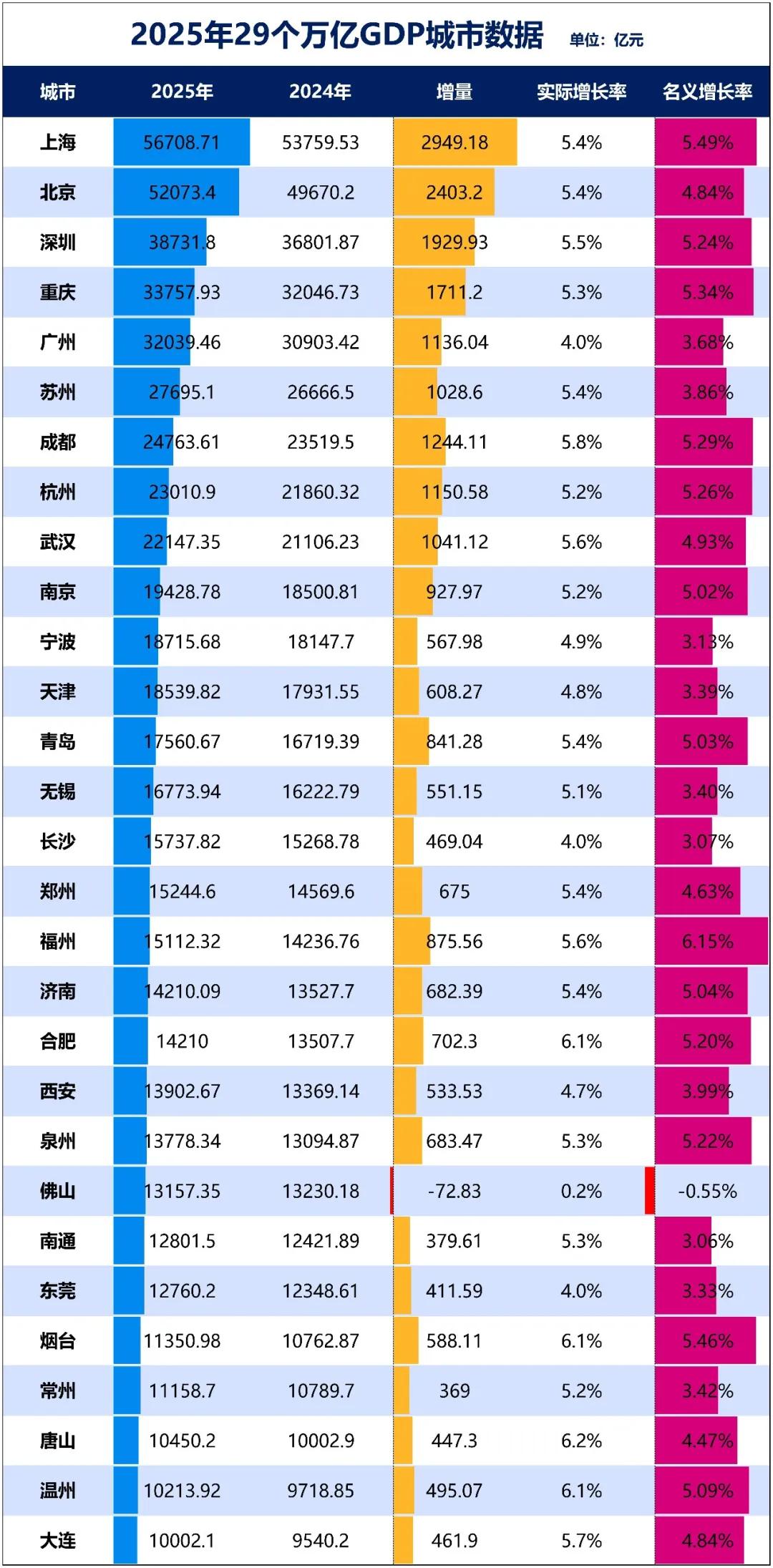
Charting: Urban Finance; Data: Statistics Bureaus of Each City
The key question is, why is Hefei so powerful?
Judging from the data, industry is its strongest support. Data shows that in 2025, the added value of the primary industry was 33.84 billion yuan, a 3.4% increase; the added value of the secondary industry (generalized industry) was 522.19 billion yuan, an 8.7% increase; the added value of the tertiary industry was 864.97 billion yuan, a 4.4% increase.
Among them, the growth rate of the added value of industries above the designated size reached 17.6%, a four - year high, and this growth rate ranked first among trillion - level cities.
In detail: In 2025, the added value of Hefei's computer, communication, and other electronic equipment manufacturing industries increased by 60.6%, and the added value of the automobile manufacturing industry increased by 11.1%. The cultivation of new - quality productive forces accelerated, and the output value of strategic emerging industries increased by 16.6% year - on - year, accounting for 60.4% of the industries above the designated size, a year - on - year increase of 2.7 percentage points. In terms of major products, the production of new - energy vehicles was 1.371 million, accounting for 8.3% of the national total; the production of micro - computer equipment was 27.723 million, accounting for 8.4% of the national total; the production of semiconductor discrete devices, industrial robots, and memory chips increased by 42.7%, 1.1 times, and 1.3 times respectively.
The growth rate of the added value of the information industry reached an astonishing 60.6%.
The production of new - energy vehicles remained stable. Moreover, due to the change in the statistical caliber in 2025, the automobile production in Guangdong dropped sharply, and Anhui's automobile production has surpassed that of Guangdong and ranked first in the country.
Under the change of the caliber, the automobile production in Shenzhen will undoubtedly also drop. Although Hefei's production of 1.371 million new - energy vehicles is slightly less than the 1.3761 million in 2024, Hefei is likely to replace Shenzhen as the top city in new - energy vehicle production in the country.
02
Hefei, the Strongest Dark Horse in the Past Twenty Years
Taking a 20 - year span, Hefei is undoubtedly the fastest - growing city among the 27 provincial capitals and autonomous region capitals.
The past twenty years have been a leap - forward stage for Hefei in terms of both economy and population.
In terms of GDP, in 2004, Hefei ranked 47th among national cities. In 2014, it rose to 25th, and in 2024, it ranked 19th, rising 28 places in twenty years.
Among provincial - capital cities, in 2004, Hefei ranked 16th, and in 2024, it ranked 10th, rising 6 places in twenty years. It is the provincial capital with the fastest - rising speed, without a doubt.
In addition, Hefei's GDP increased from 89.667 billion yuan to 1.35077 trillion yuan in the past twenty years, with a nominal increase of up to 1406.43%, also ranking first among the 27 cities.
The rapid economic growth has led to a large - scale inflow of population. Especially in the past three years, when the population increment of other central cities slowed down, Hefei's population increment was even more prominent.
In 2023, the increment of Hefei's permanent population reached 219,000, ranking first in the country. In 2024, the increment was 149,000, ranking fourth in the country.
In the past three years, the increment of Hefei's permanent population reached 537,000, ranking first in the country. Guiyang ranked second.
Hangzhou, Changsha, Zhengzhou, Shenzhen, Xi'an, Ningbo, Nanchang, Qingdao, Kunming, Jinan, Guangzhou, Wuhan, Nanjing, Hohhot, Suzhou, Nanning, and Shenyang ranked among the top twenty in terms of population increment.
With the help of the population increment, Hefei's permanent population has successively surpassed that of Nanjing and Ningbo in the Yangtze River Delta in the past few years, and its population size ranks fourth in the Yangtze River Delta, only after Shanghai, Hangzhou, and Suzhou.
In 2024, Hefei's permanent population successfully exceeded 10 million, becoming the 18th city in the country with a population of over 10 million.
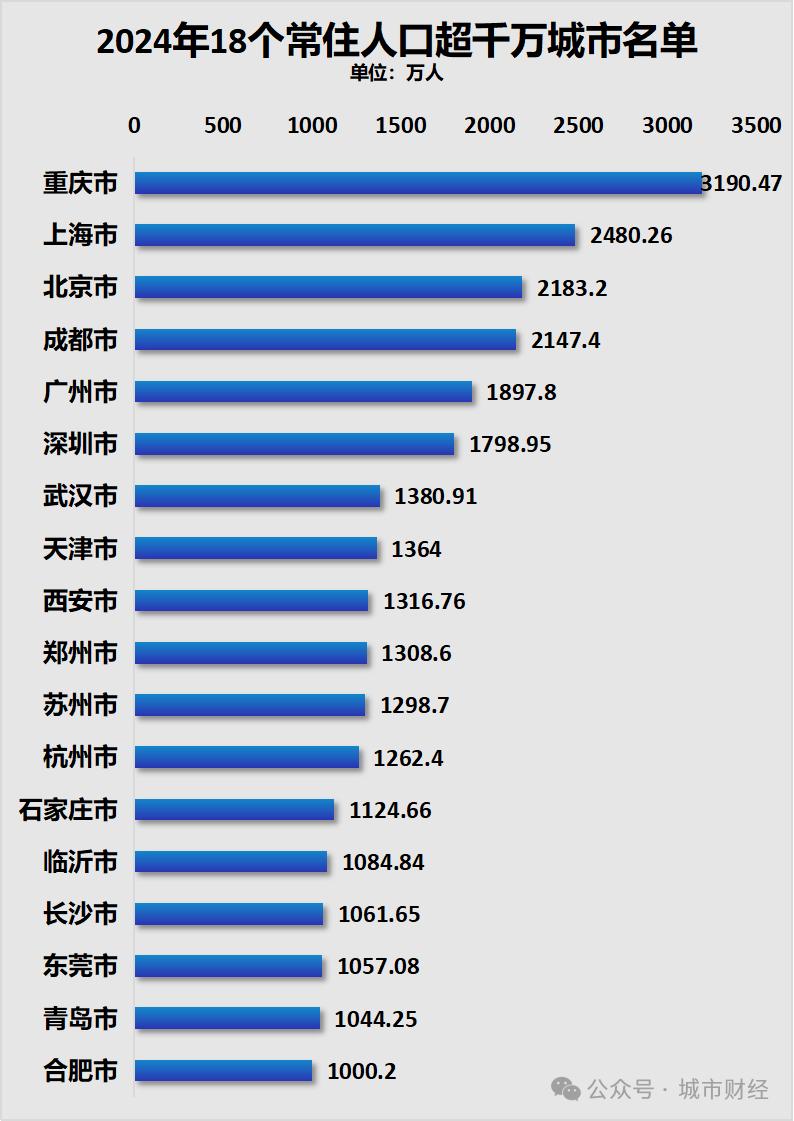
Charting: Urban Finance; Data: Statistics Bureaus of Each City
03
Hefei, a City That Changed Its Fate
This account believes that Hefei's success is due to four points:
First, a low starting point means no historical burden. Compared with other cities, Hefei doesn't have a heavy historical burden, so it can move forward bravely with a light load.
Second, it dares to take bold gambles and has unique insights. With these, Hefei has gathered eight emerging industrial systems of "Chip, Display, Automobile, and Integration" and "Integration, Lifelong, Intelligence", with great potential in the future. Zhang Henshui, a writer from Anhui, described Hefei at the time of liberation in his travelogue "Beijing - Shanghai Travel Magazine":
The urban area was only 5 square kilometers, with a population of less than 60,000. There was one road with three streetlights, and one loudspeaker could be heard throughout the city. A small river ran through the city, and there was only one two - story building.
After the founding of New China, among the four cities of Anqing, Bengbu, Wuhu, and Hefei, Hefei finally won and became the capital of Anhui Province.
Anqing, the old - established provincial capital, is located along the Yangtze River. Due to the unstable factors in the early days of the founding of the People's Republic of China, many people were worried that if the provincial capital was set in Anqing, a strategic town along the river and between Nanjing and Wuhan, once a war broke out again, the enemy might capture two provincial capitals in one day.
Wuhu and Bengbu actually had better conditions than Hefei at that time, but Wuhu is too close to Nanjing, and Bengbu has always been regarded as the northern gateway of Nanjing in history. They both faced similar dilemmas as Anqing. At the same time, in order to "reduce Nanjing's influence", Hefei finally won.
Hefei's development didn't show much brightness later. Like Zhengzhou, it was regarded as a small county town.
It really started to rise in the 21st century. After the strategy of "Building the City through Industry" was introduced in Hefei in 2005, it began to seek a new path for industrial development.
The first step to success was to tie up with BOE. In 2007, BOE, which was struggling in the financial crisis, sought financing support from local governments. Amidst the controversy, Hefei promised to invest one - third of its annual fiscal revenue in BOE's project to build the first domestic 6th - generation liquid - crystal panel production line - thus, "The Transformation of Hefei" began.
Investing in BOE was the beginning of Hefei's bold gamble. The Hefei government invested 6 billion yuan, and strategic investors invested 3 billion yuan. If strategic investment couldn't be introduced, the remaining 8.5 billion yuan would be solved through loans with the support of the Hefei government. At that time, Hefei's fiscal revenue was only 30 billion yuan.
In return, BOE has developed very well later. Its industrial chain has been continuously upgraded, and it has grown into a leading enterprise in the global screen - display industry. At the same time, it has driven more than 70 supporting enterprises to develop in Hefei, making Hefei one of the world's largest display - industry bases and radiating the entire semiconductor industry. Thus, Hefei stands at the high - point of the screen - display industry.
At the same time, since it received the University of Science and Technology of China, a university with very high domestic and international rankings, it has brought a large number of basic scientific research facilities to Hefei and the title of a comprehensive national science center. Quantum computers have become a resounding calling card for Hefei.
After that, Hefei also caught the wave of new - energy vehicles and chips.
In 2019, after NIO, which was at a loss, failed to get financing from multiple local cities, Hefei extended an olive branch. In 2020, NIO signed a gambling agreement with Hefei, and NIO's China headquarters was located in Hefei, enabling Hefei to successfully catch the wave of the times.
After joining hands with NIO, Hefei has also been continuously upgrading the industrial level of JAC, a local automobile brand, especially in JAC's new - energy vehicles.
As of now, Hefei has successively implemented more than 50 new - energy - vehicle - related industrial projects, such as JAC Volkswagen New - Energy Vehicles, JAC NIO New - Energy Vehicles, and the second - phase project of Changan Automobile. It has also gathered upstream and downstream enterprises such as NIO, JAC, Guoxuan High - Tech, Huating Power, and Juyi Technology, forming a complete industrial chain covering the whole vehicle, key components, application, and supporting facilities.
The blueprint that Hefei has drawn for future new - energy vehicles is: By 2025, breakthrough progress will be made in cultivating a world - class automobile industrial cluster, and the output value of new - energy vehicles will exceed 300 billion yuan. The production capacity of new - energy vehicles will reach 1.5 million, and the production of new - energy vehicles will account for more than 50% of the city's total automobile production and more than 25% of the national total. A number of internationally well - known brands will be cultivated.
With the explosive growth of new - energy vehicle production, Hefei has set a new goal: Strive to form 2 to 3 vehicle - manufacturing enterprises with an annual production of 500,000 vehicles by 2027, add 10 parts - manufacturing enterprises with a scale of 10 billion yuan, have a new - energy vehicle production capacity of more than 3 million, and achieve a cluster revenue of more than 700 billion yuan.
Hefei has grown into the top city in new - energy vehicle production.
In terms of chips, in 2017, the Hefei government and GigaDevice Semiconductor founded a joint - venture company, Hefei ChangXin, specializing in the R & D and production of dynamic random - access memory (DRAM) chips, and attracted a large number of upstream and downstream industries to settle down.
In the 2021 ranking of the competitiveness of integrated circuits in Chinese mainland cities, Hefei ranked sixth in the country, and the production of terminal products such as smart watches, color TVs, and notebook computers also ranked among the top in the country and the world.
Industry boosts economic take - off and population expansion.
In 2015, Hefei's GDP exceeded 500 billion yuan. Five years later in 2020, Hefei's GDP doubled, and it successfully joined the trillion - yuan club.
Today's Hefei is very different from the Hefei that Zhang Henshui saw back then: The area of the municipal district is 1,339 square kilometers, the GDP in 2024 was 1.35077 trillion yuan, and the permanent population was 10.002 million. Hefei's venture - capital model is now being learned by many cities.
Third, the strong - provincial - capital strategy.
In previous articles, I have repeatedly emphasized a point of view. There is no absolute good or bad between the strong - provincial - capital strategy and balanced development. What suits oneself is the best. Or it can be said that the strong - provincial - capital strategy and balanced development are just the needs of different eras and different strengths in regional development.
Most inland cities in China adopt the strong - provincial - capital model, and Anhui and Guizhou are no exception. For these two provinces, this is undoubtedly the right path.
After years of development under the strong - provincial - capital strategy, Hefei's economic primacy is 26.9%, which means that more than a quarter of the GDP is concentrated in the provincial capital, Hefei. From the perspective of the relationship between the first - ranked and the second - ranked cities, Hefei's economy is 2.7 times that of Wuhu.
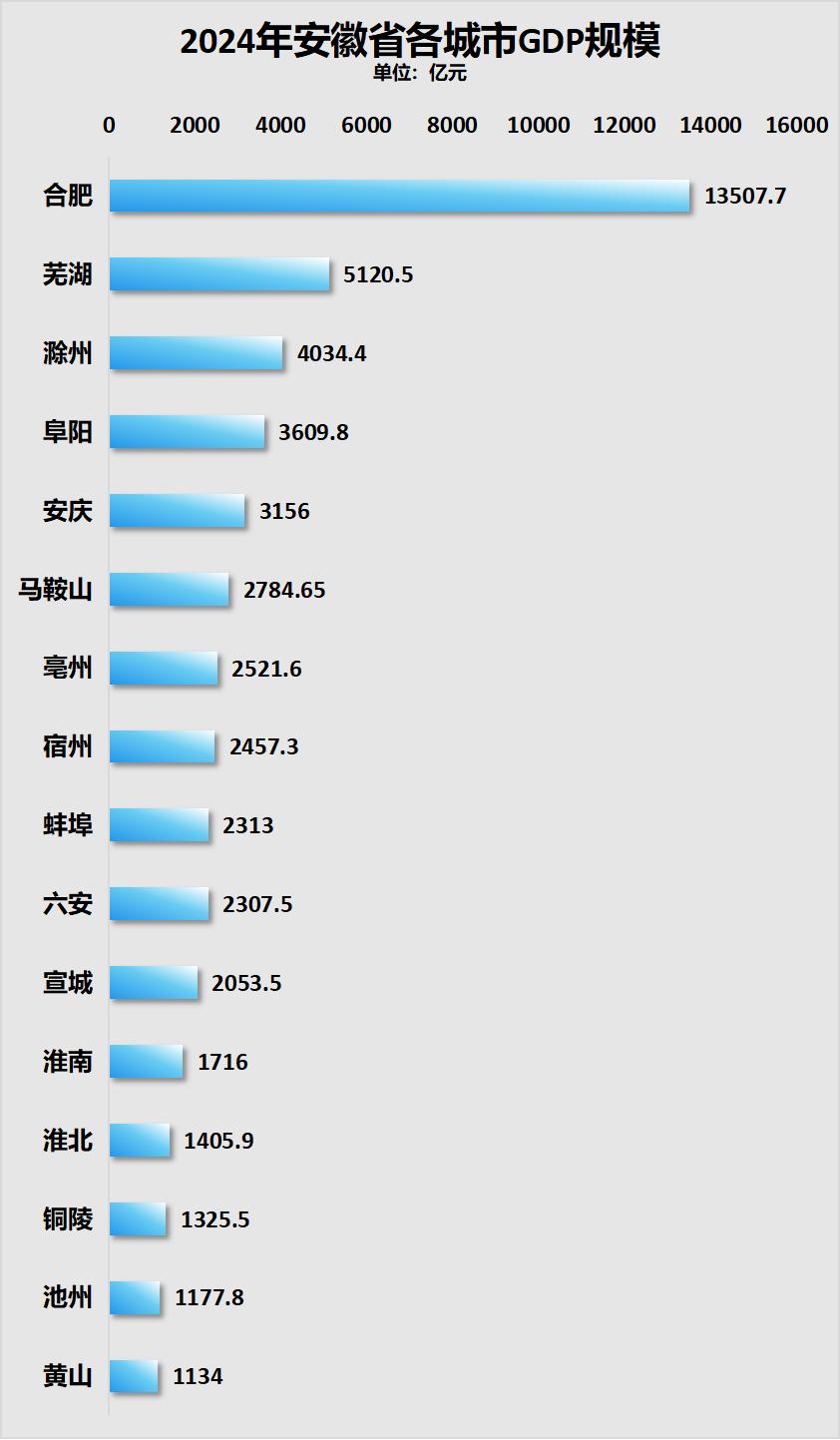
Charting: Urban Finance; Data: Statistics Bureaus of Each City
The strong - provincial - capital strategy has two results:
1. Leading the provincial development. Data shows that from 2014 to 2024, Anhui's ranking rose three places, from 14th ten years ago to 11th in 2024.
Sichuan, which adopts the strong - provincial - capital strategy, rose 4 places in the past ten years. Guizhou, which also adopts this strategy, rose 5 places. Hubei rose 5 places. Hunan rose 3 places. Shaanxi rose 5 places. Fujian and Jiangxi, which are also implementing the strong - provincial - capital strategy, rose 3 and 2 places respectively. On the contrary, Hebei, which has difficulty in implementing the strong - provincial - capital strategy, dropped 6 places.
2. A large - scale infl