Electric vehicles can't get any heavier.
In 2019, the Bugatti Chiron Super Sport 300+ set the world's fastest land speed record for a car at 490 km/h in Germany.
To shed excess weight and break through the 300 mph speed barrier, this car not only uses a 1,600-horsepower W16 engine but also has a carbon fiber body. It even has very little paint, keeping the vehicle weight under 1,996 kg.
Six years later, the BYD Yangwang U9X reached a speed of 496 km/h in Germany, breaking the record. With a weight of 2.48 tons, it seems to have buried the proposition of vehicle lightweighting in the annals of history.
However, with the trend of "small electric cars becoming more substantial and large ones becoming like tanks" across the entire electric vehicle industry, weight loss has become an urgent issue for electric vehicles.
01
The Weight-Gain Cycle
In the past few years, as the number of new energy vehicles in China has increased, the curb weight of individual vehicles has also risen. The average weight of Chinese new energy vehicles has increased by over 300 kg [1]. It's common for a mid-sized electric sedan to weigh the same as a mid-large-sized fuel-powered SUV.
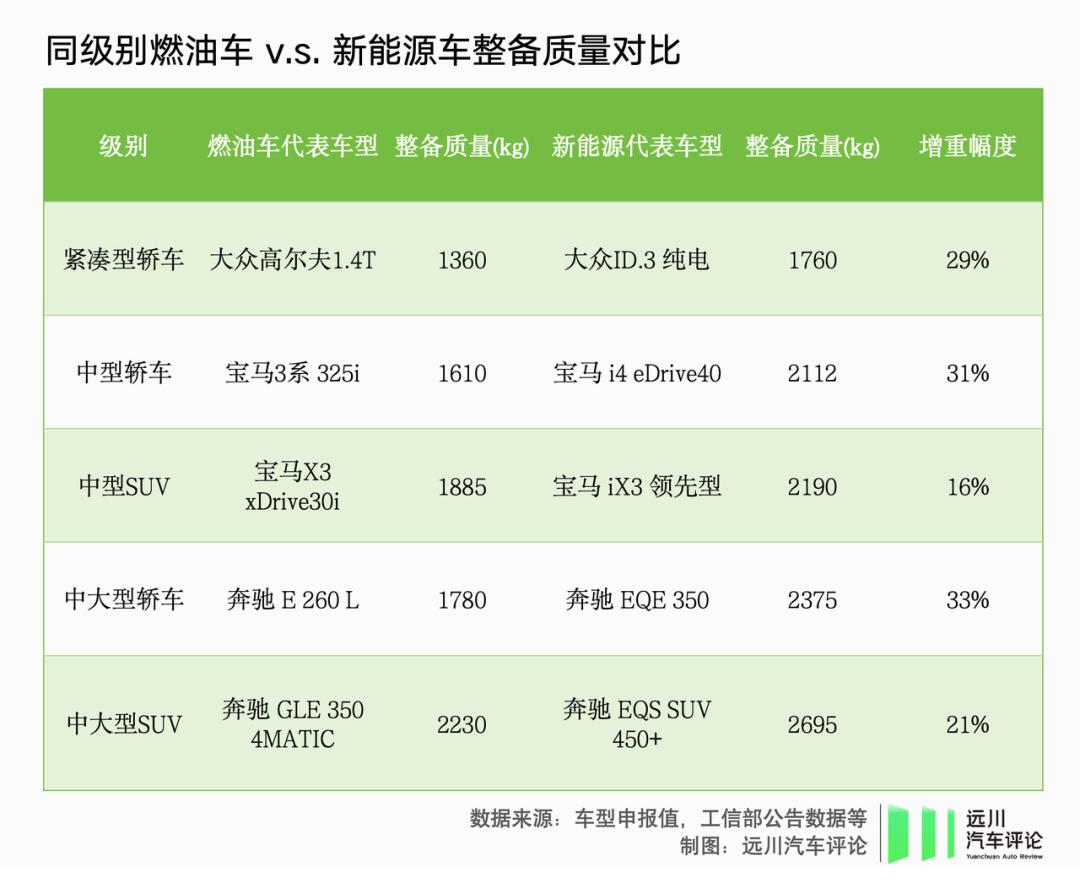
Electric vehicles of the same class are several hundred kilograms heavier in curb weight than fuel-powered vehicles.
Behind the trend of electric vehicles getting heavier, the biggest problem is the contradiction between the growing demand of the public for worry-free range and the long-standing lack of breakthroughs in battery energy density.
Compared with fuel-powered vehicles, which have "high horsepower premiums and low-cost range", electric vehicles have "equal horsepower and scarce range".
While a fuel-powered vehicle can easily achieve a range of over 500 km with a 60-liter fuel tank, mainstream electric vehicles need to carry 400 - 600 kg of batteries to barely match that range. They are inherently burdened with battery weight gain.
Meanwhile, since long range is a scarce attribute for electric vehicles, high-end models often stack batteries to gain an edge in range. Some heavyweight models with battery weights comparable to that of a small car have emerged.
For example, the BYD Yangwang U7 carries a 135 kWh lithium iron phosphate battery pack weighing 900 kg to achieve a range of 700 km. In contrast, a fuel-powered flagship sedan of the same class only needs to fill a 70-liter fuel tank weighing about 50 kg to cover the same distance.
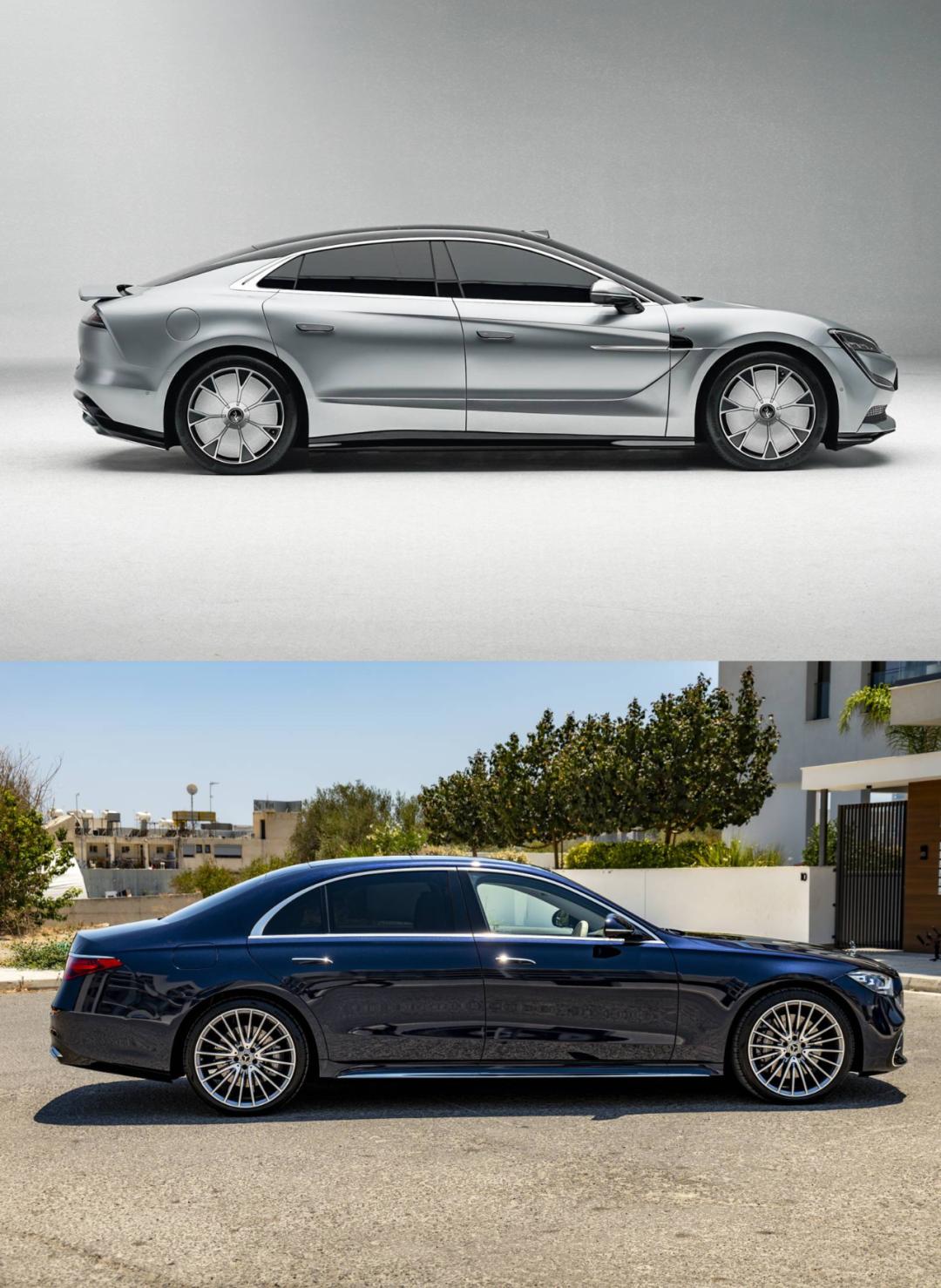
The Yangwang U7 and the Mercedes-Benz S-Class, flagship sedans with a weight difference of one ton.
The problem is that even with a relatively low combustion efficiency (assuming an internal combustion engine has a thermal efficiency of 30%), the energy density of gasoline is 20 times that of lithium batteries.
Due to the low energy density of batteries, the approach of adding more batteries to increase the range of electric vehicles is prone to diminishing marginal returns.
According to the current industry standard, for every 10 kWh increase in battery capacity, the battery pack weight increases by 60 kg. A European study shows that for every 100 kg increase in the curb weight of an electric vehicle, the average electricity consumption per 100 km increases by 0.6 kWh [8].
This means that under the same conditions, the more batteries an electric vehicle has, the heavier the battery pack, and the more energy the battery uses to carry its own weight, resulting in smaller range gains from adding batteries.
In extreme cases, the additional weight of the batteries added to increase the theoretical range by 100 km may offset 30 - 50 km of actual range in real driving.
In the complex vehicle system, the large weight of the battery can also lead to spiral weight gain.
If a vehicle wants to offset the power loss caused by the increased battery weight, it has to install a more powerful but heavier motor. To ensure safety and maintain driving characteristics, the brakes, suspension, body, and tires need to be comprehensively strengthened. As a result, for every 100 kg increase in battery weight, the total vehicle weight usually increases by 120 - 150 kg [2].
The weight of new energy vehicles can easily fall into a "more water, more flour; more flour, more water" situation - adding more batteries for long range leads to rapid weight gain, which consumes more electricity, forcing the addition of more batteries and further weight gain.
In addition, Chinese consumers have a "want-it-all" preference for cars. Car manufacturers, in the market competition, meet these demands, further contributing to the weight gain of new energy vehicles.
Consumers like large cars, so domestic car manufacturers have brought down the price of large SUVs that used to cost over 400,000 yuan to as low as 170,000 yuan. Compressor refrigerators, large entertainment screens, and hot stone massage seats, which were once only available in million-yuan luxury cars, are now available in 300,000-yuan models from new car brands. Active suspension, which was not even available in million-yuan luxury cars, has been mass-produced and applied by BYD and NIO.
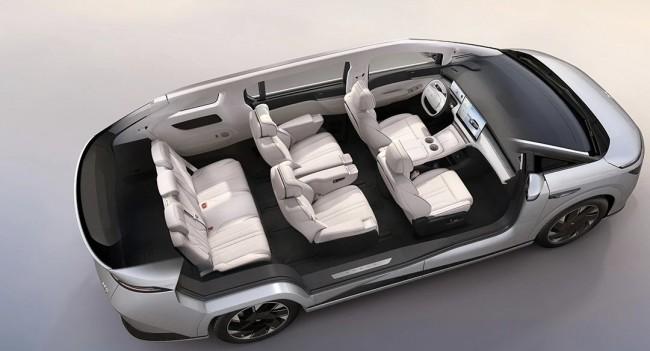
The 350,000-yuan XPeng X9 comes standard with a 10.8L hot and cold refrigerator.
As the trend of all-round weight gain sweeps through the industry, the most extreme example is that the Yangwang U7, a flagship sedan similar in size to the Mercedes-Benz S-Class, weighs a full ton more.
Cars, which were once just means of transportation, have now become real mobile homes.
02
Heavier Cars Aren't Always Better
The increasing weight of new energy vehicles is also related to a common perception among Chinese consumers: the heavier the car, the better and safer it is.
This concept stems from the experience and aesthetic habits of the early automotive industry. A heavy body usually means solid materials, durability, and crashworthiness. To some extent, this concept is reasonable - when a light car collides with a heavy one, the lighter car may absorb more collision energy [3].
However, if safety is judged solely by weight, with a "better you than me" attitude, car owners should either add a ton of solid iron to their cars or drive dump trucks.
In the modern automotive industry, the equation "heavier car = safer car" doesn't always hold. A car's safety depends more on its body structure, material strength, and anti-collision system.
For example, the Firefly, which received a full five-star rating from the China Insurance Automotive Safety Index (C-IASI) in 2025, is only 4 meters long and weighs 1.5 tons. But with its carefully designed front and rear crumple zones and a safety cage passenger compartment made of high-strength steel, its rating is on par with the 2.7-ton AITO M9. Similarly, the 1.8-ton Tesla Model 3 often receives the highest safety rating from the Insurance Institute for Highway Safety (IIHS) in the United States.
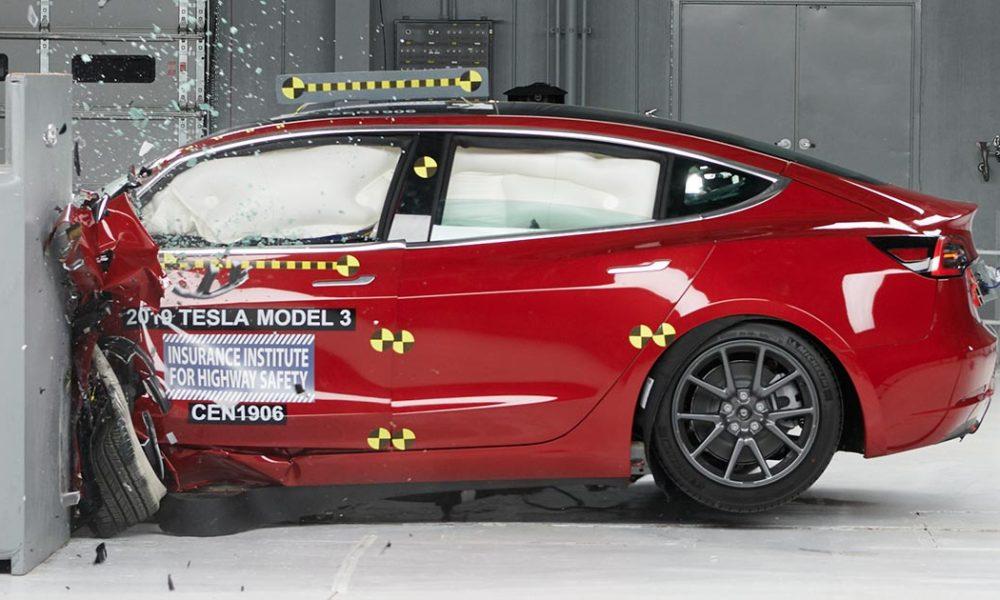
The Model 3 undergoing a small overlap front crash test at the IIHS.
On the contrary, excessive weight may pose a safety hazard.
According to the kinetic energy formula E = ½mv², a heavier car means greater kinetic energy, resulting in more severe damage after a collision. When a heavy electric vehicle hits a rigid object like a utility pole or a concrete block, the additional kinetic energy caused by the increased weight will be borne by the vehicle itself, amplifying the danger.
Secondly, a heavier car requires a longer braking distance. Under the same tire and braking force conditions, a 2.5-ton car will definitely need a longer distance to stop than a 1.8-ton car. In an emergency, the weight difference can directly translate into accident risk.
At the same time, a greater vehicle weight also brings greater sprung mass, increasing vehicle roll, or greater unsprung mass, slowing down the suspension response, making it more difficult for the tires to grip the road and weakening the vehicle's ability to avoid emergencies.
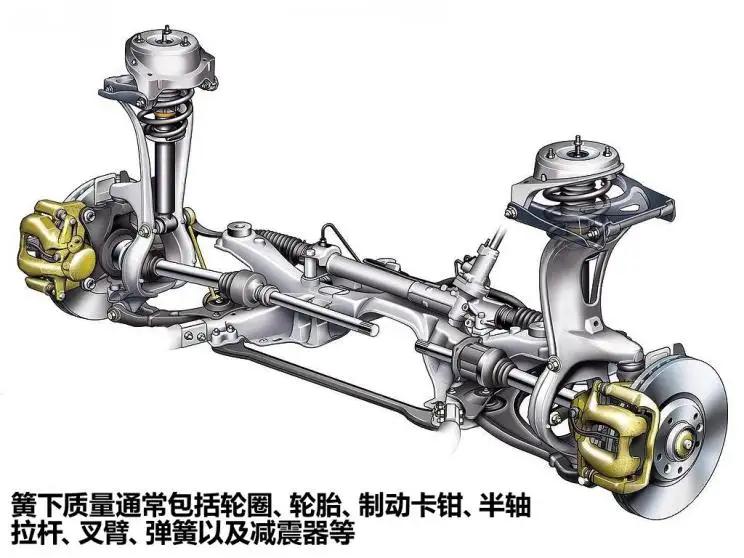
A smaller unsprung mass allows the suspension system to have better dynamic response for a smoother ride. Source: Autohome.
From the perspective of the entire product lifecycle, a heavier electric vehicle will inevitably bring higher costs in various aspects - whether it's usage cost, environmental cost, or social cost.
For consumers, the high electricity consumption of heavy electric vehicles will accumulate into significant electricity costs over time. Heavy electric vehicles also wear out tires and brake pads faster, shortening their replacement cycles. When buying car insurance, based on the logic that a heavier car can cause more damage, heavy electric vehicles are more likely to be charged higher premiums by insurance companies.
From the original intention of electric vehicles to reduce carbon emissions and protect the environment, large-tonnage electric vehicles consume more energy, emit more carbon dioxide, and also require more steel, aluminum, and rare metal resources such as lithium and cobalt during manufacturing.
In 2024, Stellantis revealed that compared with traditional fuel vehicles, producing a battery pack for an electric vehicle with a range of 400 km requires an average of about 500 kg of additional raw materials. Former CEO Carlos Tavares said bluntly: "From an environmental perspective... I don't think it makes sense [5]."
From the perspective of society as a whole, the increasingly heavy electric vehicles not only pose a greater potential risk to other road users but also increase the pressure on road maintenance.
For an electric vehicle, on the premise of ensuring safety, the lower the vehicle weight, the better the overall effect. However, car manufacturers are not very enthusiastic about this because they are faced with the classic problem of the impossible trinity.
03
Weight Loss Is Difficult but Inevitable
In the normal human realm, an adult can't control their weight while having an unrestrained diet and being sedentary. Similarly, an electric vehicle can't achieve low cost, low weight, and high configuration simultaneously.
Early on, BMW's i3 used carbon fiber to counter the weight gain of the battery, creating a body that could be lifted by two people. However, the cost of the body-in-white skyrocketed.
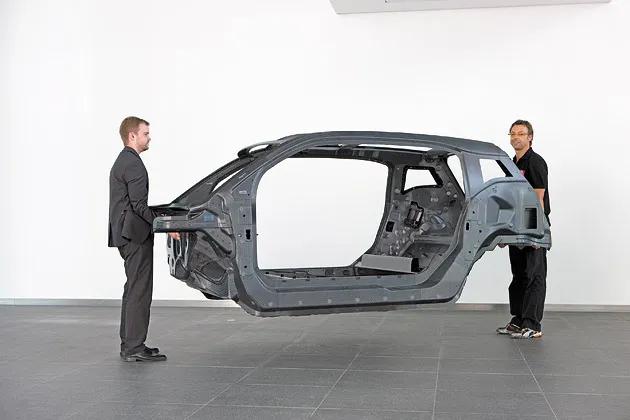
The carbon fiber body of the first-generation BMW i3.
Tesla has achieved remarkable results in lightweighting. However, this is based on a basic interior and a large investment in research and development. Tesla has successfully developed weight-saving techniques such as integrated die-casting and high integration of the battery chassis - and car owners also bear high repair and insurance costs.
If a car manufacturer wants to strike a difficult balance between the cost, weight, and configuration of an electric vehicle, the will of the top management and cross-departmental cooperation are crucial.
In June last year, NIO CEO Li Bin criticized the damage caused by heavy electric vehicles to the roads and took the opportunity to promote the LeDao L90, which is 300 kg lighter than similar models and "only" weighs 2.3 tons.
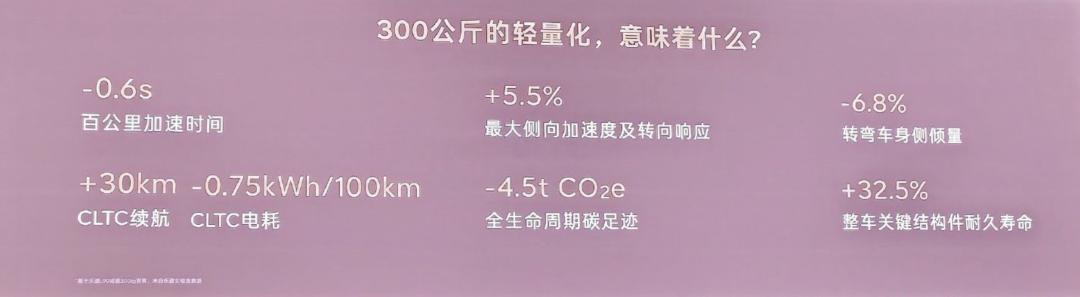
Compared with the Li Auto L8 Standard Range version, the LeDao L90 is 330 kg lighter. Its curb weight is rare among three-row SUVs of similar size.
Compared with "adding a lot of batteries and making the car extremely heavy", a 300 kg weight reduction requires painstaking efforts: the body-in-white should use 72-in-1 rear floor integrated die-casting; in terms of electronics and electrical systems, the high-voltage system should switch to a 900V architecture to halve the weight of high-voltage wiring harnesses and control the motor weight below 80 kg; the thermal management system should be highly integrated, achieving 49-in-1.
This is also the organizational dynamics problem behind the difficulty of electric vehicle weight loss: no single department in a car manufacturer can independently promote the weight loss task and enjoy the benefits alone. It either requires a strong push from a young and energetic founder or a cross-departmental cooperation mechanism established through intense market competition.
If neither of these conditions is met, car manufacturers often follow market preferences while pinning their hopes on technological breakthroughs in the industrial chain, such as solid-state batteries.
Compared with current liquid lithium batteries, the theoretical energy density of solid-state batteries can be doubled, potentially reducing the battery pack weight by 50%. This can bypass the arduous task of gradually reducing the vehicle weight. Many car manufacturers have announced timetables for installing solid-state batteries in vehicles, and it is expected that there will be intensive road tests of all-solid-state battery vehicles from 2026 to 2027.
However, despite the busy installation timetables, there are still no mature solutions to the cost and lifespan problems of solid-state batteries, while the pressure from policies is already imminent.
