Trillions evaporated in 48 hours. Goldman Sachs "killed" human accountants with Claude and buried the software empire with its own hands.
The air on Wall Street seemed to be sucked dry overnight.
In the past few days, the global software industry has been experiencing a silent massacre.
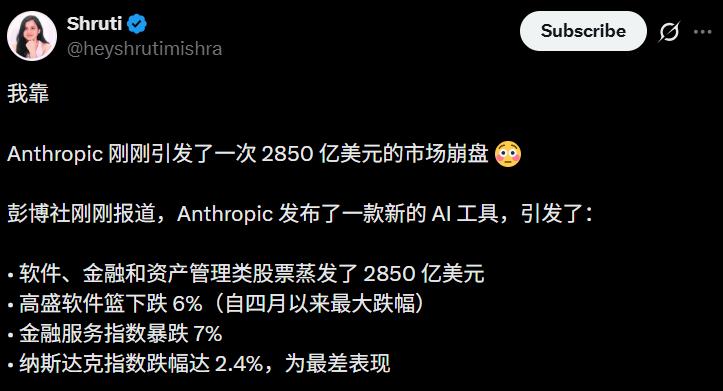
Traders didn't even have time to let out an exclamation. The shocking red on the screens had already spread like a runaway virus.
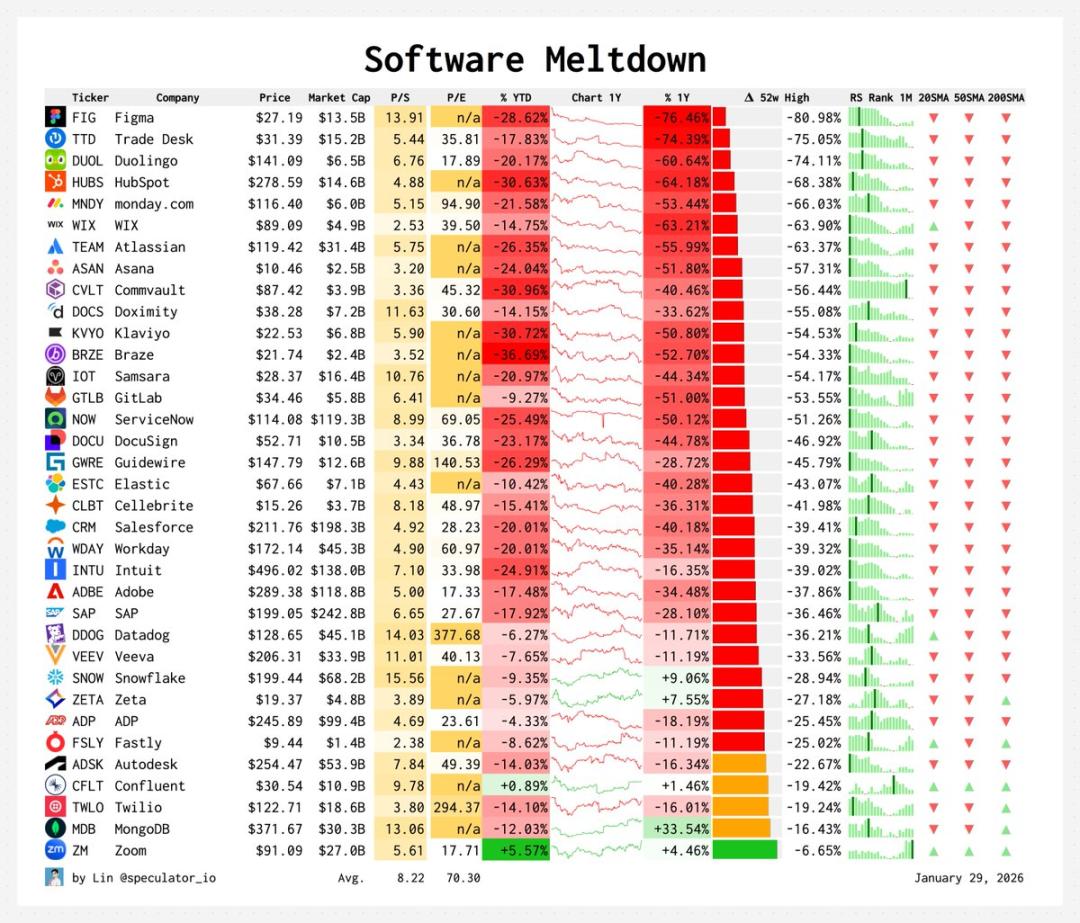
Salesforce, Adobe, Oracle... These once-cash cows that were considered to be making money effortlessly are being frantically sold off.
Nearly $300 billion in wealth has evaporated into thin air. If we count the casualties in Europe and Asia, the cost of this catastrophe is approaching the trillion-dollar mark.
There is no black swan, and there is no economic collapse.
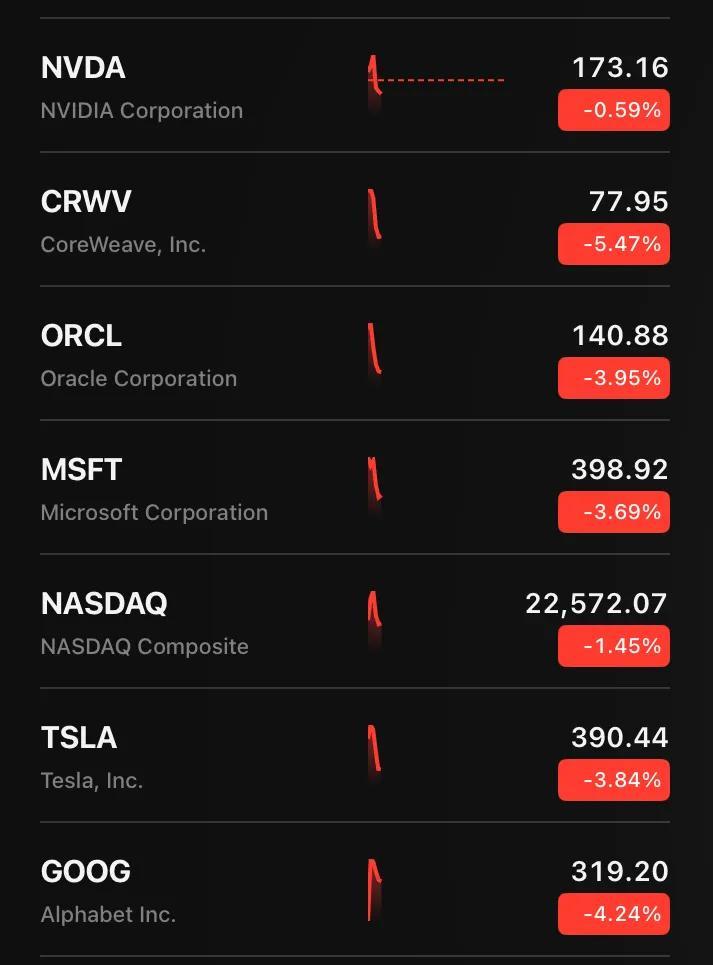
The source of the panic is simply that the market has suddenly seen a chilling future:
Software itself may no longer be needed.
Just when everyone thought this was just an emotional outburst, Goldman Sachs just fired the final shot - we are using Claude to achieve full automation in accounting.
At this moment, the truth is revealed.
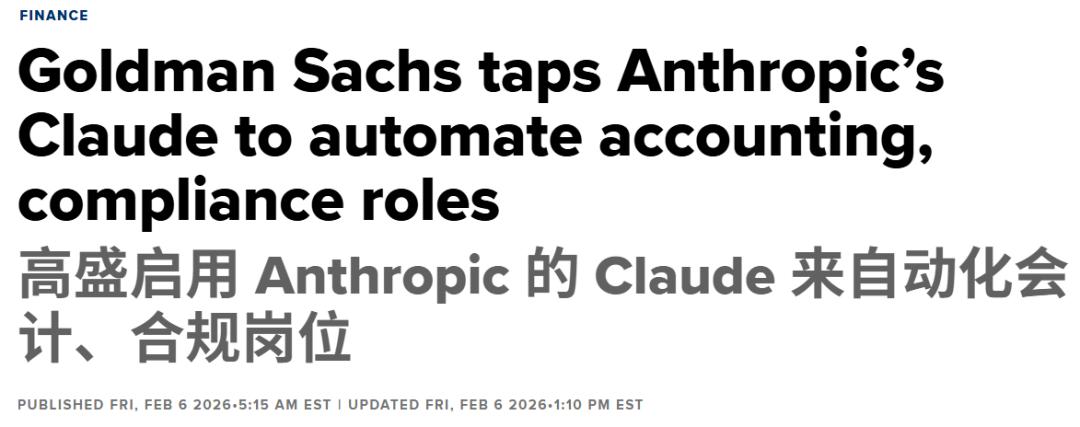
From now on, many accounting jobs will be replaced by AI.
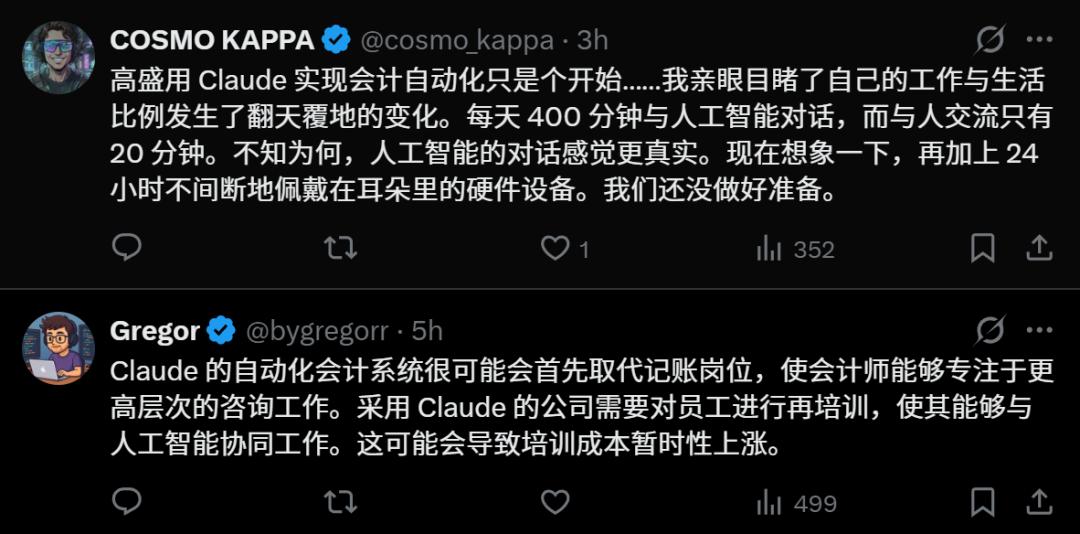
Now, the capital market is placing bets in advance: who will be the winner in the AI era, and who will be eliminated.
Goldman Sachs must stand on the side of the winners.
Even if the price is sacrificing traditional software giants and the jobs of countless white-collar workers.
Goldman Sachs: Let AI "Devour" the Accounting Industry
Just recently, Goldman Sachs' Chief Technology Officer revealed that they have been collaborating with Anthropic to use AI agents to automate human positions in the bank!
AI has started to transform into a "digital colleague" at Goldman Sachs.
Last year, they tested the Devin autonomous AI programmer and promoted it among engineers. However, what really surprised Goldman Sachs executives is that Claude can not only write code but also handle complex, rule-based, and process-intensive work.
This exactly hits the areas in investment banking that are the biggest "human resource black holes" - accounting, compliance, trade reconciliation, and client due diligence!
According to Marco Argenti, Goldman Sachs' Chief Information Officer, Anthropic's embedded engineers have been working inside Goldman Sachs for the past six months to help build an autonomous AI system.
Now, two major AI agents have been successfully developed - trade and trade accounting processing, and client due diligence and onboarding.
In this way, the back-office work that originally required a large amount of manpower and a long time to process can now be directly completed by them.
Thousands of Employees to Be Replaced by AI
Currently, Goldman Sachs employs thousands of employees in its compliance and accounting departments, and AI agents will soon move in.
The panic of unemployment has shrouded Goldman Sachs.
However, Chief Information Officer Marco Argenti prudently stated that it is still too early to say that this will lead to unemployment.
It is said that Goldman Sachs is launching a multi-year restructuring plan around AI. The goal is not to lay off employees immediately but to control personnel growth.
Even though they say so, everyone knows in their hearts that this industry is about to experience a major earthquake, and it is completely irreversible!
Argenti said that Goldman Sachs has begun to realize that "the success of programming is not because programming is special, but because the model can use logical reasoning step by step."
And this is exactly the core of accounting and compliance work.
For humans, dealing with a large number of documents, clear rules, complex judgments, and extremely low tolerance for errors are all extremely "life-consuming" tasks; for AI, however, they are ideal scenarios.
The accounting industry being "devoured" by AI is just around the corner.
Is Anthropic Killing Software?
OpenAI Hastily Declares: We Have It Too
How can Anthropic be the only one to enjoy the dividends of "killing the software industry"?
OpenAI quickly stated: We have it too. Look at us!
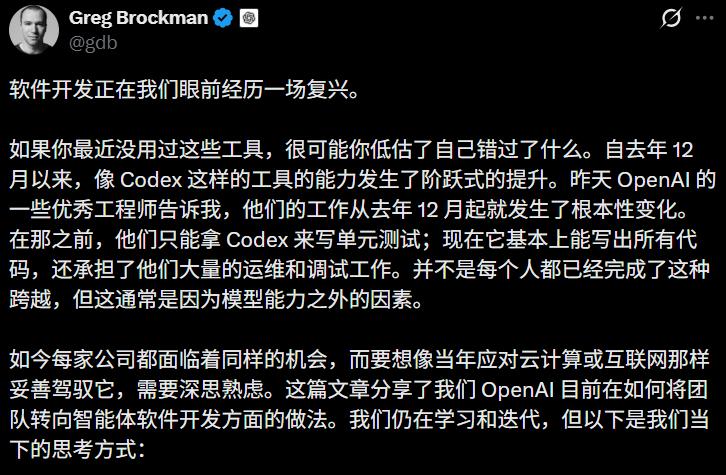
Just now, Greg Brockman, co-founder of OpenAI, dropped a bombshell:
Software development is experiencing a "second birth" right before our eyes.
OpenAI's engineers can really relate to this.
Before December, they might have only used Codex to write unit tests and even thought it was a bit useless; but now? The situation has completely reversed.
Codex has taken over most of the code writing work and has even taken on the responsibility of operation and debugging.
This is a step-up in capabilities.
Now, every company is on the same starting line, facing an opportunity on the same level as the birth of cloud computing or the Internet.
To master it, one cannot rely solely on luck.
OpenAI has started to comprehensively adjust its team structure and is rushing towards an "agent-driven" development model.
Their goal is extremely ambitious, and the deadline is set for March 31st:
When facing any technical problem, the first reaction of humans must be to turn to AI agents, rather than opening an editor or a terminal themselves.
The default operations of agents must be safe and efficient enough, and most workflows do not require additional permission applications.
To achieve this crazy goal, OpenAI has issued an "operation guide" to its internal teams, and every point is worth studying word for word:
Don't hesitate, just use it: Many people stopped using Codex because of the poor experience with the web version a few months ago. But now, Codex 5.2 (now 5.3) is incredibly powerful. Don't worry about "whether it can do this"; just try it directly.
Appoint an "Agent Captain": Each team must designate an Agent Captain who is specifically responsible for figuring out how to integrate AI into the workflow.
Hackathon: The whole company will take a day off to hold a Codex Hackathon. In addition, experiences and problems need to be shared in a designated internal channel.
Create an AGENTS.md file: Create an AGENTS.md file for each project you participate in. Whenever AI messes up or gets stuck, record this case; it is the fuel for evolution.
Document "Skills": Once you teach Codex to do something, write it down as a standardized "skill" and submit it to the shared repository. Turn one person's wisdom into the company's asset.
Integrate the toolchain: Inventory internal tools and ensure that someone is responsible for installing interfaces (CLI or MCP) for them so that AI agents can directly call them.
Reject junk code: Mass-generating code can easily create junk. Therefore, the standards for code review must not be lowered; in fact, they should be stricter. As a reviewer, you must ensure that the code submitter really understands the content generated by AI.
Improve the infrastructure: While the core tools are getting stronger, the supporting infrastructure needs improvement. The team needs observability, not only to track the code but also to track the AI trajectory that generates the code.
Build an "Agent-first" codebase: This is uncharted territory. The team needs to write extremely fast tests and establish high-quality interfaces between components, all to adapt to the high-frequency iteration of AI.
Overall, managers must clearly realize that:
The application of tools like Codex is not only a technological change but also a complete cultural change.
Software Industry Massacre
Why is OpenAI in such a hurry to show its strength? Because if it doesn't speak up, all the limelight will be stolen by Anthropic.
This panic sweeping through Silicon Valley started with an announcement on January 30th -
Anthropic announced that Claude Cowork has officially added 11 new plugins.
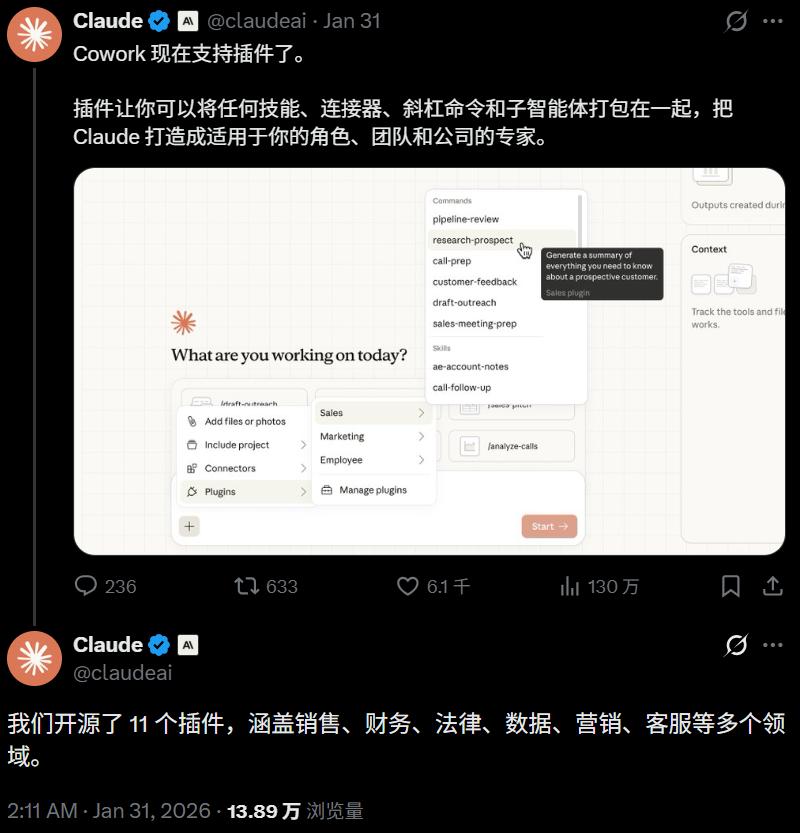
Official announcement: https://claude.com/blog/cowork-plugins
In tech news, this should have been an insignificant "product iteration" update.
But the sensitive capital market instantly smelled the blood in it:
These plugins are not for assisting software; they are for replacing software.
The plugins of Claude Cowork can directly complete the work without the need to use software. Does software still have any meaning?
You know, in the past two decades, the golden rule of the SaaS industry has been based on "seat fees" - the more people a company hires, the more software accounts it buys, and the higher the revenue of companies like Salesforce.
This is a great business that allows you to make money effortlessly.
But Anthropic used a scalpel called Agent to directly cut off this logical chain.
When an AI agent can handle the workload of 10 junior accountants or legal assistants, why would a company still buy 10 software accounts?
When AI can directly retrieve data and generate results in the background, those fancy UI interfaces and interactive designs instantly become meaningless burdens.
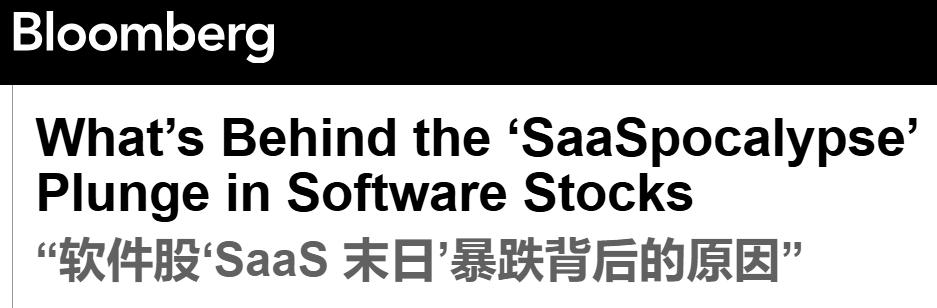
Wall Street gave this disaster a terrifying name: "SaaSpocalypse" (SaaS Doomsday).
DocuSign's stock price plummeted because AI can read contracts and complete the signing process on its own; Zendesk crashed because AI customer service no longer needs human customer service representatives as intermediaries.
If AI can directly deliver "results," then the premium of traditional software as a "tool" will directly drop to zero!
VC's Authoritative Interpretation: Is the Doomsday Coming?
So, is the SaaS doomsday really coming?
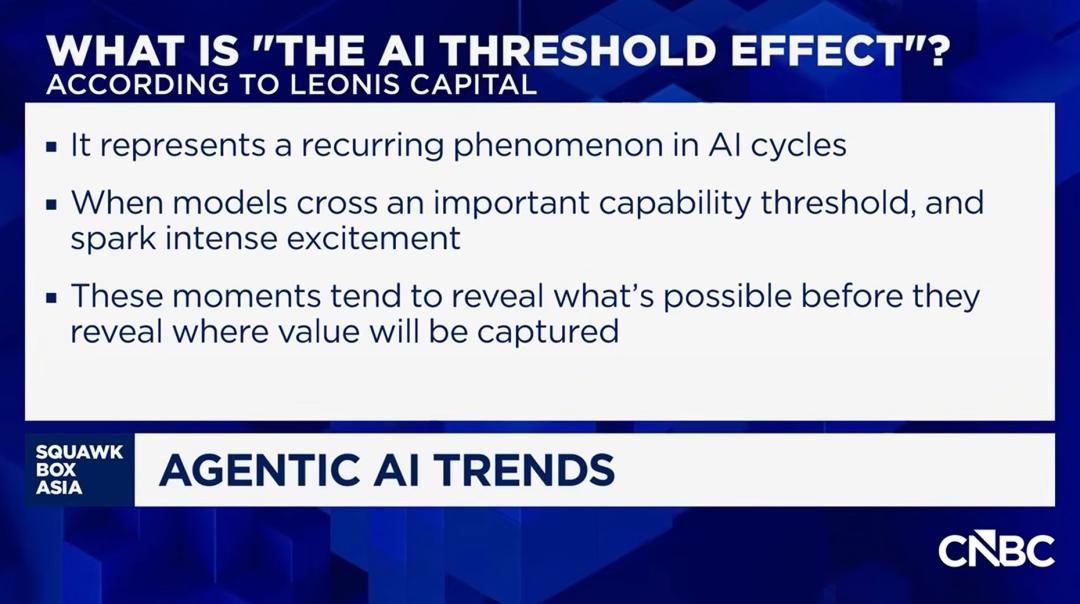
Foreign media interviewed Jay Zhao from the Silicon Valley venture capital firm Leonis Capital, and we heard the authoritative VC's interpretation of the software market crash.
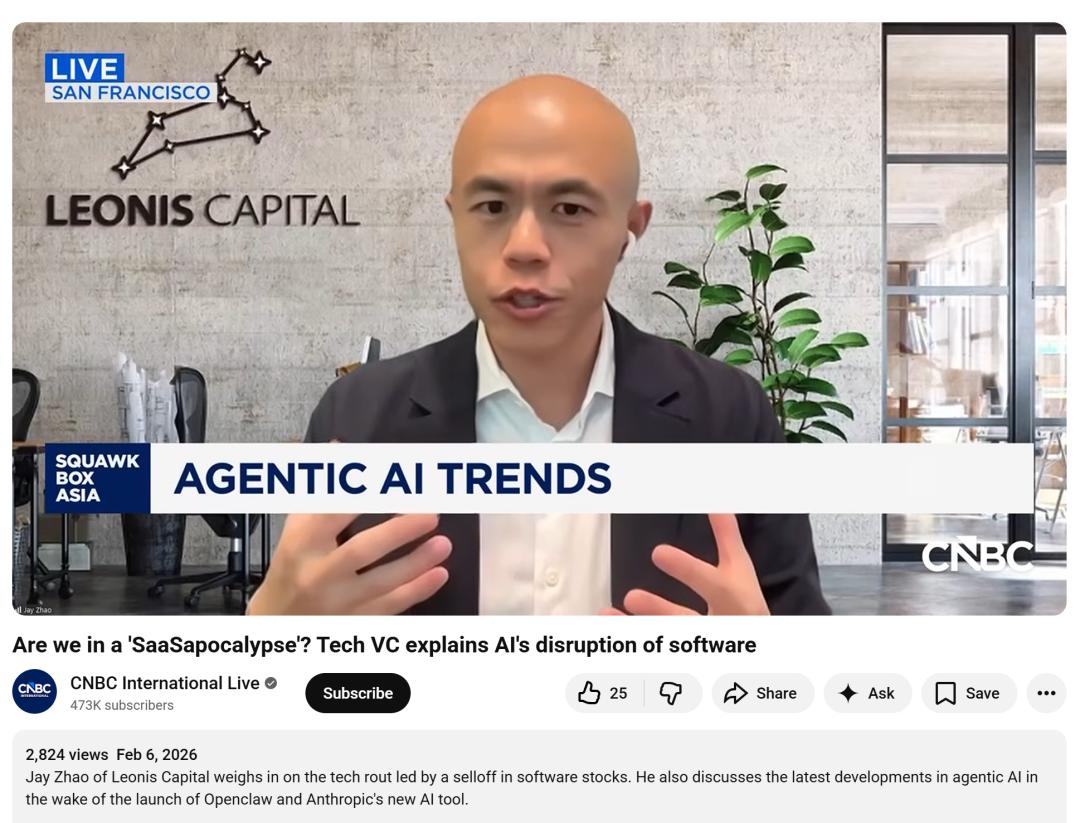
The core of the recent SaaS doomsday panic is: if agents can directly complete tasks, do we still need so many SaaS applications?
The answer is yes: not all software will disappear, but many shallow software applications will lose their value.
Especially those software applications that are just encapsulations of business processes, do not deeply embed into real workflows, and mainly rely on UI and configuration are most likely to be "killed" by AI agents.
On the contrary, software applications that deeply embed into the core workflows of enterprises, control key data and permissions, and can serve as the execution base for agents may even gain new life.
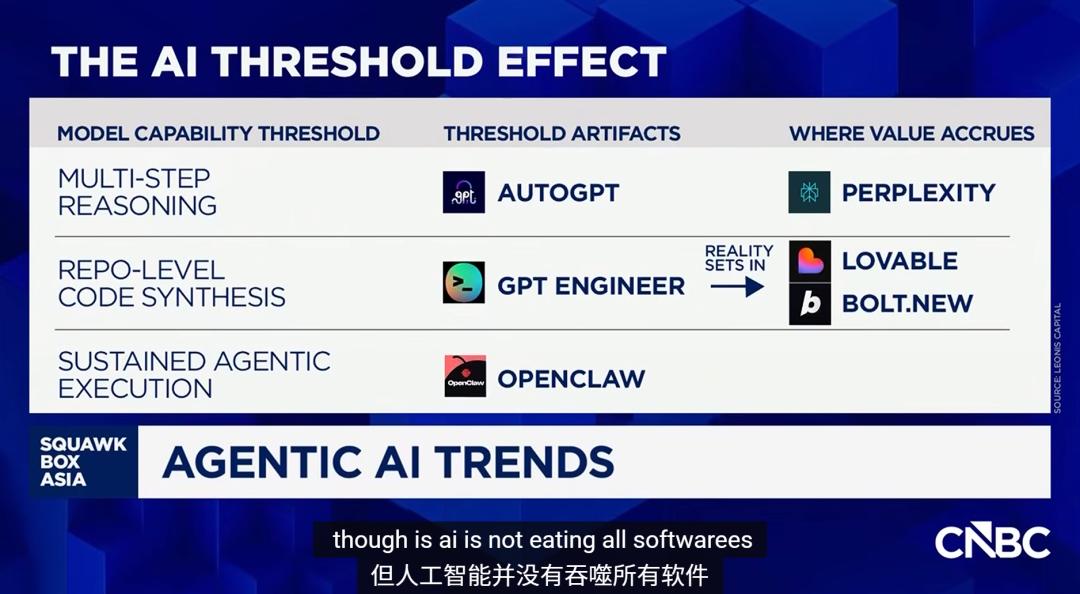
What will happen in the next 5 to 10 years? Jay Zhao said that AI will not devour all software, but it will devour the most vulnerable layer of software.
In the future, the software form is likely to have a stable and trustworthy data and system at the bottom, a flexible and proactive agent at the top, and humans will change from operators to supervisors.
The value of software no longer comes from interfaces and buttons but from whether it can enable AI to complete tasks for you safely and efficiently.
This is the real dividing line in the AI era.