Japanese chips: Seeking "revenge" on South Korea?
In the past three decades, the global storage industry landscape has witnessed a cruel and thorough power shift.
From the 1980s to the 1990s, Japanese companies almost monopolized the DRAM market. After entering the 21st century, this throne was taken away by South Korean manufacturers, who then established a long - term dominance across technology, scale, and capital. Today, HBM has become one of the scarcest and most profitable core components in the AI computing power system. South Korean manufacturers are reaping the benefits, while Japan is largely absent.
However, just when everyone thought that Japan's storage industry had "given up", an ambitious local enterprise is emerging.
The Storage History Rewritten by South Korea
Japan was once synonymous with DRAM.
In the 1980s, several Japanese storage companies together accounted for more than half of the global DRAM market share. DRAM was almost the calling card of Japan's semiconductor industry. At that time, Japan was at the peak of its global expansion in the manufacturing industry. Automobiles, home appliances, precision instruments, machine tools, and consumer electronics were internationally competitive in almost all industrial product categories, and semiconductors were the most technology - intensive and high - value - added part of this industrial system.
Let's talk about how Japan became the DRAM hegemon. From the 1970s to the 1980s, the Japanese government, through MITI (Ministry of International Trade and Industry), led a series of national - level semiconductor joint R & D programs, including the Very Large Scale Integration (VLSI) national project, sharing of basic process results among enterprises, and collaborative promotion by large enterprises, universities, and research institutions. This system gave rise to a number of companies that were extremely mature in process, materials, equipment, and manufacturing management, such as NEC, Toshiba, Hitachi, and Fujitsu.
In the mid - to - late 1980s, Japanese manufacturers once accounted for more than 50% of the global DRAM market share.
The core characteristics of the Japanese model can be summarized in three points:
First, process - oriented. Japanese manufacturers highly emphasize process details, device reliability, and long - term yield stability, rather than simply pursuing the "smallest node".
Second, manufacturing discipline. They attach extreme importance to the climbing speed of the yield curve, equipment stability, and production line consistency.
Third, industrial synergy. A highly integrated domestic industrial chain has been formed among materials, equipment, wafer manufacturing, and packaging and testing.
At that stage, the essence of DRAM competition was: who could mass - produce the process with a stable and high yield more quickly. Japan had a natural advantage in this regard.
Why did Japan lose the DRAM throne?
The turning point occurred in the 1990s. During this period, Japan's economic bubble burst, and enterprises entered a long - term balance - sheet repair period, with conservative capital expenditures.
Meanwhile, the DRAM industry underwent structural changes: the market began to experience strong cyclical fluctuations, products gradually became standardized and homogeneous, and price competition became increasingly fierce.
DRAM gradually changed from a technology - premium product to a heavy - asset industry with high capital expenditures, high cyclical fluctuations, and low tolerance for low profit margins. This was extremely unfavorable to Japanese enterprises because Japanese enterprises generally pursued stable returns, were reluctant to accept long - term losses for the sake of scale, and preferred "profitable manufacturing" rather than "strategic loss - making expansion".
Coupled with the US trade restrictions on Japanese semiconductors, Japanese manufacturers faced additional pressure in exporting to the US, further weakening their expansion ability. As a result, Japanese manufacturers gradually withdrew from the main DRAM battlefield in the 1990s and shifted their resources to areas such as logic chips, MCUs, power devices, and sensors.
South Korea, on the other hand, overtook Japan with a different logic: represented by Samsung, the South Korean government and chaebol groups formed a highly integrated industrial promotion mechanism. At the national level, semiconductors have long been regarded as a strategic industry, with low - interest loans, tax incentives, and land support provided. At the enterprise level, they can accept long - term loss cycles, investing aggressively in capital to gain scale and prioritizing market share over profit.
After the Asian financial crisis in 1997, this strategy was further strengthened. Samsung expanded DRAM production counter - cyclically and eliminated competitors through price wars. Eventually, almost all Japanese manufacturers withdrew from the mainstream DRAM market.
Subsequently, SK hynix (formerly Hyundai Semiconductor) rose in the mid - 2010s. The global DRAM market has become the domain of Samsung and SK Hynix, with other manufacturers only holding marginal shares.
After entering the AI era, this advantage has been further magnified. High - performance computing places three core requirements on memory: extremely high bandwidth, extremely low latency, and extremely high capacity.
HBM (High Bandwidth Memory) has become a key component under such requirements. The characteristic of HBM is that multiple layers of DRAM Die are stacked and closely packaged with GPUs/AI accelerators. The value of a single HBM is significantly higher than that of ordinary DRAM. For South Korean manufacturers that have accumulated rich experience in DRAM stacking, packaging, and yield control, this is a natural extension of their advantages.
Therefore, South Korean manufacturers quickly occupied the dominant position in HBM. High - end GPUs almost rely on their supply, naturally reaping the AI dividends, and the industrial voice has become more concentrated.
The problem for Japan is that it has neither mainstream DRAM production capacity, nor HBM technology accumulation, nor large - scale capital investment ability. In the current HBM industrial chain, Japan's presence is only reflected in materials, equipment components, and some packaging processes, but it is almost absent at the "product level".
For Japan, the real concern may not be how much money South Korea has earned, but whether Japan will completely lose the right to define the "core device form" in the new round of computing paradigm transformation.
Japan's Counterattack in Storage
Against this backdrop, a memory company named SAIMEMORY emerged in early February 2026. SAIMEMORY was founded in December 2024 and started operations in June 2025. It is a subsidiary of SoftBank but has kept a low profile until its first public appearance at the Intel Connection Japan 2026 event hosted by Intel in February 2026.
On February 3, 2026, SoftBank announced that its wholly - owned subsidiary, SAIMEMORY, signed a cooperation agreement with Intel on February 2, 2026, to promote the commercialization of Z - Angle Memory (ZAM).
The name ZAM comes from the Z - axis, which means that the chips are stacked axially in the vertical direction rather than just in the plane. Its theoretical advantages include shorter data paths, more uniform heat diffusion paths, higher scalable layers, and lower power consumption per unit bandwidth. In essence, this is an attempt to evolve from 2.5D stacking to a true 3D - structured memory.
The current mainstream high - bandwidth memory structure is still essentially the stacking of Die in the plane direction and interconnected through methods such as TSV. However, due to power and heat dissipation limitations, the current 16 - layer structure of this type is approaching its limit, and the maximum number of layers is expected to be around 20.
In this project, Intel is not just a "strategic investor". Its key contribution lies in the Next - Gen DRAM Bonding (NGDB). Based on the Advanced Memory Technology (AMT) project supported by the US Department of Energy, Joshua Freeman, an Intel fellow and government technology CTO, said that the traditional memory architecture cannot meet the AI requirements, and NGDB defines a new method.
The company will utilize the underlying technologies and expertise verified by Intel's "Next - Gen DRAM Bonding (NGDB) Initiative" in the "Advanced Memory Technology (AMT) Program" managed by the US Department of Energy and the National Nuclear Security Administration and implemented through Sandia National Laboratories, Lawrence Livermore National Laboratory, and Los Alamos National Laboratory. SAIMEMORY plans to develop a prototype product in fiscal year 2027 (ending on March 31, 2028) and strive for commercialization in fiscal year 2029. To this end, it will continue to promote research on innovative memory architectures and manufacturing technologies.
Now let's talk about SoftBank's plan. SoftBank is betting on a new type of memory route that may skip the HBM generation. SoftBank is preparing "self - owned memory" for AI infrastructure. SoftBank is becoming an AI infrastructure capital operator. SoftBank has stated that it will invest approximately 3 billion yen before the completion of the prototype in fiscal year 2027. This is an option - type investment: if successful, it will control the entrance to the next - generation memory; if it fails, the losses are controllable.
In the storage field, Japan has adopted a "circuitous strategy" to avoid direct large - scale competition by seeking structural innovation and architectural - level leaps. From the market environment perspective, the scarcity of memory has also given Japan a window of opportunity. Currently, AI data centers consume most of the memory. According to TrendForce data, about 70% of the global memory production in 2026 will be consumed by data centers. Both Samsung and SK hynix have warned that the shortage may continue until 2027. Moreover, the industry consensus is that the proportion of memory consumed by AI data centers is rising rapidly, and the supply - demand relationship of memory will remain tight in the next few years. As long as ZAM is significantly superior to HBM in terms of power consumption/bandwidth/cost in one dimension, even if it only occupies a niche market, it has commercial survival space.
Japan's Bets Beyond Memory
After being comprehensively overtaken by South Korea in DRAM and having its advanced logic process monopolized by TSMC and Samsung, the Japanese industrial community has actually reached a high - level consensus: Japan can no longer replicate the sweeping semiconductor hegemony of the 1980s - 1990s. Whether in terms of capital volume, industrial scale, or risk - bearing capacity, Japan can hardly compete head - on with China and the US.
Therefore, Japan's semiconductor strategy has shown an obvious shift in recent years: from pursuing "bigness and comprehensiveness" to ensuring a seat in several key technological nodes that determine the future direction.
First, the most symbolic is the emergence of Rapidus. Rapidus is not a foundry established according to traditional business logic but more like a "national - capability company". Its shareholders come from the automotive, electronics, communication, Internet, and semiconductor industries. It specializes in the 2nm advanced process. Japan does not dream of defeating TSMC in the advanced process but aims to avoid a situation where Japan has no "technological foothold" in the field of the most advanced logic chip manufacturing. Therefore, Rapidus' cooperation with IBM and its equipment binding with ASML are essentially using national power to obtain a "ticket to the advanced process".
Second, in the foundry field, Japan has successfully introduced TSMC to build Factory 1 and Factory 2 of JASM in Kumamoto through huge subsidies and cooperates with Sony and Denso. Factory 1 (mature/mid - level process) has opened, and Factory 2 will introduce the 6/7nm advanced process. By realizing local manufacturing as much as possible, it can ensure supply - chain security and also enable Japanese equipment and material manufacturers to better integrate with the top - notch foundry processes.
Third, in the field of advanced packaging, Japan is planning to obtain a ticket to the Chiplet era. Intel has formed a research group named "SATAS" with 14 major Japanese suppliers (such as Ibiden and Resonon) to jointly develop back - end packaging technology. Japan has a monopoly advantage in sub - fields such as photoresist (JSR, Tokyo Ohka), packaging substrates (Ibiden), and slicing equipment (DISCO), which are Japan's chips in the field of advanced packaging.
Fourth, in the direction of AI accelerators, Japanese enterprises are also very cautious. Almost no Japanese company publicly claims to build a general - purpose GPU to challenge NVIDIA. Japan has currently formed an AI chip matrix composed of transformed established giants, incubated top - notch laboratories, and vertical - field startups.
PFN is currently the highest - valued AI startup in Japan and the core force for Japan's AI chip autonomy. It started the R & D of the first - generation MN - Core processor in 2016 and has developed two generations so far. In 2026, PFN has started deploying its latest - generation MN - Core L1000 and is cooperating with companies such as SEGA to expand the capabilities of AI chips from high - performance computing (HPC) to a wider range of industrial and game - rendering fields.
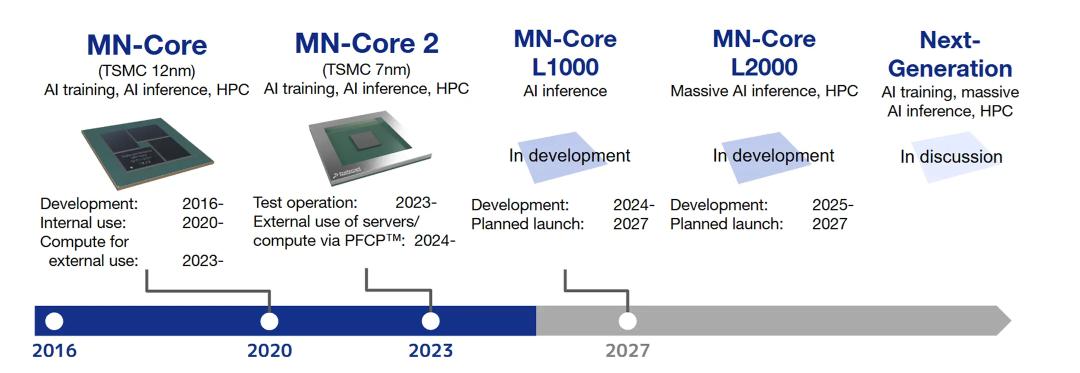
Source: PFN official website
The MN - Core is a chip architecture tailored for matrix calculations in deep learning. During the design, it deliberately removed a large amount of complex control logic in general - purpose CPUs/GPUs. The hardware architecture of the MN - Core integrates a large number of units (MAU) specifically for matrix operations to efficiently execute core operations such as multiplication and addition. The entire architecture adopts the SIMD (Single Instruction, Multiple Data) concept: that is, the same instruction drives a large amount of data for parallel computing at the same time and does not support complex conditional branches. At a higher - level structure, the MN - Core organizes computing resources into "Matrix Arithmetic Blocks (MAB)". Each MAB consists of 4 processor units (PE) and 1 matrix arithmetic unit (MAU) and is combined in a hierarchical structure. In effect, this architecture not only maintains a high degree of hardware specialization but also retains a certain degree of programming flexibility through hierarchical and multi - mode support, making it very suitable for large - scale and regular matrix calculation tasks in neural networks.
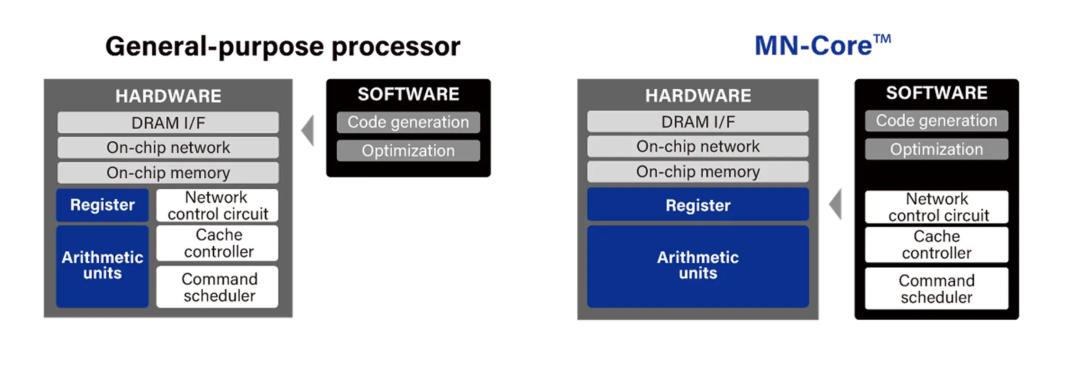
Comparison between MN - core and traditional general - purpose processor architectures (Source: PFN official website)
EdgeCortix is a dark horse in the field of edge AI. Headquartered in Tokyo and founded in July 2019, its concept is to design an AI - specific processor architecture from scratch using a software - first approach. It focuses on "edge - end" AI inference chips, and its core product is the SAKURA - II series of AI coprocessors, which adopt an architecture called DNA (Dynamic Neural Accelerator). In January 2026, its SAKURA - II chip passed the radiation - resistance test of NASA and was verified to be used for lunar missions and orbital satellites. The SAKURA - II supports models with billions of parameters such as Llama 2, Stable Diffusion, DETR, and ViT, with a typical power consumption of only 8W, meeting the needs of various edge generative AI applications in many application fields such as vision, language, and audio.
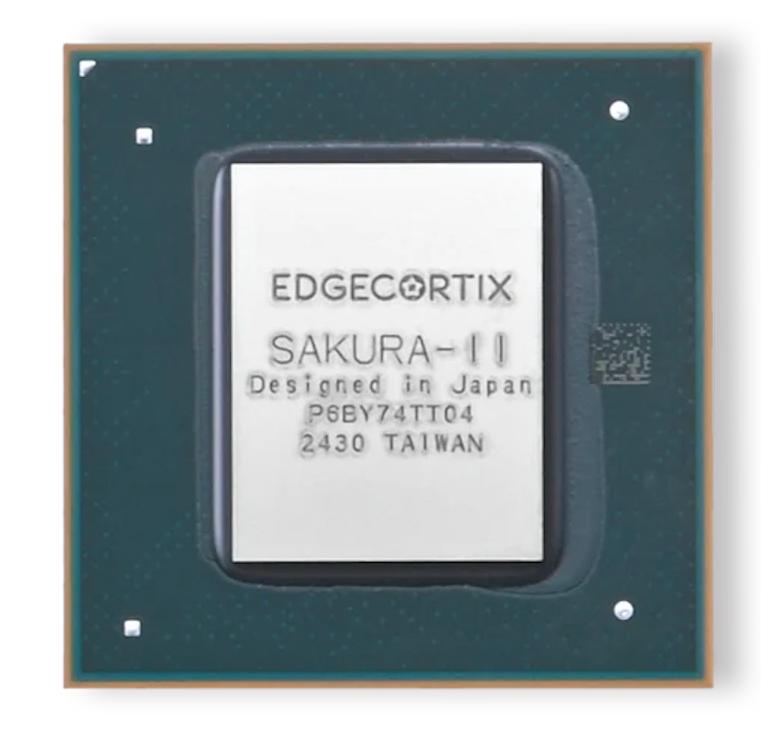
SAKURA - II chip (Source: EdgeCortix)
The laboratory of Professor Matsuo Yutaka, a Japanese AI master, has incubated a number of startups. Although most of them focus on software, they are penetrating to the underlying layer in the form of AI - SoC (System - on - a - Chip). Companies such as EQUES are cooperating with semiconductor design factories to directly solidify specific visual recognition algorithms in chips.
Japanese established chip giants are closely following the AI wave and achieving strategic transformation through "precise positioning". Sony is deeply involved in visual AI chips with its sensor advantages; Renesas is consolidating its automotive semiconductor territory through in - vehicle AI MPUs; Fujitsu is continuously expanding high - performance AI computing chips based on its supercomputer heritage. They are trying to build new barriers in the vertical segments of AI.
Conclusion
Looking back, what Japan is doing is not so much "revenge" against South Korea as a new bet on its own industrial destiny.
Japan no longer tries to replicate the success of Samsung and SK hynix in DRAM production scale, nor does it dream of challenging NVIDIA head - on in the general - purpose GPU track. Instead, it has adopted a calmer and more realistic route: maintaining