Former Alibaba executives embark on entrepreneurship, aiming to reinvent overseas e-commerce with AI | Exclusive interview by 36Kr
Author: Ou Xue
Editor: Yuan Silai
In 2026, how many people are needed to operate millions of SKUs in e - commerce?
The answer from Tang Xing, a former senior Alibaba executive and the founder of the current AI e - commerce startup project Alvin's Club, is: 5 people.
In his latest system, over 90% of the decisions from product selection, recommendation, content generation to fulfillment are dominated by AI, and humans are more like supervisors and backups.
Tang Xing has been involved in the e - commerce industry for about 10 years. He once served as the vice - president of Alibaba Group, the CTO of Alibaba's overseas digital business segment, and the general manager of the global AliExpress platform. He witnessed the evolution of e - commerce from the PC era to the mobile era and then to the content - based form.
When he left his job in 2022, he decided to put aside his inherent knowledge and rethink e - commerce in the AI era.
Currently, traditional e - commerce platforms generally embed AI into existing processes - used to optimize search recommendations, generate product descriptions, or improve customer service responses. In essence, it is still a partial enhancement of the "human - driven link".
However, Tang Xing believes that this level has far from released the capabilities of AI. He tries to build a new model: users put forward requirements, and after AI understands them, it makes product selection decisions and completes fulfillment and delivery.
Starting from the exchange rate difference between the Chinese supply chain and overseas markets, Tang Xing positions Alvin's Club as an "international version of Taobao for overseas middle - class people", but its core is far more than just the cross - border price difference.
Through self - developed user models, product models, and expert models, Alvin's Club's system can understand user needs in real - time, dynamically match products, automatically generate multilingual content and videos, and make end - to - end fulfillment decisions. In this architecture, AI is no longer an "auxiliary tool" but the "business leader".
This full - link AI takeover method reduces operating costs and, in theory, breaks the traditional e - commerce traffic distribution mechanism centered on advertising, and shifts to a "service fee" model centered on user needs.
It is worth noting that although giants such as OpenAI and Google are entering the e - commerce advice segment through large - model capabilities, their models still stay at "traffic distribution" and "demand inspiration" and do not go deep into fulfillment, quality control, and after - sales service.
What Alvin's Club tries to build is a full - closed - loop system from transaction to delivery, allowing the AI agents of merchants, logistics providers, and even consumers to collaborate autonomously.
This positioning not only avoids direct competition with Amazon in the standard - product market but also tries to establish a differential advantage in non - standard long - tail fields such as fashion and home furnishings.
Currently, the global AI e - commerce is still in the early exploration stage. Technological maturity, user acceptance, cross - border compliance, and fulfillment stability are all challenges.
Tang Xing predicts that the next 3 - 5 years will be the explosive period of AI e - commerce, and its evolution speed will far exceed that of the mobile Internet.
In his view, AI does not replace humans but allows humans to become "system designers" from "e - commerce operators" for the first time.
During this window period, startup companies may find structural opportunities in the gaps between giants with their advantages of organizational agility and technology - native features. We had a chat with Tang Xing about Alvin's Club's business experiment and how he views the trend of "AI reconstructing the global retail link".

"Vertical ChatGPT for E - commerce"
Yingke: When did you leave Alibaba to start a business? What were the main considerations at that time?
Tang Xing: I left in September 2022. From 2002 to 2022, I experienced the entire transformation of PC Internet, mobile Internet, and content Internet. E - commerce has evolved from search - driven to personalized recommendation and then to live - streaming e - commerce. In essence, it is still humans making choices among a large number of products, and the cost is getting higher and higher. What I was thinking about at that time was: Should future e - commerce be "people looking for products" or "products looking for people"?
After the arrival of the AI era, the real change lies in understanding users' real needs, fully automatically matching products, and assisting in decision - making. I believe that e - commerce is experiencing its fourth paradigm revolution, and this is the last generational opportunity for our generation.
Yingke: Why did you choose the direction of AI e - commerce?
Tang Xing: I saw several trends. First, there is a gap in the overseas middle - class e - commerce market, especially the opportunity for an "international version of Taobao". Second, AI technology is mature enough to take over the entire e - commerce process. Third, China has three major advantages in supply chain, talent, and infrastructure, which are suitable for attacking the global market.
AI can not only understand users' needs but also understand the cultures and customs of different countries, which gives us the ability to serve global users. The overseas market is larger than the domestic one. Especially, the middle - class in Europe and the United States is larger in scale and has strong consumption ability, while the Chinese supply chain can provide price advantages.
Yingke: How do you view the difference between AI e - commerce and the current mainstream e - commerce models?
Tang Xing: The biggest difference lies in whether AI is "auxiliary" or "dominant".
In our system, from product selection, recommendation, content generation to fulfillment, over 90% of the decisions are dominated by AI, and humans are more like supervisors and backups. Traditional e - commerce still centers on search engines and is restricted by the advertising model, often unable to fully match users' real needs. In our case, AI automatically matches the products with the best quality and the most suitable price according to users' needs, and the platform does not charge advertising fees but only service fees. This is similar to the difference between "assisted driving" and "driverless driving".
Yingke: Specifically, how is your AI shopping agent different from the AI tools of platforms like Amazon and Alibaba?
Tang Xing: We do full - link fulfillment, while other e - commerce platforms do traffic distribution and give advice but are not responsible for product quality, inventory, logistics, and after - sales service. We are a platform responsible for products and fulfillment. Users express their needs here, and AI directly completes the entire process of product selection, placing orders, and fulfillment, and provides quality and delivery guarantees. We are more like a "vertical ChatGPT for e - commerce", completing closed - loop transactions in the e - commerce scenario.

Alvin's Club homepage (Source: Company)
Yingke: Currently, what is the accuracy of AI in each major link of Alvin's Club? Which links still require manual intervention?
Tang Xing: There are basically no problems with text generation. The error rate of picture generation is in the single - digit percentage, and the error rate of video generation is currently about 30%, which needs manual labeling and correction. The abnormal rate of logistics monitoring is between 1% - 3%. AI is still in its "infancy", but we insist on letting AI be in the lead. The system will improve rapidly with the model's capabilities, and humans only handle abnormal cases (such as video glitches and wrong logistics numbers).
Yingke: You have "three core models" - the user model, the product model, and the expert model. What roles do they play respectively?
Tang Xing: The user model understands consumers' preferences, budgets, family situations, etc., which is equivalent to the digital avatar of users. The product model understands the structured attributes and value systems of global products. The expert model is responsible for disassembling the e - commerce link and commanding various AIs to perform tasks in different links, such as product selection, logistics, and customer service. The three work together to achieve full automation from understanding users to executing transactions.
Yingke: How does the platform specifically ensure product quality and fulfillment?
Tang Xing: We provide two major guarantees. One is the fulfillment guarantee. The products must be delivered; otherwise, we will give a full refund. The other is the quality guarantee. If there are any problems, we will also give a full refund. We implement hierarchical supply - chain management - cooperate with pallet suppliers for core categories, directly connect with manufacturers for best - selling products, and select high - quality products from platforms like 1688 for long - tail products. We conduct full - link digital monitoring to ensure the quality of product selection and fulfillment.

Good at Non - standard, Long - tail, and Fashion Products
Yingke: What is your profit model?
Tang Xing: We only charge a service fee, which is about 10% of the total amount of "product + freight". This is not high compared with the overseas restaurant tips (18% - 30%). We don't mark up the products and logistics and make a profit from the service fee.
Yingke: How do you ensure the price advantage?
Tang Xing: AI has greatly reduced our operating costs. We only need 5 people to operate millions of SKUs, while traditional e - commerce requires thousands of people. Also, the supply chain is directly connected to the Chinese production end, reducing the intermediate price - adding links. In addition, we use a third - party mature logistics network and only do digital scheduling and monitoring. In general, for non - standard and long - tail categories with comparable specifications and quality, the price is usually 30% - 70% lower than that of Amazon.
Yingke: What is the current cost structure of the company?
Tang Xing: There are mainly three parts: labor wages, AI infrastructure costs, and user growth investment. The labor cost is relatively fixed, and its proportion will decrease as the scale expands. Our current cash flow is still very healthy. The new financing is mainly used for model research and development and future user growth.
Yingke: Why did you choose North America, Europe, and Australia as the first - launch markets?
Tang Xing: These regions have a high acceptance of AI, a large middle - class population, and a significant exchange rate difference with China, so the price advantage of products is obvious. Although the acceptance of AI in the Middle East and other regions is also increasing, the language and cultural complexity are relatively high, so we will promote it later.
Yingke: Will you enter the Chinese market?
Tang Xing: Currently, no. The domestic e - commerce market is very competitive, and our advantage lies in using the Chinese supply chain to serve the overseas market. We don't have an obvious advantage in the domestic market.
Yingke: Are you in a competitive or complementary relationship with Amazon?
Tang Xing: In the initial stage, it can be said to be complementary. Amazon is good at standard products and best - sellers, while we are good at non - standard products, long - tail products, and fashion products. The overseas e - commerce market is fragmented, and Amazon's market share is less than 30%, so there is enough room. However, in the long run, the AI - native e - commerce paradigm will indeed have a seesaw relationship with traditional e - commerce. Generally speaking, we still focus more on market opportunities rather than direct competition.

Star outfit recommendation module on the homepage - Star homepage (Source: Company)

The Trend of AI is Irreversible
Yingke: What stage of development is the company currently in? How is the user growth situation?
Tang Xing: In 2023, we mainly worked on the payment system. At the beginning of 2024, we fully shifted to AI e - commerce. In May 2025, we launched the first AI version, and we are still in the rapid iteration stage, updating the version every week. In terms of user growth, we haven't carried out large - scale promotion yet. It mainly relies on the natural growth of the product and social content dissemination. However, the monthly order volume has increased by 10 - 20 times, and we expect to start large - scale user growth in 2026.
Yingke: In the future, will Alvin's Club open the platform to merchants or service providers?
Tang Xing: Yes. Merchants, logistics providers, and service providers can all access the platform through their AI agents to achieve fully automated transactions and collaborations. It is expected that the AI agents of merchants will be relatively mature next year.
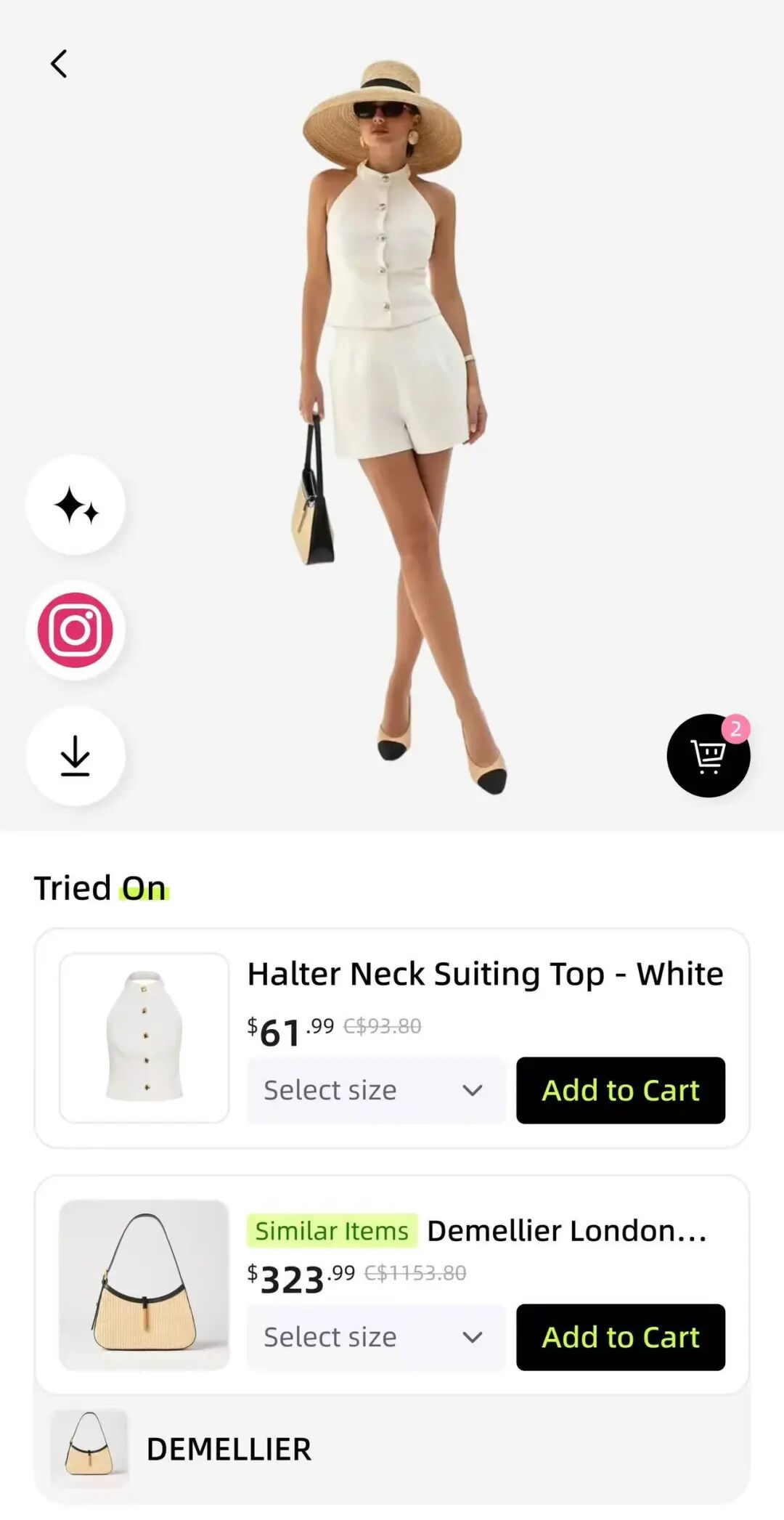
Get the outfit generation result through the Try - On function in the app (Source: Company)
Yingke: How long do you think it will take for AI e - commerce to reshape the industry?
Tang Xing: Within 3 - 5 years, the impact of AI e - commerce on the industry will be very obvious. The development speed of AI far exceeds that of the mobile Internet, especially in the aspects of understanding user intentions and generating product content. The full - link fulfillment and expert models will be a bit slower, but the overall trend is irreversible.
Yingke: What will be the strategic focus of the company in the next few years?
Tang Xing: I will invest 80% of my energy in