The car is 5.4 meters long. Can new energy vehicles be even bigger?
In August last year, the Tesla Model YL suddenly appeared on the official website. With a vehicle length of nearly 5 meters and a wheelbase of over 3 meters, it precisely hit the sweet spot of Chinese consumers. Together with the refreshed Model Y, which is a sales hit, it successfully saved Tesla's delivery volume.
After the in - China testing of FSD and the myth of the large - order of Xiaomi YU7, the keyword in the automotive market at the end of the year and the beginning of the new year is "Three - row SUVs". These vehicles generally have a length of over 5 meters and a wheelbase of over 3 meters, with a six - seat layout being the mainstream. They are doing the SUV business following the standards of MPVs.
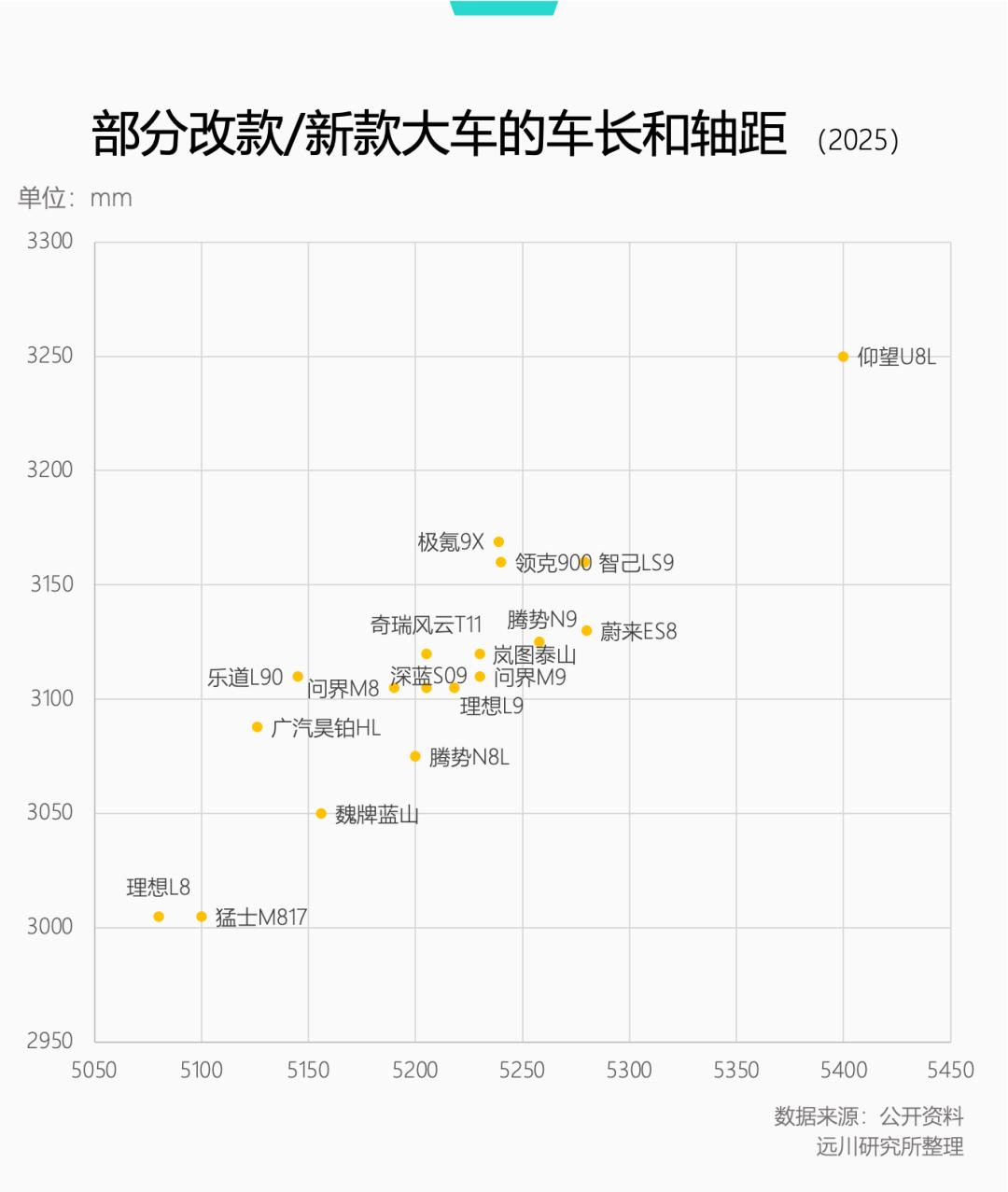
One month after the release of the redesigned Denza N9, the fine - tuned version N8L was quickly launched. With a length of 5.2 meters, it is definitely a large - sized vehicle. However, when parked next to the Yangwang U8L, which is 5.4 meters long and has a full - load mass of 4.2 tons, it might feel intimidated.
Not long ago, the NIO ES9, first introduced by the Ministry of Industry and Information Technology, comprehensively surpasses the Rolls - Royce Cullinan in size and is destined to be incompatible with mechanical parking spaces. The "Datang", a BYD Dynasty Network 9 - series SUV, has also been pre - exposed. Its length, width, and height outperform the Wenjie M9. If your partner sits in the third row, it's almost like a long - distance relationship.
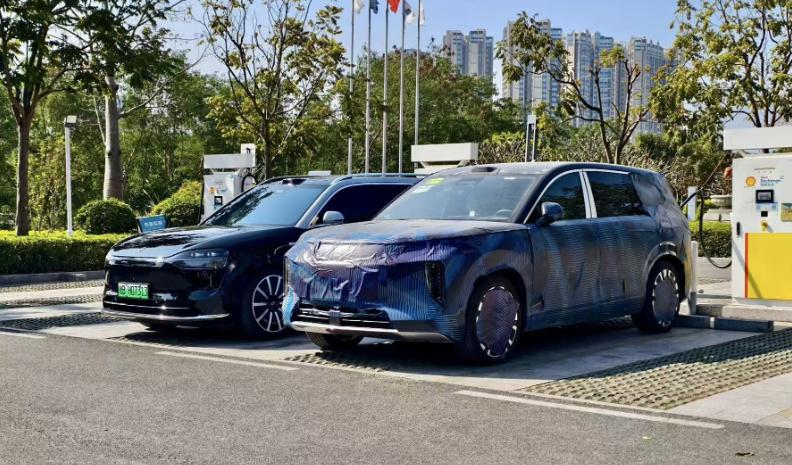
The BYD "Datang" exposed not long ago
In this year's new car market, the trend of larger vehicles is bound to continue. Judging from the vehicle length and wheelbase, the Li L9, which used to be known as a "mobile home" and had a large build, seems cute and small compared to a bunch of "mobile large - scale apartments". A vehicle with a width of 2 meters parked side by side in an old - fashioned parking space can not only test your driving skills but also measure the relationship with your neighbors.
It's still unknown how the diverse three - row SUVs will reshape the automotive market landscape. However, it's certain that either the reversing skills of car owners or the automatic parking algorithms of car manufacturers are about to face a severe test.
Getting Bigger and Bigger
Whether it's the wheels that visually occupy most of the lane or the extra half of the front of the car in the parking space, they all point to one trend: It's not that the road has become narrower, but that the cars have become larger.
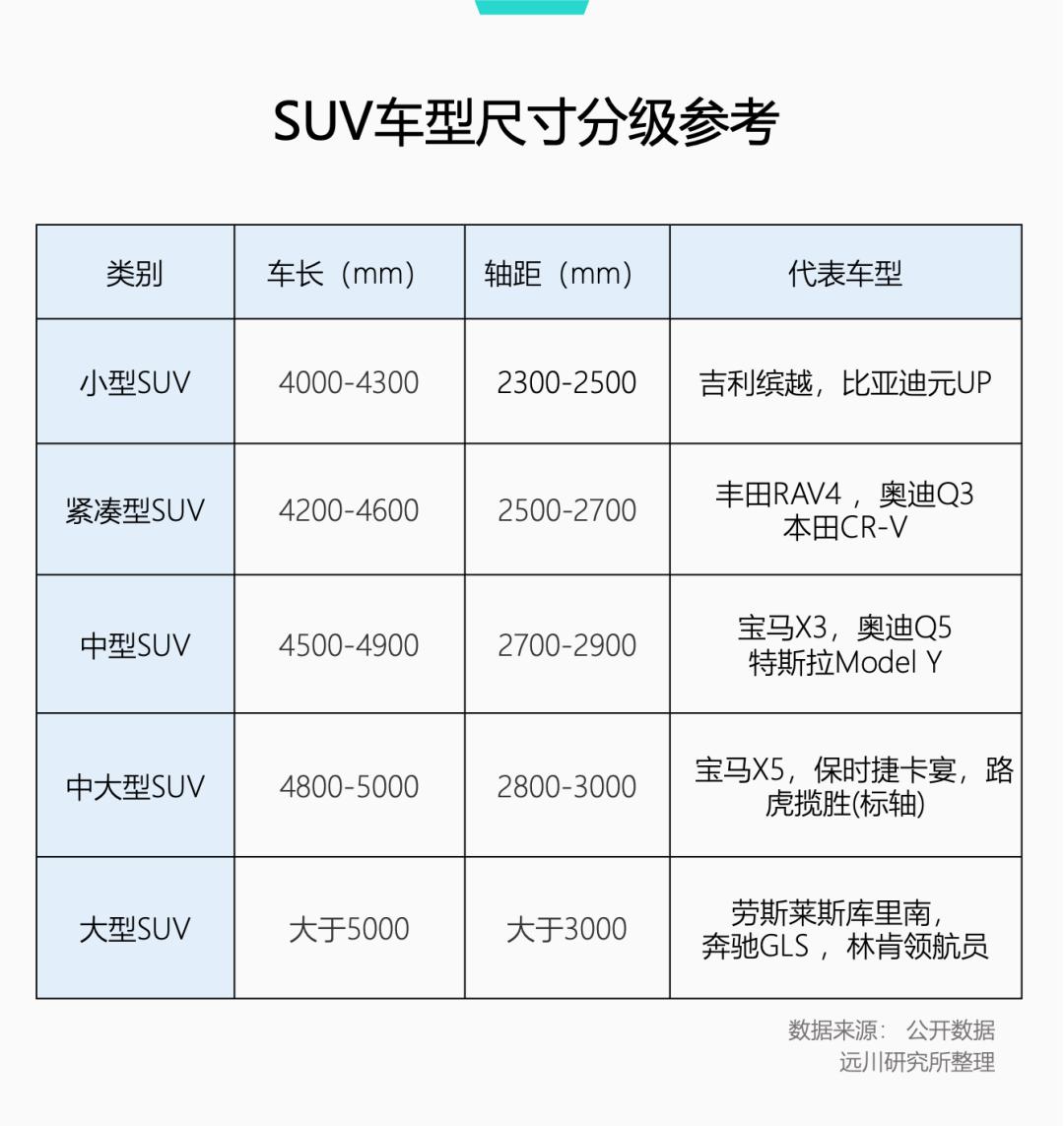
There is no strict standard for classifying vehicle sizes. According to the common classification method, mid - large SUVs have a length between 4.8 - 5 meters and a wheelbase between 2.8 - 3 meters. Large SUVs have a length of over 5 meters and a wheelbase of over 3 meters.
According to this standard, the BMW X5 barely reaches the threshold of a large SUV. The dimensions of various mid - large SUVs in China are almost on par with large SUVs. The newly launched large SUVs have a length of over 5.1 meters and a wheelbase of over 3.1 meters.
Compared with compact SUVs, which are mainly for family use and have an economical and practical image, large SUVs are a new blue ocean in the new - energy vehicle market.
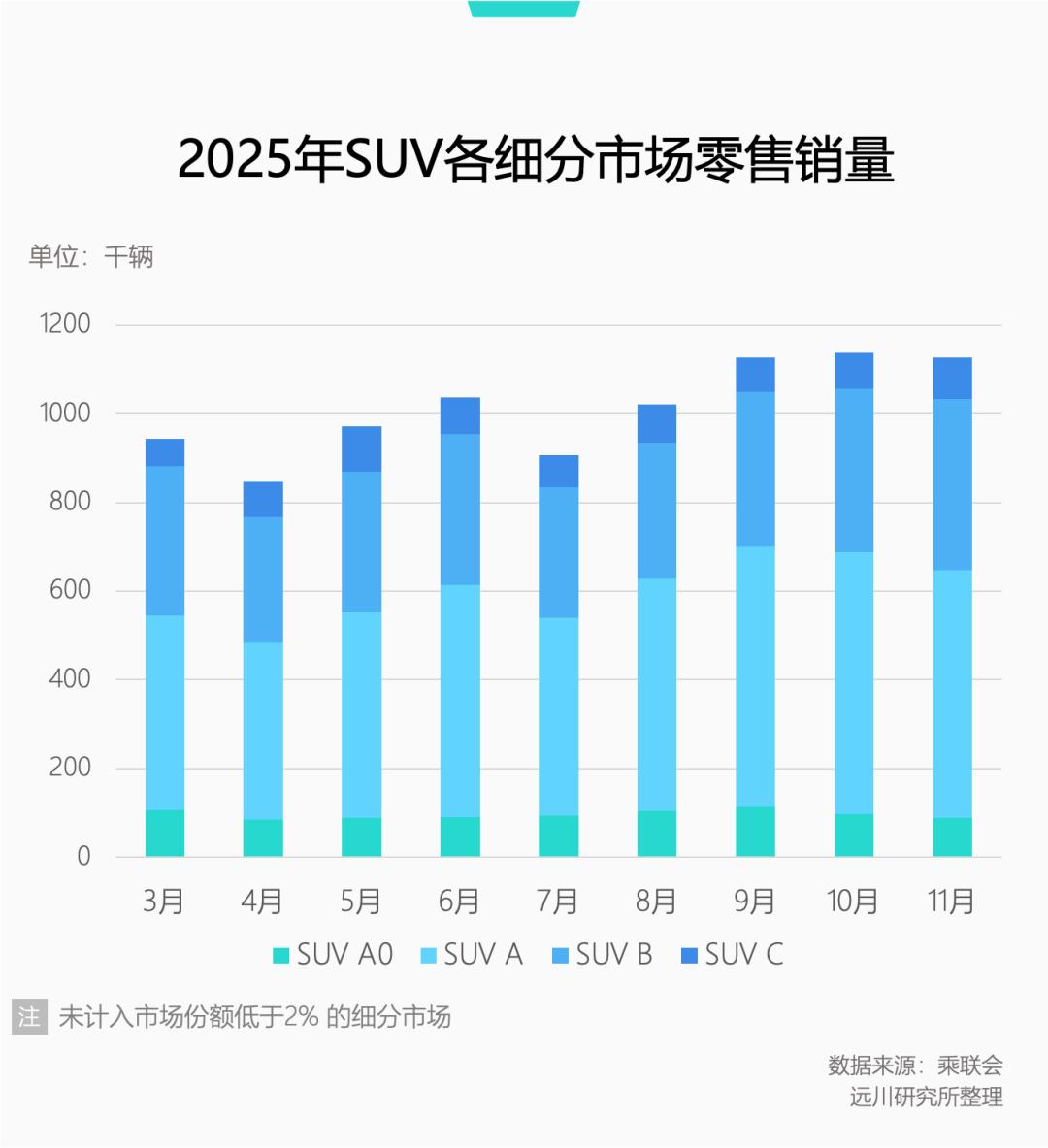
The former is the absolute sales leader, accounting for over 25% of the passenger - car market share, which is equivalent to half of the SUV market. In contrast, large vehicles have always been a niche market.
Take mid - large SUVs as an example. Since their market share exceeded 2% in September 2022, the market share has remained between 3% - 4%, while that of large SUVs is less than 2%[2].
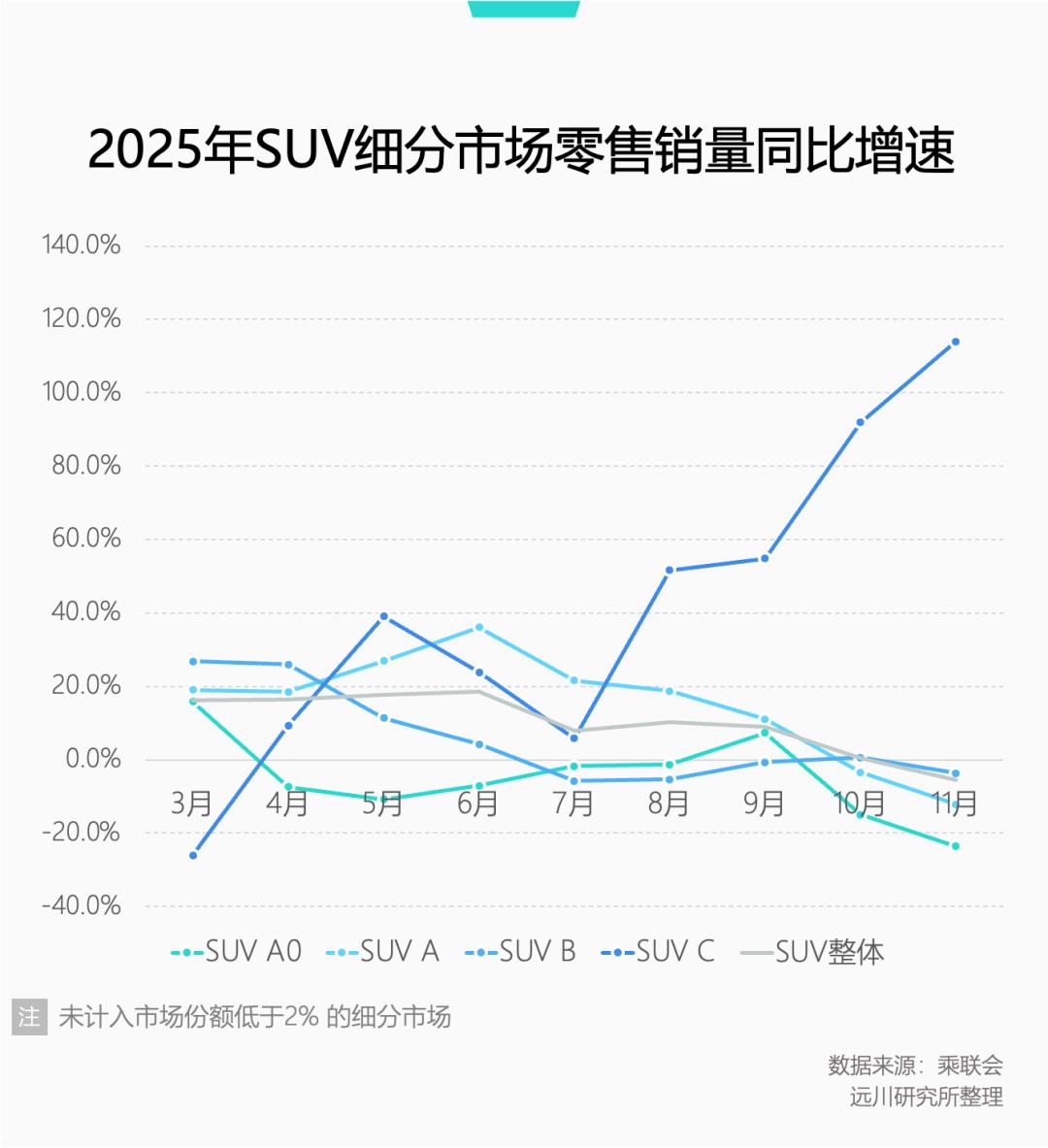
However, since the second half of last year, the sales growth rate of large vehicles has overtaken that of other segments in terms of data. The overall growth rate of SUVs stopped at 10%. After hitting the bottom in July, the mid - large SUV market quickly rebounded and became the only SUV market with positive growth recorded in November. In that month, nearly 100,000 mid - large SUVs were sold, exceeding the sales of small SUVs.
A short - term high growth rate may be an accidental event, but a growth cycle of nearly half a year is long enough to filter out many random variables.
The performance of the large SUV market is basically the same. In 2023, there were less than 5 large SUVs with annual sales of over 10,000 units in China. The best - selling one was the Li L9, with an annual sales volume of only 110,000 units.
By 2025, six - seat large SUVs will become the absolute protagonists. The annual sales of the Wenjie M8 and M9 will both exceed 100,000 units, and there will be over 10 large SUVs with sales of over 10,000 units[3]. The LeDao L90 and the NIO ES8 live up to expectations. One boosts the sales volume, and the other boosts the gross profit margin.
Car manufacturers like to produce large vehicles, and consumers like to buy them. The two sides hit it off, and the overall size of new - energy vehicles on the road has increased. Large SUVs will stand out in 2025 and become the most promising segment among SUV models.
Don't say that only Americans like pickups, because the Chinese have their own "pickups", which are called three - row SUVs.
It's All the Fault of the Batteries
The "upsizing" of new - energy vehicles is not a sudden revolution. Before the vehicle body and wheelbase were "lengthened", new - energy vehicles generally went through a process of "widening".
For example, the width of the Mercedes - Benz S is 1921mm. Its size is like a typical double - door refrigerator among fuel vehicles, but in the new - energy market, it is narrower than B/C - class vehicles such as the NIO ET5 (1960mm), XPeng P7 (1970mm), and Zeekr 001 (1999mm).
The culprit for new - energy vehicles of the same class being wider than fuel vehicles is the battery.
The chassis of new - energy vehicles is filled with batteries. Compared with fuel vehicles of the same specification, new - energy vehicles generally have a higher body and a thicker chassis. To fit more batteries, it's difficult to continue "thickening vertically", so the vehicle body has to be lengthened and widened.
Therefore, many new - energy vehicles have a 532 structure, that is, a length of 5 meters, a wheelbase of 3 meters, and a width of 2 meters.
Another reason is safety. In a side - impact collision of a fuel vehicle, the door anti - collision beam and the B - pillar are the first stress points, and the energy is transmitted and diffused to various parts of the vehicle body through the longitudinal and transverse beams of the floor and the roof.
However, the chassis of new - energy vehicles is occupied by the battery. A side - impact collision will directly hit the battery pack. Therefore, the mainstream approach is to arrange several cross - beams on the floor and thicken and strengthen the sill beams to conduct and absorb the collision energy and protect the battery safety. The price is that the vehicle becomes wider and wider.
Now, the vehicle size is further lengthened, and six - seat large vehicles are being launched in batches. The battery still has to take the blame.
In 2019, most pure - electric vehicles sold in China were positioned as mid - sized or smaller, and the entire market was almost dominated by small vehicles. The battery capacity was generally around 30kWh, and most of them had a cruising range of less than 300km (CLTC condition)[4]. Car manufacturers aiming at six - seat SUVs were basically discouraged by two problems:
Firstly, the batteries were too expensive. In the early mid - size SUV camp, both the Mercedes - Benz EQC and the Audi e - tron were equipped with a battery capacity of over 80kWh, and their prices were not cheap, both exceeding 500,000 yuan. The first - generation NIO ES6, which also came standard with an 84kWh battery pack, had a starting price of over 350,000 yuan.
At that time, the cost of power batteries was around 1,500 yuan/kWh. The value of an 80kWh battery pack exceeded 100,000 yuan, which directly increased the vehicle cost and made it out of reach for the mainstream market.
Secondly, the battery energy density was too low. Take the first - generation Mercedes - Benz EQC as an example. The 80kWh battery pack weighed 635kg, and the system energy density was only 125Wh/kg. This specification basically sentenced large vehicles to death.
A power battery is a battery pack composed of hundreds or thousands of cells. The energy density of a single cell is the theoretical performance limit of the battery system. Since a large number of structural components are introduced into the battery pack, the grouping efficiency (battery pack energy density/cell energy density) will inevitably decrease, resulting in the energy density of the whole pack being lower than that of a single cell.
Making the vehicle larger can accommodate more batteries, but the overall vehicle weight will also increase. The energy consumption is consumed by the increased weight of the battery itself, and the efficiency of improving the cruising range is very poor. Even if the drag coefficient and energy - consumption control level are optimized to the limit, it's still difficult to alleviate the problems of absolute cruising range and winter cruising - range attenuation.
The batteries were both expensive and heavy. Even if car manufacturers tightened their belts, they could only get a cruising range of less than 400km. On the contrary, the range - extender solution, which the industry was ambivalent about, perfectly solved the problems of high cost and low cruising range, leaving behind the legend of the ideal family - friendly car.
However, in the past few years, the scale effect of batteries has been gradually released, and the raw - material prices have been relatively stable, which has led to a significant decrease in costs. Although the price of lithium carbonate soared last year, it's hard to repeat the tragic situation of 600,000 yuan/ton. Large - capacity batteries are no longer a luxury.
At the same time, battery manufacturers have spared no effort to improve the energy density of single cells. Coupled with the application of the CTC (Cell to Chassis) solution, a large number of structural components are removed, and the battery is directly integrated into the chassis, which greatly reduces the energy - density loss caused by battery grouping.
Since then, large new - energy vehicles have been launched in batches, and large - capacity batteries have become a standard configuration.
The battery capacity of large pure - electric SUVs easily exceeds the 80kWh threshold. Range - extender vehicles also have a large fuel tank and a large battery, and the comprehensive cruising range has been increased to over 1,000km.
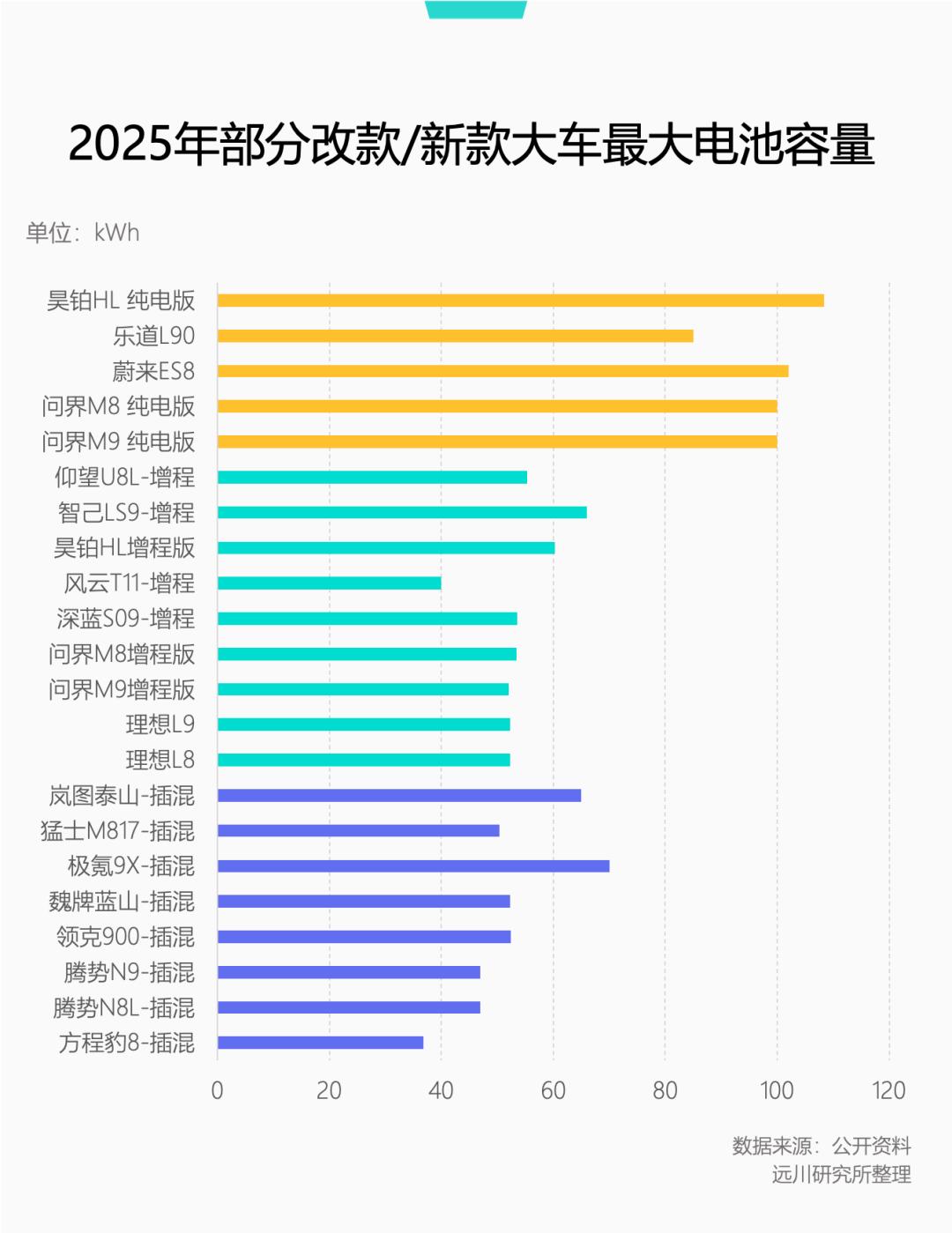
Compared with a reliable cruising range and a spacious and comfortable interior space, a little nervousness when parallel parking is nothing, right?
Explicit Demands
As the largest segment of the passenger - car market, SUV models correspond to the most mainstream consumption scenario of "family".
The characteristic of family cars is "wanting it all": Most of the time, only one person drives, but there are always times when the whole family goes out; You don't take long - distance trips very often, but you still need to leave space for everyone's luggage. "Able to carry a lot" is a basic requirement. The three - row seats in an SUV are like the camera on a laptop, emphasizing "I may not use it, but you can't not have it".
By 2025, the number of cars per 100 households in China reached 52.9, an increase of 1.7 compared with the previous year, but it is still significantly lower than that in developed economies. That is to say, a typical Chinese family is likely to have only one car. In the context of new - energy vehicles, "cruising range" and "space" almost dominate the consumer decision - making process.
If economic conditions and objective road factors are not considered, almost no one in the world doesn't love more space and better comfort. Especially, the Chinese have always had a special preference for "large vehicles". Even smart, which is known for its compact size, is no exception:
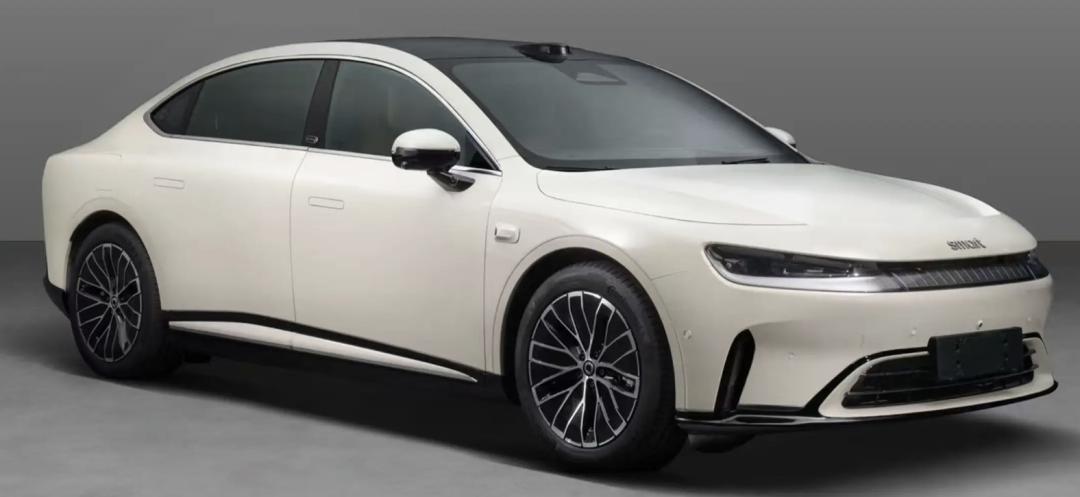
The official photo of the smart #6 from the Ministry of Industry and Information Technology
At the same time, the penetration rate of new - energy vehicles in China has exceeded 50%. Large SUVs, with high demand and considerable profit margins, are almost the last blue ocean in the new - energy market.
Fuel vehicles emphasize "mechanical priority". The chassis needs to accommodate various mechanical structures. For rear - wheel - drive and four - wheel - drive vehicles, to accommodate the drive shaft, the floor of the third row has to be raised inevitably, and the height of the third - row seats has to be reduced to gain headroom. The batteries of electric vehicles can be laid flat on the chassis. With the CTC and multi - in - one electric drive as representatives, the chassis integration degree is also constantly improving, releasing more cabin space.
Therefore, the newly launched three - row SUVs not only overcome the space competition inside the vehicle but also add electric adjustment functions to the third