Unveiling the Dark Horse in the Database Industry Valued at Billions: Used by ByteDance, Alibaba, Tencent, Microsoft, and Tesla
Riding on the wave of AI, a startup in the open - source database field has seen its valuation increase by 2.5 times in just 7 months, soaring to $15 billion (approximately RMB 104.5 billion).
According to a report by Zhidx on February 5th, at the beginning of 2026, ClickHouse, an American open - source database startup, officially announced that it had secured $400 million (approximately RMB 2.79 billion) in new financing, catapulting its valuation to over 100 billion RMB.
In the field of AI data analysis, ClickHouse is regarded by the industry as a strong competitor to two major giants:
On one hand, there is Databricks, which has received consecutive investments from NVIDIA. On the other hand, there is Snowflake, founded by senior Oracle experts. ClickHouse, officially established in 2021, has completed 4 rounds of financing to date, with the cumulative financing amount exceeding $1.05 billion (approximately RMB 7.31 billion).
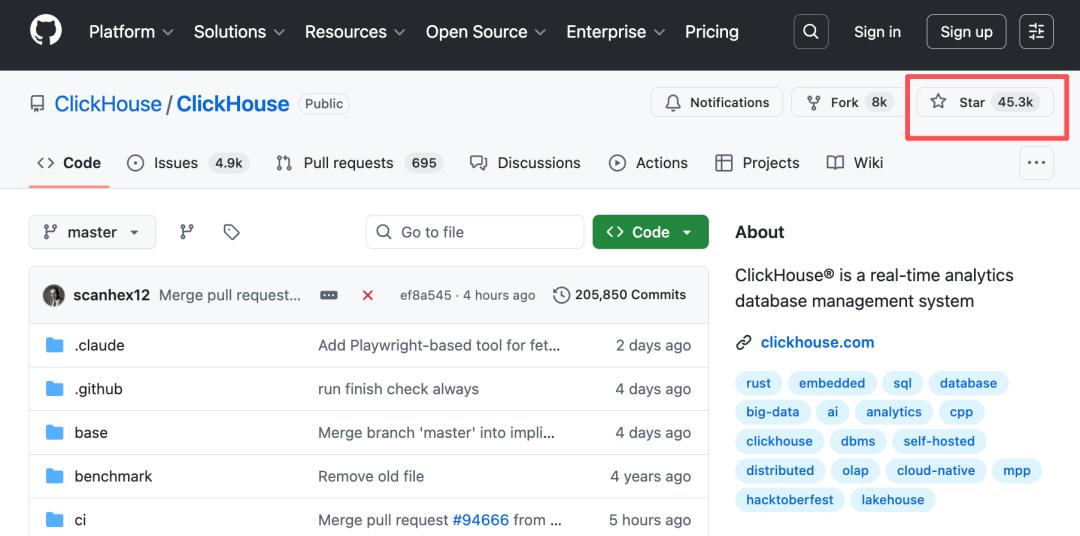
This startup has not only won the favor of the capital market but also performed outstandingly in the open - source ecosystem. The number of Stars of its open - source database project on GitHub has reached 45,290, and it has won countless star customers globally with its strong capabilities. Its customers include well - known domestic and overseas giants such as ByteDance, Tencent, Alibaba, Meta, Microsoft, Tesla, Sony, etc. Moreover, executives from OpenAI and Anthropic have specifically praised ClickHouse for its significant contribution to the release of GPT - 4o and Claude 4.
From the data released by ClickHouse, when compared with the currently popular Snowflake, ClickHouse's cost is 1/4 of Snowflake's, its query speed is 3 - 5 times faster, and its compression rate is increased by 38%.
ClickHouse's history can be traced back to Yandex, a Russian internet giant founded 28 years ago. Its founder, Alexey Milovidov, launched an experimental project within Yandex in 2009 and applied this database to Yandex's internal Metrica web analytics platform in 2012.
In 2021, Milovidov joined forces with former Salesforce executive Aaron Katz and former Google engineering vice - president Yury Izrailevsky to officially spin off ClickHouse from Yandex.
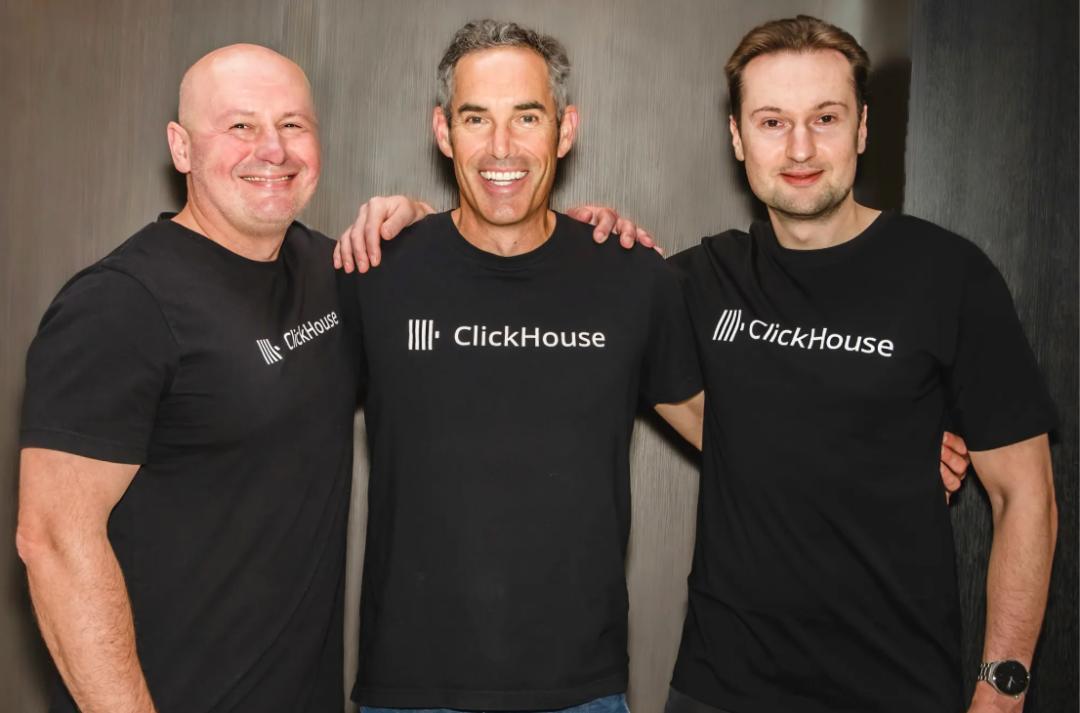
▲ From left to right: Yury Izrailevsky, Aaron Katz, Alexey Milovidov
It is worth mentioning that Dragoneer, the leading investor in ClickHouse's latest financing, has previously invested in ClickHouse's competitors such as Datadog, Snowflake, and Databricks. Christian Jensen, the co - head of private equity investment at Dragoneer, said after comparing various products that ClickHouse currently has the best "real - time analysis" capabilities.
This open - source database startup, which has only been established for 4 years, has been attracting a large amount of financing and winning numerous major global customers. What are its outstanding features? We attempt to find the answer to this question by dissecting ClickHouse's business system and architecture papers.
01 Secured $700 million in financing in 4 years, with ARR increasing by over 250% year - on - year
The establishment of this open - source database, ClickHouse, can be traced back to 2009.
Alexey Milovidov, the founder and CTO of ClickHouse, joined Yandex, the largest search engine company in Russia, in 2008. In 2009, he and his team launched an experimental project to generate analytical reports in real - time from non - aggregated data. This project was the prototype of ClickHouse.
In 2012, this database was officially launched, but initially, it only served Yandex's internal Metrica web analytics platform, which was also the second - largest web analytics platform in the world at that time.
It wasn't until 2016 that the ClickHouse database was open - sourced, and it officially started independent operations in 2021. Currently, Milovidov serves as the CTO at ClickHouse, Katz is the CEO, and Izrailevsky is the president in charge of product management.
The outstanding feature of this database is its ability to extremely efficiently ingest hundreds of petabytes of data stored in the database and perform queries for various analytical use cases on this data, while obtaining query results in milliseconds. As soon as ClickHouse was established, it started attracting major players, with financing and large customers flocking to it.
In the same year it became an independent company, this startup announced that it had received two rounds of financing totaling $300 million (approximately RMB 2.1 billion), and its valuation soared to $2 billion (approximately RMB 13.9 billion), making it a unicorn. In August 2021, ClickHouse announced that it had raised $50 million (approximately RMB 350 million) in Series A financing, and two months later, it completed $250 million (approximately RMB 1.7 billion) in new financing, with participation from well - known venture capital firm Benchmark and Russian search giant Yandex.
From June 2025 to the present, in just half a year, the company has secured two large - scale financings, with participation from well - known global investment institutions such as Dragoneer and BVP. At its first user conference, OpenHouse, in June 2025, it announced that it had received $350 million (approximately RMB 2.4 billion) in Series C financing, and on January 17th of this year, it announced that it had received $400 million (approximately RMB 2.8 billion) in new financing. Now, ClickHouse's valuation has reached $15 billion (approximately RMB 104.5 billion).
This startup's commercialization pace is also rapid. Its business model is to generate profits through the sale of managed cloud services. Katz revealed that the company's annualized revenue has now reached hundreds of millions of dollars, and its Annual Recurring Revenue (ARR) in 2025 increased by more than 250% year - on - year.
02 Query speed is 260 times faster than MySQL, with millisecond - level query response
Strong product capabilities are the foundation of ClickHouse's success.
Generally speaking, OLAP and OLTP are the core data processing architectures designed for two different business scenarios in the database field. For example, the well - established database MySQL is an OLTP database, while ClickHouse is an OLAP database.
The difference between the two is that OLTP uses row - based storage to meet the needs of high - frequency transaction processing, while OLAP uses column - based storage to achieve efficient data analysis. Nowadays, the ability to perform real - time query analysis, which helps enterprises make real - time decisions, reduce costs, and improve efficiency, has almost become a necessity for databases. Therefore, OLAP databases show greater application potential at present.
Previously, when using traditional row - based OLTP databases to process data, it might take minutes or even hours to get an answer, while OLAP databases can obtain answers in milliseconds. According to a report by analysis firm Marko Medojevic, when analyzing a dataset containing 11 million records, ClickHouse's query speed is about 260 times faster than that of the OLTP database MySQL. This also reflects the advantages of OLAP databases to some extent.
Specifically, ClickHouse is an open - source OLAP database that uses column - based storage. Its functions are similar to Google Analytics, and its goal is to execute analytical queries quickly while processing trillions of rows and petabytes of data.
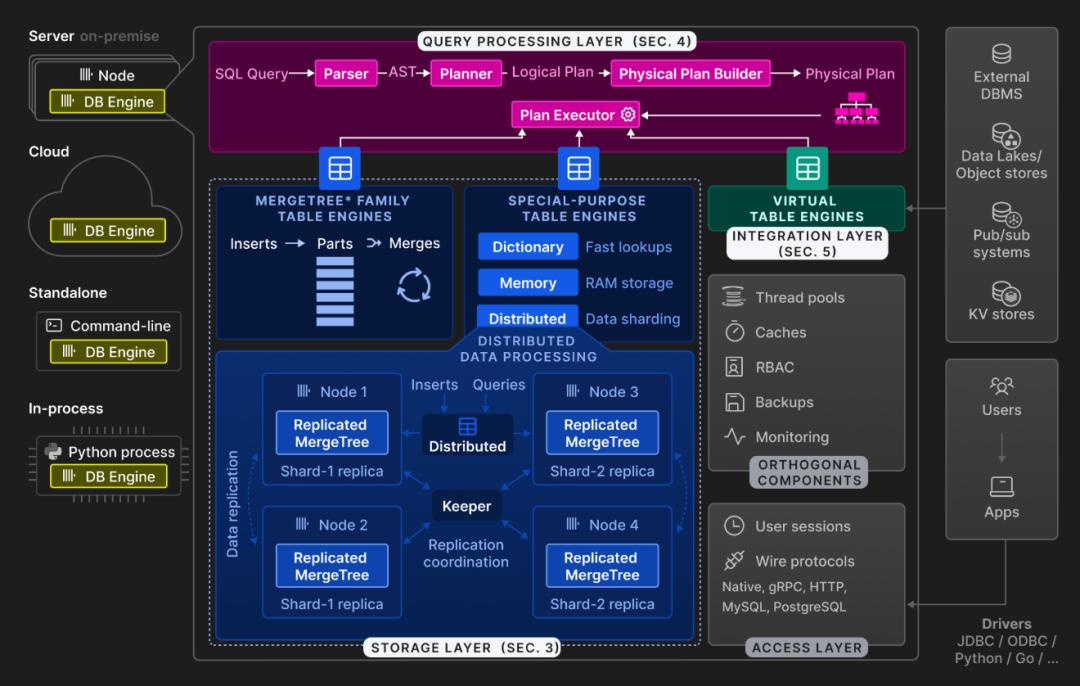
▲ The overall architecture of the ClickHouse database engine
On its official website, ClickHouse compared several mainstream databases. The comparison with the AI data analysis platform Snowflake shows that ClickHouse's cost is only 1/4 of Snowflake's, but its query speed is 3 - 5 times faster.
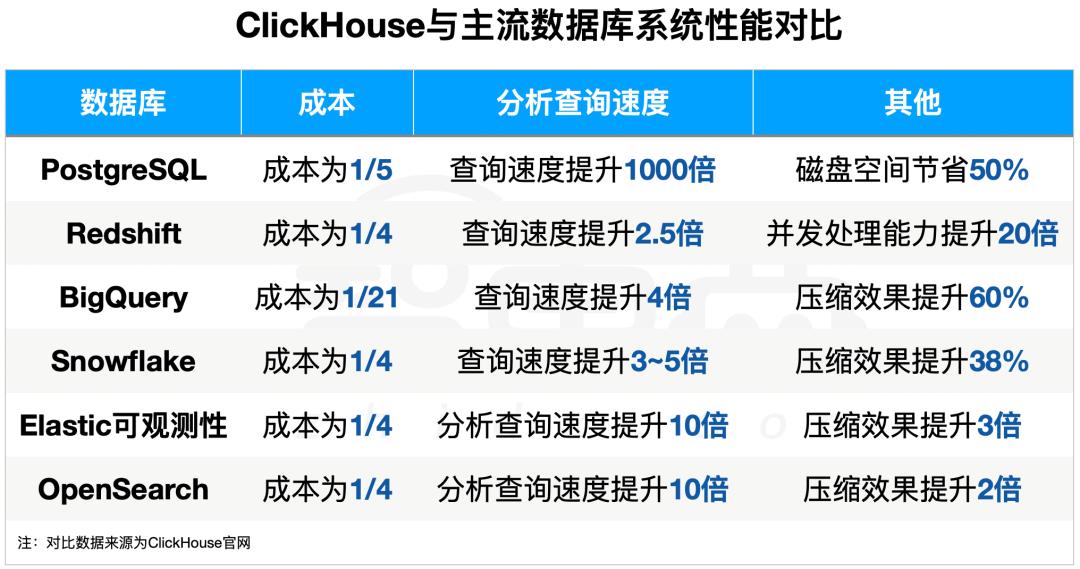
▲ Performance comparison between ClickHouse and mainstream database systems (Data source: ClickHouse official website, compiled by Zhidx)
For an enterprise's business system, a database needs to efficiently integrate and process massive multi - source data and support real - time and complex analytical decision - making. In the face of many key challenges in this process, ClickHouse's key features can effectively improve the comprehensive processing capabilities of the database.
For example, the database supports high ingestion rates, is suitable for high - concurrency and low - latency query scenarios, and has a high degree of openness. It can be compatible with diverse data storage systems, storage locations, and formats, and is equipped with an easy - to - use query language that supports performance analysis. It can run flexibly on various types of hardware, from old laptops to high - performance servers.
These are the key pain points of modern analytical data management systems, and ClickHouse is a database that supports multiple data storage engines. It can import almost any data source into the ClickHouse database and support fast and flexible drill - down analysis. In addition, Katz revealed when receiving the first round of financing that the core difference of ClickHouse also lies in the fact that most open - source database tools are developed based on Java, while ClickHouse is written in C++, so it can process large - scale data faster.
03 A top - tier customer lineup and a key contributor behind GPT - 4o and Claude 4
Although the open - source project itself is free, ClickHouse has built a huge business empire on this foundation and has over 3,000 customers globally through its fully managed service, ClickHouse Cloud.
The customer lineup disclosed by this startup is luxurious, covering domestic and overseas technology giants and top startups in vertical sectors. For example, domestic leading internet companies such as ByteDance, Alibaba, and Tencent, domestic automotive leaders such as Changan Automobile, overseas leading companies such as Microsoft, Tesla, Meta, Sony, and Netflix, as well as top startups in the AI field such as OpenAI, Anthropic, Cursor, and Character.ai.
In the field of data processing, both Tencent and ByteDance in China have built their own products based on this open - source database.
Tencent Cloud has built the Tencent Cloud Data Warehouse TCHouse - C based on ClickHouse, which can help enterprises quickly build a petabyte - level real - time data warehouse in just a few minutes. The R & D team at ByteDance has developed the ByteHouse technology based on the open - source database management system ClickHouse. WeChat currently uses ClickHouse to store log data because logs usually contain a large amount of repeated content, and using ClickHouse can achieve a high compression rate and reduce the storage space occupied by logs.
In the currently popular field of generative AI, ClickHouse has also become the core infrastructure behind Anthropic's Claude 4 and OpenAI's GPT - 4o.
Anthropic customized a special version suitable for offline isolated environments based on the architecture of ClickHouse Cloud. From the control plane to the data plane, all core components are independently operated and maintained by Anthropic's internal team. Maruth Goyal, a technology R & D engineer at Anthropic, said that ClickHouse has made significant contributions to its R & D and launch of Claude 4, such as providing high - speed analysis capabilities and flexible data processing solutions for the model.
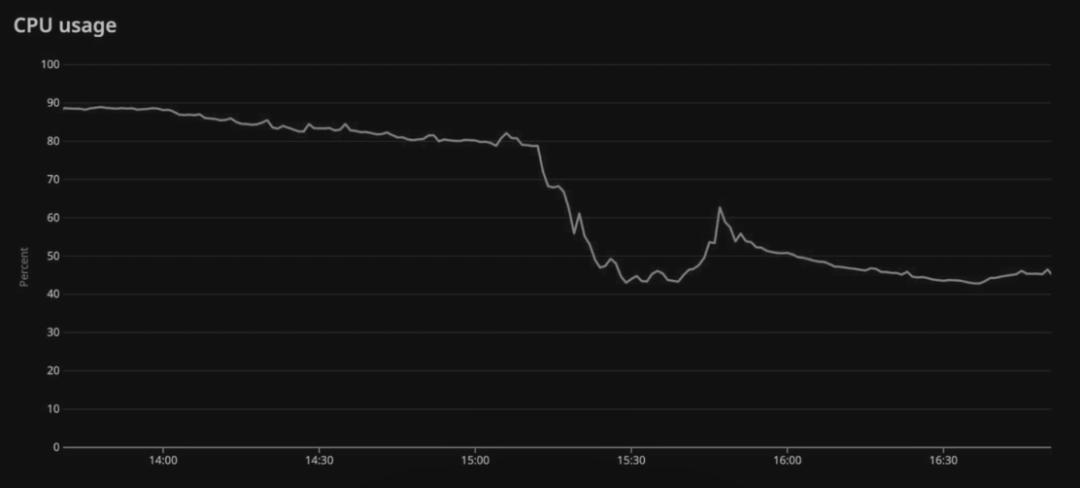
Akshay Nanavati, an engineering manager at OpenAI, said that when OpenAI officially launched the GPT - 4o image generation function in March 2025, its servers were on the verge of collapse, and the system CPU usage soared by 50% instantly. The team quickly expanded the ClickHouse cluster to resolve the crisis. Based on ClickHouse, the team only needed to modify one line of code, replacing the division operation with a combination of multiplication and bitwise operations, and the system CPU usage immediately decreased by 40%.
However, Katz revealed that ClickHouse is still operating at a loss and is making forward - looking investments. On January 17th, this startup acquired the open - source large - language - model observability platform Langfuse, whose products can ensure that the output of AI systems is accurate, safe, and in line with user intentions. The number of Stars of the Langfuse open - source project on GitHub has exceeded 20,000.
In addition, in October 2025, the company also hired Jimmy Sexton, the former head of investor relations at Snowflake, as its Chief Financial Officer. However, Katz revealed that ClickHouse is not ready for an IPO and hopes to improve several aspects first.
With the support of new funds, ClickHouse is still continuously expanding its global layout and ecosystem. In 2024, it entered the Japanese market through a cooperation with Japanese cloud - computing company Japan Cloud and announced a partnership with Microsoft Azure around the unified logical data lake, OneLake.
04 Conclusion: Riding on the AI wave, database vendors are accelerating the expansion of AI data
As an important part of AI infrastructure, the importance of AI data analysis platforms is increasing. With the wave of large - model training and iteration, the implementation of multi - modal applications, and the popularization of enterprise - level AI services, the log, monitoring, and performance data generated by AI systems are increasing exponentially. From petabyte - level data storage to millisecond - level real - time queries, more stringent requirements are being placed on underlying data analysis tools.
ClickHouse's explosive growth has precisely hit the time node when AI starts large - scale applications. With its open - source architecture, cloud - native elastic scaling capabilities, efficient indexing mechanism, and native support for SQL, ClickHouse can meet the core requirements of high - concurrency writes, complex query analysis, and full - scale data insights in AI scenarios.
In addition, from its acquisition of Langfuse and product upgrade layout, it can be seen that database startups are expanding their capabilities and providing a more unified data foundation with real - time data processing capabilities for enterprise AI data.