Is Full-Stack the King? An Analysis of Baidu's AI Entry Strategy
01
Preparing for the AI Battle, BAT Activates the "Founder Mode"
36Kr exclusively learned that recently, Robin Li, the CEO of Baidu, made an important internal sharing at the beginning of 2026.
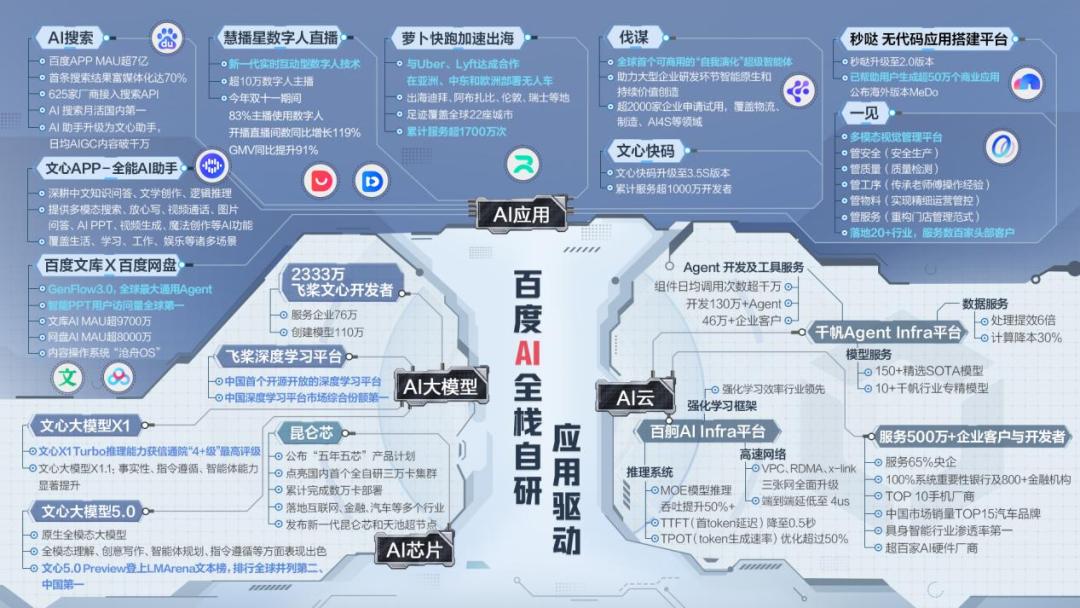
In this internal sharing, Robin Li emphasized again the importance of applications in the AI era, defining that "applications in the AI era are intelligent agents". He also clearly identified four types of intelligent agents related to Baidu for the first time: Search Intelligent Agent (the main channel of Baidu's AI applications), Digital Human Intelligent Agent (Huibo Star), Code Intelligent Agent (Miaoda), and Evolutionary Intelligent Agent (Famou).
In addition, in the sharing, Robin Li emphasized the advantages of Baidu's full - stack layout of "Chip (Kunlun Chip) - Cloud (Intelligent Cloud) - Model (ERNIE Big Model) - Agent (Intelligent Agent)". He clearly stated that "companies with excellent full - stack capabilities will be in a very favorable position in the future AI competition." It is worth noting that he adjusted the description of Baidu's previous four - layer architecture. In 2026, the cloud was singled out, becoming the brand - new "Chip - Cloud - Model - Agent".
Meanwhile, at the company level, the relationship between Baidu Search and ERNIE Assistant was clarified for the first time. The traditional search form is 1 query + 10 blue links, while search in the AI era is an intelligent agent based on a big model. In this regard, Baidu is making two attempts: one is Baikan (the current search results on Baidu with a header image + answers generated by the big model); the other is ERNIE Assistant (the chatbot that can be accessed by clicking the central button at the bottom of the Baidu APP).
In the past decade, the full - line return and direct involvement of the founders of Baidu, Alibaba, ByteDance, and Tencent for the first time mark that the decisive moment of AI in 2026 has officially arrived.
Jack Ma, the founder of Alibaba, has returned. He takes the AI golden triangle as the core AI narrative logic and personally named it "Tongyunge" (Tongyi Laboratory, Alibaba Cloud, and T - Head). He tries to strengthen the moat through the trinity of big models, cloud computing, and chips. Meanwhile, Qianwen App has replaced Quark as the core player for Alibaba to compete for the super - entry.
Ma Huateng, the founder of Tencent, has revived the "red - envelope strategy". With 1 billion yuan in cash red envelopes as incentives and a new AI social function called "Yuanbao Pai", he is actively fighting back, trying to recreate the glorious moment of WeChat red envelopes in 2015.
Liang Rubo, the co - founder of ByteDance, also issued a military order of "climbing the peak bravely" at the all - staff meeting at the beginning of the year. He is concentrating efforts to promote the penetration of Doubao and Dola (the overseas version of the AI assistant).
So far, the big companies have locked in the AI entry as the main battlefield during the critical window of the Spring Festival in 2026. The Spring Festival red envelopes are no longer just holiday gifts but have become the "tickets" to the next decade.
While everyone is trying to "build new boats" to seize the beachhead, Baidu has chosen another "boarding" logic.
02
How to Fight the Battle for AI Entries?
Behind the differentiated competition lies a profound insight into the "entry melee" in the past two years.
Looking back at 2024, new forces represented by Kimi showed their edge. Through crazy advertising investment and product innovation, they emerged on the stage of the AI super - entry.
During the Spring Festival in 2025, DeepSeek swept the field, overturning the table and redrawing the starting line. By the end of the year, Doubao became the first AI product in China with over 100 million daily active users. Almost at the same time, Alibaba launched Plan C, going all - in on the AI entry "Qianwen" and claiming to have over 100 million monthly active users. On January 20th, according to the Wall Street Journal, the monthly active users of ERNIE Assistant had exceeded 200 million.
So far, the battle for AI entries has officially entered the era of the "tripartite confrontation" among Doubao, ERNIE, and Qianwen.
Standing at the crossroads of the Spring Festival in 2026, the anxiety of the giants about AI entries has materialized into a 6 - billion - yuan "red - envelope war". This is not only a choice under path dependence but also the most familiar and heavy bet of the giants.
In the past two decades, "burning money - grabbing users - occupying territory - realizing profits" has been a tried - and - true success formula for the Chinese Internet. From the group - buying war to the shared - bike war, and then to the melee in instant retail last year, the same script has been repeated in different fields, forming a typical path dependence.
Entering the AI era, the "muscle memory" of the giants continues to work - first enclose users with red envelopes, and then talk about the follow - up. After all, no one dares to leave the users' sight for even a moment during the vacuum period of technological paradigm change.
In this red - envelope war, Baidu's ERNIE Assistant has chosen another path - it doesn't intend to persuade users to download a separate application but is committed to eliminating the "download" action itself, so that when users need to use AI, they can smoothly get on board and switch on the spot.
To achieve this goal, Baidu has targeted the Baidu App with over 700 million monthly active users as the main battlefield. The core goal of the brand upgrade of ERNIE in the new year of 2026 is: don't let users look for AI, but let AI naturally emerge in users' original search scenarios. Users don't need to go through the complex process of "download - register - use". They only need to tap lightly on the bottom bar to smoothly switch from "asking Baidu" to "asking ERNIE".
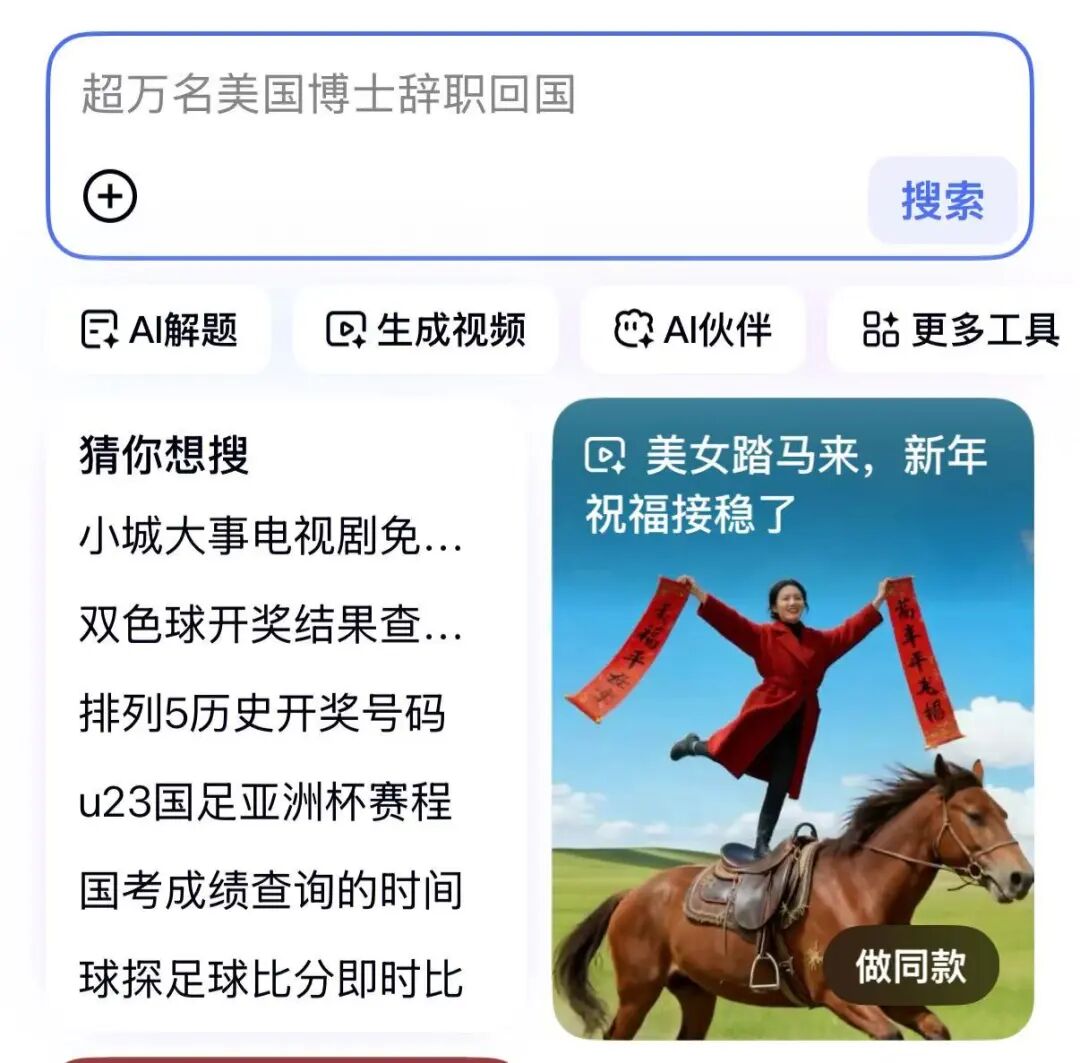
The significance of omitting "download" is not only to shorten the conversion chain but also to achieve the "habit transfer" of users imperceptibly, fundamentally changing the retention logic.
This approach is not new. The rapid rise of Gemini is based on this method. Compared with ChatGPT, which requires users to actively access or download, Google directly embeds Gemini into Gmail and the Android system to achieve endogenous growth. Data shows that the number of Android users using Gemini through system embedding is twice that of users of the independent app. When new functions are deeply coupled with high - frequency applications, the migration cost approaches zero. This "senseless migration" is undoubtedly more conducive to the rapid popularization of new technologies and products.
Of course, there is a necessary prerequisite behind this, which is to have a large enough and scenario - matching "old entry". The 700 million monthly active users of the Baidu App and its "search" scenario constitute the most natural incubator for intelligent agents. This is not a path that everyone can take. It is due to Baidu's search gene. From the search box to the intelligent agent, it is a natural evolution of the same entry, and it is also the logic of "keeping everything in the same pot".
To achieve such a goal, Baidu needs to focus its resources. Converging the previously scattered "multiple - entry approach" on ERNIE Assistant in the Baidu App is an embodiment of concentrating superior forces on the main channel. It is a key action of "ending chaos and defining order", converting the huge traffic of 700 million monthly active users into AI seed users through the shortest path, and completing market education and the popularization of AI technology among the whole people with almost zero marginal cost.
In addition to the search gene, Baidu's ability to quickly form a strategic whole also benefits from its lighter and more flexible size advantage. This allows Baidu to turn around flexibly and directly put 700 million existing users on the AI fast - track.
03
What are Baidu's Chances of Winning?
At the beginning of the new year, native applications such as OpenClaw made a splash. Peter Steinberger, the founder of OpenClaw, made a bold statement: "80% of the apps on your phone are actually dead, you just don't know it yet."
This statement reveals a cruel truth: the current battle for giant entries is still largely driven by the "FOMO" (fear of missing out) muscle memory. If AI is destined to be a marathon, then the noisy "red - envelope war" is just a mid - game battle. When the tide of traffic recedes, the real competition is just beginning.
The end - game of the AI competition is about who can complete the business cycle with lower costs, faster responses, and stronger intelligence. Behind this is a competition based on comprehensive strength. In the first lecture at the beginning of the year, Robin Li attributed this comprehensive strength to Baidu's full - stack capabilities of "Chip - Cloud - Model - Agent". He believes that "to do well in these intelligent agents, full - stack capabilities are required. This is what Baidu has been continuously doing and is also the industry consensus. Companies with excellent full - stack capabilities will be in an advantageous position in the future AI competition."
At the chip level, on January 1st, Kunlun Chip officially submitted an application for independent listing on the main board of the Hong Kong Stock Exchange. As the first big company to spin off its chip business independently, Baidu's infrastructure architecture of "full - stack AI" has become clearer. Robin Li set the tone in the internal sharing: the purpose of training is inference. While the whole industry is still struggling with computing power scale, Baidu has taken the lead in shifting to the generational competition of "inference efficiency".
According to the calculation of Changqiao Securities, based on the average price of 60,000 yuan per piece of Kunlun Chip's main product P800, about 60,000 pieces were shipped in 2025. The orders from large customers including Baidu exceeded 200,000 pieces, and there were still 140,000 pieces to be delivered, mainly restricted by Samsung's production capacity. If the production capacity is released and the orders are fully delivered, the existing orders alone can support Kunlun Chip's revenue of 8.4 billion yuan, a year - on - year increase of 140%.
At the intelligent cloud level, in this year's third - quarter report, Baidu disclosed its AI business revenue for the first time. Among them, Baidu's AI cloud revenue was 4.2 billion yuan, a year - on - year increase of 33%. The subscription revenue of AI high - performance computing infrastructure increased by 128% year - on - year. Recently, Baidu Smart Cloud has raised the target growth rate of its AI - related revenue in 2026 from 100% to 200%, striving for the first place in the AI cloud market.
At the model level, through organizational structure adjustment, Baidu has achieved a differentiated positioning: among them, BMU (Basic Model Unit) is committed to achieving SOTA (state - of - the - art globally) to ensure that the technology does not lag behind in generations; AMU (Application Model Unit) focuses on model miniaturization, response acceleration, and extreme cost reduction.
This clearer organizational positioning advantage was fully demonstrated in the official version of ERNIE 5.0 released on January 22nd. The official version of ERNIE 5.0 has 24 trillion model parameters, uses the native full - modality unified modeling technology, has full - modality understanding and generation capabilities, and supports the input and output of various information such as text, images, audio, and video. In the comprehensive evaluation of more than 40 authoritative benchmarks, the language and multi - modality understanding capabilities of the official version of ERNIE 5.0 surpass models such as Gemini - 2.5 - Pro and GPT - 5 - High, ranking firmly in the international first echelon. Its image and video generation capabilities are comparable to those of specialized models in vertical fields, and it is at the global leading level as a whole. The self - research ability of high - performance models has become the foundation to support large - scale concurrent processing of complex full - modality tasks on the C - side.
As one of the few companies in China with a full - stack layout of "Chip - Cloud - Model - Agent", the direct advantage brought by Baidu's full - stack self - research lies in extreme cost - efficiency and stable supply - chain resilience.
On the one hand, traditional AI applications are like "renting others' land to grow one's own grain", resulting in an "adaptation gap" between algorithms and hardware and causing a waste of computing power. With full - stack self - research, Baidu can formulate instruction sets at the bottom layer of the Kunlun Chip according to the algorithm characteristics of the ERNIE big model and use the "Famou" scheduling system on the intelligent cloud side to deeply couple the chip, cloud computing power, and model inference, optimize inference efficiency, and reduce inference costs.
On the other hand, against the backdrop of the complex global geopolitics and the shortage of computing resources, full - stack self - research enables Baidu to achieve autonomous control of computing power in the chip + intelligent cloud. The computing power guarantee brought by the Kunlun Chip, the millisecond - level distribution of the intelligent cloud, and the technological advantages of the ERNIE 5.0 big model give the upper - layer ERNIE Assistant the confidence to undertake the inference needs of 200 million users.
From a certain perspective, Baidu's insistence on the full - stack closed - loop is not a choice made only in the ChatGPT era but a result of years of accumulation reaching a unified convergence point. When the industry competition reaches a white - hot stage and competitors refocus on underlying model technologies, Baidu still adheres to the full - stack route and emphasizes cost reduction and efficiency improvement at the same time.
In the Internet era, single - point capabilities may win the market, but in the AI era, a closed - loop of underlying technology, middle - layer engineering capabilities, and application capabilities is indispensable. This is also the most important underlying logic behind the big companies' heavy investment to become all - around players.
Does full - stack mean full victory? This is the question from the outside world. But for Baidu, it is the ultimate armor to deal with uncertainties.
In the current situation where people are prone to fall into the FOMO anxiety of competing for AI entries, Baidu has built a comprehensive defense line with its in - depth layout of "Chip - Cloud - Model - Agent". The battle for entries may become obsolete, and model rankings may change, but the system that can continuously transform technology into user value will ultimately become the stable core to cross the cycle.
The significance of full - stack is not to win every battle but to always have cards to play and have the qualification to ultimately define the rules of the game.