Duan Pengfei was promoted by Elon Musk to be the director of Tesla's Autopilot engineering. He is an alumnus of Wuhan University of Technology.
Elon Musk has just promoted an alumnus of Wuhan University of Technology.
It's worthy of attention because of the special time - point. Tesla's Robotaxi has just launched fully autonomous operation.
It's also because of the special person being promoted —
This key figure in Tesla's Robotaxi has been working at Tesla for 9 years. Before the promotion, he was the company's Chief Software Engineer and the leader of the FSD V14 R & D team.
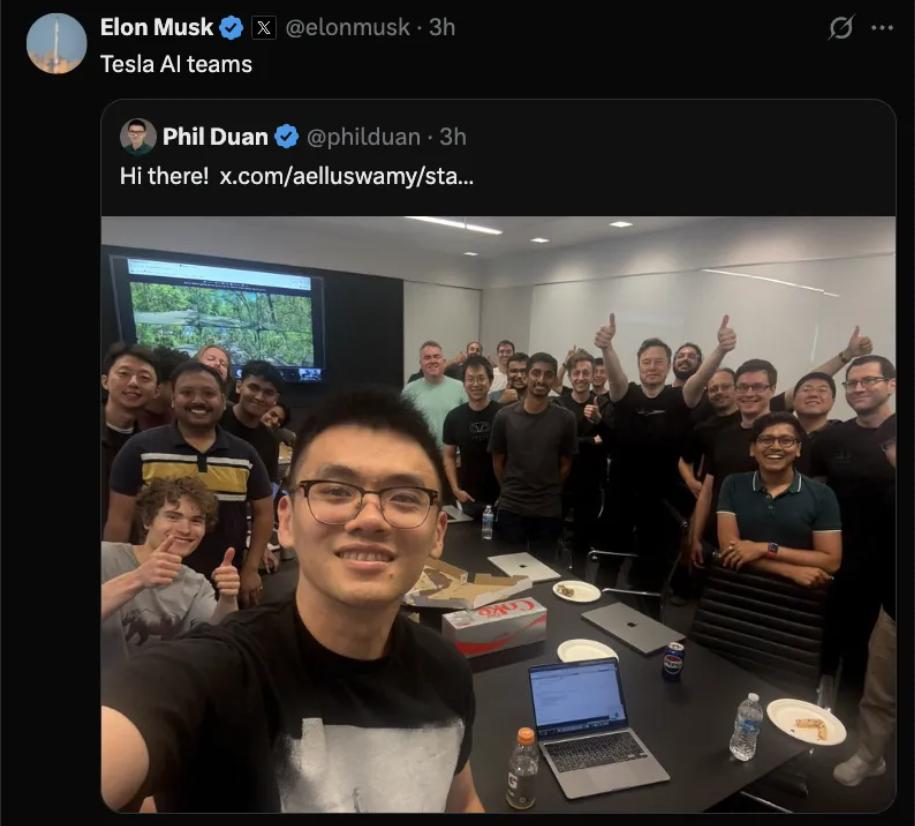
Previously, in a widely - circulated group photo of Tesla's AI team, he was also the Chinese person in the "center position" holding the camera.
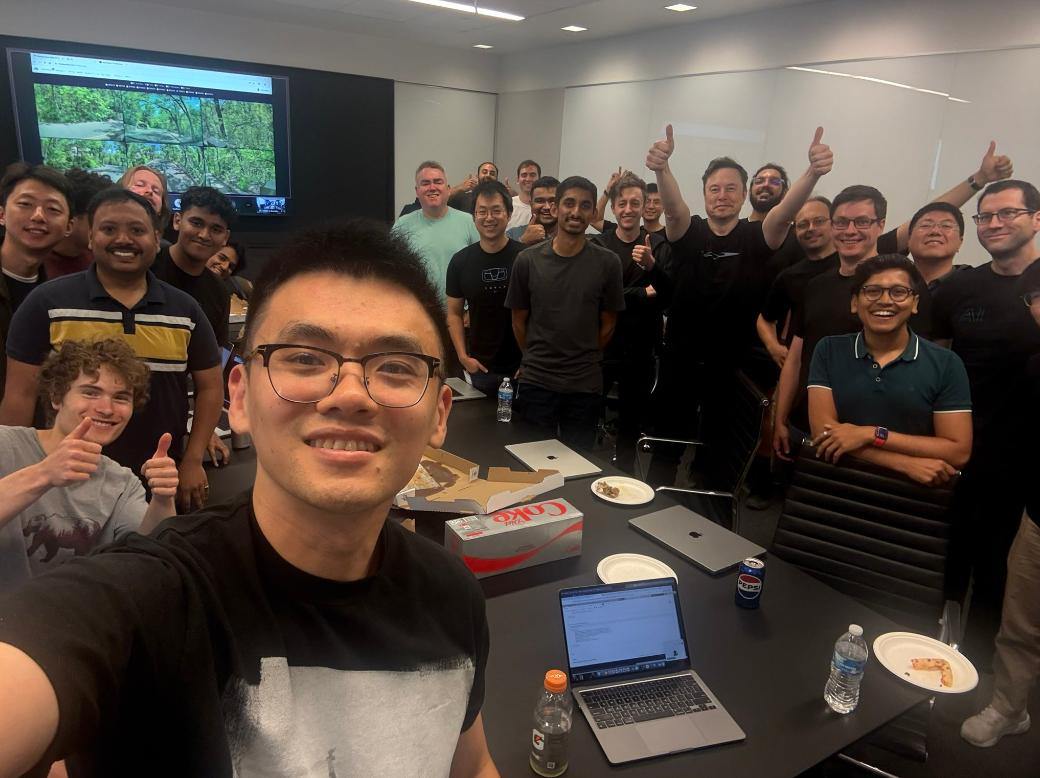
Elon Musk Promotes an Alumnus of Wuhan University of Technology
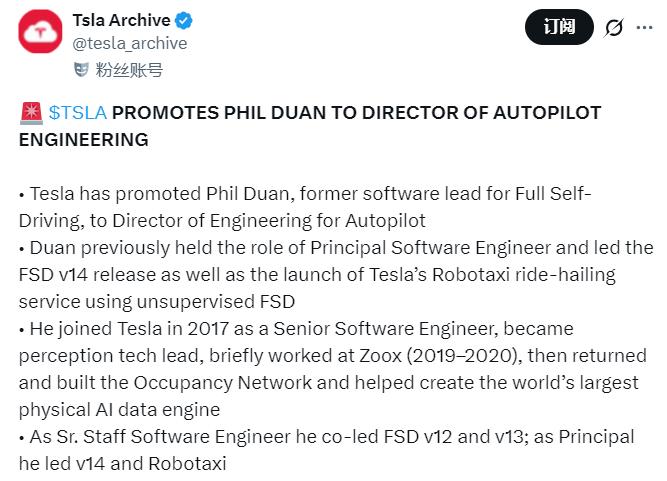
According to Tsla Archive's revelation on the social platform X, Phil Duan, the person in charge of Tesla's FSD software, has now been promoted to Director of Tesla's Autopilot Engineering.
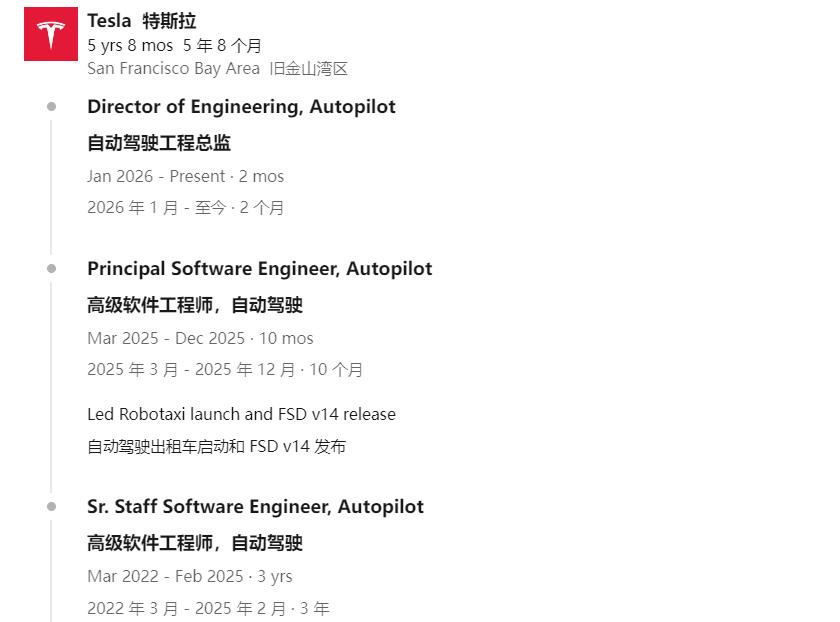
On his LinkedIn profile, his latest position has also been updated.
Who is Phil Duan?
He graduated from Wuhan University of Technology with a bachelor's degree in Optoelectronic Information Science and Engineering.
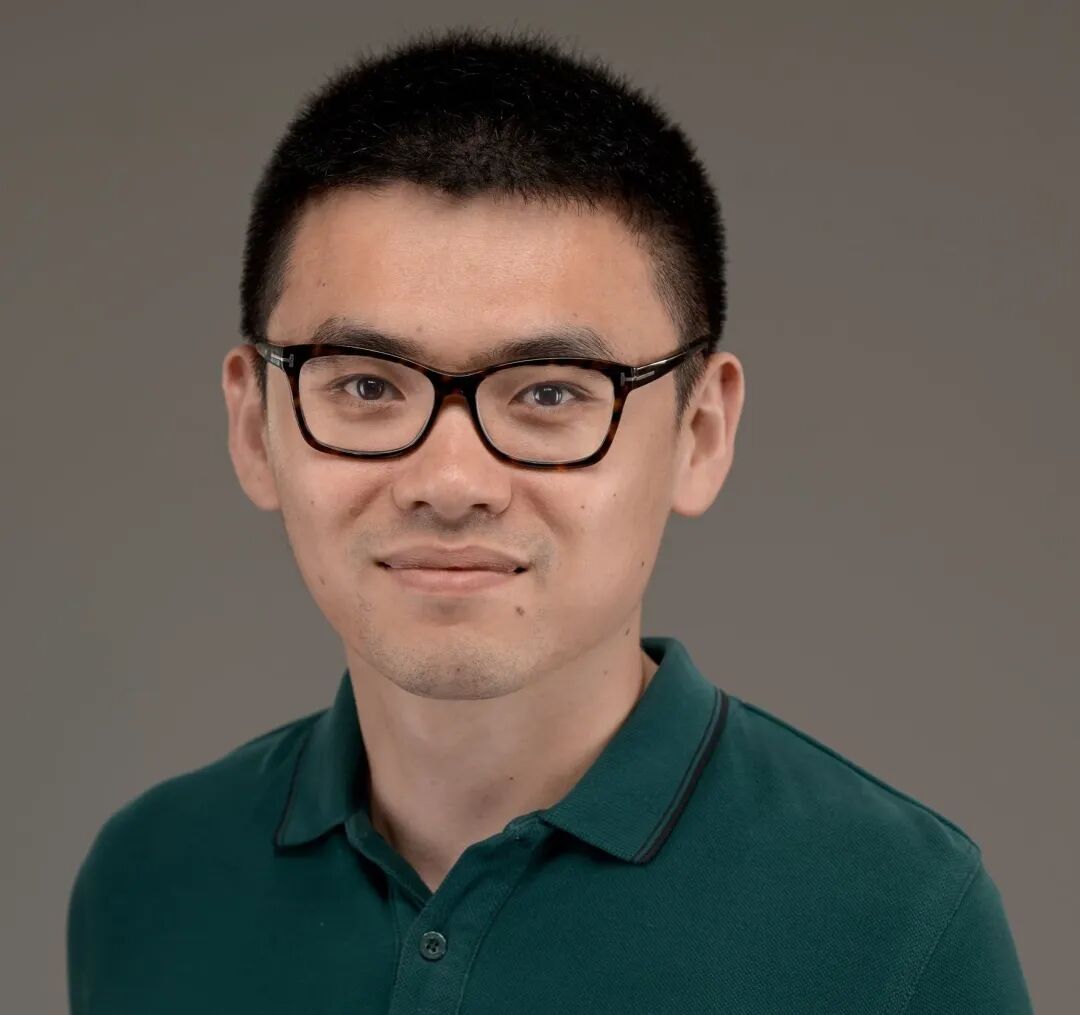
He completed his master's and doctoral studies at Ohio University in the United States in the field of Electrical Engineering. He also won the William E. Jackson Award in 2019.
This award was established mainly to commemorate William E. Jackson, a pioneer in the development and implementation of the U.S. air traffic control system and an enthusiastic supporter of student engineers.
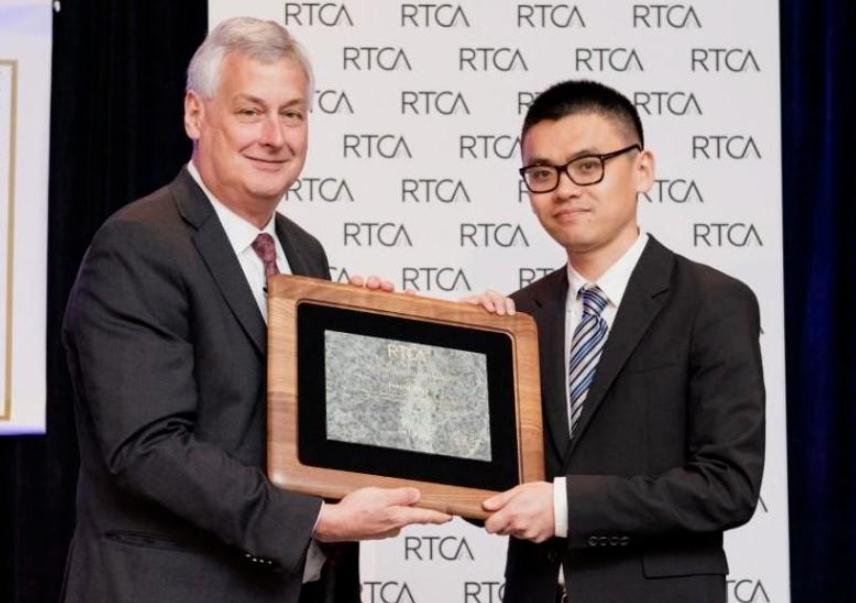
Phil Duan's fate with Tesla began in 2017.
Before that, he worked at the NASA Langley Research Center in the United States as an Information Technology Support Engineer, at Trimble Navigation as a technical staff member, and at Samsung Electronics as a Senior GNSS Software Engineer.
Until 2017, Phil Duan joined Tesla for the first time as a Senior Software Engineer for the autopilot project.
But after working for Elon Musk for two and a half years, Phil Duan chose to leave. He once publicly stated the reason:
It was during Tesla's Autopilot Day in 2019, and everyone was frantically rushing to meet the deadline. At that time, he "had been working non - stop for several months without a single day off. He was really exhausted and felt drained."
So after Autopilot Day, he left Tesla and joined Zoox, one of the top five autonomous driving companies in Silicon Valley at that time and owned by Amazon, focusing on prediction work.
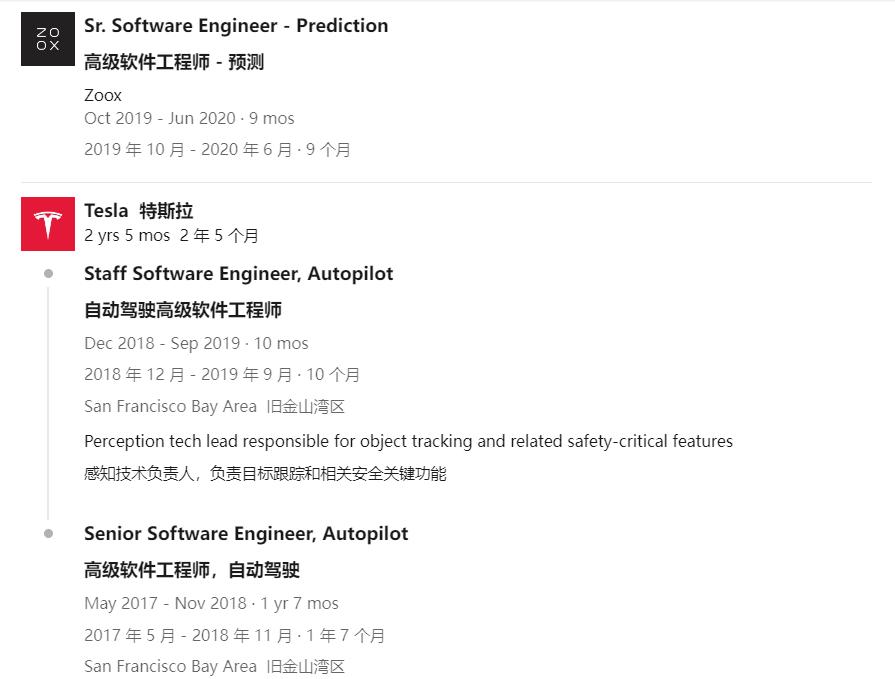
However, after nine months, feeling "bored", Phil Duan had a change of heart. So he called his former boss and asked to be taken back. "I've decided. I'd rather be drained than just idle away my time."
Just like that, in 2020, Phil Duan returned to Tesla and continued to work as a Senior Software Engineer. It was also from this time that he gradually became a key figure in Tesla's FSD.
In the first two years after returning to Tesla, he built the neural network model for Tesla's autonomous vehicles — Occupancy Network. After the Occupancy Network was first implemented by Tesla, it quickly became a consensus among a number of domestic autonomous driving players and was widely emulated.
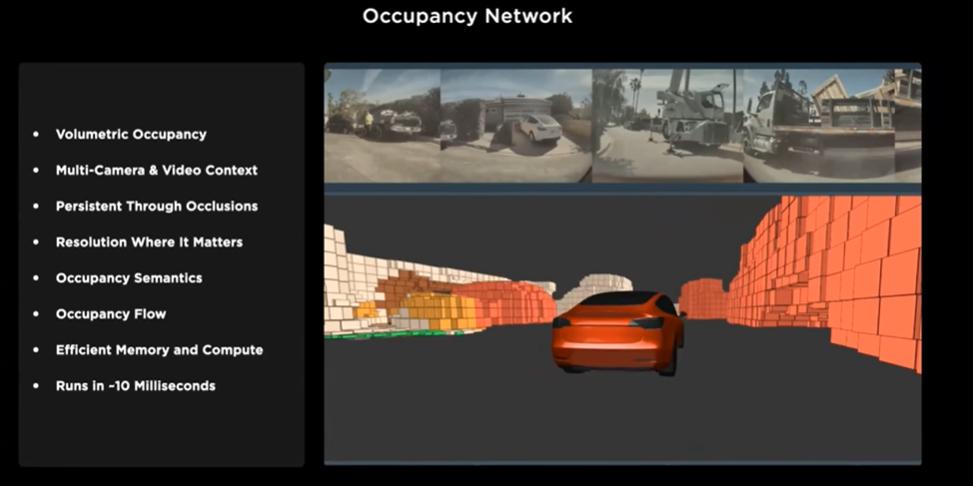
Since 2022, Phil Duan has been pushed to the forefront and appeared more in the public eye.
For example, at Tesla's AI Day in 2022 and the autonomous driving sub - forum of CVPR 2023, he appeared to introduce the relevant technologies of the Occupancy Network.
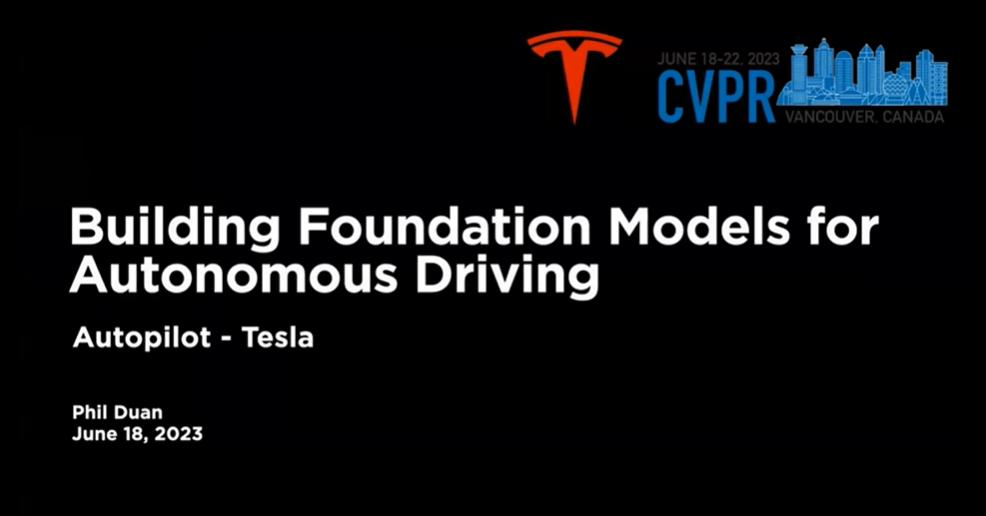
Meanwhile, the evolution of Tesla's FSD from V12 to V14 is also closely related to him and his team behind:
He participated in leading the AI development of FSD V12 and V13 and led the AI team in data and perception work.
In March last year, Phil Duan was promoted by Elon Musk to Chief Software Engineer and led the release of Tesla's FSD V14.
This FSD V14 significantly increased the driving mileage between two interventions and was also praised by the outside world for its remarkable performance improvement.
Jim Fan, the head of NVIDIA's robotics department and a distinguished scientist, also said after the experience that this was the first time he had experienced an AI that passed the Physical Turing Test.
Simply put, it means that he can no longer tell whether it is a human or an AI driving.
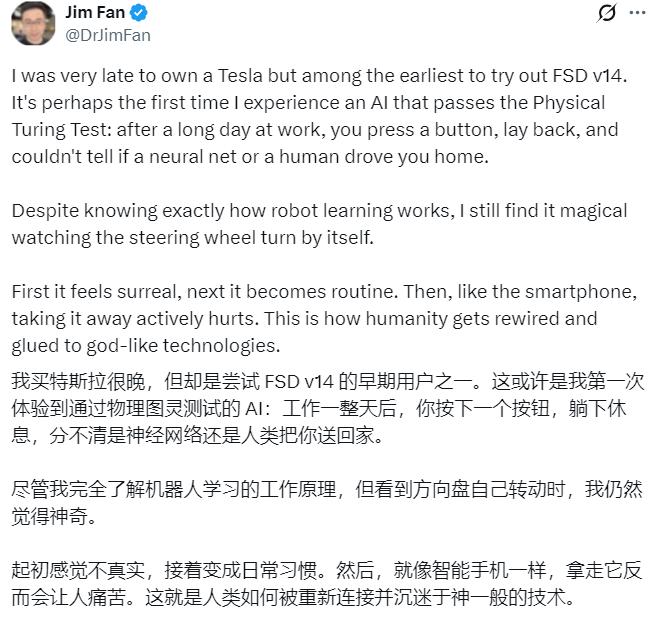
Overall, the upgrade of FSD to date cannot be separated from this engineer from China.
But Phil Duan's importance is not limited to this. He is also a key figure in Tesla's Robotaxi.
How Far Has Tesla's Robotaxi Progressed?
It has only been nine months since Tesla's Robotaxi was launched, and its progress has been remarkable.
Almost every milestone moment has seen the presence of Phil Duan.
First, in June last year, Tesla's Robotaxi hit the road for the first time. Although only 20 vehicles were deployed and initially only open to employees, it still set off a storm in the technology and automotive circles, with numerous reports.
Elon Musk also highly praised it on X and reposted the group photo of the office celebration party. The Chinese face holding the camera is Phil Duan.
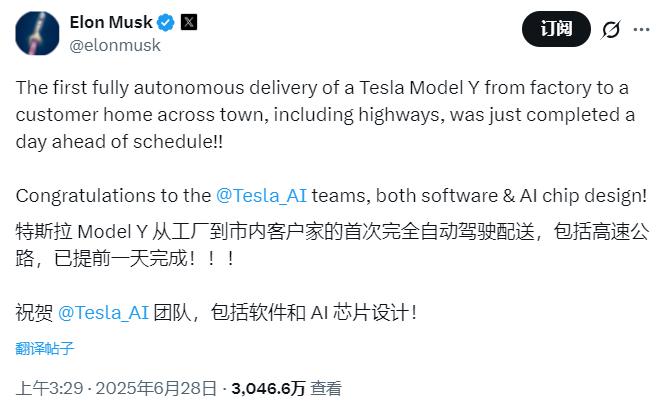
About a week later, a Tesla Model Y also completed an "automatic delivery" by driving itself from the Austin factory to the customer's home without any human intervention.
Elon Musk emphasized that this delivery crossed the town, the route included highways, and there was no one in the car.
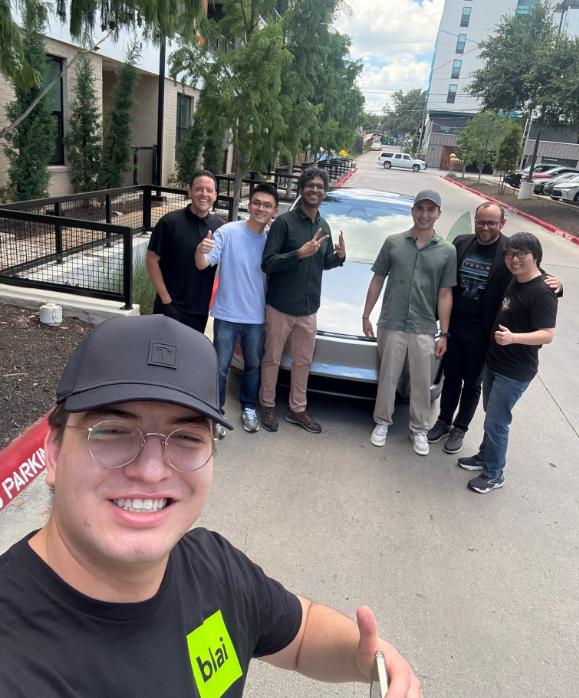
The car owner also posted the "receiving scene" on X and took a group photo with several Tesla executives, including Phil Duan (second from the left in the back row).
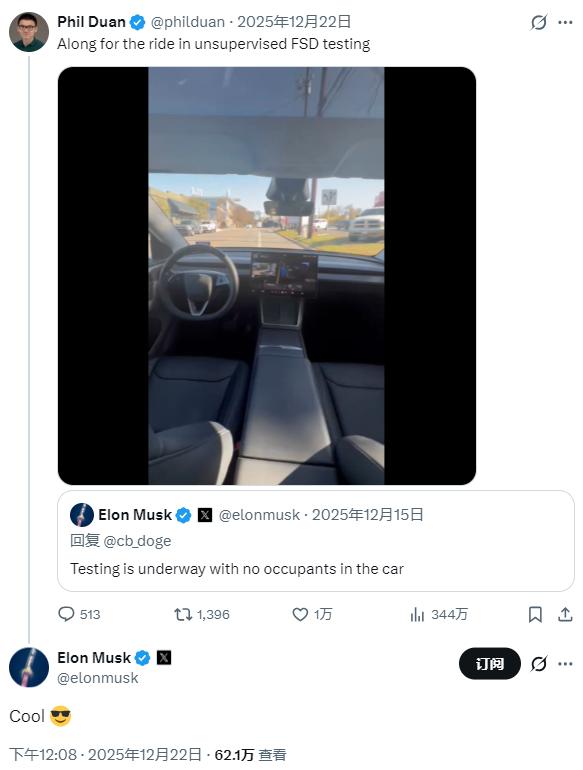
Another important milestone was in December last year, when Tesla's Robotaxi started fully autonomous testing.
Phil Duan was one of the first employees to participate in the unsupervised version of the test. He also posted the test video on X, with the front seats empty. Elon Musk said "It's so cool!":
Moreover, this key engineer of Tesla's Robotaxi also frequently appears on the X platform, responding to the outside world's curiosity about Tesla's progress.
For example, at the end of last month, James Wang, a long - term Tesla shareholder, questioned that although Tesla was ahead of Waymo in terms of geographical coverage, its technology was still far behind Waymo.
Phil Duan also responded at that time with a concise statement: Get ready to be shocked.
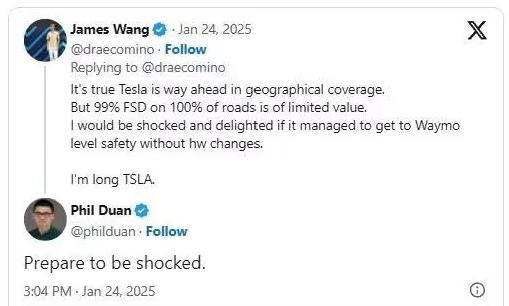
Perhaps this engineer's words imply that Tesla's FSD and Robotaxi have made even more significant progress.
So what is the current level?
Looking at technological breakthroughs, Tesla's unsupervised FSD has been open to the public in Austin and is operating in a mixed mode with Robotaxis with safety drivers. Many American netizens have already tried it.
Looking at the fleet size, there are currently two sets of data.
In late January this year, according to Robotaxi Tracker, Tesla's Robotaxi fleet had reached 200 vehicles, with 158 deployed in the San Francisco Bay Area of California and the remaining 42 in Austin.
Another set of data comes from Tesla's recent earnings conference call. Elon Musk revealed that the fleet size has reached 500 vehicles, and there are plans to expand to cities such as Dallas, Houston, Phoenix, and Miami in the United States in the first half of this year.
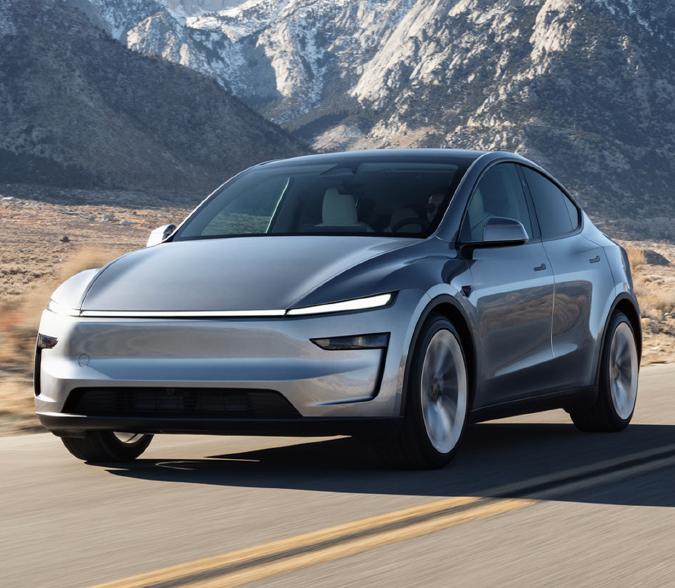
Compared with other top Robotaxi players, Tesla's current fleet size is not large. Based on the latest data disclosed by each company:
Waymo currently has a publicly reported fleet size of 2,500 vehicles (as of November 2025).
Following closely is Luobo Kuaipao, whose currently known fleet size significantly exceeds 1,000 vehicles. The specific data may have to wait for the financial report disclosure.
XPeng Robotics has a fleet size of 1,159 vehicles (as of the end of December 2025), and WeRide's Robotaxi fleet size is 1,023 vehicles (as of January 2026). Both have entered the "thousand - vehicle era".
However, Elon Musk doesn't seem worried at all. He even said in the conference call that the Robotaxi fleet size will double every month in the future.
On the one hand, this may be due to the confidence brought by the upcoming mass - production of the Cybercab.
On the other hand, it may refer to Elon Musk's previous idea of considering allowing Tesla's old owners to join the operation of the Robotaxi fleet.
So how large could this potential Robotaxi fleet be?
