Production of Model S/X has ceased, but Elon Musk has launched two more high-stakes gambles.
"I'm a bit sad, but it's time for the Model S/X project to retire honorably because we're truly moving towards a future based on autonomous driving."
Elon Musk announced a sad piece of news: Tesla's benchmark models, the Model S/X, will be discontinued by the end of the second quarter.
Looking back at the Model S, which was launched in 2012, it was once hailed as the "iPhone of the automotive world"; the Model X, which made its debut in 2015, amazed the world with its falcon-wing doors. These two models were once Tesla's sharpest double-edged swords to break through the iron curtain of the traditional automotive industry. They not only pioneered the era of smart electric vehicles but also defined the standards for high - end electric vehicles with their disruptive technologies.
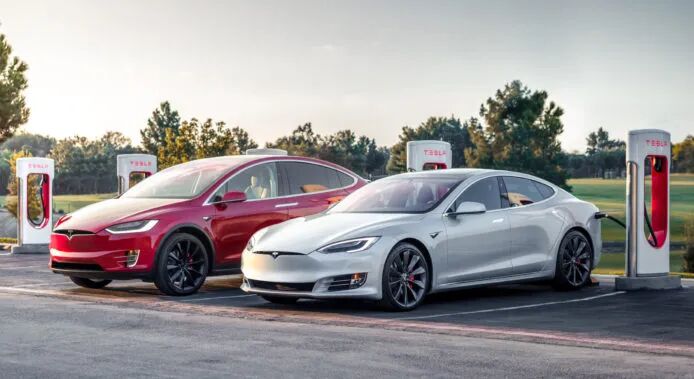
Image source: Internet
So, why choose to discontinue these two models that once defined the industry benchmark at a time when the electrification process is accelerating? What kind of game is Musk playing?
Why are the once - flagship models being discontinued?
In the business world, there are no eternal heroes, only timely strategies. In fact, the Model S and Model X have reached a point where they have to be abandoned.
Looking back at the Model S launched in 2012, it proved to the world that electric vehicles are not only environmentally friendly but also "more performant, smarter, and cooler" with its 0 - 100 km/h acceleration in 3.9 seconds, 17 - inch central control touchscreen, and over - the - air (OTA) vehicle upgrades.
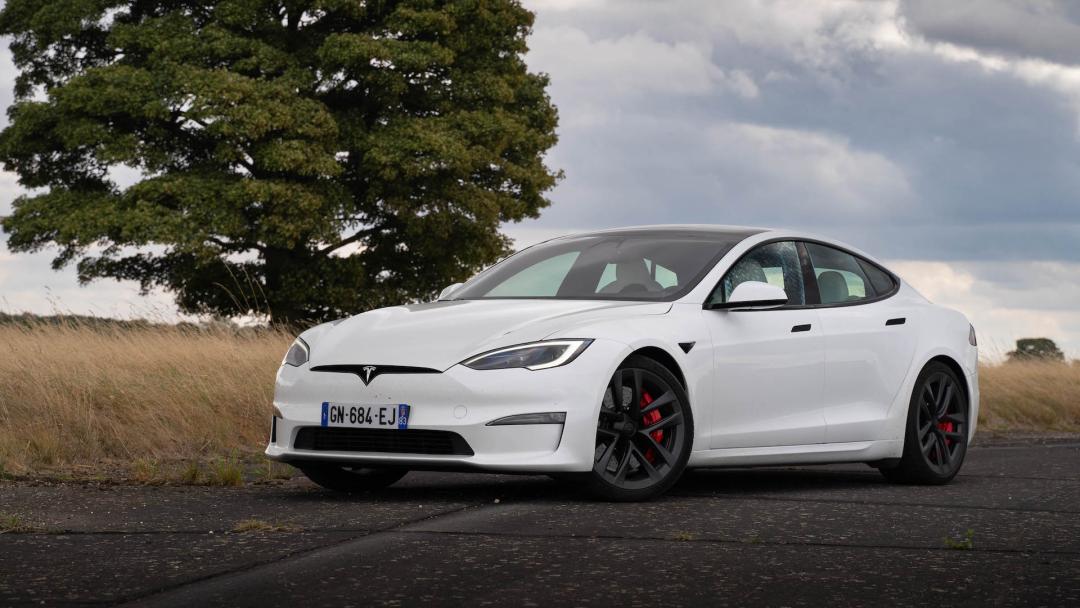
Image source: Internet
The Model S broke the market's stereotypical impression of electric vehicles as "weak, slow, and ugly" and won Tesla its first batch of high - net - worth customers.
Three years later, the Model X made a more radical entrance. With its falcon - wing door design and bioweapon defense mode, it once became a status symbol for Silicon Valley elites and was also one of the earliest mass - produced and delivered all - electric full - size SUVs a decade ago.
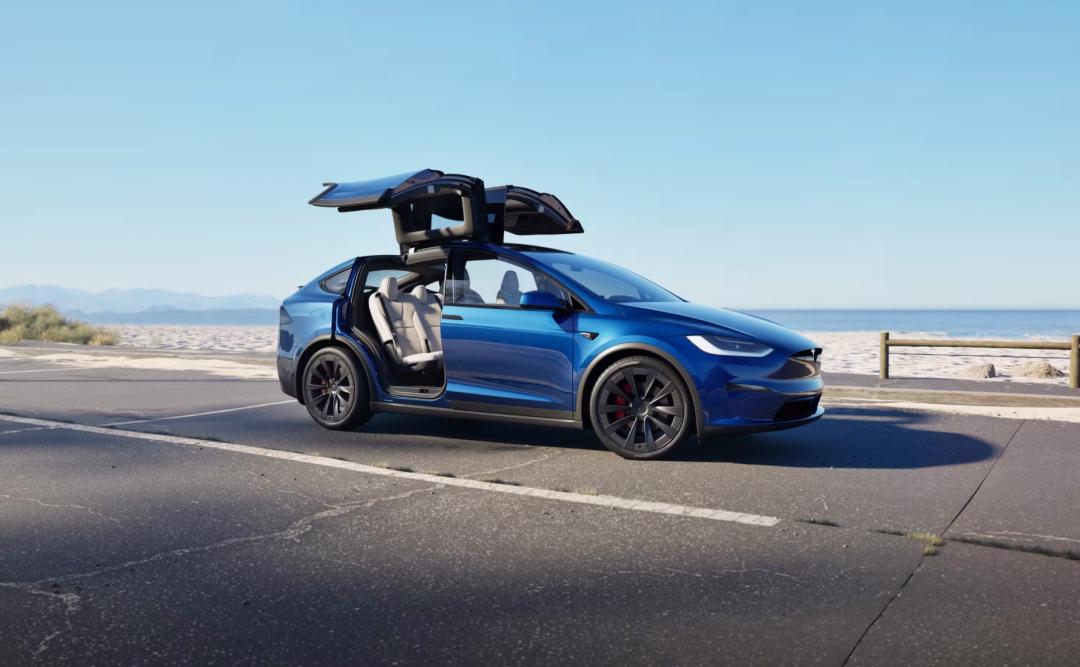
Image source: Internet
However, any product has a life cycle, and Tesla is no exception.
In 2025, Tesla sold 50,850 "other models", which included the Model S, Model X, and Cybertruck. The overall sales volume decreased by 40.2% year - on - year.
The once - flagship products now account for less than 3% of Tesla's annual sales volume. The sluggish sales are the fundamental reason for the discontinuation of these two models.
Behind this change is the systematic challenge that Tesla is facing.
Recently, Tesla's Q4 2025 financial report showed that Tesla's revenue was $24.9 billion, a 3% year - on - year decrease, and the net profit was only $840 million, a sharp drop of 61%.
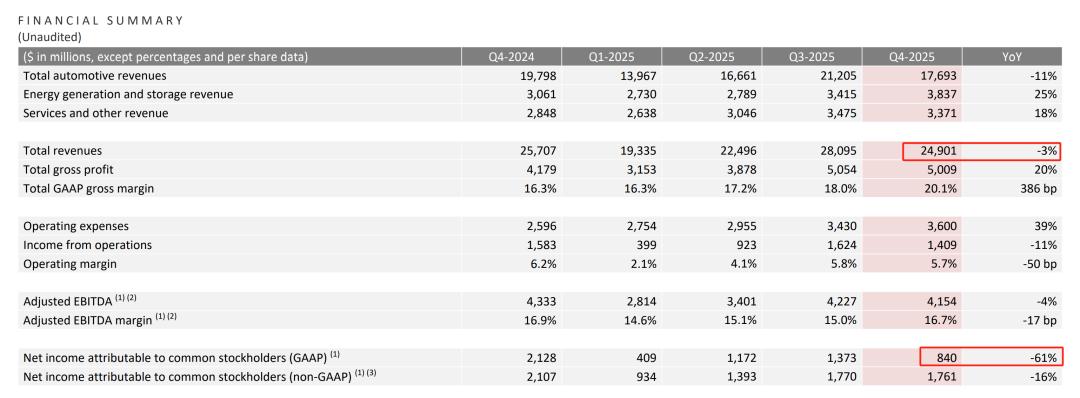
Image source: Tesla's Q4 2025 report
Looking at the longer - term timeline, the situation is even more severe. Tesla's total annual revenue in 2025 was $94.827 billion, a 3% year - on - year decrease. This was Tesla's first annual revenue decline in history. The annual net profit was only $3.794 billion, almost "halved" compared to the whole year of 2024, a 46% year - on - year decline.
Meanwhile, in 2025, BYD surpassed Tesla for the first time to become the world's champion in electric vehicle sales with 2.2567 million pure - electric vehicle sales and a 28% year - on - year increase.

Image source: Internet
While Tesla is still using the design language from a decade ago, the market has been occupied by competitors who understand local needs better. Even after launching derivative models such as the "Refreshed Model Y", "Model YL/YP", and the "Standard Trimmed Version", the sales volume still declined in 2025.
Tesla's full - year performance in 2025 showed that it delivered a total of 1.6361 million new vehicles during the period, a year - on - year decrease of 8.6%. Among them, the Model 3/Y had a cumulative delivery of 1.5853 million units, a 7.0% year - on - year decrease, and the other models had a cumulative delivery of 50,900 units, a year - on - year decline of over 40%.
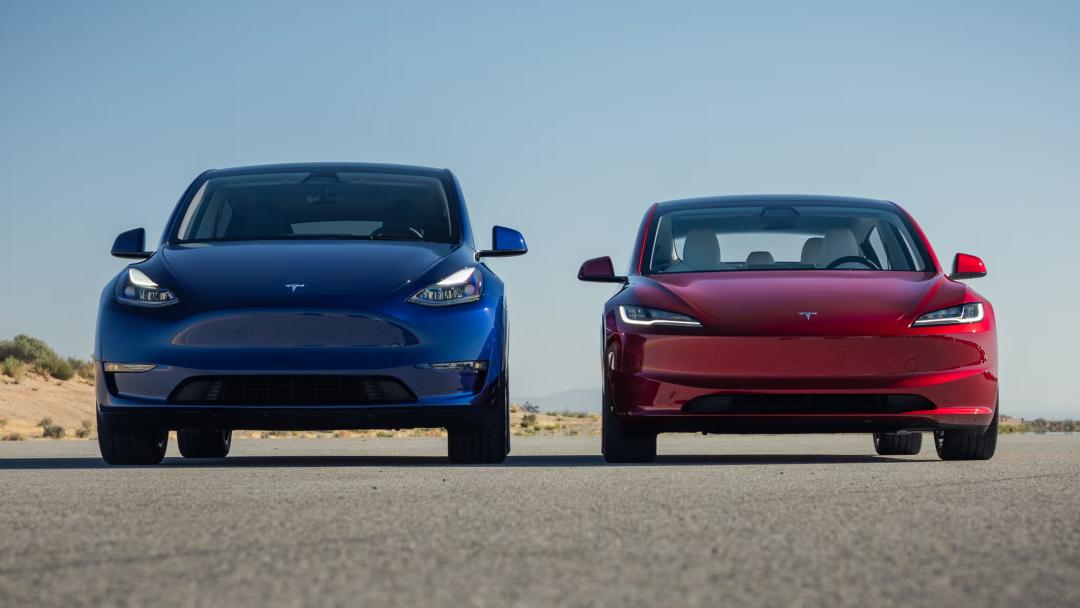
Image source: Internet
In this context, discontinuing the Model S/X is no longer a sad choice but a strategic necessity.
The fundamental challenge Tesla faces is not how to continue the classic but how to reallocate resources between its automotive business with a capped growth and new businesses.
In business history, great companies always reinvent themselves at their peak. Apple launched the App Store when the iPhone was at its most popular, and Amazon went all - in on AWS when it had a monopoly in e - commerce.
Tesla's choice today is the same. It is actively dismantling the monument it has erected to gain an advantage in the next industrial wave.
Going all - in on robots and autonomous driving, Musk is taking another big bet
In fact, Musk is no longer very concerned about the traditional automotive business.
This tech maverick candidly told investors: "If you still want to buy a Model S or X, now is your last chance." Behind these words, the production line at Tesla's Fremont factory is being re - arranged. The space that once produced the "iPhone of the automotive world" is now being transformed to produce the Optimus humanoid robot.
Tesla is peeling itself out of the shell of an automotive manufacturer and transforming into a 'fusion of cutting - edge technology and large - scale manufacturing'.
Musk has confirmed that the third - generation Optimus robot will be unveiled in a few months. This is the first model designed for mass production. According to Musk, it can learn by observing human behavior. Demonstrate a task to it, describe a task verbally, or even show it a video, and it can perform the task.
Tesla is building its first production line with the goal of starting production by the end of 2026, and the long - term plan is to produce one million units annually. In the new arena of humanoid robots, Musk admitted: "China is a competitor on another level." He clearly realizes that in terms of large - scale manufacturing and AI technology, the strength of Chinese competitors cannot be underestimated.
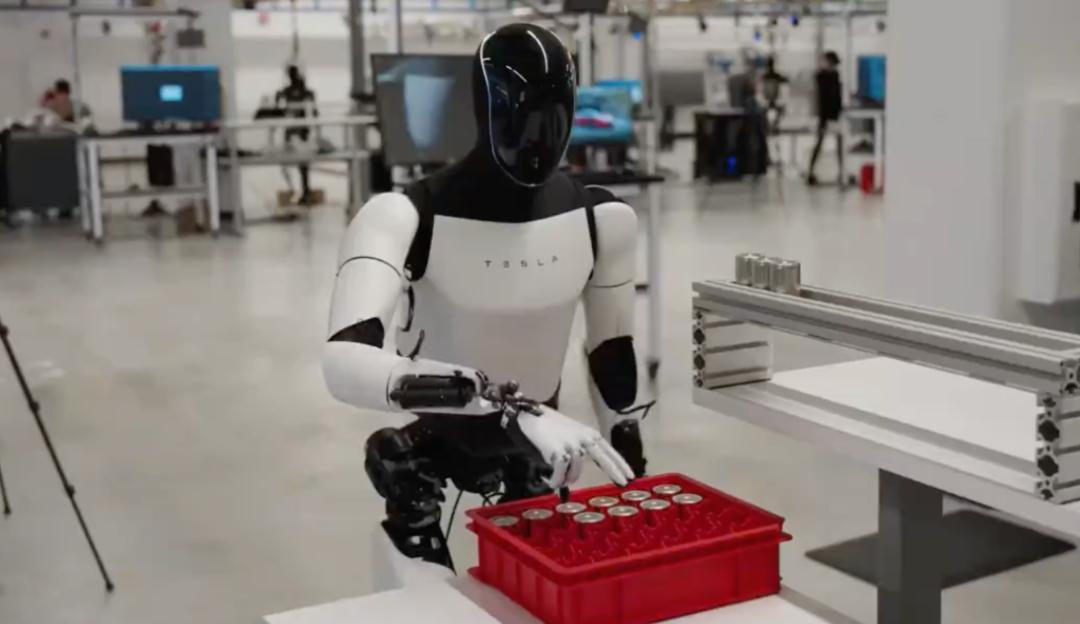
Image source: Internet
Indeed, in addition to innovative companies such as Unitree, Ubtech, and Zhipu Robotics, Chinese automotive manufacturers such as XPeng, GAC, Chery, and Li Auto have also entered the field of humanoid robots, making the market competition even more intense.
And there is a grander layout in the field of autonomous driving.
The Robotaxi, regarded by Musk as the ultimate business model, has entered the practical stage: Paid passenger - carrying services without safety drivers have been launched in Austin and will be expanded to several US cities such as Dallas and Phoenix in the first half of 2026.
The Cybercab, specially designed for driverless operation without a steering wheel and pedals, will start mass production in April 2026, with the goal of having a fleet of 1,000 vehicles by the end of the year. Musk even predicted that the future production volume of the Cybercab will "exceed the sum of all other Tesla models".
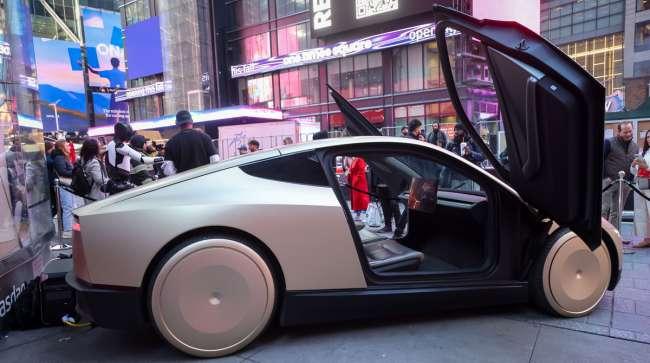
Image source: Internet
The financial data provides the confidence for transformation.
Tesla disclosed for the first time that the number of paying customers globally is now approaching 1.1 million. Among them, nearly 70% are one - time purchases. Calculated based on the total of 8.9 million vehicle deliveries, the penetration rate of FSD is about 12%.
The market has voted with real money. Despite the decline in Tesla's Q4 financial report performance, the stock price rose instead of falling. The logic on Wall Street is clear: They no longer evaluate Tesla by the standards of an automotive company but regard it as a core target in the era of AI and robots.
However, the risks are also extremely obvious. Fierce competition from Chinese brands, the dual challenges of technology and regulation faced by Robotaxi, and the huge capital expenditure for new businesses - any problem on any front could put Tesla in a difficult situation. Musk defined 2026 as "a year of huge investment expenditure", with an expected capital expenditure of over $20 billion. This bet is indeed bold.
Fortunately, Tesla still has money in its coffers. As of the end of Q4 2025, Tesla's total cash, cash equivalents, and investments reached $44.1 billion (approximately RMB 306.3 billion), an increase of $2.4 billion quarter - on - quarter.

Image source: Tesla's Q4 2025 report
At the end of the earnings conference call, Musk quoted again the famous words of Andy Grove, the former CEO of Intel: Only the paranoid survive.
The first half of automotive electrification is over, and the second half of intelligentization and robotization has just begun. Discontinuing the Model S/X is not a failure of the product but a necessary cost for strategic switching.
SpaceX acquires xAI: Musk's pursuit of the stars
In addition, Musk's most explosive business move recently is that SpaceX officially announced the acquisition of xAI, an artificial intelligence company he founded. Rockets, AI, space Internet, satellite communication - Musk is integrating everything that can be integrated.
"This is not only the next chapter in the missions of SpaceX and xAI but also the starting point of a new journey," Musk declared in a statement. "We want to develop on a large scale, create a'sentient sun' that understands the universe, and spread the light of consciousness to the stars."
This long - awaited internal integration is essentially a capital operation of moving assets from one hand to the other.
The merger of SpaceX, valued at $1 trillion, and xAI, valued at $250 billion, will create a super - private entity with a total valuation of $1.25 trillion, with an expected issue price of $526.59 per share.
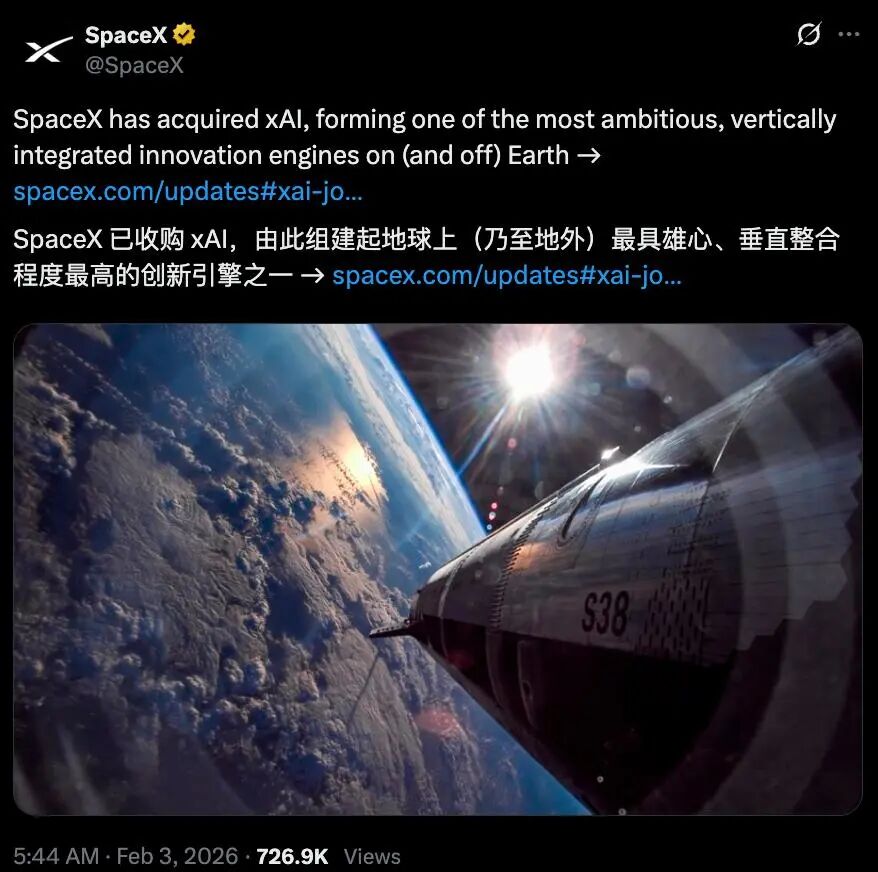
Image source: X
After the transaction is completed, xAI will become a wholly - owned subsidiary of SpaceX, and xAI had previously acquired the social media platform X. In Musk's business empire, these two companies play different but complementary roles.
SpaceX, with its mature rocket launch business and rapidly expanding Starlink satellite Internet service, is considered the "most successful and stable" enterprise under Musk and holds a leading position in the global commercial space industry.
On the other hand, xAI is an AI project that Musk has been focusing on in recent years. It specializes in large - language - model training and has launched the chatbot Grok, which is integrated into the social platform X, directly competing with leading competitors such as OpenAI, Anthropic, and Google DeepMind.
For xAI, which has been burning money continuously, this acquisition means that it has finally found a solid financial backer. The cost of developing Grok is extremely high. Previously, there were reports that xAI burned about $1 billion per month. And SpaceX has a stable profitability, which can provide cash - flow support for xAI's long - term technological breakthroughs.
Why the merger? Musk also clearly explained the strategic considerations for this merger in the statement.
He believes that current ground - based data centers are facing dual bottlenecks in energy supply and heat - dissipation capacity, and the global power infrastructure is difficult to support the exponential growth of AI computing power demand. If it continues to rely entirely on ground - based data centers, it will place a significant burden on the community and the environment.
To this end, he proposed a disruptive solution: Deploy some computing equipment in