Valued at 874 billion yuan, the most expensive unicorn in autonomous driving is born.
Waymo has secured the largest private equity financing in the history of autonomous driving.
$16 billion, approximately RMB 111 billion in financing. Waymo, an autonomous driving company under Alphabet, Google's parent company, announced on its official website that the deal has been completed.
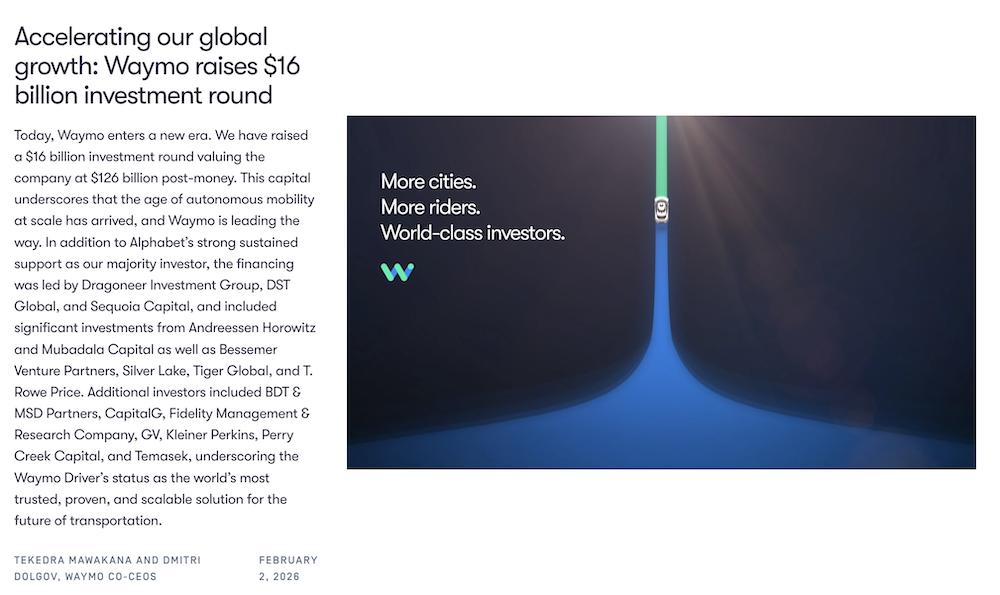
This round of financing has soared nearly three times compared to Waymo's previous round. It is not only the largest investment in the global autonomous driving field in history but also has skyrocketed Waymo's post - investment valuation to $126 billion (approximately RMB 874.1 billion), a 180% surge from the previous valuation of $45 billion.
Even though Waymo has recently experienced a series of "mishaps," such as illegally overtaking school buses, "stalling" on the street due to power outages, and then hitting a child, it has not dampened investors' enthusiasm.
Today, Waymo has become the most valuable unicorn enterprise in the current autonomous driving industry.
01 The More Mishaps, the More Attractive for Investment
From 2009 to 2019, Waymo completely relied on Alphabet for funding. Since it first introduced external capital in 2020, only three rounds of financing have been publicly disclosed, but the cumulative financing amount has exceeded $10.4 billion, and the valuation has risen from about $30 billion to $45 billion.
The newly obtained funds not only exceed the sum of previous financings but also have raised Waymo's latest valuation to $126 billion, approximately RMB 874.1 billion.
Moreover, the investment lineup for each round of financing is very impressive. This round of financing is still led by the parent company Alphabet and has also attracted many top - tier investors such as Sequoia Capital, Dragoneer, DST Global, Mubadala Capital, Bessemer Venture Partners, and Silver Lake.
Although Waymo did not specifically disclose how much each party invested in the announcement, two days before the official announcement of the latest financing, overseas media reported that Google invested up to $13 billion in this financing, accounting for three - quarters.
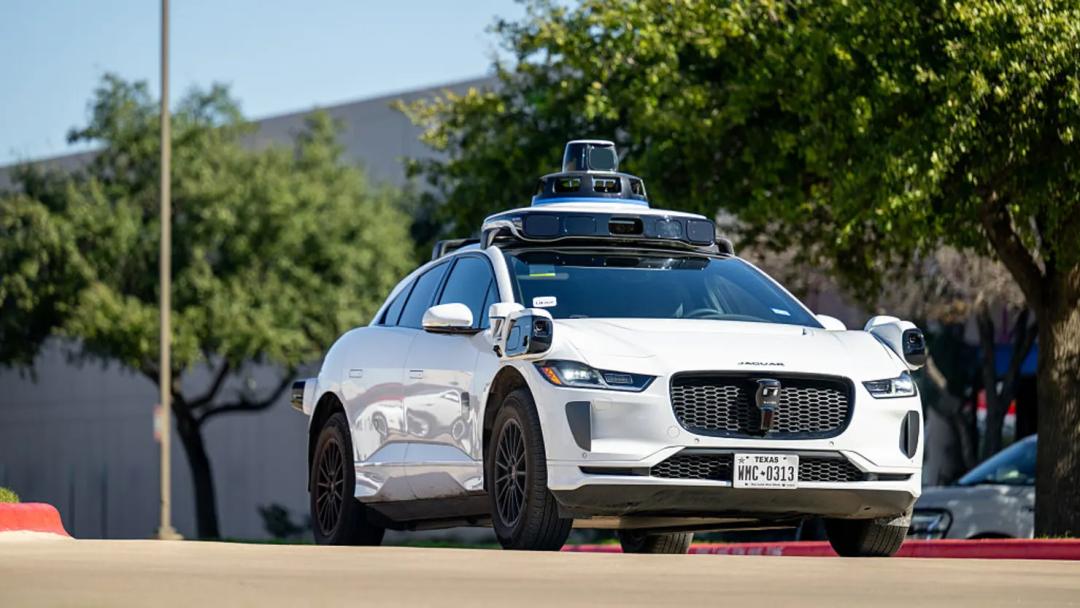
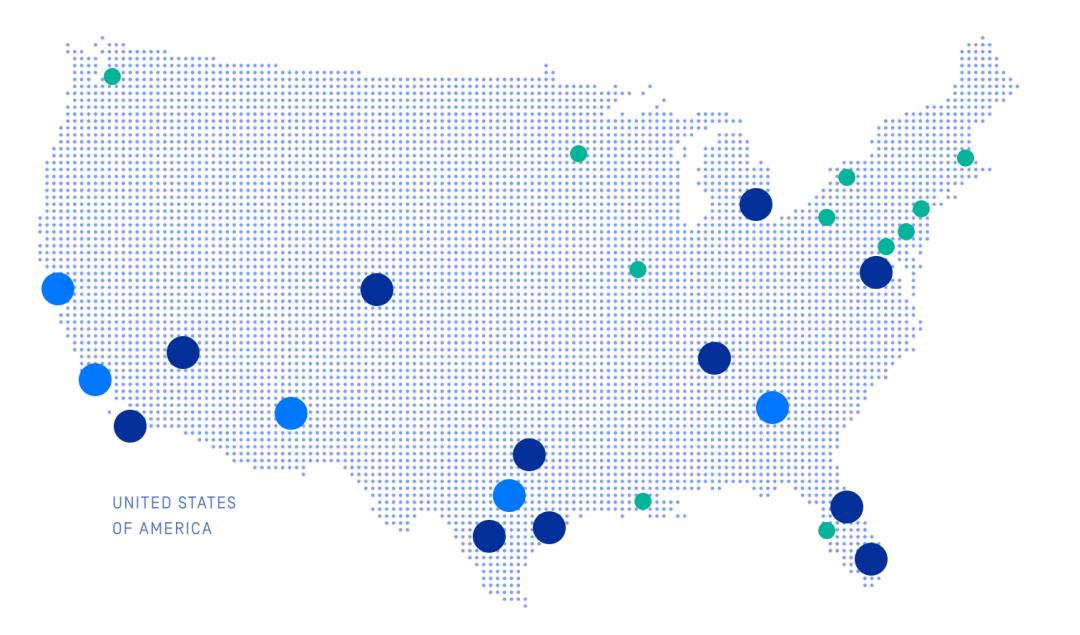
Looking at the use of the financing, the $16 billion will mainly flow into three major areas: First, to accelerate the launch of ride - hailing services in more than 20 cities in 2026, including international markets such as Tokyo and London; second, to expand the fleet size, support the modification of Jaguar I - PACE and the testing of new models such as Zeekr RT and Hyundai IONIQ 5; finally, to optimize the sixth - generation autonomous driving system and further reduce hardware costs and deployment cycles.
Perhaps to prove that it can justify such a high valuation, Waymo has simultaneously released the latest commercialization results of its Robotaxi.
Waymo has been operating stably in six cities in the United States, including Phoenix, San Francisco, Los Angeles, Austin, Atlanta, and Miami. The number of paid orders per week has exceeded 400,000, a nearly 150% increase from 175,000 at the beginning of the year.
In 2025, the total number of orders reached 15 million, more than twice that of 2024. The cumulative historical number of orders has exceeded 20 million. Passengers have accumulated a total riding time of 3.8 million hours, and the fully autonomous driving mileage has also exceeded 200 million kilometers. Its system has reduced serious casualty accidents by 90%.
However, the specific fleet size has still not been disclosed. According to a previous report by Bloomberg, the number of Waymo's fleet has increased from 1,500 in April 2025 to 2,500 in November. Among them, 1,000 are deployed in the San Francisco Bay Area, 700 in Los Angeles, and 500 in Phoenix.
Waymo's co - CEOs, Tekedra Mawakana and Dmitri Dolgov, said in a blog post, "This milestone is built on the foundation of safety, and now, Waymo's safety is statistically better than human driving. We are no longer validating a concept but scaling up a commercial reality."
However, behind the emphasis on safety and the tens of billions in financing are a series of "mishaps" and frequent regulatory crises. At the end of last year, affected by a substation fire and power outage, dozens of Waymo vehicles "stalled" on the streets of San Francisco, causing large - scale traffic paralysis. Waymo was also ordered by the local school district to suspend peak - hour operations due to more than 20 incidents of illegally overtaking school buses.
In January this year, the mishaps came in various forms. First, a Waymo vehicle drove onto a light - rail track when there were trains approaching from both the front and the back, forcing passengers to escape urgently.
On January 25, an autonomous driving test vehicle under Waymo suddenly lost control. The vehicle rushed up a roadside slope and hit several parked vehicles in succession, almost injuring pedestrians nearby. Not long ago, it even hit a child near a primary school in California, causing minor injuries.
A series of events have directly triggered regulatory minefields. Now, Waymo is facing multiple safety investigations by NHTSA regarding its autonomous taxis.
02 Will Waymo Become the Ceiling?
However, the negative news has not affected Waymo's progress.
Evan Schlossman, an investor from the venture capital firm SuRo Capital, which has long been concerned about Waymo, once said that Waymo has control over both hardware and software, and one can see a considerable revenue base growing rapidly without relying on particularly radical assumptions. In his view, it is highly feasible for Waymo to expand its business coverage area to about five times the current scale.
Google CEO Sundar Pichai also predicted that Waymo will make a "substantial" contribution to the financial situation of its parent company Alphabet as early as 2027.
Moreover, for Waymo, an even more attractive factor for capital is that its revenue sources will probably not rely solely on the ride - hailing business.
Waymo's co - CEO, Tekedra Mawakana, said that the company plans to extend its business from autonomous taxi services to local delivery and long - haul trucking and license its autonomous driving technology to automobile manufacturers in the subsequent stage.
Previously, Waymo and DoorDash announced in October last year that they would launch an autonomous food delivery service in Phoenix. This cooperation may indicate its next expansion direction.
A reference data is that in Uber's business structure, the food delivery business already accounts for one - third of the total revenue, and its growth rate is faster than that of the ride - hailing business. Calculated on a basis excluding stock - based compensation, depreciation, and amortization, food delivery contributes about 40% of Uber's operating profit.
In addition, the business of licensing autonomous driving software to automobile manufacturers may be implemented later. But in the long run, this part of the licensing revenue is expected to increase the overall profit margin because the indirect costs required for software maintenance and iteration are likely not to be as heavy as continuously expanding the fleet of autonomous taxis.
Although Waymo does not need to pay for human driving costs, there are still many long - term cost issues that remain unresolved. In terms of hardware costs, Waymo is at a disadvantage compared to other autonomous driving enterprises.
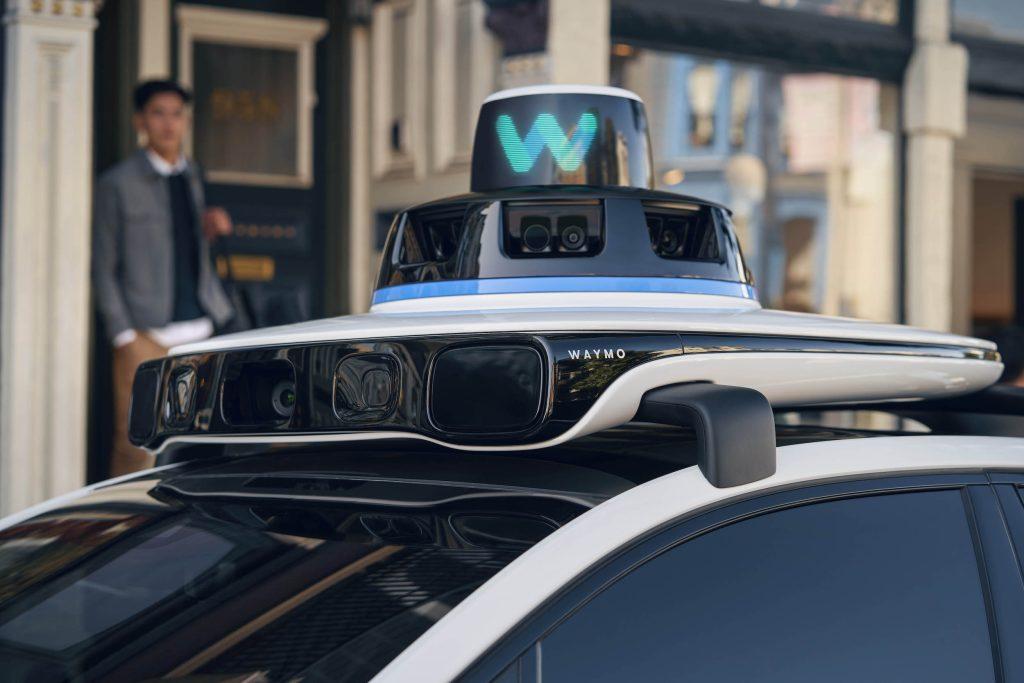
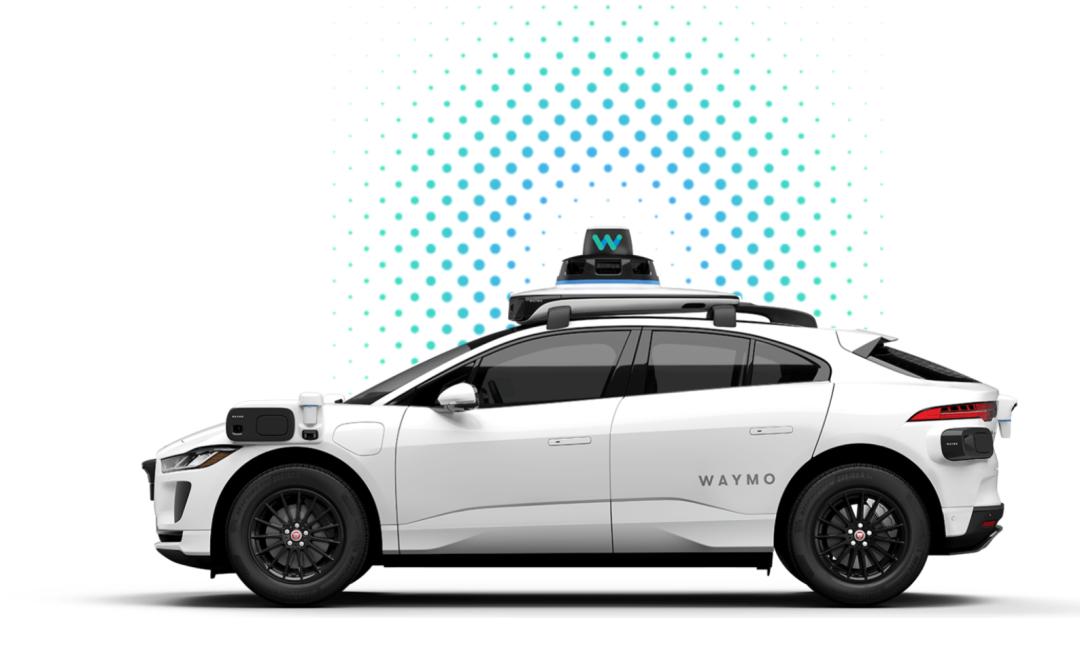
Taking Waymo's currently operating fifth - generation models as an example, the base model of the fifth - generation is the all - electric Jaguar I - PACE, which is equipped with 8 cameras, 5 millimeter - wave radars, and 3 lidars. The cost of one vehicle reaches $175,000, far higher than the $50,000 of Tesla's Robotaxi.
Previously, an analyst from Morgan Stanley estimated that Waymo's current operating cost per mile is about $1.36 - $1.43, while Tesla's is only $0.81.
Therefore, how to reduce costs will be the key to victory. Waymo has already started the full deployment of its sixth - generation autonomous driving model, the Zeekr RT. Compared with the current fifth - generation product, the number of cameras has been reduced from 29 to 13, and the number of lidars has been reduced from 5 to 4. While maintaining a 360 - degree, 500 - meter coverage, it significantly reduces hardware costs, and the deployment time has also been shortened to half of that of the previous generations.
An analyst from Morgan Stanley predicted that the operating cost of the new models that Waymo plans to deploy in 2026 is expected to drop to the range of $0.99 to $1.08 per mile.
In contrast, a group of domestic autonomous driving enterprises are more optimistic. In terms of single - vehicle cost, the price of the Luobo Kuaipao RT6 is only 205,000 yuan, and the cost of Pony.ai's seventh - generation model is estimated to be about 300,000 yuan, which gives them a significant advantage over these overseas autonomous driving enterprises.
Moreover, their scale should not be underestimated. Taking Luobo Kuaipao as an example, it operates in more than 10 cities. It entered the UK's London around the same time as Waymo and is deploying in the Middle East market. Luobo Kuaipao's fleet size exceeded 2,000 last year. Currently, the number of fully autonomous orders per week has exceeded 250,000, and the number of global mobility service trips has exceeded 17 million.
Judging from the core data, it is the Robotaxi player closest to Waymo in terms of global commercialization progress, and other domestic Robotaxi players are also making rapid progress.
Now, driven by $16 billion in hot money, the decisive moment has arrived, and only full - scale efforts will do.
This article is from the WeChat official account "SuperEV - Lab" (ID: SuperEV - Lab), author: Wang Lei. Republished by 36Kr with permission.