Top 5 highlights of the commercial dimension of the Milan Winter Olympics
When the Winter Olympics, which originated in the Alps a century ago, returned to Italy after 20 years and to Cortina d'Ampezzo after 70 years, the business and marketing outside the stadium also entered a new stage.
1. This is the first Winter Olympics held after ChatGPT triggered a global wave of generative AI and the International Olympic Committee (IOC) released the "Olympic AI Agenda". When AI, which is being applied in various industries, meets the "Olympic AI Agenda", the digital and intelligent transformation of the Olympics is bound to accelerate. For this event, both the IOC itself and various partners at all levels have comprehensive and detailed plans for accelerating the digital and intelligent upgrade of the Olympic Movement.
2. This is also the 11th cycle and a new 40 - year period for the Olympic Global Partner Program (TOP Program). After the Paris Olympics, the TOP Program witnessed the largest - scale reshuffle in history. Five companies withdrew, including Toyota, which had held the global partner status in the travel category newly created by the IOC for it in the previous four Olympics. Only TCL joined as a new face. In this Winter Olympics, Stellantis Group, the world's third - largest automaker, appeared among the senior partners. The sponsorship right for the automotive travel category has been adjusted from the IOC's global sponsorship level to the domestic sponsorship level of the Winter Olympics Organizing Committee. Does this mean a major shift in the TOP Program after the major reshuffle?
3. This is also the first Winter Olympics after the IOC exclusively granted the rights of the global hospitality program to a single company. The IOC did so during the Paris Olympics for the first time in history and praised this move after the games, saying it had set a new benchmark for the event's hospitality program. Italy is also a country with multiple advantageous resources such as natural landscapes, history, culture, sports, art, fashion, and cuisine. Compared with its western neighbors, it is not inferior at all and even surpasses them in some aspects. For example, Italy has the most World Heritage Sites in the world (60, including the Dolomites, one of the host locations of this Winter Olympics, which was included in 2009 for its unique geological structure and landform). Another example is that Italian cuisine was the first cuisine to be included in the World Heritage List.
All these factors have piqued the outside world's greater interest in the business and marketing of this Winter Olympics.
Technological Upgrade: Deeper Digital and Intelligent Transformation of the Olympics, and More Substantial TOP Sponsorship from Chinese Enterprises
The "Olympic 2020 + 5 Agenda" released in 2021 identified digitalization as one of the five pillars, and the "Olympic AI Agenda" in 2024 made a systematic plan for the integrated development of artificial intelligence and sports. Following the IOC's top - level planning, the digital transformation has been continuously promoted and upgraded in the past few Olympics.
In this event, the digital and intelligent transformation has been further intensified. In the most - watched area of broadcast reporting, the Olympic Broadcasting Services (OBS) will deploy the most advanced broadcast technology suite to date and combine film - making technology, artificial intelligence, drones, and data - driven storytelling methods for broadcast reporting.
• 32 film - grade cameras will be used for the broadcast of all events in this Winter Olympics. This figure was zero in the Beijing 2022 Winter Olympics. Moreover, film - grade cameras will be equipped with screen graphics display functions for the first time, seamlessly integrating information such as athletes' names into the live - broadcast pictures.
• Artificial intelligence will support the real - time transcription and translation of comments and interviews. The AI highlight system made its debut at the Paris 2024 Olympics and will cover all 16 events in this Winter Olympics, automatically generating highlight clips for media rights holders and social platforms.
• Multiple new technologies will be used to enhance storytelling, data analysis capabilities, and the overall viewing experience. For example, in the curling event, a new overhead track camera and AI - driven curling trajectory tracking graphics technology will improve the broadcast effect, accurately showing the trajectory and tactics of each curling stone. In the bobsleigh, skeleton, and luge events, AI - driven graphics technology will use color - coded lines to display real - time race rankings, clearly showing who is leading and by how much.

The Main Media Center for this Winter Olympics has started operation.
In the digital and intelligent upgrade of the Milan Winter Olympics, TOP sponsors such as Visa, Samsung, and Deloitte have played crucial roles. However, Chinese enterprises including Alibaba and TCL, as the backbone of the IOC TOP sponsors, have also taken on even greater responsibilities. Among them, Alibaba is the most representative.
In media broadcast, Alibaba will provide 17 sets of 360 - degree replay systems, covering 17 sports events, a significant increase compared to the 10 sets in the Beijing 2022 Winter Olympics. Twelve sets of stroboscopic replay systems, jointly designed by Alibaba and another TOP sponsor OMEGA, which use artificial intelligence technology to highlight key body postures and movement trajectories in replays and display consecutive frames in an easy - to - understand visual sequence, will be applied to the live broadcast of 15 events. Only one stroboscopic replay system was used in the Beijing 2022 Winter Olympics. The OBS Cloud, jointly established by Alibaba and OBS, has been upgraded to the latest version. The Milan Winter Olympics will benefit from cloud - based workflows, making broadcasts more flexible, cost - effective, and sustainable. It will enable rights - holding broadcasters to remotely access, edit, and transmit Olympic content, reducing the need for on - site equipment and lowering the carbon footprint of Olympic event operations.
In terms of event operation and sustainable development, following its successful deployment at the Paris 2024 Olympics, Alibaba continues to cooperate with the IOC to expand the use of a cloud - based AI sustainable development platform to monitor and analyze the energy consumption of Olympic venues. This system provides real - time insights into power demand and efficiency, supports more informed planning, and helps organizers reduce their environmental impact.
Another Chinese enterprise, TCL, gives full play to its display technology advantages and provides relevant products and technologies to support the upgrade of the Olympics. This includes presenting on - site perspectives, providing exclusive displays for athletes and spectators, offering TVs, monitors, and technical support for the OBS Broadcast Center, the International Broadcast Center, and some VIP areas, and equipping the Olympic Village with household appliances such as TVs.
In the past decade, Chinese enterprises have been riding a wave of going global. While becoming the main sponsors of various top - level sports events, their participation in these events and understanding of sports have gradually evolved from simply spending money on advertising in the early days to promoting global sports innovation and progress through their own technological capabilities and advantages. Moreover, the application of technology is becoming more widespread, and the driving force for innovation is getting stronger. This trend is not only reflected in the Olympics but also in other major events such as the FIFA World Cup and the UEFA European Championship.
Changes in the TOP Program: Downgraded Sponsorship from Automakers, "Return to the Original Owner"?
The TOP Program started in 1985. Over the past 40 years, as the shining pearl on the crown of global sports business, the TOP Program has cooperated with 37 world - class enterprises. While witnessing changes in the world economy, technological iterations, industry ups and downs, and corporate rises and falls, it has also achieved revenues of up to $10 billion, and the revenue has always maintained an upward trend.
During this period, thanks to its global influence, the TOP Program has indeed provided endorsement and impetus for the global expansion of some well - known brands. The stories of how Visa surpassed its competitor American Express with the help of the Olympics and how Samsung better competed with Motorola through the Olympics have long become industry legends and have been widely reported, so they will not be repeated here.
However, times have changed. With the iteration of media means and the transformation of marketing methods, the TOP Program has inevitably reached a crossroads. After the Paris Olympics, there was the largest - scale reshuffle of TOP sponsors in history. Toyota, Panasonic, Bridgestone, Intel, and Atos withdrew, but only one and a half successors emerged. One refers to TCL filling the gap left by Panasonic in February 2025, and the other half refers to Deloitte renewing its contract with the IOC at the end of the Paris Olympics and including the category left by Atos in its sponsorship scope. There has been no more news other than this.
Actually, there was a relevant news item in March last year. Stellantis Group, the world's third - largest automaker, joined the sponsorship list of the Winter Olympics Organizing Committee as a senior partner in the automotive category, but this was not widely reported by Chinese media at that time. Stellantis Group was formed by the merger of PSA Group and Fiat Chrysler Automobiles and has 14 brands under its umbrella, such as Fiat, Jeep, Maserati, Peugeot, and Citroën. After sponsoring the Milan Winter Olympics, four authentic Italian brands under the Stellantis Group, namely Alfa Romeo, Fiat, Lancia, and Maserati, will be the main characters in the marketing campaign.
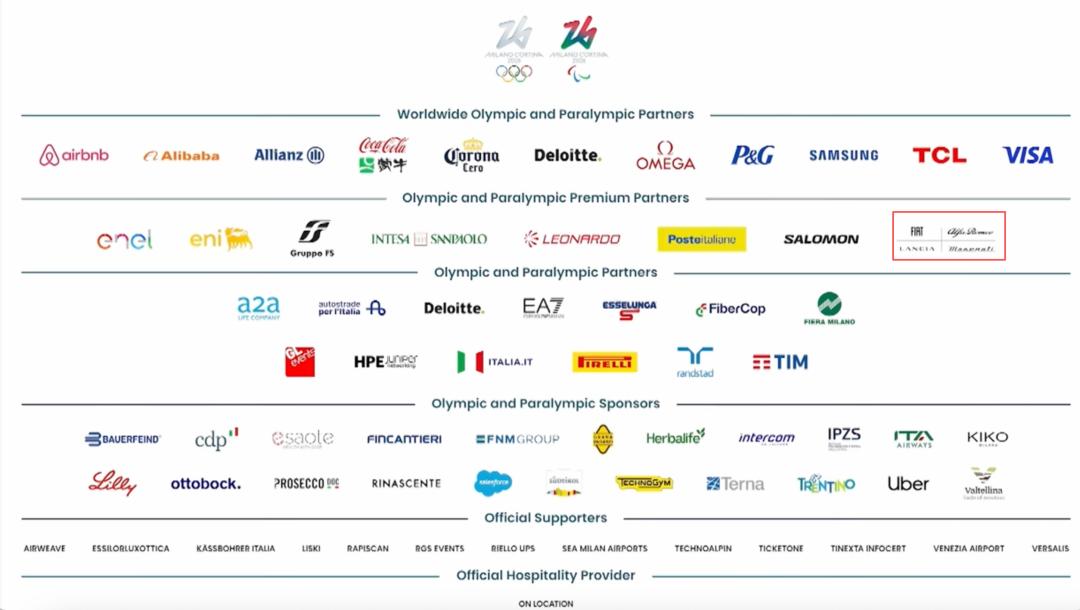
The logos of four brands under the Stellantis Group appear on the LOGO wall of this Winter Olympics.
Does Stellantis Group's acquisition of the marketing rights for the automotive travel category in the host country mean that the IOC has changed its strategy and returned the rights of individual TOP sponsorship categories to the organizing committee? Or is it just a temporary measure because the IOC failed to find an automaker willing to become a global Olympic sponsor before this Winter Olympics?
Looking back at the history of automotive category sponsorship in the Olympics may be helpful in finding the answer to this question.
As one of the biggest financial backers in sports sponsorship, the automotive industry has long been among the core categories in the sponsorship recruitment of the Olympic organizing committees. For example, the automotive sponsor of the Turin 2006 Winter Olympics Organizing Committee was the Fiat Group, that of the Beijing 2008 Olympics was Volkswagen China, that of the Vancouver 2010 Olympics was Chevrolet, that of the London 2012 Olympics was BMW, and that of the Rio 2016 Olympics was Nissan. After Tokyo won the right to host the 2020 Olympics, Toyota joined the IOC's TOP sponsorship list and obtained the TOP sponsorship right for the newly created travel category from 2017 - 2024 for $835 million, with the rights covering all global markets. However, due to its extremely small market share in South Korea and considering public relations and public opinion issues, Toyota finally gave up the marketing rights in the single market of South Korea but still retained the rights in all other markets. This allowed Hyundai - Kia to join the organizing committee's sponsorship list and obtain the marketing rights in South Korea. Moreover, Toyota's status as an IOC TOP sponsor continued until after the Paris Olympics.
The IOC has never made any explicit regulations regarding the number of partners and categories in the TOP Program but has always adopted a flexible strategy. This gives it more freedom in sponsorship recruitment. On the one hand, it can embrace new technologies according to technological development trends, such as signing Alibaba as the global exclusive partner in the cloud computing and e - commerce categories and Intel as the global exclusive partner in the categories of 5G platform, VR, 3D/360° content, AI, and drone light shows. On the other hand, it can also maintain a dynamic cooperation relationship with enterprises in traditional categories. For example, in January 2014, it signed a contract with Anheuser - Busch InBev, a beer manufacturer. Beer is also one of the core sponsorship categories of the Olympic organizing committees. Beijing had Tsingtao Beer and Yanjing Beer as organizing committee sponsors in its two Olympic Games, and the Tokyo 2020 Olympics had Asahi Beer. At present, the change in the sponsorship right of the automotive category is more similar to that of the beer category.
Stellantis Group's choice to join the Milan Winter Olympics Organizing Committee instead of the TOP Program actually raises another discussion about the global recognition of the TOP Program. In recent years, the IOC has obviously shown a dependence on enterprises from the Olympic host countries when signing new TOP partners. For example, the IOC signed contracts with Alibaba and Mengniu after Beijing won the right to host the 2022 Winter Olympics, with Toyota after Tokyo won the right to host the 2020 Olympics, and with Airbnb and Deloitte after Los Angeles won the right to host the 2028 Olympics. Although the number of TOP sponsors will not continue to decrease after this Winter Olympics (assuming no special circumstances, as all current sponsors have signed contracts until after the 2028 Los Angeles Olympics), the question of whether the TOP Program has true global attributes will still be a focus of attention in the coming years.
Communication Revolution: Internet Celebrities Are in the Spotlight, and the IOC and Traditional Media Giants "Bend the Knee"
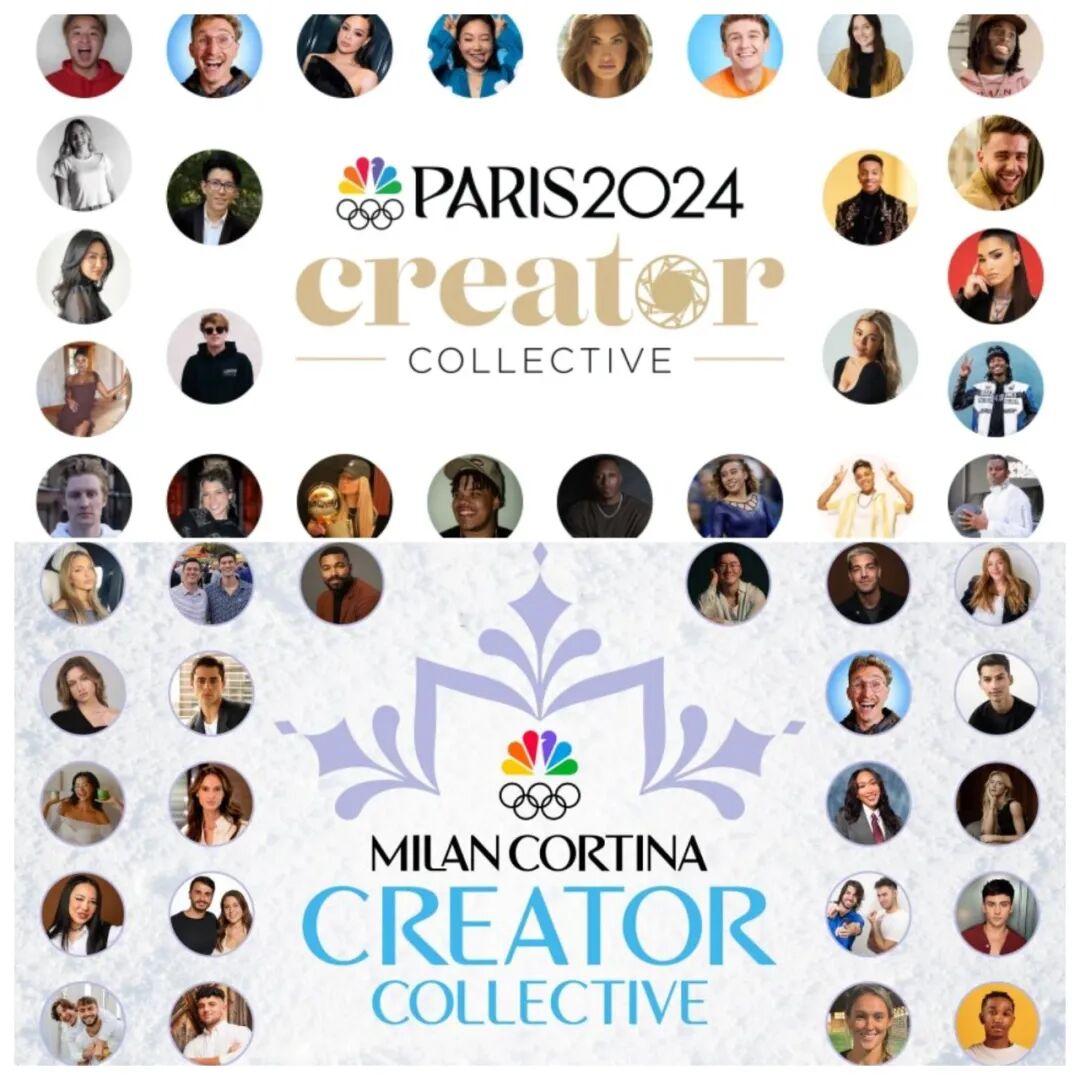
In 1956 in Cortina d'Ampezzo, the Winter Olympics was televised live for the first time in history. 70 years later in Milan - Cortina d'Ampezzo, the communication model of the Winter Olympics has undergone another revolution. NBCUniversal, the exclusive rights - holding broadcaster in the US market, has partnered with YouTube, Meta, and TikTok and sent a creator alliance composed of internet celebrities to report on the event for the first time in the Winter Olympics.
The 25 creators sent by NBCUniversal have diverse professional backgrounds, including athletes, internet celebrities, podcast hosts, comedians, etc. They will be granted exclusive access, which is only available to Olympic rights - holding broadcasters, to enter Olympic venues and even restricted areas such as the athletes' village, enabling them to have close - up contact with athletes and the competitions and produce relevant content. At the same time, advertisers can cooperate with these content creators through NBCUniversal to develop brand - customized content.
As a top - level sports IP, the Olympics has clear and strict intellectual property red lines. The reason why NBCUniversal can do this is that the IOC has actively given the green light in terms of policy. Since the Paris Olympics, the IOC has joined hands with Olympic rights - holding broadcasters to launch the Olympic Creator Program and has cooperated with social platforms such as YouTube and TikTok, inviting top - notch digital content creators from around the world to experience and report on the Olympics. The areas opened by the IOC include many areas that are usually only accessible to the Olympic broadcast signal production teams. These locations offer unique close - up perspectives, making it more convenient to film and record the performance of participants and also more conducive to internet celebrities' personalized creation based on the exciting content of the events.
During the Paris Olympics, NBCUniversal sent a creator alliance to create Olympic - related content for the first time, and the European rights - holding broadcaster Warner Bros. Discovery (WBD) also adopted the same approach. At that time, 27 creators brought more than 300 million views on social platforms for NBCUniversal, which greatly excited this biggest financial backer of the Olympics. Therefore, they repeated the same strategy in the Milan Winter Olympics and invited 25 internet celebrities to participate.
The main reason why the IOC and traditional media represented by NBC are willing to "lower their noble heads" is to attract more young Olympic audiences. With the development of new media, today's young fans are significantly different from previous generations. Young people in the new era trust internet celebrities on digital platforms such as YouTube more than traditional commentators.
Data also shows that the focus of current Olympic fans, especially young fans, has shifted from traditional TV stations to content creators. According to data from market research firm YouGov, nearly half of global sports fans follow sports internet celebrities, and this proportion is as high as 59% among adults aged 18 - 44. Among the things that these internet sports fans are most interested in, besides game highlights, are the personal life dynamics of internet celebrities. During the Paris Olympics, YouTube accounted for 17% of the total global Olympic interactions, attracting 850 million unique viewers and generating 12 billion cumulative views.
This shows that internet celebrities can effectively resonate with young people by combining the drama and authenticity of sports events with a character - centered storytelling approach.
The implication for brands is that if they want to reach young sports fans, they should give priority to cooperating with internet celebrities or creators, combine the performance of sports events with character - centered storytelling, and creators who can effectively combine exciting game footage with personal stories can maximize trust and engagement.
Internet celebrities or creators have long become the main force in