The big question determining AI deals: How much can OpenAI raise in this round of financing?
The scale of OpenAI's new round of financing has become a key variable in determining the trading logic of the AI sector. The latest rumor suggests that the financing amount could be as high as $170 billion. However, NVIDIA has clarified that its investment is less than expected, directly impacting Oracle's ability to fulfill a $300 billion contract as a supplier.
To fill the gap, OpenAI is seeking support from tech giants. SoftBank is in talks to invest up to an additional $30 billion, and Amazon is also in contact regarding participation in this round of financing.
Whether OpenAI can successfully complete this new round of massive financing is not only a matter of its own survival but has also become a key variable in determining the trading logic of the entire AI sector.
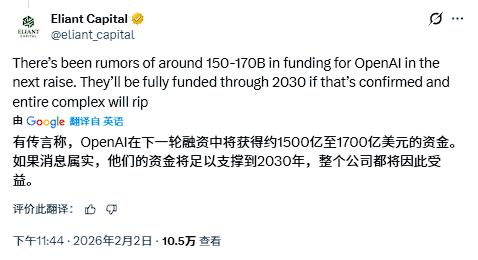
Although market rumors indicate that the scale of OpenAI's next - round financing could be as high as $150 - 170 billion, if this information is true, it will ensure the stability of its capital chain until 2030 and is expected to drive a significant rise in the entire AI sector. However, uncertainties in reality are increasing.
According to a previous article by Wallstreetcn, Jensen Huang clearly clarified on January 31st that although the chip giant "will definitely participate" in OpenAI's latest round of financing, the amount is far from what the outside world has speculated.
On February 2nd, according to The Wall Street Journal, this funding gap has triggered a chain reaction, directly impacting Oracle, which provides computing power for OpenAI. Oracle had previously included a $300 billion contract with OpenAI in its remaining performance obligations (RPO), which supported the earlier surge in its stock price.
Analysis points out that now, as the investment intentions of core investors are adjusted, investors are beginning to question whether OpenAI has the ability to pay this astronomical fee and whether Oracle's accounting treatment of including the full amount in its accounts is prudent.
The report indicates that currently, Oracle is facing a dilemma: on the one hand, it needs to raise funds by issuing stocks to defend its investment - grade credit rating; on the other hand, it needs to address shareholders' concerns about dilution after the stock price has been halved from its high in September last year.
01 Huge Uncertainty in Financing Scale
The final scale of OpenAI's current round of financing is the "decisive factor" in determining the flow of funds in the AI industry chain.
On February 2nd, the latest market rumor circulated on social platform X suggests that the amount of OpenAI's next - round financing could be as high as $150 - 170 billion. This optimistic expectation is regarded as the fuel for the continued surge of the entire AI complex.
However, the actual progress of financing is full of uncertainties. According to a report in The Wall Street Journal last Friday, due to internal doubts at NVIDIA, the letter of intent disclosed by both parties in September - that is, the deal where NVIDIA would invest up to $100 billion in OpenAI over several years - has stalled.
NVIDIA CEO Jensen Huang clearly clarified on January 31st. When asked if the investment amount would exceed $100 billion, he clearly stated: "No, no, not at all." Although he confirmed that NVIDIA will definitely participate in OpenAI's latest round of financing, the reduction in the investment scale is a foregone conclusion.
To fill the funding gap, OpenAI is seeking support from other giants. After SoftBank invested $22.5 billion in OpenAI in December last year and increased its stake to 11%, it is in negotiations for a further investment of up to $30 billion.
In addition, Amazon is also in contact with OpenAI regarding participation in this round of financing. Considering that OpenAI is estimated to have various commitments of up to $14 trillion, whether it can successfully raise a huge amount of funds from the above - mentioned investors will directly determine its ability to fulfill its obligations.
02 Oracle's $300 Billion Gamble
The relationship between OpenAI and NVIDIA has long been regarded as an epitome of the "cyclicality" of AI trading: NVIDIA invests in OpenAI, OpenAI uses the funds to purchase computing power from Oracle, and Oracle then uses this revenue to buy NVIDIA chips.
The uncertainty of OpenAI's financing exposes its core supplier, Oracle, to significant risks. As of November 30th, Oracle reported remaining performance obligations (RPO) of $523 billion, which is approximately nine times its revenue in the past four quarters.
Notably, this includes a $300 billion contract related to OpenAI. In early September last year, due to the financial report showing that RPO had more than quadrupled compared to the previous quarter, Oracle's stock price soared by up to 36% in a single day.
Oracle spokesperson Deborah Hellinger said:
"The deal between NVIDIA and OpenAI has zero impact on our financial relationship with OpenAI. We are confident in OpenAI's ability to raise funds and fulfill its commitments."
However, according to accounting standards, only when management judges that collection is "probable" can the recording party include this $300 billion in RPO. If OpenAI cannot pay the full amount or needs other customers to fill the gap, the credibility of the book data will be greatly reduced.
This also poses an urgent question for Oracle's management: In the upcoming financial report, do they still consider it "probable" to recover $300 billion from OpenAI? This judgment will directly affect market confidence.
03 The Battle to Defend Oracle's Balance Sheet
Amid concerns about OpenAI's ability to fulfill its obligations and its own debt level, Oracle is taking action to maintain its financial credibility.
On February 1st, Oracle announced a plan to issue up to $20 billion in common stock this year, which is part of a broader plan to raise $45 - 50 billion through equity and debt financing to expand its cloud infrastructure business.
The report states that although this move will dilute shareholders' equity - and it comes after the stock price has fallen by about half from its high in September last year - increasing the equity buffer is considered a prudent move in the current environment of high uncertainty in AI trading. Oracle is currently borrowing to build data centers, and these investments largely depend on the contract signed with OpenAI.
Market concerns have been reflected in the bond market. Oracle's current credit rating is BBB, and it has been placed on the negative watch list by S&P and Moody's, facing the risk of a downgrade. The trading price of some of Oracle's debt (including the 10 - year notes issued in September) has recently approached junk - bond levels, and the cost of its debt - default protection has soared.
This article is from the WeChat official account "Hard AI". Author: Focused on technology R & D. Republished by 36Kr with permission.