Musk announced: Mass production
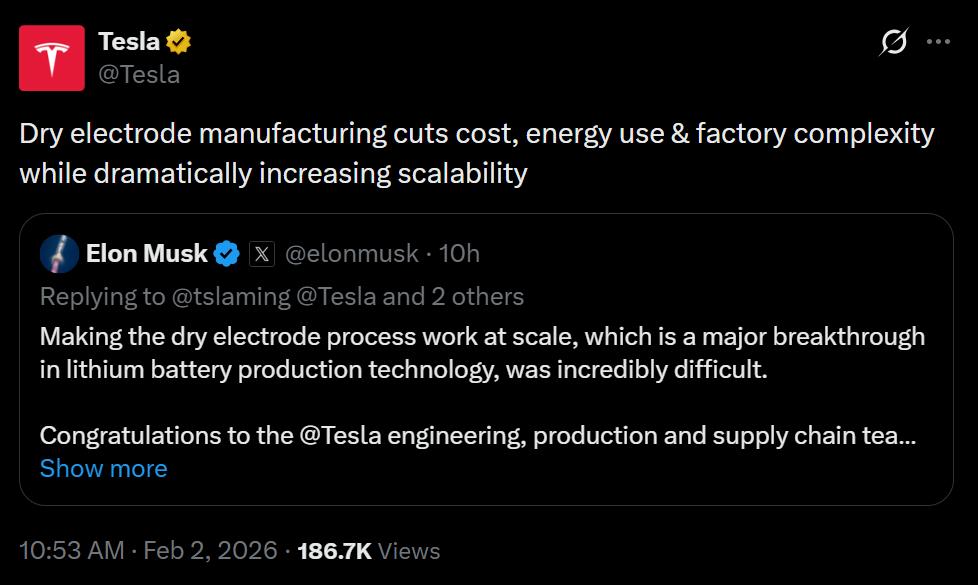
On February 1st local time, Elon Musk stated on a social platform, "Achieving large-scale production of the dry electrode process is a major breakthrough in lithium battery production technology and extremely challenging. Congratulations to the Tesla engineering, production, and supply chain teams, as well as our strategic partner suppliers, on their outstanding achievements."
Subsequently, Tesla's official team reposted the message and replied, "The dry electrode manufacturing process can reduce costs, energy consumption, and factory complexity while significantly improving scalability."
Just recently, Tesla announced a patent named "Composition and Preparation Method of Dry Electrode Film with Low Binder Content". By mixing the active material and conductive carbon first and then adding the dry binder in a specific sequence, it avoids damage to the particles caused by high shear forces. The patent stipulates that the conductive carbon content should not exceed 8% by weight, and the binder usage should be less than 2%.
The dry electrode process, also known as the dry process, is one of the pre - production methods for solid - state batteries. Traditional lithium battery electrode production mostly uses the wet process: the electrode/electrolyte materials are mixed with a binder to form a slurry, which is then coated and dried to form a film. In contrast, the dry process eliminates the use of solvents and the drying step. It relies more on high - shear dry mixing and fiberization equipment to achieve uniform dispersion and pre - forming of materials, and the film - forming process is directly completed through multi - roll compaction.
In recent years, Tesla has always regarded the dry electrode as the core manufacturing process for battery production and claims that it will make the 4680 battery the "complete" version. It has been nearly two years since the design of the dry cathode 4680 battery was finalized in 2024.
Why is battery technology so important? Recently, Tesla's Chief Financial Officer, Vaibhav Taneja, said at an earnings conference, "The biggest constraint for (FSD) globally remains battery pack production. Although our team is trying to alleviate this problem through innovative methods such as applying the 4680 battery to non - structural battery packs, we are still continuously optimizing the relevant technologies."
From an overall industrial perspective, Soochow Securities stated that the wet process is still the main choice for solid - state battery production lines. The dry process, with its comprehensive advantages in cost, process, and material compatibility, is gradually becoming the mainstream direction for the pre - production process of next - generation solid - state batteries. In China, according to incomplete statistics from the Science and Technology Innovation Board Daily, some companies have actively planned for the dry process:
In May last year, Sanfu Xinke announced that it plans to invest 620 million yuan in a project for the industrialization of key materials for high - safety dry electrode batteries and high - frequency electronic information composite materials, and the project is expected to be completed by the end of 2027.
Yinghe Technology said at a performance briefing that it has now launched the latest solutions for solid - state batteries covering both wet and dry processes.
The investor relations activity record of Nakanoer shows that the company will actively cooperate with downstream customers to adjust and optimize the dry electrode production equipment to accelerate the industrial application of the dry electrode process.
In terms of investment, GF Securities said that it is estimated that the global shipment of all - solid - state batteries will reach 181 GWh in 2030. In the early stage of the new industry, equipment manufacturers will be the first to benefit. Although the solid - state battery route has not been fully confirmed, compared with liquid batteries, there are changes in the front, middle, and back stages of solid - state battery equipment, and the changes in the process will inevitably lead to an incremental demand for equipment. It is recommended to pay attention to leading manufacturers of lithium battery whole - line solutions, which have closer ties with downstream leading customers, as well as equipment manufacturers that benefit from the marginal changes in the solid - state battery process.
This article is from the WeChat official account "Science and Technology Innovation Daily", author: Zhang Zhen. It is published by 36Kr with authorization.