The fuel-powered cars you look down on are the "lifeblood" of these automakers.
Guided by the global "dual carbon" goal and continuously supported by policy dividends, the new energy vehicle market in China is reshaping the industry landscape at a visible pace and has become an important driving force for the global automotive industry transformation.
Data from the China Association of Automobile Manufacturers shows that in 2025, the production and sales of new energy vehicles in China exceeded 16 million units, reaching 16.626 million and 16.49 million respectively, with year - on - year growth rates both exceeding 28%. The proportion of new energy vehicle sales in new vehicle sales climbed to 47.9%, an increase of 7 percentage points from the previous year, meaning that one out of every two newly added vehicles is a new energy model.
From the consumer side, market acceptance has shifted from policy - driven to spontaneous choice. In December 2025, the retail penetration rate of new energy passenger vehicles reached as high as 59.1%. There were 147 cities in the country where the penetration rate of new energy vehicles exceeded 50%, and a dense consumer cluster was formed in the eastern coastal areas.
Against this background, "going all - in on new energy" has become the strategic choice for many automakers, and there are also many successful cases. Many domestic brands have achieved overtaking on the new energy track. In 2025, the sales share of Chinese brand passenger vehicles reached 69.5%, and the penetration rate in the new energy track was as high as 80.9%, completely breaking the market monopoly of traditional joint - venture brands.
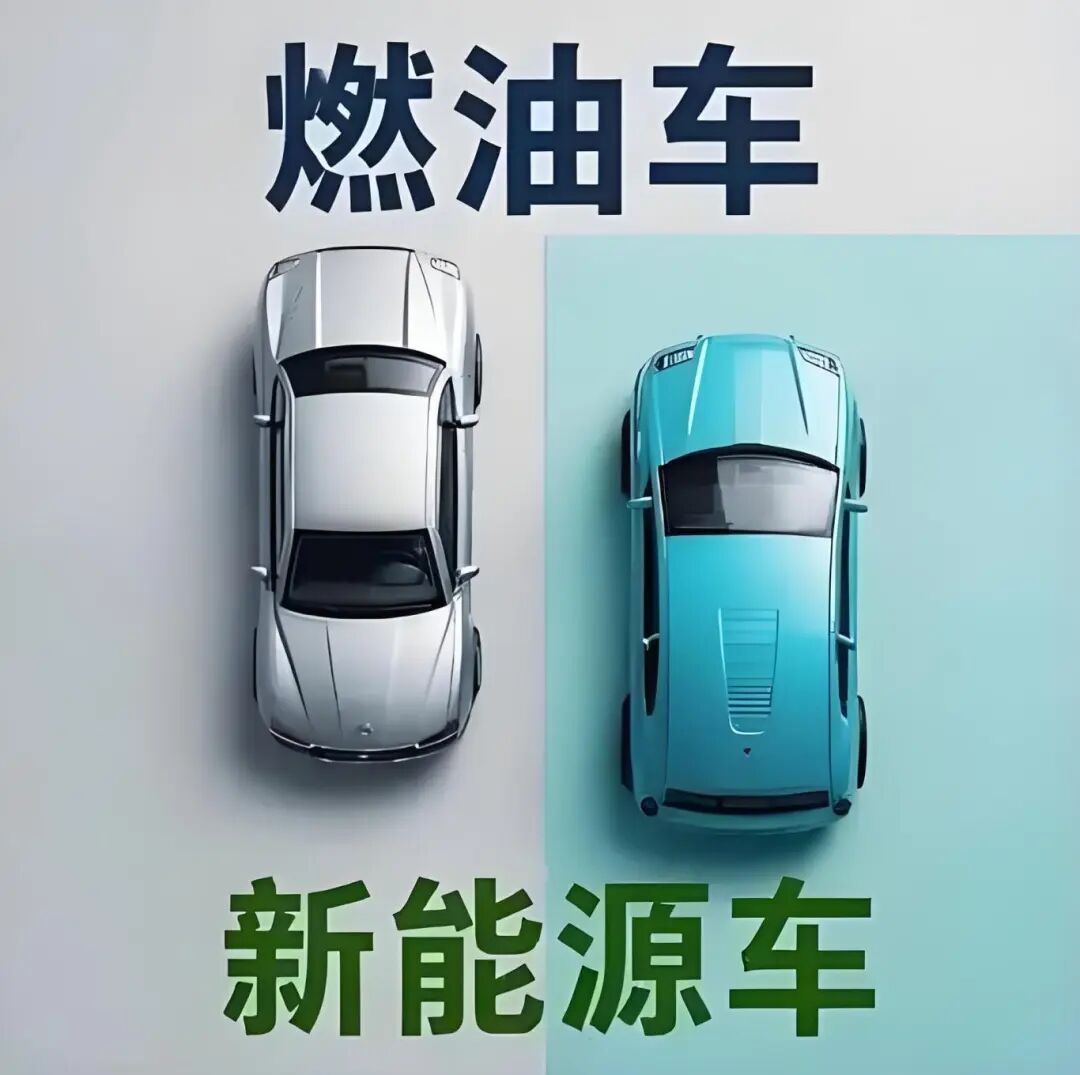
However, the rapid development of new energy vehicles has not completely squeezed the living space of fuel - powered vehicles. When the industry focuses on the continuous breakthrough of the penetration rate of new energy vehicles, a set of data is worthy of attention: In 2025, the production of fuel - powered vehicles in China still reached 18.25 million units. Although it decreased slightly by 1% year - on - year, it still accounted for more than half of the total vehicle production.
In fact, many automakers still rely on fuel - powered vehicles to achieve stable profits. The sales of fuel - powered vehicles of many enterprises account for more than 50% of their total sales. These fuel - powered models are not only a stable source of sales for the enterprises but also become the "cash cows" to support their new energy transformation and technological R & D. During the painful period of new energy transformation, the continuous contribution of fuel - powered vehicles has given many automakers more buffer space in the fierce market competition.
Fuel - powered Vehicles Hold Up Half the Sky
In the automotive market in 2025, the value of fuel - powered vehicles has not been completely overshadowed by the glory of new energy vehicles. Especially for joint - venture brands, luxury brands, and some leading domestic brands, they still rely on a powerful product matrix of fuel - powered vehicles to achieve double - guarantee of sales and profits.
However, not all automakers that attach importance to fuel - powered vehicles can gain recognition in terms of sales. From the data, there are many automakers whose sales of fuel - powered vehicles account for more than 50%. Their common feature is that their fuel - powered models have withstood long - term market tests, formed a stable user group and brand reputation, and become the core pillar of corporate profitability.
For example, among joint - venture brands, the Volkswagen Group has performed well. In 2025, the sales of fuel - powered vehicles of SAIC Volkswagen and FAW - Volkswagen accounted for more than 90%. Among them, FAW - Volkswagen sold 1.587 million vehicles, and the market share of its fuel - powered vehicles increased by 0.9 percentage points against the trend. Classic models such as Sagitar and Magotan continued to lead the compact and mid - size car markets with their advantages of durability and high cost - effectiveness, becoming the "ballast stones" for stable sales; SAIC Volkswagen sold more than 1 million vehicles throughout the year. Models such as Passat and Tiguan L still had strong competitiveness, and the annual market share of its fuel - powered vehicles reached 8.3%, contributing most of the revenue and profits to the enterprise.
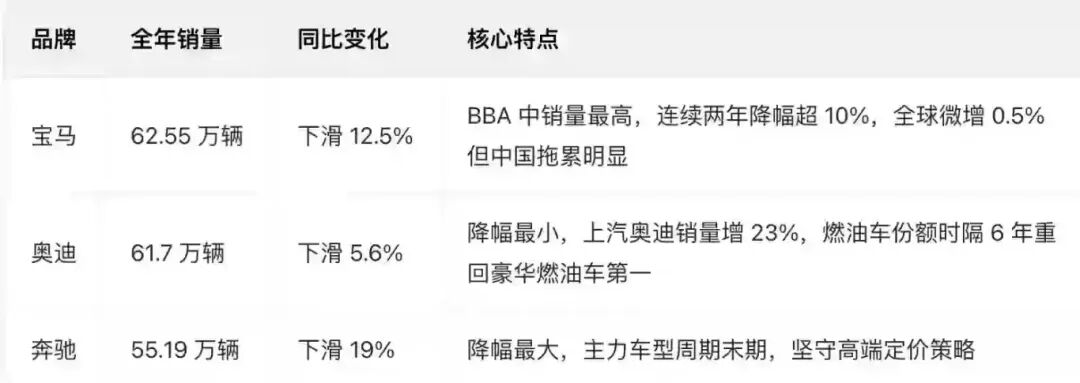
In addition, in the luxury brand field, the fuel - powered vehicles of the three German luxury brands still hold great value. In 2025, the sales of fuel - powered vehicles of BBA (Mercedes - Benz, BMW, Audi) in China still accounted for more than 70%.
Specifically, BMW sold 625,500 vehicles in China in 2025. Its fuel - powered models such as the 3 Series, 5 Series, and X3 were still the main sales pillars. Especially, the 5 Series ranked among the top in the sales of the mid - large luxury sedan market; Mercedes - Benz sold 575,000 vehicles in China. The strong performance of fuel - powered models such as the C - Class, E - Class sedans, and GLC SUV allowed Mercedes - Benz not to rush into its electrification transformation; Audi sold 617,000 vehicles in China. The fuel - powered vehicles of FAW Audi won the first place in the sales share of domestic fuel - powered luxury vehicles. Models such as Q5L and A6L have long ranked among the top in the sales list of segmented markets, providing solid support for Audi's brand influence and profit growth.
Meanwhile, Japanese brands have continued their reliance on fuel - powered vehicles.
Toyota sold a total of 1.78 million vehicles in China in 2025. The sales of fuel - powered models such as RAV4, Avalon, and Corolla were stable, becoming the core competitiveness of Japanese fuel - powered vehicles; Nissan sold about 800,000 vehicles in China. As an ever - green model in the compact car market, Sylphy has long ranked among the top in the sales list and has become one of Nissan's most core sales sources; Honda sold about 700,000 vehicles in China. Although the sales of fuel - powered models such as Accord and CR - V declined slightly, they were still the main sales forces and maintained strong market competitiveness.
In addition, among domestic brands, many enterprises have achieved stable development by relying on fuel - powered vehicles.
Hongqi sold more than 400,000 vehicles throughout 2025, and the proportion of fuel - powered vehicles exceeded 60%. Fuel - powered models such as Hongqi H5 and HS5 performed outstandingly in the mid - size car and SUV markets and became the benchmark models for domestic fuel - powered vehicles; Geely's fuel - powered SUVs such as Xingyue L and Boyue ranked among the top in the sales of domestic fuel - powered vehicles, providing sufficient financial support for Geely's new energy transformation... The fuel - powered vehicle business of these domestic brands is not only a supplement to sales but also lays the foundation for the comprehensive transformation of enterprises in terms of technology accumulation and supply - chain improvement.
New Energy is the Future, but Fuel - powered Vehicles Won't Exit the Market
Currently, new energy vehicles have become the recognized future direction in the industry. Almost all automakers have elevated their electrification transformation to a strategic level, and the proportion of new energy vehicle sales has also become an important indicator to measure the effectiveness of enterprise transformation.
From the industry data, in 2025, the penetration rate of Chinese brands in the new energy track reached 80.9%, while that of mainstream joint - venture brands was only 8.2%. This huge gap has prompted joint - venture brands to accelerate their electrification layout, and they have launched new new energy models and platforms one after another, trying to narrow the gap with domestic brands.
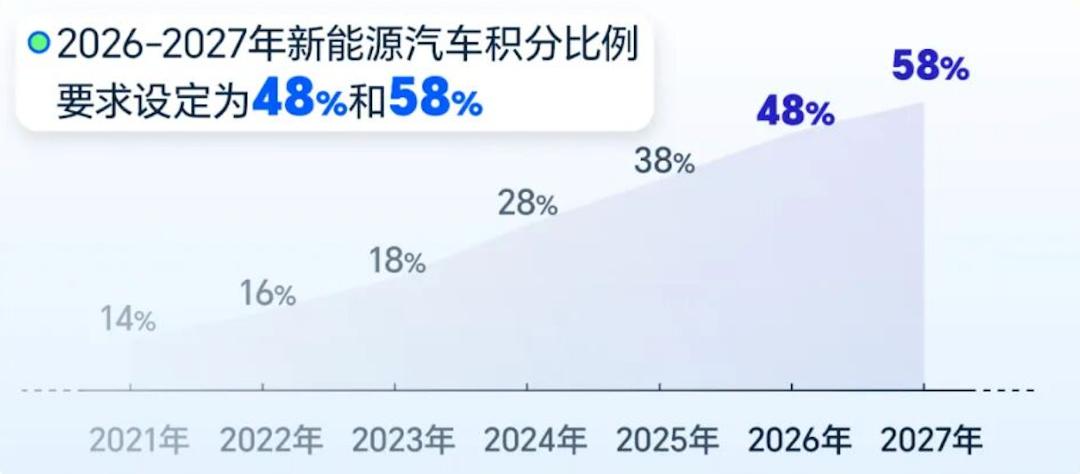
At the policy level, the "Passenger Vehicle Fuel Consumption Evaluation Method and Indicators" implemented in 2026 is known as the "strictest fuel consumption standard". Through differential assessment and full - cycle supervision, it forces automakers to accelerate their new energy transformation. In 2026, the new energy credit ratio of automakers needs to reach 48%, and it will rise to 58% in 2027, further strengthening the development orientation of new energy.
It is undeniable that the core trend in the future automotive market will surely be the continuous increase in the proportion of new energy vehicles. With the continuous breakthroughs in battery technology, the improvement of charging infrastructure, and the in - depth integration of intelligent technology, the product strength of new energy vehicles will continue to increase, further squeezing the market space of fuel - powered vehicles.
Globally, the popularization of new energy vehicles is an irreversible trend. As the world's largest new energy vehicle market, China will continue to lead this transformation. It is expected that the penetration rate of new energy vehicles will continue to move towards a higher level in the next few years and gradually become the absolute mainstream in the automotive market.
However, this does not mean that fuel - powered vehicles will completely disappear. On the contrary, for a long time in the future, fuel - powered vehicles will still be an important source of sales and profits for many automakers.
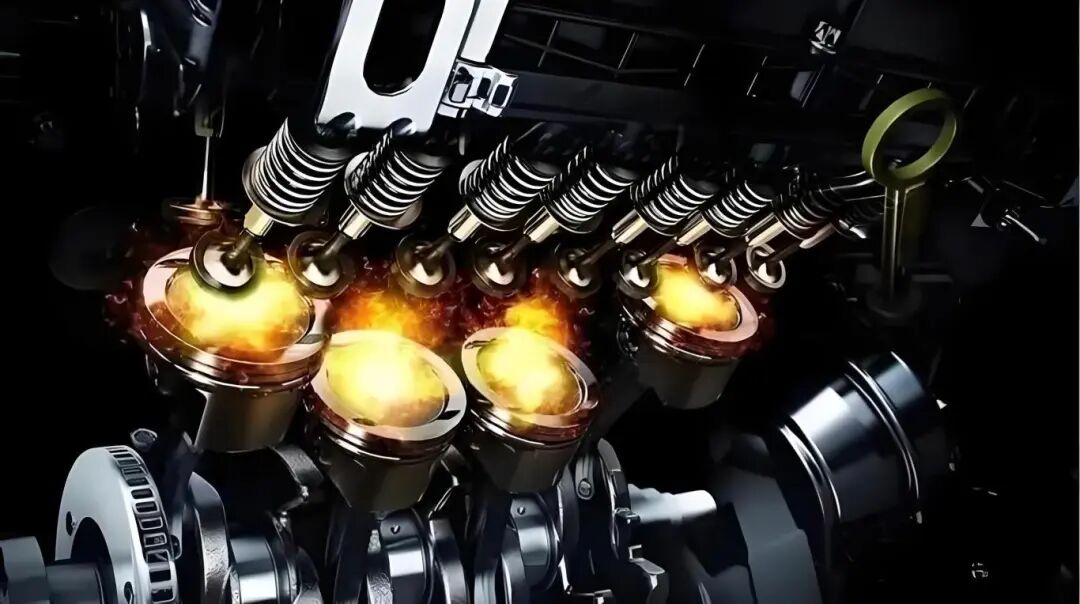
From the perspective of market demand, fuel - powered vehicles still have a stable core audience. For example, users who often travel long - distance or do not have a fixed charging pile value the refueling efficiency of fuel - powered vehicles, which can be fully refueled in 5 minutes, and they don't have to face the problems of waiting for charging and range anxiety; consumers in cold northern regions prefer the stability of fuel - powered vehicles in low - temperature environments, avoiding the problem of reduced range of new energy vehicles; middle - aged people over 45 years old pay more attention to the continuity of driving experience. The linear power output, mature mechanical texture of fuel - powered vehicles, and long - term usage habits make it difficult for them to quickly switch to new energy vehicles.
The existence of these segmented demands provides continuous living space for fuel - powered vehicles.
From the perspective of technological development, fuel - powered vehicles are achieving a "second evolution" through high - efficiency and clean - energy upgrades, rather than moving towards the end. Currently, the industry is promoting the thermal efficiency of internal combustion engines to approach the theoretical limit of 48%. By optimizing the combustion system through technologies such as direct injection in the cylinder, variable valve timing and lift, and combining with the application of new lightweight materials, fuel consumption has been significantly reduced.

Meanwhile, hybridization has become an important transformation direction for fuel - powered vehicles. Hybrid technologies such as BYD's DM - i 5.0 have achieved a low fuel consumption of 2.6 liters under power - feeding conditions. While fully meeting the strict fuel consumption standard, they have solved consumers' refueling anxiety and become a strategic buffer during the transformation period. In addition, the industrialization exploration of clean fuel technologies such as hydrogen fuel and methanol also provides the possibility for the long - term existence of fuel - powered vehicles, enabling them to meet the environmental protection requirements under the "dual carbon" goal.
Therefore, for automakers, the continuous profit - making value of fuel - powered vehicles cannot be ignored. After all, the new energy transformation requires huge capital investment in many aspects, including R & D, production line transformation, and supply - chain construction. The stable profit flow of fuel - powered vehicles can provide strong support for these investments. Especially for joint - venture brands and luxury brands, the fuel - powered vehicle business is not only the current core of profitability but also the key to maintaining brand influence and stabilizing the dealer system.
Most likely, the automotive market will form a pattern of "new energy as the mainstay and fuel - powered vehicles as a supplement". Fuel - powered vehicles will focus on segmented scenarios and precise user groups, exist continuously with the positioning of "niche and high - quality products", and continue to contribute value to automakers.
This article is from the WeChat official account "Automobile Commune" (ID: iAUTO2010), author: Li Sijia, published by 36Kr with authorization.