American parents have started using Robotaxis to pick up and drop off their children. Robotaxis seem doomed, while Tesla is trying to break through by making tough decisions.
Children finish school at four o'clock. One by one, they stand at the school gate, waiting to be picked up. Parents who get off work at six are still debating fiercely and writing furiously at their workstations. When the winter vacation begins, parents want to send their children to tutoring classes to achieve multiple goals, but then they start to worry about how to pick them up and drop them off.
To pick up or not to pick up?
On the one hand, parents worry about their children's safety; on the other hand, they want their children to be independent. They are accused of over - spoiling their children on one side and being irresponsible on the other.
Finally, parents can't escape this epic question.
Not only in China, but parents in another time zone also have the same troubles.
One Saturday night, Laura Mancuso in San Francisco, USA, was caught in such a dilemma.
On one hand, her 15 - year - old daughter wanted to go to a friend's house a few hours' drive away. On the other hand, there was an event she had to attend, and her husband had to take care of their younger son...
So, the couple called a Waymo for their daughter.
In October 2020, Waymo officially opened its fully driverless ride - hailing service to all the public in Phoenix, Arizona, USA, with no safety drivers in the car. As of now, Waymo has been operating stably in six cities in the United States, including Phoenix, San Francisco, Los Angeles, Austin, Atlanta, and Miami, with the number of paid orders per week exceeding 450,000.
As autonomous driving technology matures and regulations are gradually relaxed, more and more cities around the world are gradually opening up Robotaxi services, mainly in China and the United States. Cities in China such as Wuhan, Beijing, Shanghai, Shenzhen, Chongqing, and Guangzhou all offer this service to varying extents.
Forcing Commercialization
"I have no concerns about her taking a Waymo alone. And among my peers, calling a Waymo for teenagers to travel has been fully accepted."
"It has really become a part of our culture."
The latest survey data released by Obi, a global real - time ride - hailing price aggregation platform, shows that people's acceptance of autonomous vehicles has significantly increased. 63% of people said they felt comfortable with autonomous vehicles, while in a study conducted by the company in the spring of 2025, this proportion was only 35%.
Moreover, nearly half of the respondents said that autonomous vehicles may become their main mode of transportation in the future. Among them, 57% of men said they would trust using Robotaxi to pick up and drop off children, while the proportion for women was 47%.
In addition, safety is the most concerning issue for people regarding Robotaxi, followed by the risk of technical failures and data privacy issues.
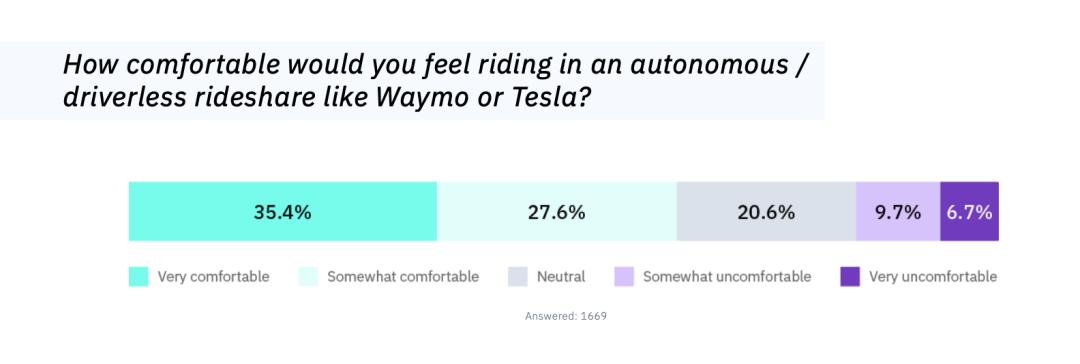
Many American parents are willing to accept using an unsupervised Robotaxi to pick up and drop off their children and even regard it as a crucial way. Part of the reason is that they think it is safer than ride - hailing services driven by humans and much more reassuring than riding in a car driven by a peer who has just got a driver's license.
Obviously, this is a change in concept - machines are more trustworthy than humans.
Compared with strangers, novice drivers, and the complex situations such as drunk driving and carpooling that may occur, they are more willing to trust autonomous driving. Because the former is full of uncertainties, while Robotaxi is more predictable, which makes them feel at ease.
"It's just a bit expensive." Apart from this, the mother mentioned above had no complaints about this mode of travel. It is reported that the trip cost $39.75 after an 80% discount on the platform.
Ideas do vary among different cultures and groups. For example, some parents may probably not allow a 15 - year - old girl to go to a friend's party on the other side of the city alone at night. Some parents also want to attend a friend's party and have a drink on a weekend night...
However, at least one thing in common is that adults as parents can't have 72 clones. "Modern Family" once depicted a phenomenon where middle - class adults have to hire someone to pretend to do housework outside their busy work to play the role of parents well.
Another mother living in San Francisco said bluntly in a media interview that she hoped her daughter, who likes to go out for various activities, could also find a way to get home when she was not at home. And Robotaxi gave both her and her daughter more freedom.
Although this phenomenon is becoming more and more common in the United States, it is still a high - risk behavior and is controversial locally. For example, it is criticized for ignoring safety and being negligent in duty for the sake of convenience.
Interestingly, Waymo's official policy does not allow minors to take the vehicle alone. Parents are not only exploiting loopholes but also forcing Waymo to improve its services and regulations.
In fact, as early as 2024, some American parents used Robotaxi to pick up and drop off their children.
A Waymo spokesperson pointed out, "We have received a lot of feedback from families hoping to allow teenagers to take the vehicle independently. We are working hard to provide this service within the scope permitted by applicable laws."
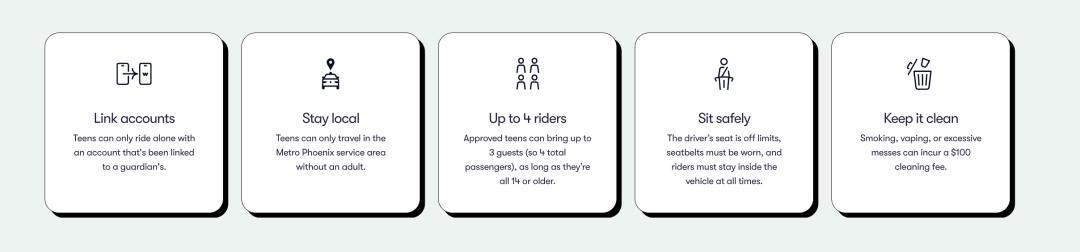
In July last year, Waymo launched a service for teenagers aged 14 to 17 in Phoenix, but each teenager's account must be associated with a parent or guardian.
Waymo pointed out that the purpose of this policy is to overcome the obstacles to teenagers' travel, including the cost of buying a car, parents being too busy with work to drive, and concerns about traffic accidents. One of the benefits of this service listed by the official is "safe, stranger - free space".
Emergence of High - Frequency and High - Demand Scenarios
It can be seen that the commercialization of Robotaxi does not only rely on technological drive.
Parents using Robotaxi to pick up and drop off their children is a high - frequency and high - demand entry point that naturally emerges from travel scenarios and user pain points.
Picking up and dropping off children is a huge and not fully integrated part of the current travel market.
Different from business travel or tourism and entertainment, the scenario of picking up and dropping off children has a very high regularity, mainly concentrated in the morning and evening rush hours, twice or four times a day.
What does this mean for Robotaxi operators?
It means a long - term and stable order flow, which can effectively improve the utilization rate of the fleet.
Moreover, the current parent group using this service in the United States shows a very high willingness to pay and relatively low price sensitivity.
On the one hand, as mentioned in previous articles, Robotaxi with L4/L5 technology as the core is essentially a productivity tool. Solving the problem of picking up and dropping off children directly liberates the productivity of parents.
On the other hand, the "stranger - free" feature has begun to have a premium.
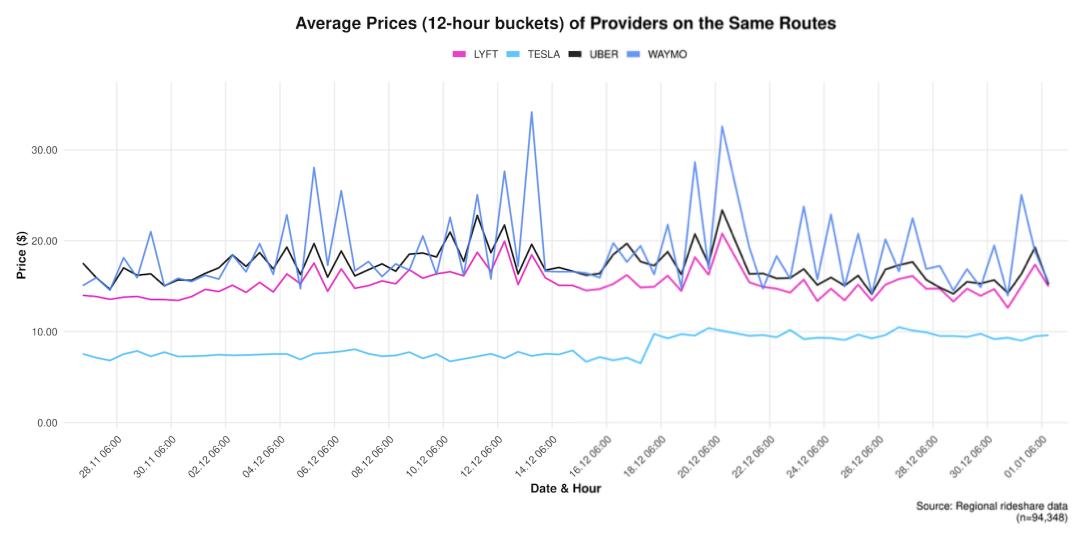
According to a survey conducted by Obi from November 27, 2025, to January 1, 2026, the median price of a Tesla Robotaxi (still equipped with a safety driver) is $7.39, the median price of a Lyft ride is $12.99, and that of an Uber is $14.94, while Waymo is the highest at $17.25.
From the lowest price to the highest price, the price increase is as high as 133.42%.
Ashwini Anburajan, the CEO of Obi, said, "When Waymo entered the market, our research found that its ride price was 30% to 40% higher than that of Uber or Lyft, but consumers still enthusiastically accepted it, regarding autonomous shared travel as a high - end product. In contrast, Tesla's Robotaxi is completely the opposite. Its price is low and rarely increases, which is a new pricing model for shared travel."
Why do parents dare to let their children take a driverless Waymo but not a stranger driver on Uber or Lyft?
The biggest pain point of traditional ride - hailing services is the risk of strangers. Robotaxi can eliminate the uncontrollable factors brought by a third - party in the car, such as no harassment, no certain recording risks, and no emotional driving.
On one hand, some people worry that children traveling alone lack the role of a temporary guardian that a human driver can play; on the other hand, the cold machine gives people another kind of security.
It can be said that parents' allowing their children to take Robotaxi alone has already endorsed their trust in autonomous driving technology.
With the implementation of safety and regulatory issues, Robotaxi shows significant market potential in the scenario of picking up and dropping off children, which will form a new growth point in the travel business and promote the commercialization of Robotaxi.
This is a signal indicating that autonomous driving is transitioning from the technology verification stage to the commercial penetration stage.
Becoming a Public Facility
It is worth noting that once Robotaxi is statistically proven to be significantly safer, then choosing human - driven vehicles will be re - defined as an active choice of higher - risk behavior, which will be a change at the social norm level.
At that time, the question being discussed will change from "Is Robotaxi allowed?" to "Is human - driven vehicles allowed?"
This is exactly what Waymo emphasizes in its narrative.
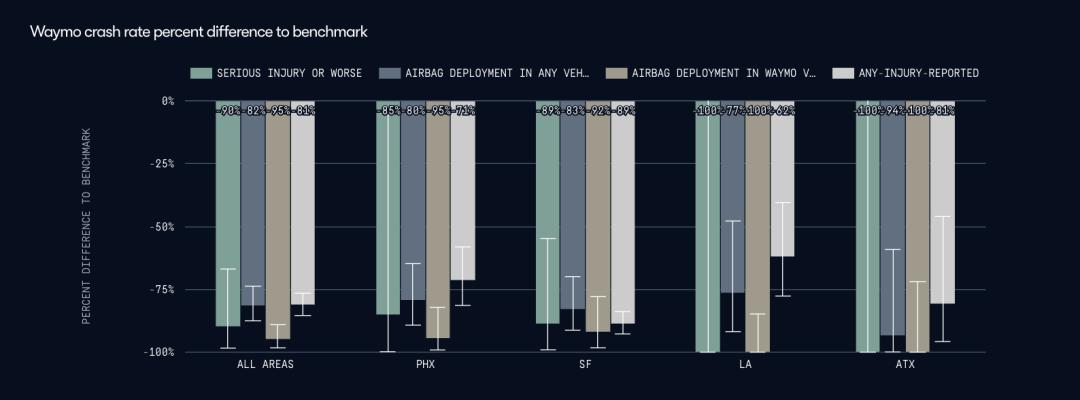
For example, as shown in the figure above, Waymo compared the percentage difference in the collision rates between its autonomous driving system and the human driver benchmark in different locations, with a 95% confidence interval. A negative value indicates that Waymo's autonomous driving system has reduced collision accidents compared with human drivers. A confidence interval that does not include 0% means that the percentage difference is statistically significant.
The percentage reduction and the confidence interval indicate that compared with the human benchmark, Waymo Driver has achieved a significant and statistically significant reduction in accident rates in many results and locations.
The so - called change at the social norm level means that driving by real people will gradually lose its rationality.
By then, not only strange drivers, novice drivers, drunk drivers, and drivers with road rage, but almost all human drivers will become the unsafe elements and uncertain factors on the road.
As mentioned in previous articles, the prosperity of Robotaxi is the inevitable way for the commercialization of autonomous driving technology. Its technical characteristics determine that it cannot bypass the B - end to directly face C - end private users.
It can be seen that in the early stage of this technology diffusion, almost all the driving forces are moving towards the B - end, especially with Robotaxi as the core. Not only are capital willing to invest, local governments willing to approve, but users are also willing to use it.
Robotaxi undertakes the responsibility of centralizing early - stage technical risks, which means that C - end individual users hardly bear the risk responsibility.
However, at the same time, Robotaxi at the B - end may also become the biggest delaying factor on the way for autonomous driving technology to reach the C - end on a large scale.
When the social norm about the legitimacy of human - driven vehicles changes and private individuals no longer need to own vehicles, in the commercial evolution of autonomous driving technology, the way to the C - end may be blocked.
That is, the C - end form of Robocar may be strangled in the cradle before large - scale implementation.
Unless the responsibility for bearing risks and decision - making power of autonomous driving technology can be transferred to individuals, especially when individuals can bear uncontrollable risks.
In other words, the key to the large - scale implementation of Robocar does not lie in technology or cost.
Correspondingly, Robotaxi represents that the ability of machines to drive safely is stronger than that of human - driven vehicles, and the risks are centrally managed.
The public form is more reasonable, and the success of Robotaxi will continuously strengthen this logic. This indicates that the implementation form of autonomous driving technology will become a public facility.
Every time a parent uses Robotaxi to pick up and drop off a child, it is actually a vote for the public facility of autonomous driving. Because this scenario naturally requires safety, controllability, clear responsibility, and a system to support it.
Reconstructing the Transportation Network
One of the most important changes brought by Robotaxi is that it removes drivers from the huge and complex transportation network. This was almost impossible in the past transportation network structure. It cuts off the connection between the "driver" node and all other nodes, as well as the relationships and circulation channels established on this basis.
What are the newly introduced nodes? They are the autonomous driving system, operators, and the map, cloud, and data closed - loop system. These new nodes will establish new connections, such as data and algorithms, algorithms and platforms, platforms and operators, operators and regulators.
Based on the efficient collaboration of vehicles, roads, networks, clouds, and maps, the network formed by Robotaxi can be regarded as a flexible Internet of Things system.
Vehicles have the ability to make collaborative decisions based on global information. The traffic efficiency in scenarios such as intersection games, speed and distance coordination, system yielding in emergency situations, and urban congestion prediction and detouring has been greatly optimized.
Individual driving can only achieve local optimization, while Robotaxi can approach the optimal solution of the system. For example, it can predict the demand explosion in a certain area 15 minutes later through algorithms and dispatch empty vehicles in advance.
This reconstruction turns the transportation network from a rigid and easily congested pipeline system into an elastic and breathable fluid system.
In terms of business logic, the number one enemy of Robotaxi is the original inefficient private vehicle - ownership model, which is reflected not only in safety but also in efficiency.
Once urban traffic efficiency begins to significantly depend on this collaboration, human - driven vehicles will be regarded as the destroyers of system efficiency, which will directly trigger the differentiation of right - of - way.
In addition, the biggest flaw in the current transportation network is that private cars are parked most of the time. Robotaxi can greatly improve the vehicle utilization rate, which means that the mathematical relationship between the total number of vehicles and transportation demand in the current transportation network is directly reconstructed. As a means of transportation, the reusability of the vehicle's carrying capacity will be greatly enhanced.
Robotaxi is breaking the boundary between transporting people and goods. As mentioned in previous articles, Kia's PBV strategy is doing just this. For ride - hailing services and express delivery vehicles, the traditional passenger transportation network and logistics network are two parallel systems, while Robotaxi has the ability to integrate them into a unified intelligent dispatching network.
Robotaxi with autonomous driving as the core is more like a new operating system for the transportation network. Its "ambition" is to format the entire hard drive, including private cars, logistics, and right - of - way allocation, and then reinstall a brand - new logic.
It can be said that Robotaxi is the first case in the real world to successfully run through the commercialization of physical assets, real - time networking, and software - dominated behavior. It may be the sign that the physical Internet has truly entered the commercial verification stage.