The production of Model S/X has been discontinued. This time, it's really a scheme by capital.
Tesla's annual financial report is out. Its annual revenue declined for the first time, and the delivery volume of its automotive business decreased for the second consecutive year, with revenue dropping by a significant 10% year-on-year. During the earnings call, Elon Musk announced a sad piece of news:
Tesla's flagship models, the Model S/X, will be discontinued by the end of the second quarter. The production line in Fremont will be converted into an Optimus robot factory, with a tentative annual production target of 1 million units [1].
As the elder siblings of the S3XY series, the Model S was launched in 2012 and was Tesla's first real mass-produced model after the Roadster. The Model X was released in 2015. These two models established Tesla's brand image as the leader in electric vehicles.
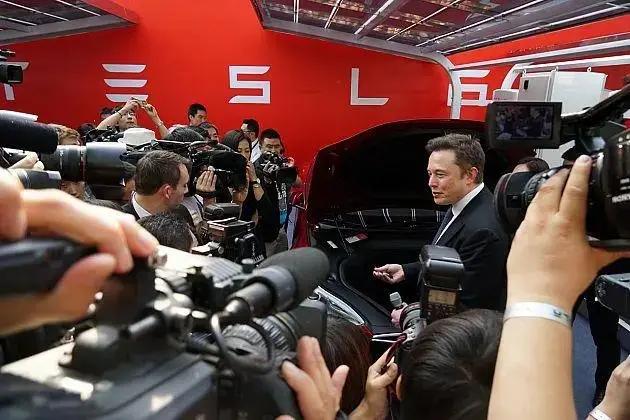
In 2014, the first batch of Model S cars were delivered in China.
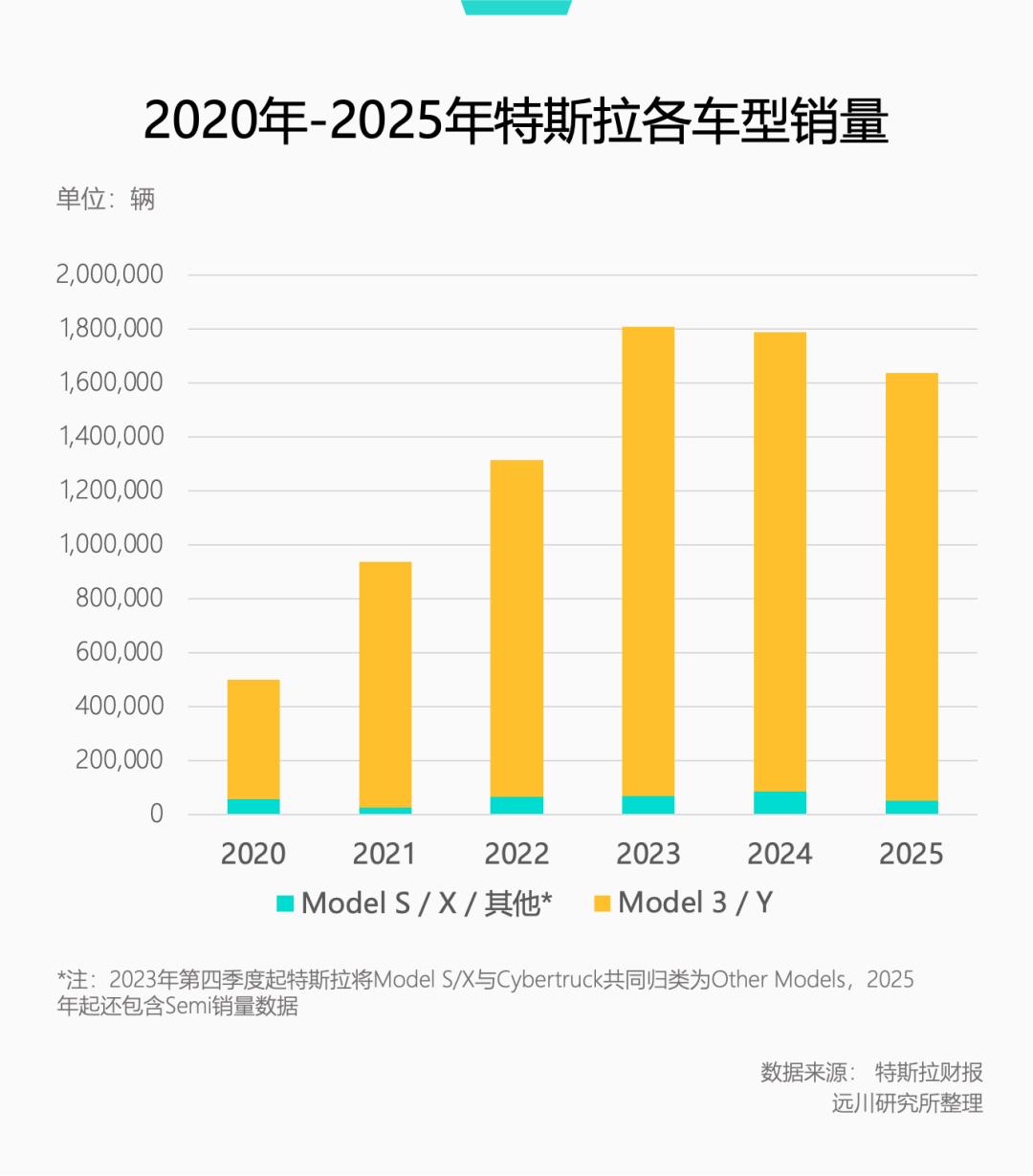
However, in terms of sales, the Model S/X, along with the Cybertruck and Semi, are classified as other models in Tesla's financial report. Their sales have always been low. In 2025, the total sales of these four models were less than 50,000 units, only a fraction of the Model 3/Y's sales (1.5853 million).
Elon Musk said as early as 2019 that continuing to produce the Model S/X was "more out of sentiment" [2]. Now, six years have passed, and that's long enough to wear away that sentiment.
Behind the "honorable retirement" facade lies an increasingly clear fact: Tesla no longer cares about cars.
Affordability is the key
The discontinuation of the Model S/X is related to Elon Musk's long - standing business philosophy.
Different from most car manufacturers' strategy of covering all price ranges with different models, since the day Musk took over Tesla, he has been committed to continuously reducing the production cost of cars and making cars more and more affordable.
Tesla's development plan has always been public, known as the "Master Plan," which has now gone through four iterations. In the Master Plan 1.0 released in 2006, Tesla simply and directly put forward its goal:
Make money, use the money to produce affordable cars, and then use the money from selling affordable cars to produce even more affordable cars.
When the Model S/X was born, the electric vehicle industry chain was still in its infancy. The whole world didn't quite know how to build electric vehicles well. Objectively, this led to extremely high costs for components centered around the three - electric systems (battery, electric motor, and electric control), making it difficult to compete with fuel - powered cars in the mass market.
In other words, in 2012 when the Model S was launched, an electric vehicle priced at 300,000 RMB was hard to compete with a fuel - powered car of the same price in terms of specifications and user experience. However, an electric vehicle priced at 1 million RMB could match or even surpass a fuel - powered car of the same price in terms of specifications and experience.
In this situation, Tesla chose to use the high - priced Model S/X to open up market space, drive the growth of the supply chain, and pave the way for subsequent affordable models.
In 2017, the sales of the Model S/X reached their peak. These two models accounted for 99% of Tesla's annual delivery volume and contributed over $10 billion in revenue. From this point on, the Model S/X gradually began to pass the baton, ceding the spotlight to the Model 3 launched in 2016 and the later Model Y.
In 2018, the sales of the Model 3, which had emerged from the production bottleneck, exceeded those of the Model S/X. The following year, its sales were five times that of the Model S/X, and it rightfully became the new flagship model.
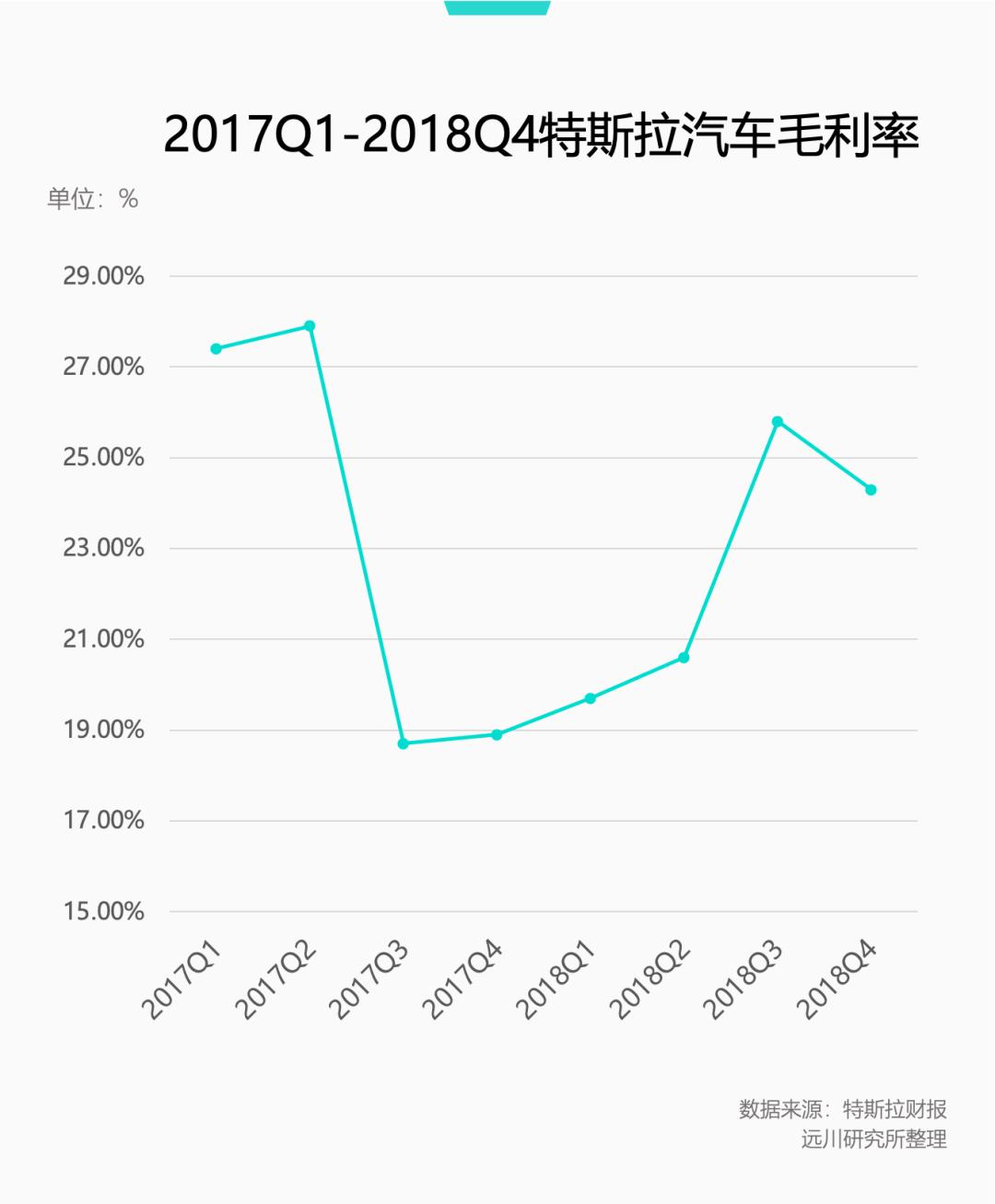
Changes in Tesla's automotive gross profit margin (GAAP) during the Model 3 production bottleneck period
Musk's concept is easy to understand. In his vision, the added value of cars will shift from hardware to software represented by autonomous driving. Only when the sales volume of cars is large enough can the R & D expenses of autonomous driving be spread out, and more consumers can be covered to generate profits. The key to increasing sales volume is to make cars more affordable.
Therefore, different from what most consumers think of Tesla, Musk doesn't want to be the Mercedes - Benz of the electric era. Instead, he wants to produce the Toyota Corolla of the electric era.
Note that we're not denying Tesla's "high - tech" nature. However, Tesla's adoption of a highly integrated electronic and electrical architecture, R & D of 4680 batteries, and introduction of production methods such as one - piece die - casting are all aimed at reducing production costs. Developing an affordable, durable, and profitable Toyota Corolla is no easier than designing a high - performance sports car without considering cost.
On the other hand, the significance of technological progress is to benefit the general public rather than to re - divide social classes. Musk himself is a firm advocate of economies of scale. In his public letter, "The facts about SpaceX Costs," he said:
SpaceX's pricing is not to seize market share but to defeat overseas cheap labor through innovation. Over time, SpaceX will perform better and its prices will become lower. This is the development law of all technological fields.

The "car shed" built by Tesla during the Model 3 production bottleneck period
By 2020, the Model Y began to be delivered. After 2023, it has won the global sales championship year after year, and the Model S/X has been completely marginalized.
According to the original plan, Tesla's next high - volume model should have been the "Model Q," which was supposed to be cheaper than the Model 3. However, due to issues such as the difficulty in mass - producing the 4680 battery, the affordable Model Q came to nothing, replaced by simplified versions of the Model 3/Y.
When the Model 3/Y also began to face the question of "being past its prime," a new generation of affordable models emerged - Cybercab.
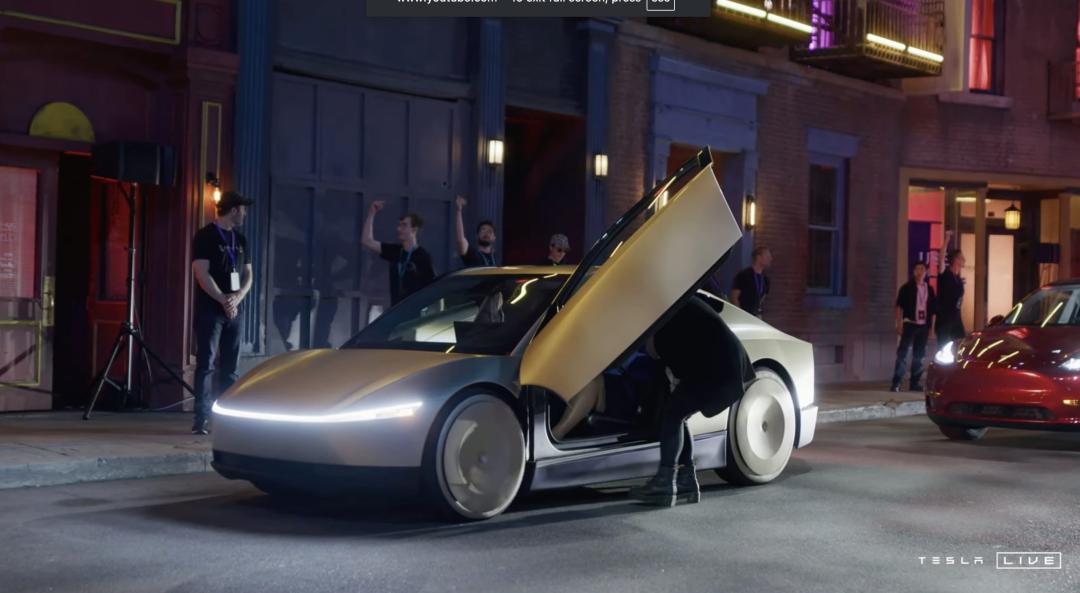
The launch event of the Cybercab
The Cybercab is the culmination of Tesla's years of cost - saving techniques. In Musk's words, its only design goal is to optimize the unit - mile cost of autonomous driving and bring the manufacturing cost below $30,000.
To achieve this, the steering wheel, brake/accelerator pedals can be omitted (relying on autonomous driving), two seats and one screen are enough. The latest "Unboxed" production process is used, and the number of components is reduced by about 50% compared to the Model 3.
During the just - ended earnings call, in response to the question of "whether there are plans to launch new models," the vice - president of vehicle engineering evaded the question and instead emphasized [1], "We have launched the cheapest model ever (referring to the Cybercab)."
Musk also couldn't hold back and made a startling statement: "I think in the long run, except for the next - generation Roadster we hope to launch in April, we will only produce autonomous vehicles [1]."
In this situation, the relatively expensive Model S/X seems a bit redundant.
Wall Street is more impatient than Musk
In addition to Musk's own business philosophy, another reason for the sudden discontinuation of the Model S/X is the epic about - face of the capital market.
Since last year, Tesla's stock price has almost staged the "Tesla Paradox [5]" every quarter, which is specifically manifested as: The worse the performance, the higher the stock price.
In January last year, Tesla released its 2024 financial report. Its car sales declined for the first time in a decade, and all core financial indicators missed expectations. However, Musk staged a reversal during the earnings call, indicating a strong possibility of FSD entering the Chinese market in the first half of the year. Coupled with the old AI players like Robotaxi and robots, the stock price rose instead of falling.
In 2025, the performance was even worse. Among the many dismal financial data, there were only two good news. One was the increase in the overall gross profit margin, and the other was that the number of global paid users of FSD was approaching 1.1 million, of which about 70% were prepaid users.
After the release of the financial report, Tesla's stock price rose by 4% in after - hours trading. Musk also talked a lot about a $20 billion capital expenditure during the earnings call, supplemented by a lot of details about autonomous driving and mass production of robots, which pushed the stock price up again.
In other words, the capital market no longer cares about Tesla's automotive business:
A decline in car delivery volume - Is that a problem? The Cybertruck not selling well - What kind of car is that? A year - on - year decline in revenue - Who asked you? An increase in automotive gross profit margin - Does anyone care? Musk drew another AI pie - Add more positions.
After the release of the latest financial report, various institutions adjusted their target prices for Tesla. Their actions were not unified, but the assessment criteria were all related to AI.
Optimistic institutions, such as MorningStar, raised the target price from $300 to $400 for three reasons: First, the testing of Robotaxi in Texas and California is progressing smoothly; second, they are optimistic about the FSD subscription service; third, the robot Optimus will be mass - produced this year [6].
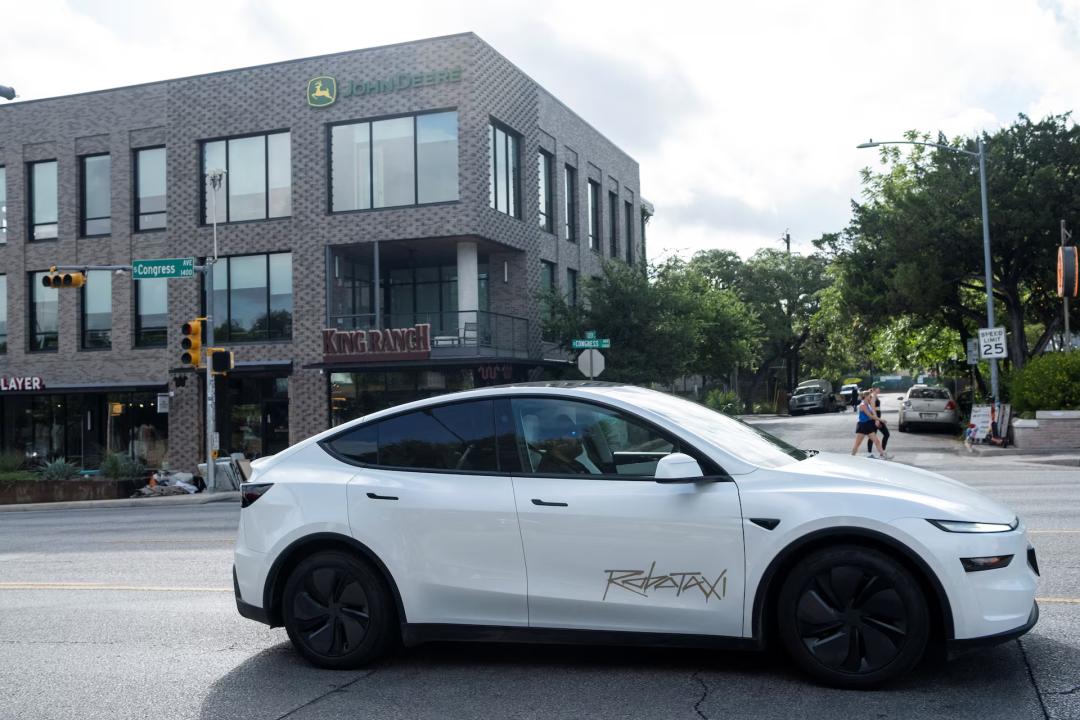
A Robotaxi being tested in Texas. Source: Reuters
The reason for pessimistic institutions to be bearish is not that Tesla's cars are not selling well, but their concern about the uncertainty of Tesla's AI business implementation.
Morgan Stanley lowered the target price from $425 to $415 because it was worried that Tesla's $20 billion capital expenditure was too large [8] and would consume too much cash flow.
Goldman Sachs lowered the target price from $420 to $405. Although it recognized the progress of Tesla's AI business, it also thought that the competition was intensifying [9]. For example, Waymo plans to double the number of cities where it operates robotaxis, and NVIDIA recently open - sourced Alpamayo, which may take away some of Tesla's market share.
Just two or three years ago, the capital market was still arguing about whether Tesla was an "automobile company" or an "artificial intelligence company." At one point, Musk even had to teach investment institutions how to invest during the earnings call:
"If you only see Tesla as an automobile company, your understanding of Tesla is one - sided."
Unexpectedly, as time passed, in an era where for every additional dollar of AI capital expenditure, the market value increases by two dollars, the capital market's question to Tesla has become "Why are you still making cars?"
According to Tesla's plan, of the $20 billion capital expenditure, in addition to six factories including the Cybercab and Optimus, it will also be used for AI infrastructure investment, such as a $2 billion investment in xAI. In response, Musk said he was forced to do so [1]:
"Many investors have asked us to do this, and Tesla's shareholders have also said that we should invest in xAI."
Currently, Musk's top priorities include but are not limited to the development of AI5/AI6 chips, the construction of the xAI data center, the mass - production plan for robots, and the expansion of FSD paid subscriptions. It is estimated that even the TerraFab project, a self - built wafer factory that is still in the early stages, has a higher priority than the Model S/X.
Each of these things excites the capital market, but none of them has anything to do with cars.
If you were originally planning to buy a Model S/X, then this time, you've really been caught in a capital game.
References
[1] Tesla (TSLA) Q4 2025 Earnings Call Transcript
[2] Tesla (TSLA) Q3 2019 Earnings Call Transcript
[3] Do You Have to Wait Months to Get Your Tesla Model S/X? It Might Not Be a Bad Thing, GentlemanZ
[4] Tesla Investor Day: Produce a New Car Every 45 Seconds, Reduce Assembly Costs by 50%, and Achieve Annual Sales of 20 Million Units with Ten Models by 2030, Jiemian News
[5] The Tesla Paradox: Profits Plummet, Stock Rises. Is Musk’s Vision Enough? NAI 500
[6] Tesla Earnings: Progress on Robotaxi and Optimus Shows Real World AI Growth, MorningStar
[7] Tesla Eyes $3 Trillion Valuation. Here's What Noted Bull Dan Ives Expects From The Elon Musk - Led Company In 2026, Investors
[8] Tesla price target lowered to $415 from $425 at Morgan Stanley, tripranks
[9] Goldman Sachs lowers Tesla stock price target to $405 on AI focus shift, investing.com
[10] Elon Musk: “Why the US Can Beat China”, SpaceX