Humanoid robot company Zhuji Dynamics has completed a new round of financing worth $200 million, with participation from leading overseas funds and additional investments from SAIC and NIO | Exclusive from Yingke
Author | Huang Nan
Editor | Yuan Silai
Yingke has exclusively learned that the humanoid robot company LimX Dynamics has completed a Series B financing of $200 million.
The institutional investors in this round of financing include Stone Venture (UAE), Orient Fortune Capital, Cornerstone Capital, Tianchuang Capital, GF Xinde Investment, Hefei Innovation Investment, Guotai Junan Innovation Investment, CSC Financial, Tangxing Capital, and Caixin Capital; strategic industrial investors include JD.com, Zhongding Co., Ltd., Guangyang Co., Ltd., and Dongtu Technology; old shareholders such as Shangqi Capital under SAIC Group, Beyond Time, NIO Capital, and Mingshi Venture Capital have continued to increase their investments.
Embodied intelligence, a track that has been intensively discussed in the past two years, is entering a critical crossroads. After the dazzling demonstrations of laboratory demos and interactive stages, how to make robots truly enter the industrial end and achieve stable mass delivery, and work autonomously and reliably in the ever - changing real physical world has become a new yardstick to measure the technological value of a company.
Previously, LimX Dynamics successively released two key technologies: the multi - form embodied robot TRON 2 and the embodied intelligent agent operating system LimX COSA. The former is positioned as a "reusable and expandable general base", while the latter aims to become the "thinking and scheduling center" of robots.
These are not two independent products. Together with the full - size humanoid robot Oli, they form a combined solution that attempts to solve the problem of the "disconnect between knowledge and action".
For a long time, the high cost of hardware customization and the long development cycle have been the primary barriers to the large - scale deployment of robots. In the traditional model, different task requirements often mean that different robots need to be designed from scratch, which is known in the industry as the dilemma of "one scenario, one dedicated machine".
The core of TRON 2 lies in its original "full - body modular architecture", that is, one body with multiple forms that can be freely combined. Through modular splicing, TRON 2 can flexibly switch between forms such as two - arm, two - legged, and two - wheeled - legged to meet different needs from fine operations to moving on complex terrains.
Put simply, it is like a highly engineered "robot Lego", allowing enterprise users and developers to quickly combine different forms according to task requirements.
For example, in scenarios that require fine operations such as home meal preparation or laboratory sample processing, its two - arm form can have human - like flexibility. The design of 7 degrees of freedom for a single arm provides precise control, a 70 - centimeter arm span covers a wide working space, and a load - bearing capacity of 10 kilograms is sufficient to handle most daily items.

TRON 2 performing fine operations (Source/Enterprise)
In scenarios that require crossing complex terrains such as steps in logistics warehouses or slopes during outdoor inspections, both the two - legged and two - wheeled - legged forms of TRON 2 have all - terrain passability, and have significantly improved in terms of endurance and load, achieving a 4 - hour endurance and a 30 - kilogram load capacity.
The direct benefit of this "general base" model is cost reduction and efficiency improvement. Enterprises do not need to purchase dedicated robots for each new task. One TRON 2 can meet diverse needs by replacing modules, which can effectively improve hardware utilization and return on investment.
At the same time, as an open and standardized verification platform, it allows enterprise customers to conduct algorithm verification and business closed - loop testing at a lower cost and faster speed before large - scale mass production, and simplifies the most risky and costly trial - and - error stage in product development.
In addition to having a flexible body, a general robot also needs a "brain and nervous system" that can handle different environments and tasks.
Although the current Visual - Language Model (VLA) has made rapid progress, most of its capabilities are still limited to linear task chains where a single instruction completes one action, lacking the ability to continuously perceive the environment and dynamically plan between multiple tasks. This is exactly the problem that LimX Dynamics aims to solve by releasing LimX COSA, which is also the industry's first embodied Agentic OS.
Actual test demonstrations show that when the humanoid robot Oli equipped with COSA receives a long - range instruction to "bring water to the guests at the front desk" and is then asked to "pick up the express delivery" on the way, Oli does not stagnate or get confused. Instead, it mobilizes the cognitive layer of the system to judge the task priority, independently plans an action path of "deliver water first and then pick up the package", and performs a series of operations such as moving, obstacle avoidance, and grasping.
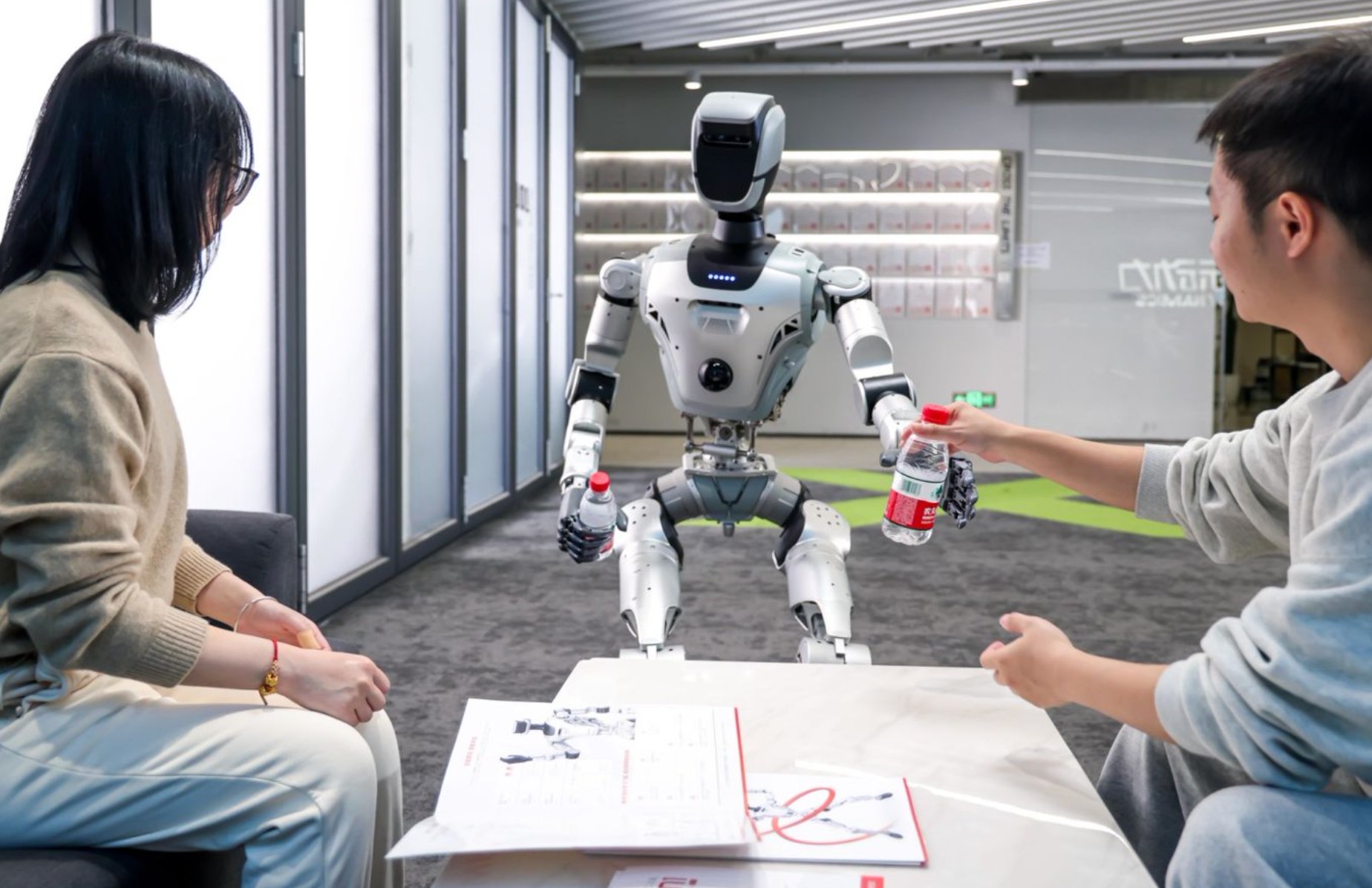
The humanoid robot Oli equipped with COSA receiving the water - delivery instruction (Source/Enterprise)
The entire process is completed autonomously from end to end, rather than relying on pre - written fixed solutions. LimX Dynamics told Yingke that this is not only an improvement in the model but also an upgrade of the system architecture. COSA plays the role of a "scheduling center", unifying the management and scheduling of high - level task understanding, middle - level skill libraries, and low - level motion control models, enabling the robot to achieve autonomous and coherent actions from thinking to execution.
Thus, within this framework, the embodied robot body composed of the TRON 2 modular base and the Oli general humanoid robot, the LimX COSA operating system, and its self - developed "cerebellum" basic model work together to form a reusable production capacity for embodied intelligent agents.
TRON 2 and Oli provide a standardized and high - performance general physical body to ensure stable movement and precise operation. The cerebellum basic model is responsible for generating arbitrary full - body movements in real - time. The integration of the "cerebrum" and "cerebellum" connects the alignment between complex behaviors such as navigation, obstacle avoidance, mobile operations, and stair - climbing, and the basic full - body motion control model. LimX COSA, as the scheduling center, is responsible for complex task understanding, planning, and scheduling.
Under this division of labor process, development efficiency can also be significantly improved. Enterprise engineers and developers do not need to start from scratch to solve high - threshold problems such as hardware stability and basic motion control. Instead, they can focus on the application layer development in their vertical industries based on the verified "body" and "cerebrum - cerebellum integrated skills" provided by LimX Dynamics, and use open interfaces and development tools.
This is not only modularization at the product level but also a re - positioning of industrial roles. The choice of the technical path is clearly reflected in the demarcation of its market boundaries.
When the complex "body" and "brain" are standardized, LimX Dynamics' core task naturally shifts to how to make this system create value in scenarios that most require adaptability and interactivity.
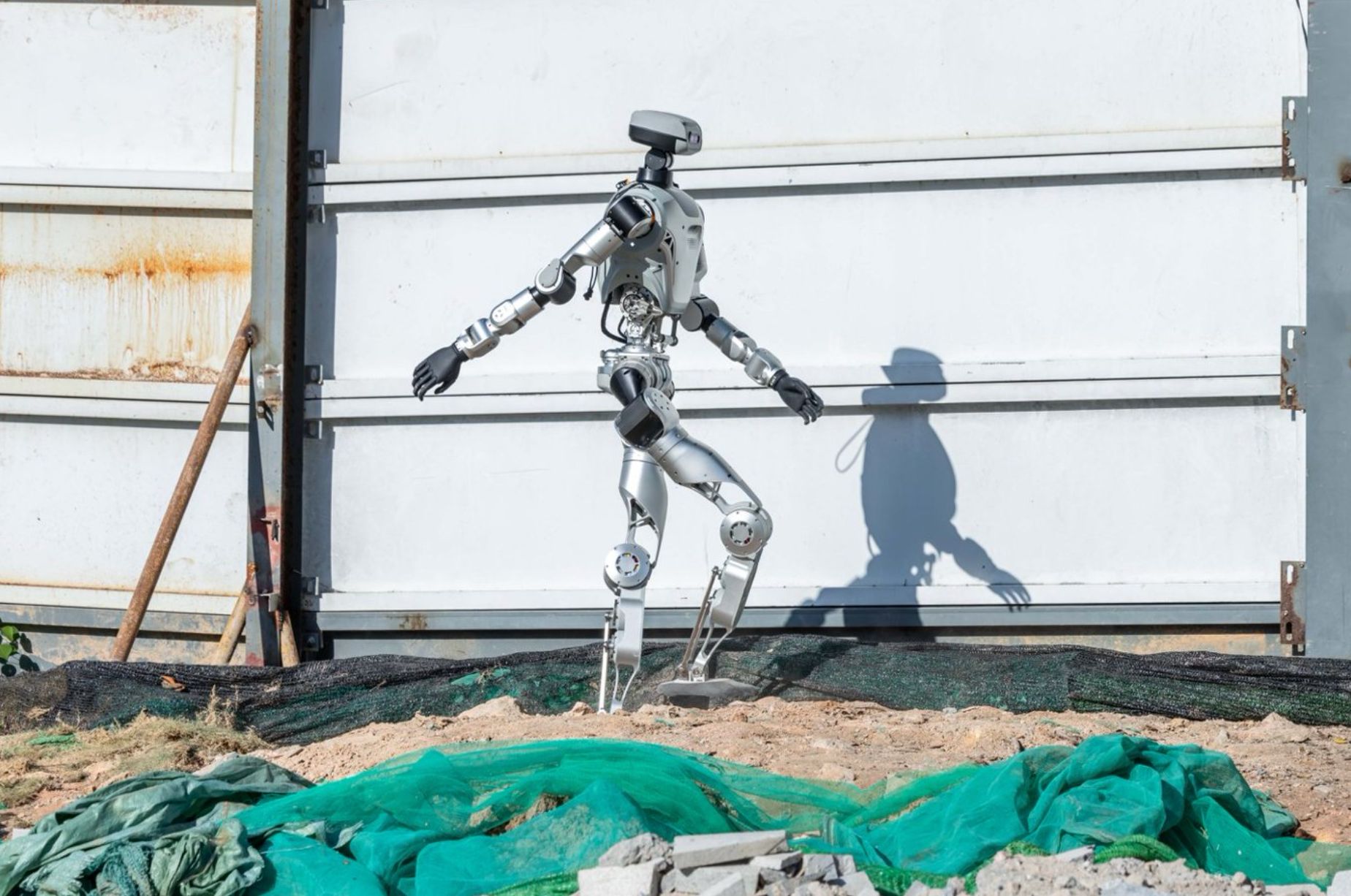
The full - size humanoid robot Oli walking on a construction site (Source/Enterprise)
Based on the fundamental positioning of "serving people rather than production processes", the implementation scenarios targeted by LimX Dynamics are primarily focused on areas that require direct interaction with people and high adaptability, and are expanding from B - end commercial services such as reception and guidance to C - end home services.
Facing the overseas market, based on the advantages of rapid iteration and cost control brought by the Chinese supply chain, the company will also accelerate the establishment of a local ecosystem including developers, customers, and channels to achieve the local integration of technology and the development of the embodied intelligence market.
When robots finally enter daily life, they need not only a perfect demonstration once but also reliability and naturalness in every interaction. The full - stack investment in the standardized "body" and intelligent "brain" may be exploring a practical path for the industry to break through the complexity fog and move towards large - scale applications.