Satellites are swarming into space, and banks' risk control has reached a "new height".
With increasing policy support and enterprises rushing to get involved, the commercial space industry is surging.
Recently, the "Several Measures of Beijing Municipality to Promote the Development and Utilization of Commercial Satellite Remote Sensing Data Resources (2026 - 2030)" was officially issued.
The document mentions that enterprises are encouraged to plan and construct commercial satellite constellations with differentiated advantages, clear commercial value, and a clear application prospect; improve space infrastructure resources, promote the integration of communication, navigation, remote sensing, and computing capabilities to meet diverse usage needs; and strengthen the application of new - generation information technologies such as space cloud computing, artificial intelligence, and big data in satellite constellations.
Against this background, the enthusiasm of all walks of life has been mobilized. Even the traditional banking industry, which seems to have nothing to do with the space industry at first glance, has actively participated and is eager to seek change.
Recently, joint - stock banks such as China Merchants Bank and Shanghai Pufa Bank have sent their own satellites into space.
01 Banks' Satellites Rush into Space
On January 16, China Merchants Bank's "CMB Golden Sunflower" satellite and Shanghai Pufa Bank's "SPDB Digital Intelligence" satellite were successfully launched into orbit from an area near Rizhao, Shandong.
It is understood that both satellites belong to the "Tianqi Constellation", the first low - orbit satellite Internet of Things constellation with global networking in China.
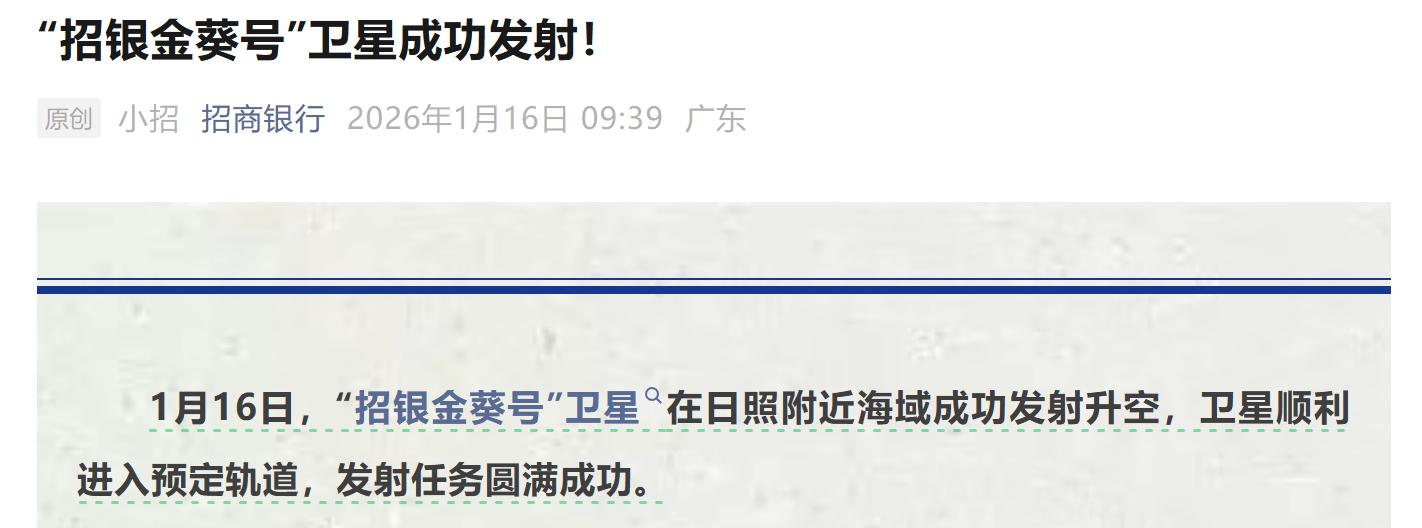
Regarding the specific use of the launched satellite, China Merchants Bank said that the "CMB Golden Sunflower" is a low - orbit narrow - band Internet of Things satellite, mainly used for high - precision construction monitoring of first - hand mortgage real estate projects across the country.
Information provided by relevant personnel of Shanghai Pufa Bank shows that relying on the Internet of Things data acquisition ability of the "Tianqi Constellation", the bank will further improve its intelligent risk control and comprehensive service system. In extreme scenarios such as major natural disasters, it can quickly resume and provide key basic financial services through satellite links.
In fact, it is not new for banks to launch satellites.
Long before Shanghai Pufa Bank and China Merchants Bank, Ping An Bank launched the "Ping An 1" and "Ping An 2" Internet of Things satellites in 2020 and 2022 respectively, aiming to build an integrated space - ground Internet of Things solution and innovate supply - chain finance business.
The "top - performing" China Merchants Bank is not willing to lag behind and has also made large - scale bets in the past two years.
On December 5, 2024, the "CMB 1" satellite was successfully launched on a Long March series carrier rocket from the Taiyuan Satellite Launch Center.
Then, on March 12, 2025, the "CMB 2" took off from the Hainan Launch Site, performing a perfect "relay in space", also carried by a Long March series carrier rocket.
Generally speaking, from focusing on the ground to venturing into space, the trend of banks' layout in the commercial space industry is clear. However, at present, the players are mainly large - scale and wealthy leading banks.
Industrial and Commercial Bank of China mentioned in its 2025 semi - annual report that it will expand the coverage scenarios of satellite remote sensing monitoring, strengthen applications in agricultural fields such as planting and forestry, and improve the risk prevention ability of inclusive finance business.
Bank of China clearly stated in its 2025 semi - annual report that "to support the digital transformation of corporate finance, increase the application and promotion of artificial intelligence, use satellite remote sensing technology for post - loan management, and promote the implementation of technologies such as large models and OCR (Optical Character Recognition)."
Industrial Bank directly demonstrated its achievements in the meeting documents of its 2024 annual shareholders' meeting. It has launched satellite remote sensing monitoring projects in 18 branches across 14 provinces.
Shanghai Rural Commercial Bank wrote in its 2025 semi - annual report that the company "continues to optimize and upgrade its independently built intelligent supply - chain platform. Aiming at intelligent operation, it integrates five core technologies: big data, satellite remote sensing, artificial intelligence, blockchain, and OCR recognition to enhance the intelligent level of business support and risk prevention and control."
In the private banking sector, MYbank is at the forefront. Its independently developed "Great Tit" satellite remote sensing risk control system was showcased at the 2024 Chinese Farmers' Harvest Festival.
02 Banks' Risk Control Advances to "Space - Ground Collaboration"
The shift from focusing on the ground to venturing into space reflects banks' eagerness to upgrade their risk control capabilities and their proactive response to complex and changing real - world needs. It also marks the beginning of a new journey of "space - ground collaboration" in the field of risk control in the banking industry.
The core pain point of traditional risk control lies in "information asymmetry". There is always a layer of information fog between banks (fund providers) and customers, especially small and medium - sized enterprises and farmers, due to limited human resources, delayed, distorted, and one - sided information.
The addition of satellites effectively solves this problem. The high - resolution optical, radar, and multi - spectral sensors they carry provide banks with a stable, objective, and wide - coverage "God's - eye view".
For example, China Merchants Bank's "CMB Golden Sunflower" satellite, relying on high - resolution satellite remote sensing images, can improve the monitoring accuracy of construction progress to over 95%, greatly enhancing the efficiency of traditional post - loan inspections.
The "Ping An 2" and "Ping An 1" together play the role of a "data transfer station", helping Ping An Bank obtain first - hand production and operation data authorized by enterprises, breaking through the information barriers between industry and finance, and overcoming the limitations such as lack of collateral and credit that enterprises often face in financing.
In the field of agricultural finance, satellite - based risk control also has outstanding performance.
MYbank's "Great Tit" system is a model of this mode. It innovatively integrates artificial intelligence technologies such as deep learning with satellite remote sensing images, enabling accurate analysis of crop planting area, variety, and real - time growth status. At the same time, combined with a unique agricultural risk control model, it can scientifically estimate crop yields and expected market values, providing a reliable digital basis for determining reasonable credit limits for farmers.
The higher - order value of "space - ground collaboration" lies in its powerful dynamic monitoring and risk early - warning capabilities, thus establishing a mechanism that shifts from "post - event response" to "pre - event insight".
Once the satellite system detects an abnormal and sharp decrease in the inventory of goods in a mortgaged warehouse or a long - term shutdown of a factory that claims to be under construction, it can automatically trigger an early warning to remind risk control personnel to conduct investigations.
This ability to move the risk discovery point forward from "after loan default" to "when there is an abnormal change in assets" greatly enhances the initiative and predictability of banks' risk management.
In addition, banks' enthusiasm for venturing into space may have another "motive".
Currently, the commercial space industry, as a new - type industry, has a long - term and prosperous future and is developing rapidly.
However, commercial space enterprises are labeled as "high - tech, long - cycle, and high - barrier". Rocket R & D technology is complex, the cost accounting logic is special, and they lack the collateral required for traditional credit. Facing this "vast expanse of space", banks often find themselves in a dilemma of "not understanding, not being able to accurately estimate, and not daring to lend", and thus miss opportunities.
Now, banks' active involvement may very well be a in - depth due diligence and value discovery process.
A person in the industry said frankly: "Banks are currently quite interested in the commercial space industry... More forms of interaction and exploration are quite normal."
"Our company has also interacted with banks and bank AIC institutions." Zhang Shu said. "Guodian Gaoke is still in the financing stage, so more forms of interaction are normal."
Taking China Merchants Bank as an example, while the "CMB" series of satellites were launched into space, its wholly - owned subsidiary, CMB Financial Leasing, took corresponding actions. Based on the networking and operation needs of the Tianqi Constellation, it innovatively completed the first satellite leasing business in China carried out in the SPV (Special Purpose Vehicle) mode.
03 Conclusion
In short, the collective move of banks to venture into space is far more than just a technological upgrade. It means that the banking industry is moving from the traditional risk control mode that relies on ground - based data to a new era of "space - ground collaboration" and all - dimensional perception.
This is not only a crucial step for banks to enhance their core competitiveness and solve the problems of inclusive finance but also indicates that financial capital is deeply integrating into and promoting the development wave of cutting - edge industries such as the commercial space industry as an active participant.
To some extent, in the future, those who can build a more intelligent collaborative network between "the stars" and "the ground" will gain the upper hand in the next stage of financial competition.
This article is from the WeChat official account "Qi Finance", author: Hua Cheng. Republished by 36Kr with permission.