49,000 electric vehicle quotas released. What are Canadian consumers talking about?
After the Canadian government released a quota of 49,000 low - tariff import quotas for Chinese - made electric vehicles, the public opinion quickly heated up.
In October 2024, Canada followed the United States' lead and imposed a 100% punitive tariff on Chinese electric vehicles, almost halting the path for Chinese - made electric vehicles to enter Canada. Now, according to the new agreement, starting from 2026, the Canadian government will allow a maximum of 49,000 Chinese electric vehicles to enter the Canadian market each year. These vehicles within the quota will enjoy the most - favored - nation tariff treatment of 6.1%. This quota will gradually increase to 70,000 in the next five years.
The agreement also stipulates that by 2030, at least 50% of the Chinese electric vehicles imported under the quota should have an import price of no more than 35,000 Canadian dollars (about 177,000 Chinese yuan).
While politicians and business representatives from various parties expressed their opinions and argued ceaselessly, another group of stakeholders who were often overlooked - Canadian consumers - also started a lively discussion on this issue.
Supporters, on - lookers, and opponents are not simply divided along geopolitical lines. Instead, they have launched a more realistic discussion around vehicle model selection, the current state of the industry, charging infrastructure, and safety standards.
Based on dozens of posts on the overseas forum Reddit, "Power Plant" has sorted out the four most prominent issues in the discussion among Canadian consumers: Which models do they hope to see enter Canada? Which models do they think are most likely to enter Canada? Why do most Canadians have a relatively positive attitude? And what are the concerns of Canadians?
If they could choose, which Chinese cars would Canadians most like to see?
Different from the stereotype of "cheap dumping," the wish list of Canadian netizens is not monotonous.
BYD is mentioned the most. Atto 1 (the international version of Seagull) and Seal are frequently mentioned. For example, "I've been paying attention to Atto 1 recently. It's a great small car, and the 2026 Dolphin is also very good," and "I really hope BYD's Seal/Sealion can be launched."
The most - discussed model is BYD's overseas - exclusive pickup truck, Shark. A user explained that in his province, "winters are long and towns are scattered," so pickup trucks are not a niche demand. And Shark's plug - in hybrid structure "theoretically solves the range and charging anxiety."
"Shark is the biggest threat. I'm sure that if it enters Canada, Americans will be scared, and it will never be allowed to enter the United States," said an Australian netizen. "I live in the Australian countryside, and Sharks are everywhere. They've flooded the market just 12 months after import. They are cheap, well - equipped, seem very durable, and are very fast. Their size is almost as big as a Ford F150."
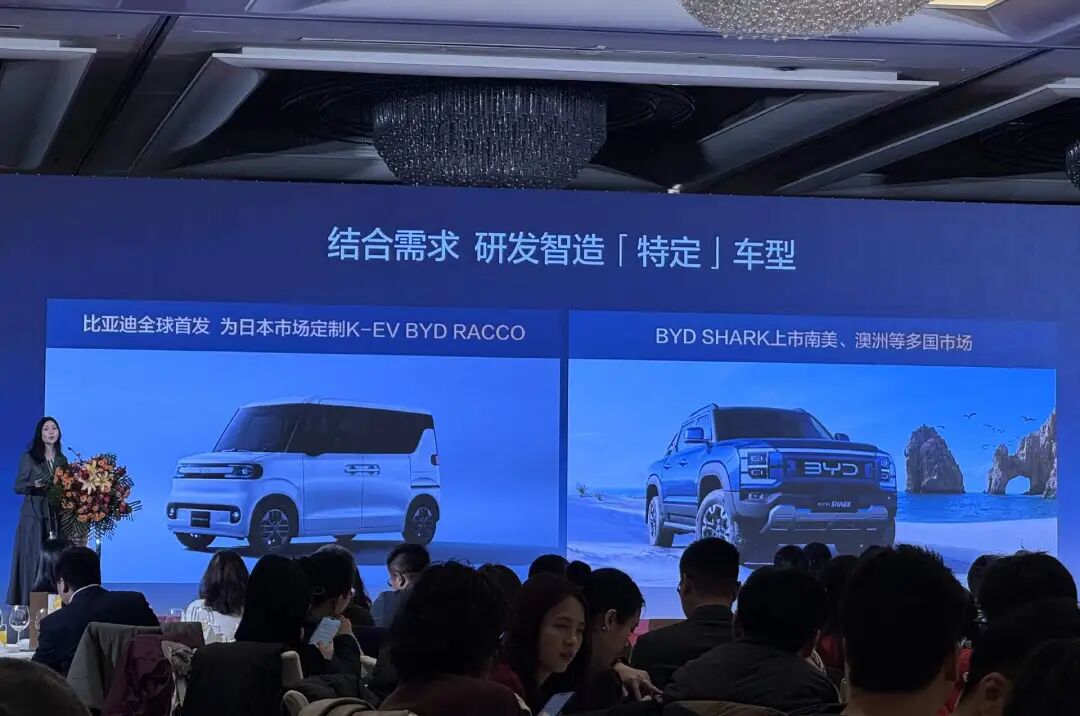
Photo source: Taken by Zhai Fangxue, a reporter from Power Plant
Data shows that after BYD Shark 6 was launched in Australia for one year, with an annual sales volume of 18,073 units, it occupied 8.5% of the Australian 4x4 double - cab pickup market, becoming the fourth - best seller in this segment. So far, in addition to Australia, this pickup truck has entered many overseas markets such as Brazil, Panama, Cambodia, Mexico, and Pakistan.
However, consumers are worried that Shark's power form may become an obstacle to entering the Canadian market. "It's not yet clear whether plug - in hybrid electric vehicles (PHEV) are included in the new agreement, but I hope China can support its inclusion. This type of vehicle is a key entry - level product to promote the popularization of electric vehicles in markets where people are still on the fence about electric vehicles (such as pickup truck users). I fully recognize the importance of BYD Shark in the Canadian market."
"Before the specific details are announced, we really can't have a comprehensive understanding. If BYD and Canadian policymakers can receive email feedback from potential users about their intention to purchase the Shark model, it will provide important references for their market planning. I think Canada should accept pre - orders for the Shark model first to more accurately assess the actual market demand."
Zeekr is also frequently mentioned. The 007, 009, and 7X are considered "a product form currently missing in the North American market." Their prices are significantly lower than traditional luxury brands, but the configurations and materials are not cheap. Netizen "lronLover64" posted, "I want a Zeekr 009 luxury MPV because it's the closest thing we can get to a Toyota Alphard in Canada."
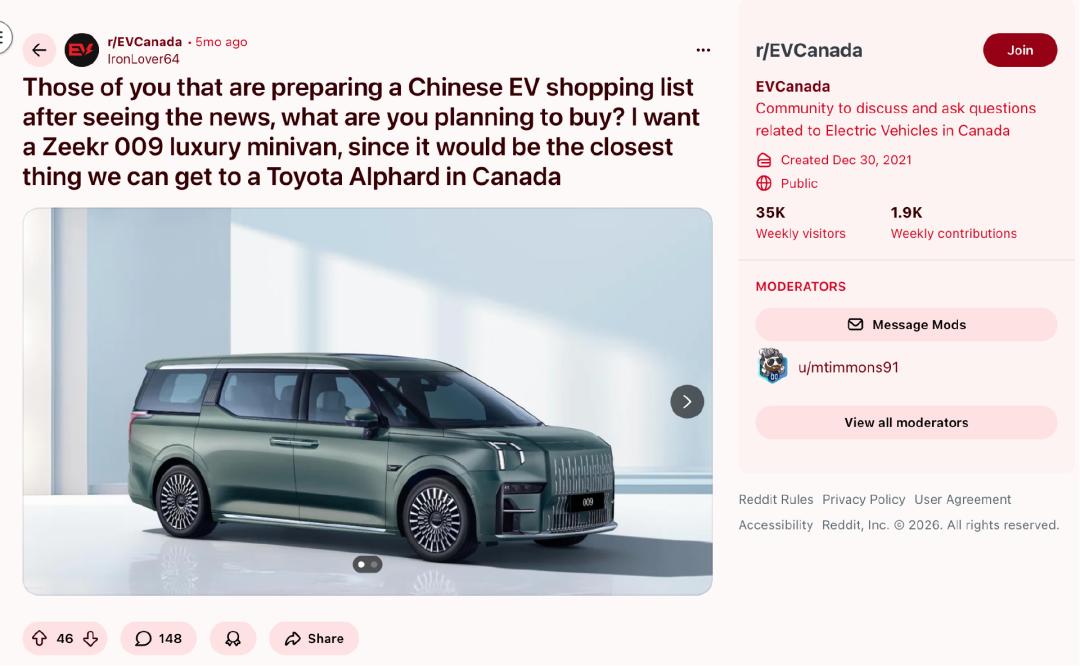
Photo source: Reddit forum
Xiaomi's SU7 and SU7 Ultra have not entered any North American markets yet, but they are frequently mentioned in the forum. Phrases like "Give me my SU7 Ultra" appear many times in the discussion. Besides Xiaomi cars, XPeng among the new - force automakers is mentioned the most, especially the XPeng P7, which is considered "a very good choice."
Back to reality, which domestic models do Canadians think are most likely to enter the market?
Enthusiasm does not overshadow rationality.
When the discussion shifts from "hope" to "possibility," the criteria for judgment quickly become consistent: whether the models have passed Canada's safety and compliance tests and whether there is a sales system foundation in the local area.

Photo source: Reddit forum
In this regard, Tesla cars produced in Shanghai are frequently mentioned. Before the tariff increase, Model 3 and Model Y sold in the Canadian market have long been from the Shanghai Gigafactory. Data shows that in 2023, 44,400 Tesla electric vehicles were shipped from China to the Port of Vancouver, accounting for the vast majority of China's automobile exports to Canada.
Although Tesla also has factories in the United States, cost is the fundamental reason for choosing to import from afar. Elon Musk once sighed, "Tesla's Shanghai factory has the lowest cost structure among all factories." The Shanghai factory also has cost advantages in land and supply chain, and it operates efficiently 24/7, helping Tesla achieve a gross profit margin of over 30%.
"We've already driven Chinese - made cars before, we just didn't pay much attention," a Canadian netizen summarized.
Geely - affiliated cars are also regarded as one of the most likely options because Volvo and Polestar under Geely have long been on Canadian roads. Data from the global automotive industry platform Marklines shows that in 2024, the total sales volume of electric vehicles in Canada was 76,462 units, and the only Chinese automaker on the sales list was Geely.
"There will definitely be Chinese - made Teslas and Volvos. I guess Polestar will re - launch the Polestar 2, and may also import some Chinese - made Polestar 3, 4, and 5."
"Geely has a branch in Canada, while most other Chinese electric vehicle companies do not. Canada can simply import electric vehicles from Geely, Volvo, and Polestar, and all of them can be sold."
Geely's luxury brand, Lotus, also seems very confident. Lotus published a statement on its official website, saying that as the first all - electric super SUV of Lotus, the Eletre has successfully passed the strict certification of the North American market in 2024 with its excellent product performance. It is currently the only Chinese - made electric vehicle priced over $80,000 that has entered the North American market. The new tariff policy is expected to reduce its planned retail price by about 50%, "which is expected to drive the sales volume of the Eletre in Canada to grow exponentially."

Photo source: Lotus official website
BYD is also mentioned. Although its private passenger cars have not entered Canada, its electric buses and taxis have been put into operation in many cities. A netizen from Montreal mentioned, "They've been on the streets for several years, which at least shows that maintenance and compliance are not starting from scratch."
Why do most Canadians have a relatively positive attitude?
Different from the politicians and business representatives who reacted strongly, ordinary Canadian consumers have a more positive attitude towards these 49,000 low - tariff Chinese electric vehicles.
One reason is that they believe these 49,000 vehicles cannot have an impact on the Canadian automotive ecosystem. Data shows that the estimated sales volume of electric vehicles in Canada in 2025 is 110,000 units. The quota of 49,000 for China accounts for about 44.5%, which is similar to the sales volume of Chinese electric vehicles in Canada before the tariff increase. Moreover, in terms of the overall automotive scale, the total sales volume of automobiles in Canada in 2025 is about 1.9 - 1.95 million units, and the import volume of 49,000 units is less than 3%.
"People seem to think that Chinese electric vehicles will prompt a large number of consumers to switch to pure electric vehicles, thus disrupting the Canadian market. This is pure nonsense. Pure electric vehicles are still a niche market in North America because of the low market demand, and this downward trend has continued. The geographical environment outside our major cities is not suitable for pure electric vehicles, and people here still mainly prefer fuel - powered cars and hybrid cars."
On the other hand, these Chinese electric vehicles are unlikely to have an impact on the local manufacturing industry in the short term because there is no mature electric vehicle industry chain in Canada, so almost no one will lose their jobs because of this. On the contrary, Canadians hope that Chinese automakers can build factories locally to create job opportunities.
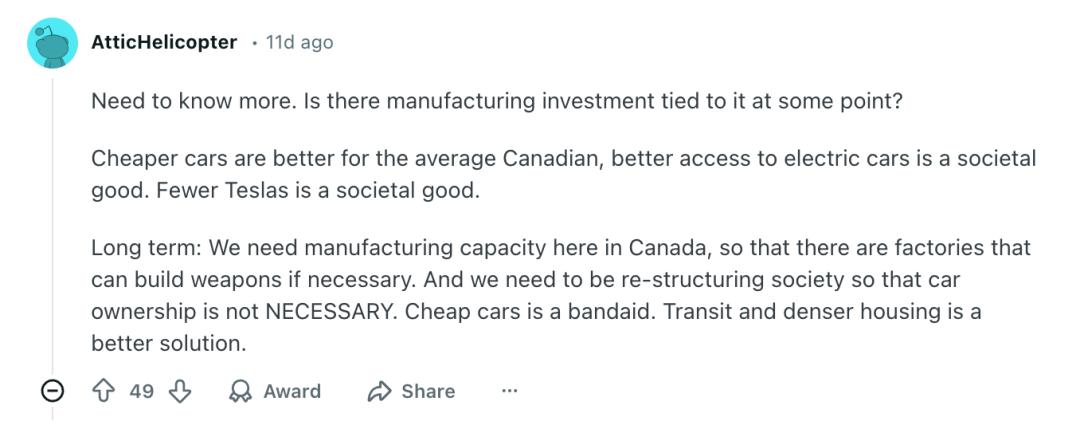
Photo source: Reddit forum
"Except for the Dodge Charger Daytona (electric version), we don't produce any electric vehicles here, and the Dodge Charger Daytona is not practical for most people."
"Those who are worried about losing their jobs... Canada won't actually lose any jobs because the Big Three automakers don't produce electric vehicles in Canada. So why are you dissatisfied with the increasing choices of electric vehicles?"
"Chinese electric vehicles are banned in the United States, and the Canadian market is too small... Unless China is sure that we will buy their cars, they won't build factories in Canada. It's logical to first import a small amount to test the market. Ford's call not to buy their cars is stupid and goes against the long - term interests of Ontario."
Canadian consumers hope to have more choices of electric vehicles. A poll conducted by Abacus Data for Clean Energy Canada last year showed that 53% of Canadians support reducing tariffs to improve affordability, and 29% even support completely abolishing tariffs. As a netizen summarized, "I think most people don't care who the company belongs to. They just want electric vehicles."

Photo source: Reddit forum
Netizen "bcsam" accused, "The Big Three automakers don't want us Canadians to have the best products. They just want to continue selling us inferior and expensive cars and transfer the profits to the south. They don't invest enough in R & D to improve product quality or promote technological development. To be honest, they have already lost in the electric vehicle field. If the government stops protecting them and prevents Chinese car companies (especially in North America) from selling their products, they will eventually lose in the fuel - powered car field too."
Tesla has also incurred the dissatisfaction of some Canadian consumers because of Elon Musk's political actions. "I'll never buy a car with a Nazi logo. Elon Musk is a terrible person. He supports a terrible fascist regime. Even if Tesla were the only electric vehicle option on earth, I would never give this guy a single cent," "Elon Musk tweeted that Canada isn't a real country. Why should we have any loyalty to Tesla?"...
Under the influence of various factors, Canadian consumers hope for new choices.
Under the support, there are real and specific concerns
The most concentrated concern still comes from infrastructure.
Data from Natural Resources Canada shows that the per - capita density of public charging piles in Canada is still significantly lower than that of EU countries. Brian Kingston, the CEO of the Canadian Automobile Manufacturers Association, publicly stated last year that there is a large and growing gap in public charging infrastructure in Canada. 40,000 chargers need to be installed every year to make up for it, and at the current speed of infrastructure construction, it is impossible to meet the federal government's mandatory electric vehicle sales target.
Many users pointed out that due to the backward charging facilities, electric vehicles are far less convenient in daily use than advertised.
"In China, charging facilities are very popular and convenient... There are battery - swapping stations everywhere, and you can just leave after swapping. We'll never have such conditions here."
"All our newly - built residential buildings are apartment buildings. The cost for developers to install charging piles is very high. The electricity price for Level 2 charging piles may be as high as $0.30 - $0.35 per kilowatt - hour, which is ten times the price of home charging at night."
"There are no such facilities (charging piles) in the parking lots of apartments and residential buildings. I think this is the biggest obstacle for most people."
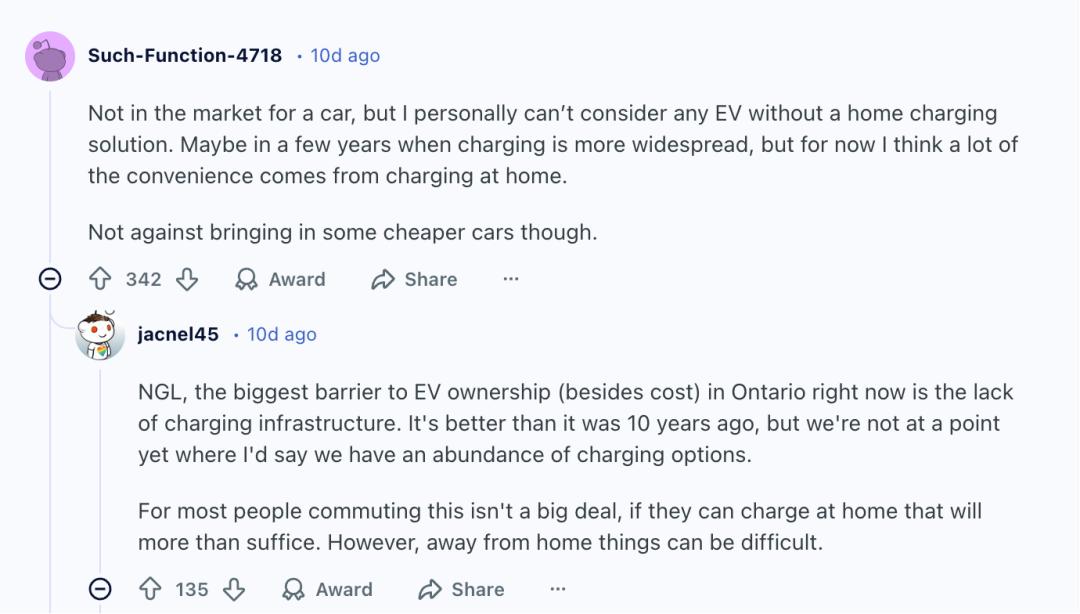
Photo source: Reddit forum
The imperfect after - sales service system has also become a consideration factor. Netizens from Mexico and Australia, which are also destinations for Chinese electric vehicles to go global,