Are the "Four Little Dragons of AR" Entering a Profitable Era?
At the beginning of 2026, the "Four AR Dragons" took the lead in securing nearly 2 billion yuan in total financing.
However, for a long time in the past, AR glasses have been constantly questioned as "vaporware" and "semi-finished products".
For example, Yang Longsheng, the post - 90s founder of INMO Technology, which recently received new funding, told "Market Insights": "The label of 'vaporware' is actually an inevitable stage for a mobile intelligent terminal, which is a misalignment between technology and the market. Currently, China's capabilities in display, optics, overall device manufacturing, and algorithms can generally support the growth on the consumer side. The smart glasses industry has gradually emerged from the controversial period."
What really brought AR glasses into the public life was the global success of Meta Ray - Ban. It made the entire industry quickly change its course. With the help of large AI models, AR glasses have transformed from "spatial display devices" chasing visual spectacles to "wearable intelligent assistants" solving specific pain points, and found practical use scenarios.
Yang Longsheng believes that "currently, AR glasses have proven to be useful and easy - to - use in vertical scenarios, and the products are gradually moving towards the stage of being in demand."
But in the second half of the game, the hardware supply chains highly overlap, and the public - version solutions tend to be similar. As a result, the core battlefield for differentiation has shifted from hardware parameters to AI experience and ecological integration capabilities. For the 'Four AR Dragons' without general large - model capabilities, how to find a differentiated growth path has become the key.
Rokid has joined hands with Alibaba to build the most open AI application ecosystem; Thunderbird Innovation has partnered with telecom operators and may even explore the offline model of giving away glasses when customers recharge their phone bills in the future; XREAL has accumulated patents and launched two patent battles overseas to build competitive barriers. INMO Technology relies on local state - owned capital to obtain more industrial resources.
According to the prediction of the industry analysis institution IDC, in 2026, driven by the global layout and local production in China, the shipment volume of Chinese smart glasses manufacturers is expected to account for 45% of the global market.
The start of the "era of abundant capital" not only provides sufficient ammunition for a new round of growth but also indicates that a more intense reshuffle is about to begin.
Received as much money in 15 days as in the whole of last year
At the beginning of 2026, AR glasses manufacturers witnessed a wave of financing.
On January 5th, Thunderbird Innovation announced the completion of a new round of financing exceeding 1 billion yuan; then on January 9th, XREAL announced the completion of its Series D financing, amounting to 100 million US dollars; on January 15th, INMO Technology disclosed the completion of its Series C1 financing, with an amount as high as hundreds of millions of yuan. This was also its third round of financing in the past six months, with a cumulative amount of 500 million yuan.
In just half a month, the financing amount of the 'Three Dragons' far exceeded the total financing of the 'Four Dragons' in the past year.
Meanwhile, according to China Securities Journal, since the fourth quarter of 2025, 18 companies in the AI glasses industry chain have been surveyed by more than 100 institutions. On the Shenzhen Stock Exchange's interactive platform, the number of questions about "AI glasses" has approached 400 in the past three months.
The financing boom at the beginning of the year may be brought about by the lively consumer market last year.
For a long time in the past, at most smart glasses product press conferences, there was no physical product display. The products were demonstrated throughout via PPTs and videos, resulting in a situation where the speeches were full of grand claims while the user experience was poor. Coupled with the repeated delays in product delivery, AR glasses have been widely criticized for the "vaporware" problem.
On the consumer side, consumers were also not interested in products such as AR glasses and VR headsets. According to data released by IDC, the estimated shipment volume of the Chinese AR/VR market in 2024 was 535,000 units, a year - on - year decrease of 26.3%.
However, since the second half of last year, this situation has been changing.
In June 2025, Xiaomi's first AI glasses were launched. Their sales exceeded 50,000 pairs in 3 days, reached 70,000 pairs in the first week, and the cumulative sales reached about 80,000 units within half a month.
The new AI glasses successively launched by the 'Four AR Dragons' - Thunderbird Innovation, Rokid, XREAL, and INMO Technology - were also very popular. Among them, the new products of Rokid and INMO Technology achieved tens of thousands of orders in just a few days after their release. The AI glasses launched by large companies such as Huawei, Baidu, and Quark also achieved good sales.
During the "Double 11" period in 2025, smart glasses became one of the fastest - growing categories in the 3C digital industry, with the transaction volume increasing by 2500% year - on - year.
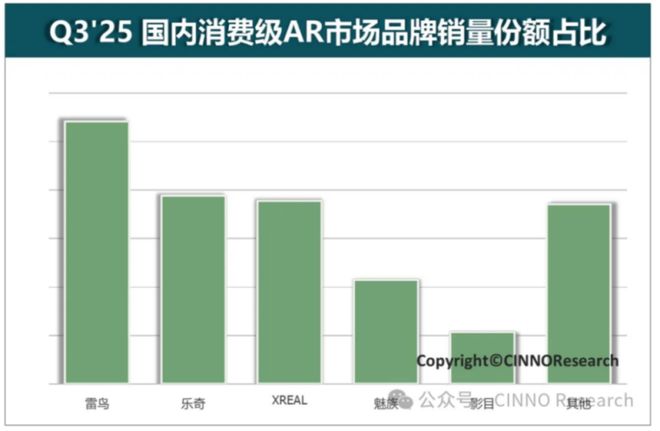
The latest statistics from CINNO Research show that at the end of the third quarter of 2025, the sales volume of the Chinese consumer - grade AI/AR market increased by 186% year - on - year. Among them, the AR market continued its high - growth trend, exceeding 129,000 units. All - in - one AR glasses (AI glasses with screens) became the biggest highlight with a growth rate of 355%. The 'Four AR Dragons' and Meizu occupied the top five sales spots.
Meanwhile, CINNO Research predicts that the shipment volume of Chinese AI/AR glasses will reach 900,000 units in 2025, a year - on - year increase of 133%. A year ago, the annual sales volume of Chinese consumer - grade AR/VR decreased by 25% year - on - year.
Are the Four AR Dragons going AI - oriented?
So far, thanks to their first - mover advantage, the "Four AR Glasses Dragons" represented by Thunderbird Innovation, XREAL, Rokid, and INMO still lead the industry.
But an obvious change is that since 2024, the products these companies have been promoting externally have been systematically shifting from AR glasses to AI glasses.
According to the statistics of "Market Insights", almost all the new products of the Four Dragons in the past year have integrated large - model capabilities: they are equipped with built - in AI voice assistants, emphasizing functions such as taking photos/videos, real - time translation, navigation, and information retrieval. The product narrative has also shifted from "display and spatial computing" to "portable AI assistant".
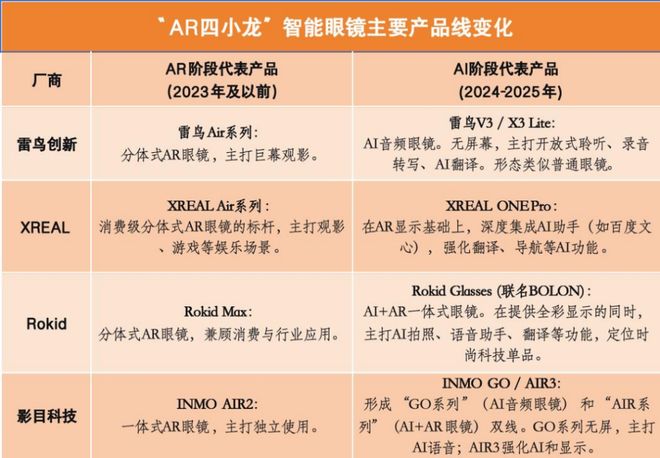
Compiled based on public information
Judging from the consumer - side data, this shift did not happen out of thin air.
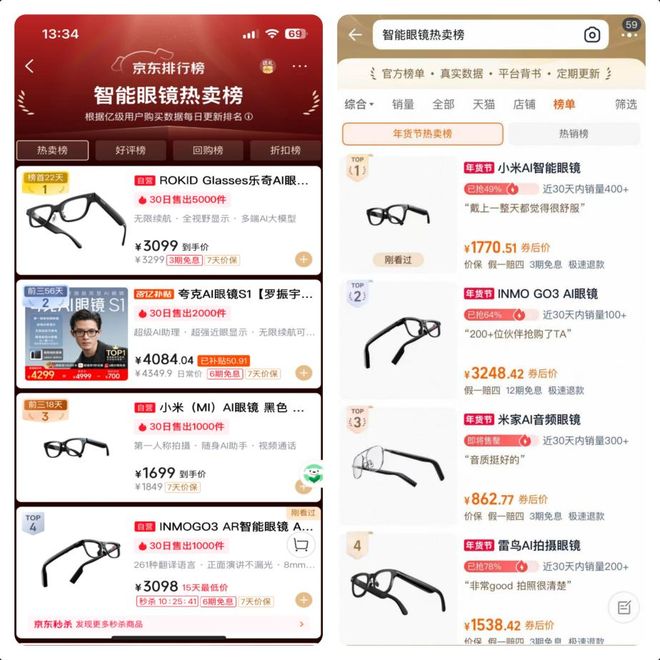
As of January 27th, among the top 30 best - selling smart glasses on JD.com, AI glasses accounted for nearly 90%. Among them, ROKID Glasses ranked first for 22 consecutive days, and Xiaomi AI Glasses, INMO GO3, Thunderbird V3, Quark S1, etc. also stably ranked among the top ten. The structure of the Taobao list is basically the same.
If we only look at the results, the popularity of AI glasses has indeed significantly surpassed that of AR glasses. But in Yang Longsheng's view, this does not mean that AR glasses have been abandoned. The current market products are just a manifestation of users' phased needs.
AR glasses and AI glasses are two different product forms suitable for different stages of industrial development. AR glasses have carried out a lot of work on technology verification and form exploration from the beginning, while AI glasses are more like a process of shifting from technology - driven to demand - driven. The all - in - one AI + AR path that INMO has always adhered to has also achieved good results so far.
It's hard to say that AI glasses are the ultimate form of the industry, even though many AR glasses manufacturers have started to focus on launching AI glasses products.
In an earlier cycle, AR was placed in the grand narrative of "the metaverse is the next - generation Internet gateway". Without really understanding "what the metaverse is", capital and technology companies quickly made their bets.
The representative product of that stage was the head - mounted VR device. Meta Quest 2 once captured nearly 90% of the market share in Q1 of 2022; ByteDance (Pico), Apple (Vision Pro), Samsung (Galaxy XR), etc. also launched their respective headset products.
However, they are heavy and not suitable for long - term wearing; they are expensive and difficult to penetrate on a large scale; they have short battery life and their usage scenarios are severely limited.
These factors together have lowered the shipment ceiling of VR.
As the metaverse narrative gradually cooled down, problems such as the slow progress of the VR device application ecosystem, the fading of users' novelty, and the high idle rate of products emerged. Manufacturers began to look for a more lightweight and implementable solution - AR glasses.
During this period, Meta and Ray - Ban launched the Ray - Ban Meta, starting at $299 (about 2,166 yuan). It no longer focuses on the AR display effect but positions itself as an "AI voice assistant + fashionable and lightweight design", supporting many practical functions such as voice interaction, image recognition, real - time translation, navigation, and teleprompter.
Its sales exceeded 1 million units just 4 months after its release. This great success even directly defined a replicable product direction for smart glasses manufacturers, which is to make smart glasses with built - in AI assistants.
Following that, Chinese smart glasses manufacturers represented by the "Four AR Dragons" launched key products targeting different scenarios around the new product direction. For example, Thunderbird Innovation, XREAL, and Rokid mainly target scenarios such as movie - watching and gaming, focusing on split - type AR smart glasses; INMO Technology focuses on independent use and launched INMO Air, the first domestic binocular full - color all - in - one AR smart glasses.
Although early AR glasses still had a strong sense of being "semi - finished products", compared with the bulky and expensive VR headset devices, the consumer market gave an "encouraging vote" to this optimized solution.
According to Counterpoint statistics, the shipment volume of domestic AR smart glasses increased by 67% year - on - year in 2023. In contrast, the shipment volume of domestic VR headsets decreased by 61% year - on - year, the largest decline in the past five years.
Each shows its prowess in the second half
Currently, manufacturers are trying their best to depict the future blueprint of AI glasses.
Xu Chi, the founder of XREAL, once said: "AR is the best carrier for AI, and AI is the best interaction for AR. This is very likely to be the two core technologies that can change consumer electronics and our terminal experience in the next decade."
Coincidentally, Zhu Mingming, the founder of Rokid, also expressed a similar view.
Yang Longsheng also emphasized to "Market Insights": "I always believe that glasses will be the next - generation personal mobile intelligent terminal, and AI will be the best carrier."
But in the era of AR glasses, the competition was about hardware R & D capabilities, while in the era of AI glasses, the key may be large - model capabilities. When the competition dimension of smart glasses has expanded from "simple hardware parameters" to the full - stack capabilities of "hardware + operating system + AI algorithm + ecological service", it is not easy to achieve differentiation in AI experience.
For example, recently, vivo stopped its AI glasses project that had been secretly prepared for half a year because many senior executives, including Hu Baishan, the executive vice - president of vivo, judged that it was "difficult to differentiate its AI glasses in the current situation".
IDC predicts that in 2026, more than 30% of smart glasses in the market will support AI on the terminal side, and more than 75% of voice assistants will support large models to provide support for complex tasks. Under such changes, the "Four AR Dragons" without large - model capabilities have started to find their own ways to stay competitive in the second half:
Rokid is taking a route of "open ecosystem + rapid function iteration".
In terms of the ecosystem, Rokid Glasses almost support access to all domestic large AI language models and are deeply integrated with applications such as Alipay and Gaode to build a closed - loop scenario. It is reported that it will be the first smart glasses to access WeChat Pay. In terms of function iteration, Rokid pushes out a function update about every two weeks.
Thunderbird Innovation has chosen to cooperate with telecom operators and take the route of "offline channel terminals".
According to sources, Thunderbird plans to cooperate with operators in channels, giving away glasses when customers recharge their phone bills, channel construction, and cloud services. Once this cooperation model is successful, Thunderbird Innovation's glasses may enter the "contract - phone logic". IDC predicts that in 2026, the direct - sales stores, operators, and retail channels in the Chinese smart glasses market will all show high growth in the shipment channels.
XREAL, which focuses on the overseas market, is taking the route of "competing with technological patents".
In recent months, its patent battle with Viture has spread from Germany to the United States and achieved phased victory. The German court issued a temporary injunction against Viture's affiliated company. The advantage of this patent - battle approach is that once the court determines that infringement is established, it will accurately and effectively strike the opponent and help it quickly rise in a certain market.
INMO Technology, one of the first batch of enterprises selected as the seed unicorns in Sichuan Province, received Series C1 financing led by Chengdu Science and Technology Innovation Investment Group at the beginning of the year. In an article published by Chengdu Science and Technology Innovation Investment Group, it was proposed to take INMO Technology as the core node to continuously promote the agglomerated development of the AI + AR industrial chain. Whether INMO will take the TO - G route remains to be seen as there are no more obvious actions for now.
As the next - generation intelligent terminal with the mission of "replacing mobile phones to take over people's digital lives", smart glasses have been elevated to the regional strategic level, deeply cooperated with national - level telecom operators, and integrated into the national - level application ecosystems such as WeChat and Alipay. After the financing boom, the growth and competition of the Four AR Dragons in a larger market may have just begun.
This article is from the WeChat official account "Market Insights", written by Wang Haoran, and published by 36Kr with authorization.