After the author of Moltbot was challenged by Claude: MiniMax M2.1 is the best open-source model
After Clawdbot lost its original name and was renamed Moltbot, its popularity remained undiminished.
Some people have unlocked fancy ways of playing with it —
A developer's Moltbot suddenly started speaking on its own, which scared him so much that he let out a series of exclamations. He joked that soon it would be flying around the room.
He just set instructions for Moltbot to optimize the workflow automatically using the Codex CLI tool while he was asleep every day. As a result, he would get a little surprise every morning when he woke up.
One night, Moltbot designed a unique image for itself. The next night, it developed a voice function by calling the ChatGPT API. When the developer woke up the next morning, Moltbot suddenly started speaking.
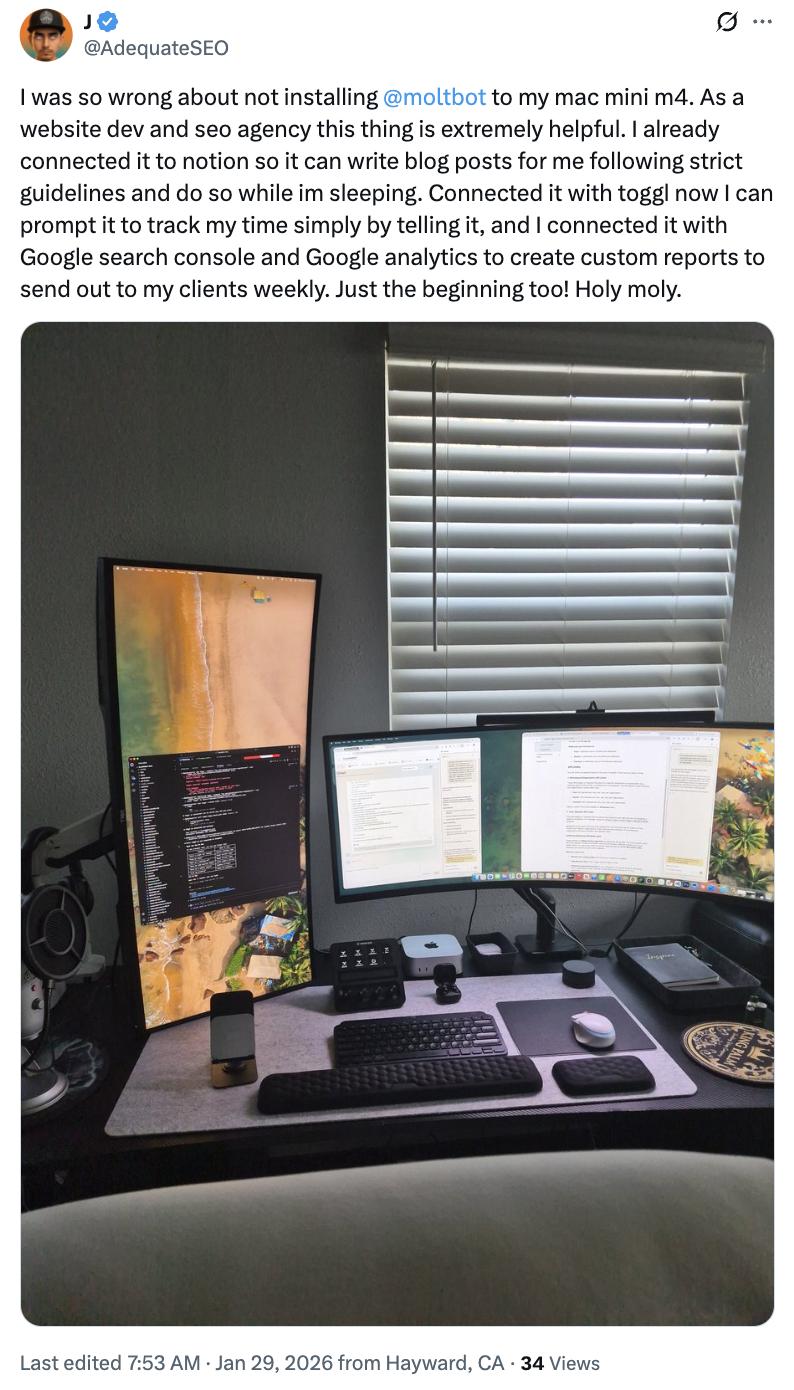
The practical value of Moltbot has been fully explored by developers. A practitioner in website development and SEO exclaimed, "I regret not installing Moltbot on my Mac Mini earlier."
He not only connected Moltbot with Notion to let it automatically write blogs in strict accordance with the specifications, but also enabled it to work continuously while he was resting. At the same time, it is connected to Toggl, allowing automatic time recording with just verbal instructions. Moreover, it is linked with Google Search Console and Google Analytics to generate customized data reports and send them to customers automatically every week.
On the other hand, people don't need to rush to stock up on Mac minis compatible with Moltbot anymore. A series of cloud services have been launched one after another.
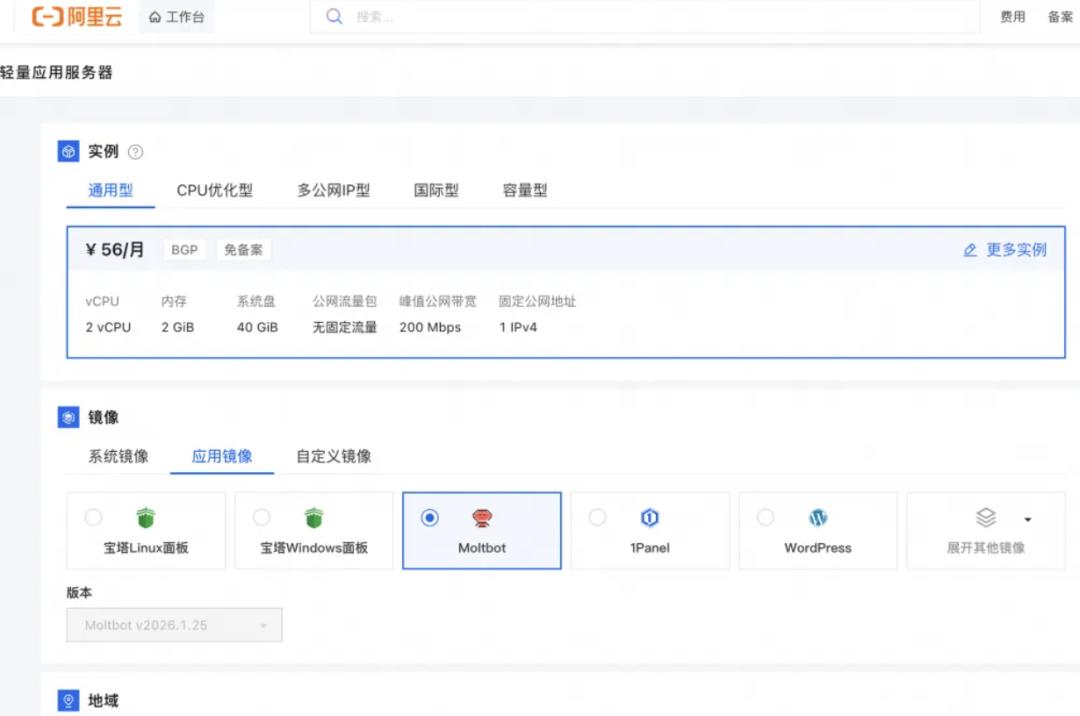
Alibaba Cloud quickly launched a full - set of exclusive cloud services and provided detailed deployment tutorials.
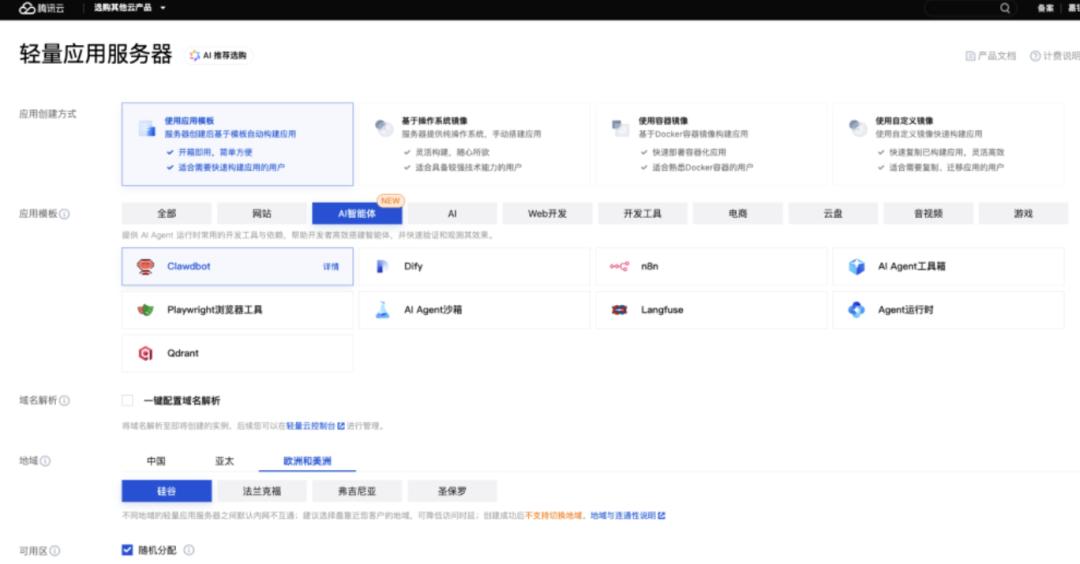
Tencent Cloud's Lightweight Application Server Lighthouse has also simultaneously launched the Clawdbot application template, pre - installing the environment required for Clawdbot to run. The official has also issued a one - click installation tutorial:
In addition, Moltbot's competitors in the market are also quite popular.
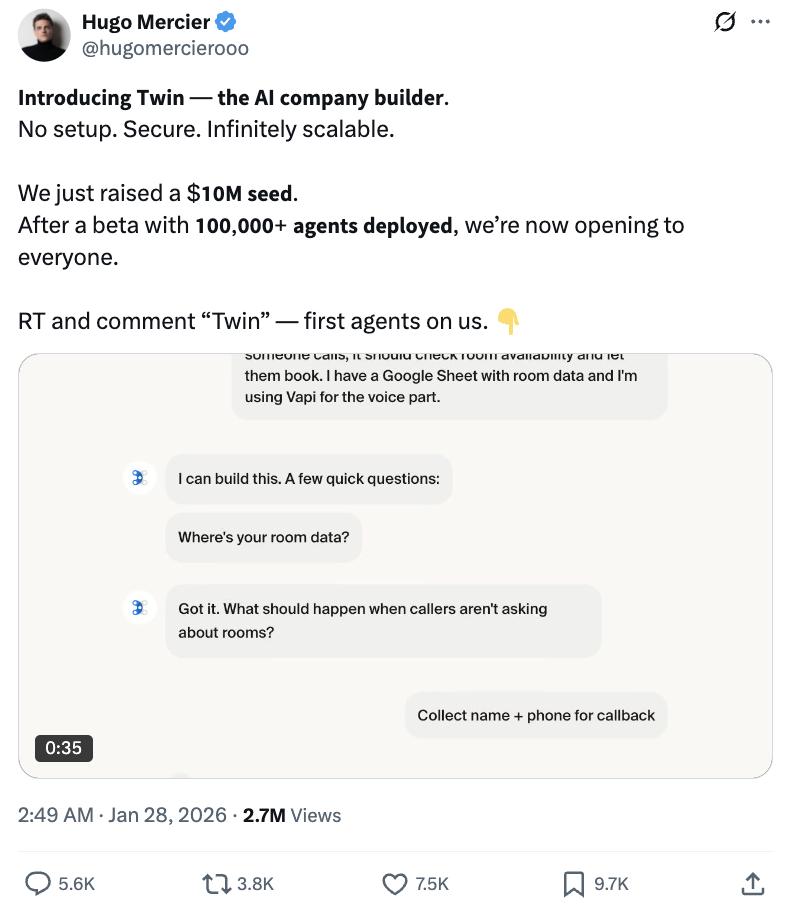
For example, the following one - stop AI business building tool "𝗧𝘄𝗶𝗻" claims to have zero - configuration deployment, be security - native, and have infinite elastic scalability. Its core capabilities are to be compatible with various apps, support browser control, make independent decisions, and have long - term memory.
The team behind it has just completed a $10 million seed - round financing.
Riding on the wave of popularity, Peter Steinberger, the author of Moltbot, was also pulled out for an interview.
Peter recently participated in a live interview program on the TBPN platform and answered a series of questions that netizens were interested in, including the origin of the Clawdbot project, the motivation for development, the development process, the renaming process, the industry impact, the application prospects, and the security challenges.
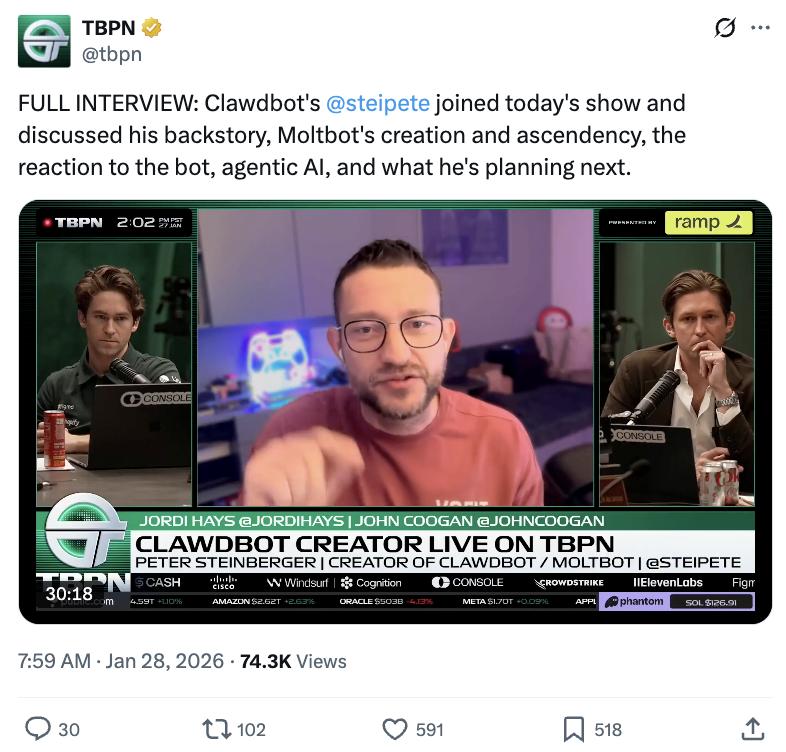
QbitAI edited and organized the content without changing the original meaning.
Interview Transcript
Host: I'd like to start with the beginning of this project. Can you talk about your professional background and your future plans for this project? Also, I'm curious. Is this your first project, right?
Peter Steinberger: It can be considered my first serious project of writing code.
Host: We previously saw a screenshot of your GitHub profile, and we were really shocked. It was truly an overnight sensation. I'm really happy to have you here.
Peter Steinberger: I'm also extremely happy to be here. I ran a software company for 13 years and sold it four years ago. After that, I fell into a slump, and those days were really hard to describe.
Host: Fortunately, you're back on track now.
Peter Steinberger: You know, they say you should take a one - year break after working for four years, but I worked non - stop for 13 years. So, for those three years, I was basically in a lazy state. It wasn't until last April that I suddenly regained my enthusiasm for doing things.
I had been deeply involved in the Apple and iOS fields for a long time and gradually got a bit bored. I always wanted to do something new, but I didn't have relevant experience. I didn't want to seem ignorant, so I dived into the AI field.
The initial exploration experience was quite good. It wasn't extremely amazing, but it was attractive enough. I was wondering at that time why there wasn't much discussion about such an interesting field. Now I think it's because I missed the trough period of AI development in those three years, and I returned at just the right time.
In February, Claude Code started its public beta. This was also my first time using this kind of tool, and I thought it was really amazing. After that, I was so excited that I couldn't sleep. It was really that kind of sleepless state. It was like when you were addicted to something before, and now I found that feeling of full - immersion again.
Host: But this time, it's a positive kind of immersion.
Peter Steinberger: Absolutely. I also dragged a lot of friends into researching it. They were just like me. I sent them messages at 4 a.m., and they replied instantly. I even organized an offline communication group, which is like my small circle. At first, it was called Claude Code Anonymous, and now it's renamed Agents Anonymous. After all, you have to follow the trend.
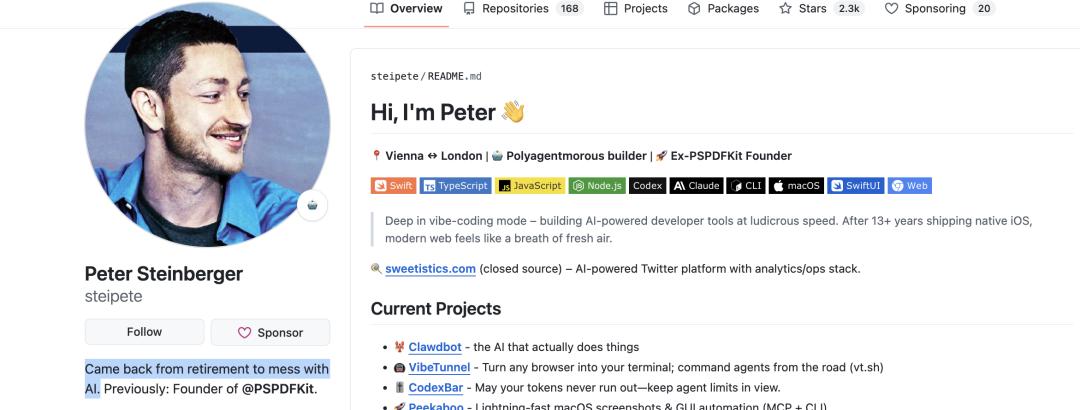
After that, I wrote this sentence in my personal profile: Goodbye to "retirement", let's play with AI. I really love this state.
Host: Can you tell us what other things you did before this project? And what was your thinking when doing these projects? I guess you must have thought that some projects would be more popular than others, but no one could have imagined that this project would become so popular.
The most absurd thing is that I saw on Ins that people who don't usually pay attention to technology at all went to the Apple Store to buy Mac Minis. Looking at the star count on GitHub, usually people like to show the data charts of projects, but the star chart of this project is really a straight - up line. I even want to talk to the people at GitHub. It's really crazy.
Peter Steinberger: To be honest, the core purpose of what I do is to have fun. The best way to learn these new technologies is to play with them with interest and do practical operations. So, I do things that I think are useful.
I've tried different programming languages and different development ideas. I'm kind of groping my way. I don't really like the term "vibe coding". I always like to joke that I do charming engineering work first, and then around 3 a.m., I start doing vibe coding and end up regretting it.
Host: You'd better go to bed earlier.
Peter Steinberger: Sometimes I just can't help it, and then I keep tinkering with all kinds of small things.

Actually, I had the idea of making a personal agent earlier. I also tried it at that time. GPT - 4 had just come out not long ago, and the experience was really poor. I thought that the major technology companies would definitely make it in a few months, so why should I bother? I just waited for the big companies to produce finished products. They would definitely do better than me.
I haven't done many things. There is a project that is still unfinished and I plan to polish it well later. I will develop a lot of command - line tools (CLIs) because agents are really good at this, and this link needs to be connected.
This is actually the core secret: to build a system that allows agents to do software development in the optimal way.
This is a little trick. I've tried a lot of directions. Last November, I was still wondering: Where is the agent I want? In May, I did a small project that took two months. At first, it was just for fun. My two friends and I were bored and just came up with the idea: What kind of interesting tool should we make? Wouldn't it be cool if we could call Claude Code from our phones?
Actually, everyone has this kind of idea. I see people doing similar things every day. Now I even think that the way to become a reliable practical engineer is to make a clumsy orchestration tool for yourself. The process is troublesome, but it's really interesting.
I spent two months making this tool and finally had to stop because it was so useful that my friends and I kept studying it every day. But it was so addictive that it seriously affected my mental state. I was almost trapped in it.
Host: Some people are extremely obsessed with this kind of thing. I've seen someone get off the plane and start tinkering with Claude Code on their computer at the airport. They were completely immersed in it and wouldn't stop until they sent another instruction.
Peter Steinberger: Now, as soon as the agent stops working, I feel uncomfortable. You can see that I still have two terminals open now, just hoping that it can keep running and keep doing things.
I was in the same state last November. The first thing I did when I woke up every day was to turn on my computer. I thought I wouldn't do anything new that day and would take a break, but I still couldn't help but check what new things the agent had come up with on WhatsApp. Even when I went to the kitchen to get a glass of water, I would come back to check and couldn't help but type in some prompts.
Later, I simply made an integration function for WhatsApp. By sending a message to call Claude Code, I could get the output result of the model with one click. The whole process was seamless. This function only took me an hour, and it worked on the first try. I thought at that time, "Wow, this is so cool."
But when I write prompts, I always like to combine text and pictures. Because pictures can convey a lot of context information without typing a long paragraph of text. This is actually a practical little trick that can improve efficiency a lot. So, I added the ability of image recognition to this function.
Later, I went on a short - term trip on the weekend and found that this tool was much more useful than I thought, and it could be used not only for programming. For example, when looking for a restaurant, it has built - in Google services and can directly search for information and make recommendations.
At that time, I thought, "Let me try sending a voice message." As a result, I found that there was no voice support in the function. Looking at the read prompt of the message, I was really curious to know how it would handle it. Ten seconds later, the agent actually replied to me. I was really confused. How did it do that?
It said, "You sent a file link without a visible file extension. I identified the file header and determined that it was an audio format. I originally wanted to use the FFmpeg tool on your Mac to convert it into a recognizable WAV format, but it wasn't installed, and there was an installation error. Then I found your OpenAI key in your environment. So, I used the curl tool to send your voice file to OpenAI's speech - to - text interface and then replied to you."
It was at that moment that everything became clear. It turns out that as long as you give them enough permissions, these agents are so smart and resourceful.
Then I kind of got obsessed with it. I did all kinds of strange things. For example, I used it as an alarm clock and let it migrate to my computer in London. Then I logged in to my MacBook via SSH and turned up the volume to the maximum in the morning to wake me up. Now I think I've made the most expensive alarm clock in the world.
It even made mistakes because I added a heartbeat mechanism. You know, in the normal mode of just sending a prompt and getting a result, giving the agent full access rights has great security risks. But I wanted to take it a step further: to automate the whole process and let it run autonomously.
The feedback it gave really surprised me.
In my opinion, this project is not just a technical development but also an artistic creation and exploration. On the one hand, it essentially just stitches together existing technical modules, like using glue. On the other hand, it completely changes the way we interact with technology. All the complex technical details are hidden, and you don't have to care about them at all.
You don't have to worry about how to compress conversations or which model to choose. At most, you occasionally consider the token cost because tokens are not cheap now. But apart from that, communicating with it is like chatting with a friend.
Host: Yes, perhaps everyone wanted this kind of agent interaction experience last year, but all the focus was on the browser at that time. I always think that the direction was wrong from the start. If agents could talk to you across all apps and devices, then the browser... I just don't care about the browser anymore.
Peter Steinberger: Actually, before doing this project, I did a lot of preparatory work and wrote a lot of command - line tools. Because my previous development environment was very simple and had no scalability. Later, some people made all kinds of strange retrieval tools on this basis, but the ones that can really achieve large - scale use are still command - line tools.
Agents understand the Unix system. You can run thousands of small programs on your computer. As long as they know the names of the programs, call the help menu, load the required resources, and follow the instructions in the help menu, they can get the job done.
Moreover