For the first time, annual revenue has declined. Tesla @everyone: I'm no longer an automobile company.
On January 28th local time, Tesla released its financial report for the fourth quarter and the full year of 2025. The data shows that the company achieved a revenue of $24.9 billion in the fourth quarter, a slight year-on-year decrease of 3%, slightly higher than market expectations; the adjusted earnings per share were $0.5, exceeding analysts' expectations.
However, beneath the glamorous surface, there are hidden concerns: the revenue of the core automotive business decreased by 11% year-on-year to $17.7 billion, and the quarterly net profit shrank significantly by 61%, recording only $840 million.
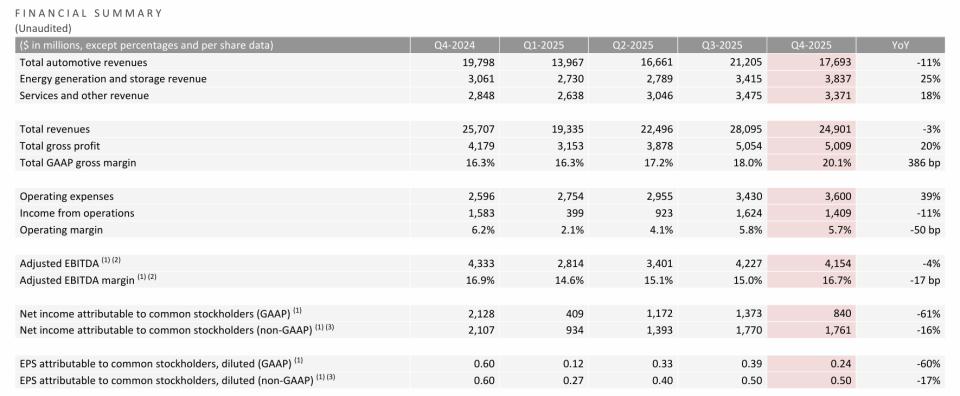
Tesla's performance in the fourth quarter of 2025
What's more noteworthy is the full-year performance: Tesla's total revenue in 2025 was $94.8 billion, a 3% year-on-year decrease. This is the first annual revenue decline in the company's history. The annual vehicle delivery volume decreased by 8.6% year-on-year to 1.64 million units, ending the multi-year growth record.
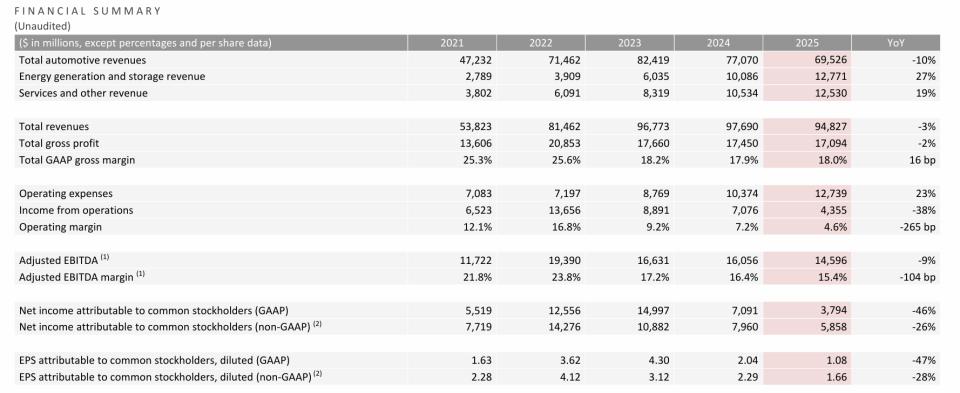
Tesla's full-year performance in 2025
Despite the first revenue decline in history and a sharp drop in net profit, after the release of the financial report, Tesla's stock price rose by more than 3% in after-hours trading. Investors seem to be more concerned about the company's long-term vision, namely the AI future centered around Full Self-Driving (FSD), Robotaxi, and humanoid robots.
Tesla also announced that it will invest $2 billion in xAI, an AI startup founded by Elon Musk, to further strengthen its technological narrative.
01 Automotive Business: The Growth Engine Faces Challenges
Tesla's automotive business is experiencing the pain of transformation.
In the fourth quarter, the revenue of this segment decreased by 11% year-on-year, becoming the main factor dragging down the overall revenue. Looking at the full year, the automotive business revenue was $69.5 billion, a 10% decrease from 2024. Its proportion in the total revenue has dropped from the high of 88% in 2021 to about 73%.
In the fourth quarter, Tesla delivered 418,000 vehicles globally, a 16% year-on-year decrease; the cumulative annual delivery volume was 1.64 million units, a 8.6% year-on-year decrease, marking the first annual negative growth. This change reflects the profound transformation of the market competition environment.
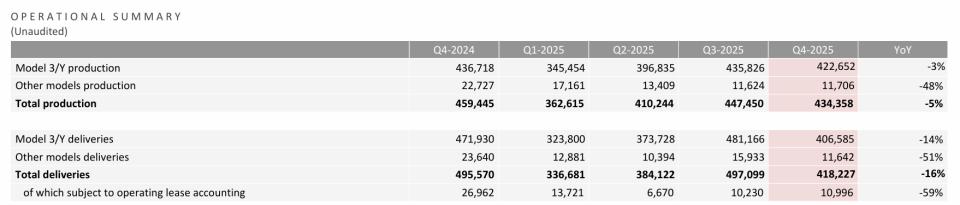
Tesla's vehicle production and delivery data in the fourth quarter of 2025
Foreign media reported that Tesla is facing fierce competition in the global market, "especially the impact from BYD in China."
Meanwhile, the expiration of the US federal electric vehicle tax credit policy at the end of September last year also had a negative impact on sales.
Facing the pressure, Tesla adjusted its price strategy.
The starting prices of the standard versions of Model 3 and Model Y launched in October 2025 dropped to $37,000. However, this measure had limited effect in boosting sales and instead squeezed the profit margin.
Analysis by Barclays Bank shows that Tesla's pre-tax profit margin in 2025 was about 6%, less than half of Toyota's. Tesla also pointed out that the reduction in the allocation of fixed costs for some models and the increase in tariffs led to an increase in the average cost per vehicle.
Meanwhile, the slowdown in Tesla's product update rhythm is also a potential concern. Except for the Cybertruck launched in 2023, the main models Model 3 and Y have been on the market for many years. Facing the rapid progress of competitors in terms of charging speed and mileage range, the competitiveness of the existing product line is being tested.
As the company's fundamental business, how to revitalize the growth momentum of the automotive business has become a real challenge that Tesla must face.
02 Autopilot Business: The Gap Between Vision and Reality
The commercialization of FSD advanced steadily this quarter. The monthly subscription volume doubled in 2025, and the user scale reached about 1.1 million by the end of the year. Tesla has launched user test rides in multiple European markets and continues to seek regulatory approval in China and Europe.
Notably, Tesla has gradually phased out the one-time payment option and fully switched to the monthly subscription model, aiming to establish a more sustainable software revenue system.
Meanwhile, the implementation of Robotaxi has made preliminary progress.
Tesla disclosed that it launched the driverless test in Austin in December last year and removed the safety drivers within a limited scope starting in January this year. The service expansion plan shows that the service will be promoted in seven US cities such as Dallas and Houston in the first half of 2026. The production preparation for the dedicated model Cybercab has also started, and the production capacity is expected to ramp up in April 2026.
These developments support Tesla's long-term valuation logic. Some investment institutions believe that the company's existing vehicle scale provides it with a unique advantage, and a large number of existing vehicles can be transformed into an autopilot service network through software updates.
However, the real challenges remain severe. Many commercialization schedules set by Elon Musk previously have not been met as planned, and the financial report still does not provide a clear profit path. In contrast, competitors such as Waymo have carried out commercial operations in multiple cities.
More importantly, this future business is consuming a large amount of Tesla's current resources. This quarter's operating expenses surged by 39% year-on-year to $3.6 billion, with a considerable portion invested in autopilot R & D. This directly led to an 11% year-on-year decrease in operating profit and a significant decline in net profit.
03 Robot Business: From Concept to Mass Production
The humanoid robot Optimus is moving from the R & D stage to industrialization.
The financial report disclosed that the third-generation Optimus will be released in the first quarter of 2026, and this version is defined as "the first model designed for large-scale production." Tesla is building its first production line, with the goal of starting production before the end of 2026, and the long-term plan is to achieve an annual production capacity of 1 million units.
Elon Musk previously said that sales may start in 2027.
However, this business is still in the investment stage. The relevant R & D expenditures are included in the significantly increased operating expenses, and key information such as the target market, pricing strategy, and profit model has not been specifically stated in the financial report.
04 Energy Business: A New Growth Pillar
The energy business has become a prominent highlight in this quarter's financial report.
The revenue of this segment in the fourth quarter was $3.84 billion, a 25% year-on-year increase; the annual revenue was $12.77 billion, a 27% increase, and it has become an important growth engine.
The gross profit of the energy business in the fourth quarter reached a record high of $1.1 billion, breaking the record for the fifth consecutive quarter. This is mainly due to the increase in the deployment of energy storage products, especially the demand for the grid-scale energy storage system Megapack. The company plans to put the new-generation Megapack 3 into production at its Houston factory in 2026 to further consolidate its market position.
In 2025, Tesla participated in grid regulation more than 89,000 times through the Powerwall home energy storage network, covering more than 1 million devices. It is estimated that these virtual power plant activities saved users more than $1 billion in electricity costs.
05 Strategic Investment: Balancing Short-Term Profits and Long-Term Investment
The most prominent feature of Tesla's current-quarter financial report is the change in the cost structure. While the revenue decreased slightly by 3%, the operating expenses increased significantly year-on-year.
The annual operating expenses in 2025 reached $12.7 billion, a 23% year-on-year increase. The funds are mainly invested in AI R & D, the construction of new production lines, and the expansion of global infrastructure. This clearly reflects the company's strategic choice: sacrificing short-term profits in exchange for long-term growth potential.
The management said in the financial report that the increase in expenses reflects the shift of resources to future fields such as autopilot and robots, which is "a necessary investment for long-term growth."
Although the capital expenditure in the fourth quarter decreased year-on-year, the market expects that the total capital expenditure in 2026 will increase from $9.5 billion to $11 billion - for the construction of six new production lines and the expansion of AI training computing power infrastructure.
Notably, Tesla also announced that it will invest $2 billion in xAI's financing round to further strengthen its layout in the AI field.
The sufficient cash reserve provides a guarantee for the implementation of the strategy. According to the financial report, the total cash and investments at the end of the fourth quarter reached $44.1 billion, a quarter-on-quarter increase of $2.4 billion, mainly from the cash flow generated by business operations.
However, the impact of this investment model on the current performance is obvious. Tesla's annual operating profit margin has dropped from 16.8% in 2022 to 4.6%, and the net profit has declined significantly year-on-year.
The key lies in the time window. If the high investment cannot be converted into considerable commercial results within a certain period, and if the core automotive business further declines in the fierce competition, the company will face dual pressures.
Special correspondent Jin Lu also contributed to this article
This article is from the WeChat official account "Tencent Technology", author: Su Yang. It is published by 36Kr with authorization.