Claude Code discovered that the Clawdbots were trying to replace it by using its shell.
There's no need to elaborate on how popular Clawdbot has been recently. It has over 70,000 stars on GitHub, and its growth rate far exceeds that of most projects. On social platforms, developers and tech enthusiasts are sharing screenshots, discussing usage, writing tutorials, and sharing installation experiences. The community's enthusiasm is spreading like wildfire, even boosting the sales of Mac Mini.
Overnight, this project has become one of the representatives in the Agent field.
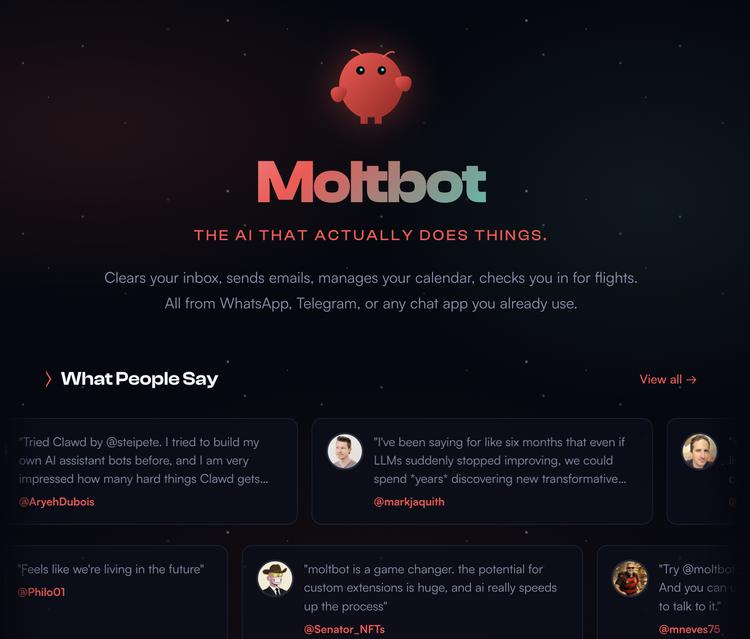
However, the sudden popularity has also brought troubles. On January 27, 2026, due to Anthropic's concern about the similar pronunciation of "Clawd" in the name Clawdbot to its trademark Claude, Clawdbot was officially renamed Moltbot, and its mascot also changed from a space lobster to a molting lobster.
Some netizens complained that Anthropic is as stingy as ever. Its Claude Code still holds an unshakable position. In fact, everything Clawdbot can do, Claude Code can also achieve. Essentially, it's just a re - skinned version.
But from the actual usage situation, Clawdbot has indeed impacted Claude Code, far more than just being a "re - skinned" version. Anthropic should be worried.
From Re - skinned 1.0 to Re - skinned 2.0, Who Wouldn't Be Worried?
When it comes to "re - skinned", our first reaction is often to create a chat box and connect to ChatGPT's API. This is indeed the earliest and most typical form of re - skinning after the emergence of large models. Its essence is based on the dialogue ability of large models, adding some prompt words, buttons, and scenario packaging. The value mainly lies in the interface, guidance, and scenario naming, rather than the ability itself.
But Re - skinned 2.0 has gone beyond that. It's not just a simple UI change but starts to extend to the functional layer, trying to address the issues that Agent companies deliberately ignore. For example, how to keep tasks going? How to save states? How does the system continue to run when people are absent? How to roll back after an error?
This is exactly the reason why Anthropic should be worried. Tools like Clawdbot are addressing the issues that Claude Code deliberately didn't do or chose to ignore from all aspects, and they are doing it quickly and systematically. They don't challenge the model's ability, nor do they try to "create a smarter Claude Code". Instead, they make Claude Code go from being usable to being easy to use around real - world usage scenarios.
Claude Code is designed very conservatively. It only cares about one thing: whether the execution is reliable. Reading files, modifying code, running commands, and generating diffs, and completing tasks in a controllable environment, that's its boundary.
But once it enters the real workflow, problems immediately surface: people leave, tasks are interrupted, and confirmations are delayed. When you open it the next day, no one can guarantee that you'll understand what happened yesterday.
Clawdbot and other "Re - skinned 2.0" tools are precisely addressing these ignored real - world problems head - on. And Clawdbot is the furthest - advanced one among them.
The biggest highlight of Clawdbot is its architecture. It runs a unified message hub locally, connecting WhatsApp, Telegram, Slack, and terminal messages. You can, like a boss, put forward requirements on your phone, and Clawdbot will execute like an employee and reply on your phone.
In addition, with its memory system, all chat records and user preferences are saved in local Markdown files. When the AI needs to "recall", it will automatically search these files, bring relevant information back into the context, and continue the conversation without forgetting.
Finally, it comes with a built - in tool system that can directly execute commands, read and write files, and call various services without additional configuration. It's ready to use out of the box and supports more than 50 common services, such as Gmail, GitHub, Spotify, and smart home devices.
The Re - skinned 2.0 Ecosystem
Even if we put Clawdbot aside, there are still a bunch of Re - skinned 2.0 products around Claude Code. They may not be as popular, but they are enriching the ecosystem.
First, make the execution process "visible".
For example, opcode turns Claude Code's execution process into a visual timeline: every decision - making node, every file modification, and every token consumption are recorded and can be retrieved at any time. More importantly, it provides a "checkpoint" mechanism. When the agent modifies the code incorrectly, you can accurately roll back to a certain historical version.
Another example is to make control "anywhere and anytime".
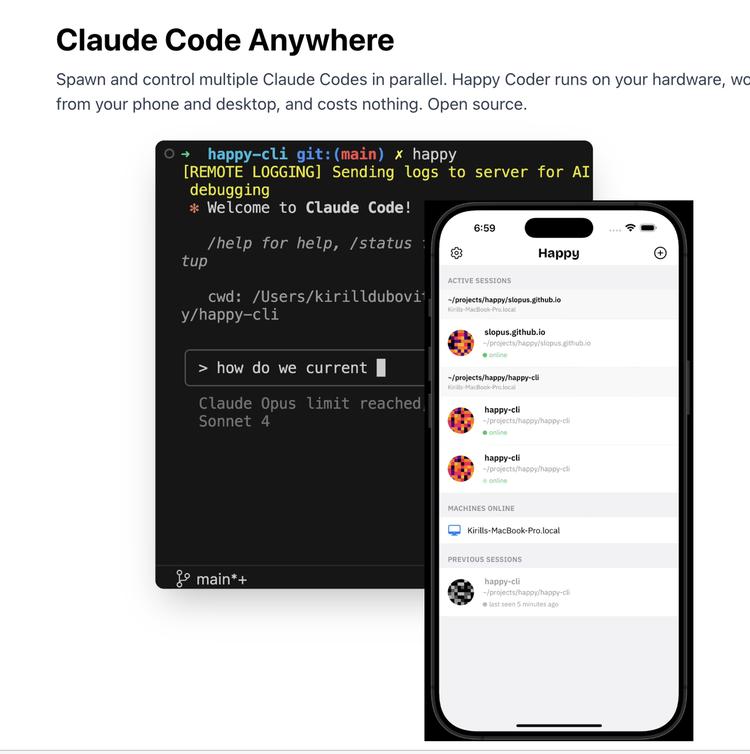
Claude Code is bound to the local terminal, which means you have to sit in front of the computer to interact with the agent. But the agent's execution often takes a long time, while human attention is fragmented. You may be in a meeting, commuting, or taking a lunch break, but the agent encounters a branch that requires human confirmation at this time. Happy turns the mobile phone into a remote control for Claude Code. It doesn't reconstruct a complete agent on the mobile side but focuses on two things: remote intervention and status awareness. You can quickly respond through voice input or directly check which step the current execution has reached on your phone. This changes the rhythm of human - machine collaboration.
There are also some tools that make history "traceable".
claude - code - webui allows you to quickly check the agent's current status on any device with a browser and even trigger new execution tasks. claude - run focuses on "post - analysis". After a long - term task is completed, you can review the complete execution log, locate where the problem occurred, and where human intervention is needed.
Next is the governance layer, which makes the agent manageable.
When Claude Code moves from a personal experimental tool to team collaboration and even the production environment, governance issues start to surface. ccundo provides file - level version control and roll - back capabilities. ccmanager tries to solve the problems of session isolation and parallel management, allowing multiple agents to work simultaneously without interfering with each other. claude - code - otel and sniffly turn the execution process into an observable data stream: how many tokens are consumed by which operations, where anomalies occur, and what the overall cost is.
At the bottom is the infrastructure, which makes the underlying model "replaceable".
Claude Code uses Anthropic's API by default, which has limitations in terms of cost and flexibility. claude - code - proxy, y - router, and agentapi allow developers to freely switch the underlying model through proxy or routing mechanisms. Use cheaper models for simple tasks and more powerful models for complex tasks. You can even mix multiple models in the same workflow.
Looking at these complementary levels together, a clear development logic can be found:
Visualization layer: Make the invisible execution process visible
Control layer: Make the control bound to the local machine available anywhere and anytime
Traceability layer: Make the linearly lost history traceable
Governance layer: Make the wild - growing execution manageable
Infrastructure layer: Make the fixed - dependent underlying model replaceable
These tools are not repeating Claude Code's functions but are building the peripheral functions it lacks. Claude is responsible for execution, while the Re - skinned 2.0 ecosystem tools are responsible for making this execution manageable, controllable, traceable, and sustainable.
Forcing the Official to Do a Good Job on Agents
What really makes Anthropic nervous about Re - skinned 2.0 is not whether they threaten the existence of the official product, but that they are systematically rewriting users' expectations of "what an Agent should look like". Claude Code can still adhere to its extreme conservatism in execution reliability. However, when more and more developers are used to a traceable timeline, interruptible tasks, and control entrances that can be accessed at any time, these capabilities are no longer "bonus points" but are assumed to exist. If they don't, it means being backward.
This is a very effective forcing mechanism. The ecosystem has raised the threshold of "usability" to a higher level. Even if Anthropic chooses not to build all these capabilities into Claude Code, it must at least respond to these demands directly, through official extensions, interface opening, or at least make clearer trade - offs in the product boundaries. Otherwise, the core product will become more and more like a puppet, and it will be the external systems growing around it that truly carry out daily work.
More importantly, this forcing mechanism is irreversible. The reason why Re - skinned 2.0 tools can iterate quickly is that they are directly exposed to the real workflow. Feedback on where there are bottlenecks, where things are unclear, and where human intervention is needed is almost immediate. They are not the "future of Agents" obtained through user surveys.
The ecosystem explores the way forward, and the official integrates later. Perhaps this is the healthiest symbiotic relationship in the Re - skinned 2.0 era.
This article is from the WeChat public account "Silicon Star GenAI", author: Dong Daoli. It is published by 36Kr with authorization.