The trillion-yuan commercial space industry has uncovered another thousand-billion-yuan market segment.
Recently, with the booming of the commercial space industry, 3D printing has also caught the wave. From trendy collectible blind boxes to space satellites, the industry is on the verge of an explosion.
01 The Rise of Another Trillion - Dollar Track
Currently, 3D printing has long bid farewell to the previous stage of concept hyping. With the continuous expansion of application scenarios in commercial space, new - energy vehicles, medical devices, and creative consumption, the industrialization process has also accelerated under policy support.
3D printing is hailed as one of the core technologies leading the third industrial revolution. It mainly realizes software modeling through CAD or 3D scanners and stacks materials with the help of digital devices to form physical models.
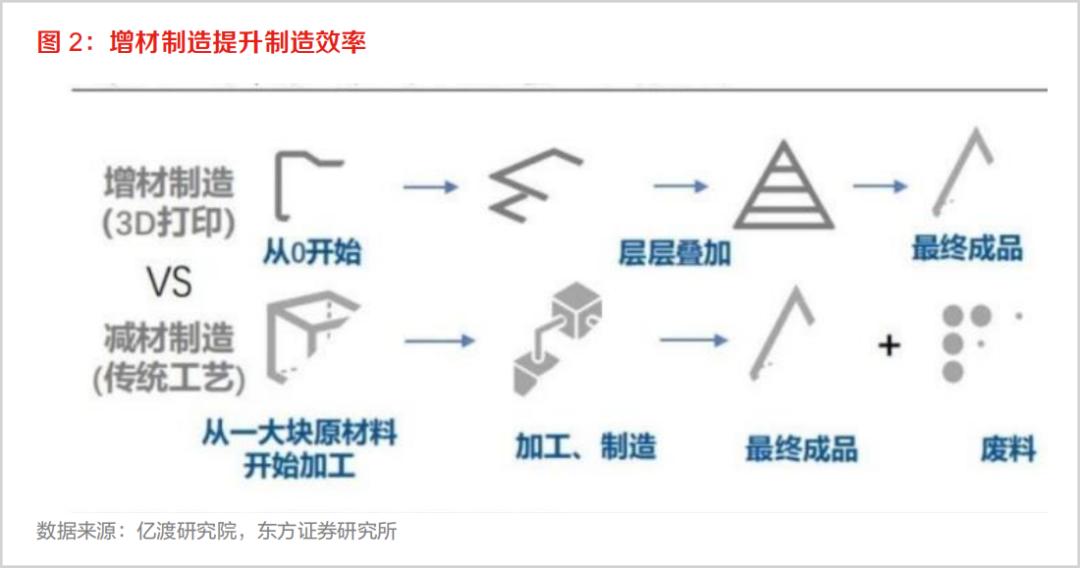
From the perspective of manufacturing processes, traditional industrial manufacturing belongs to subtractive manufacturing, which cuts and processes raw materials into the required shapes and sizes through cutting, planing, milling, etc. However, there are difficulties in processing and forming complex - shaped or large - scale structural parts. Multiple components need to be processed first and then assembled. This not only involves many procedures and high processing costs but also has a low material utilization rate.
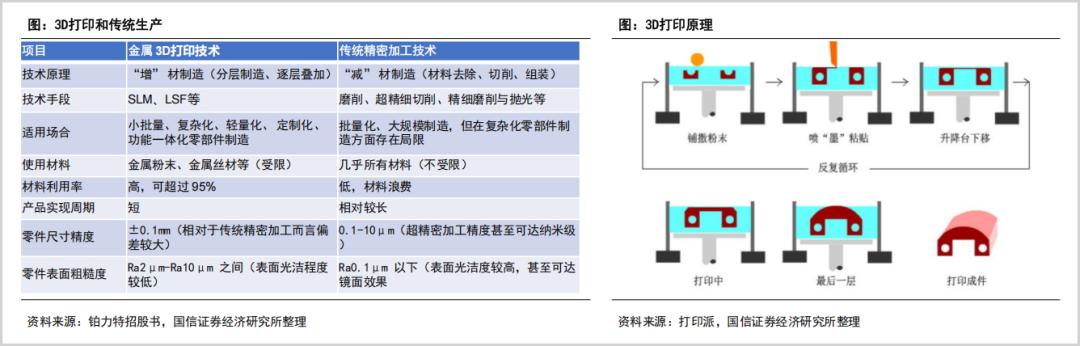
3D printing belongs to additive manufacturing. Based on a 3D model, it uses high - energy heat sources such as lasers to melt and stack raw materials layer by layer through layered superposition, thus obtaining the target entity. It can easily complete internal cavity structures and hollow designs that are difficult to achieve with traditional processes, eliminating complex procedures such as mold design and manufacturing. This shortens the production cycle and saves costs at the same time.
In comparison, 3D printing manufacturing is more flexible, with prominent advantages in personalized production, lightweight design, cost control, material utilization rate, and production cycle. It is more suitable for efficient manufacturing of customized, complex - structured, and small - batch products.
In terms of market space, the 3D printing industry is still in a blue - ocean track with rapid growth. According to the research of Guoxin Securities, the global 3D printing market revenue reached $21.9 billion in 2024 and is expected to reach $115 billion by 2034, with a compound annual growth rate of 18% over 10 years.
In the downstream market, 3D printing is mainly applied in high - end manufacturing fields such as commercial space, automobiles, and medical devices. Among them, the aerospace application space is the largest, and it is already a trillion - level market. According to the research of Guosheng Securities, the market scale of domestic commercial space reached 2.3 trillion yuan in 2024 and is expected to increase to 2.8 trillion yuan in 2025.
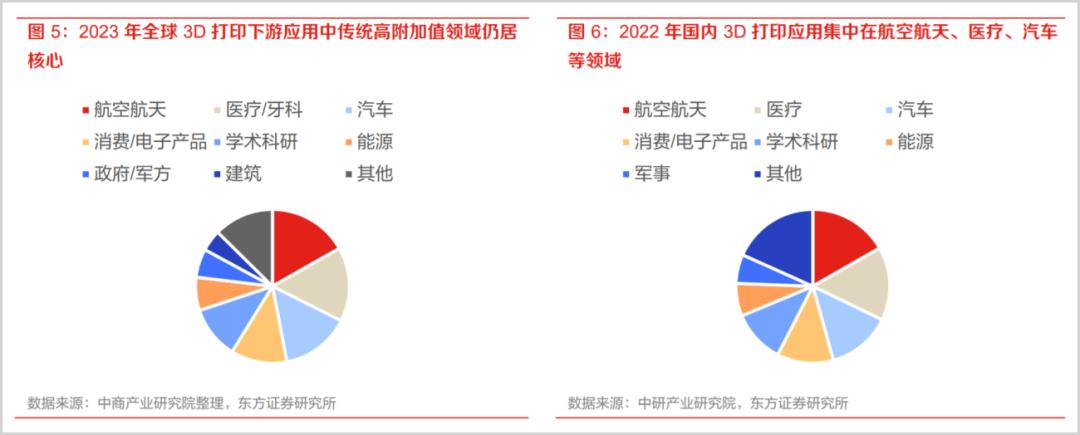
As the commercial space industry enters a prosperous cycle, it will surely drive the development of the 3D printing industry.
All along, the 3D printing industry has faced the problem of low industry penetration. With the maturity of technology and the decline of costs, the industry will rise rapidly.
02 The Inflection Point Has Arrived
In the 3D printing market, printers occupy the vast majority of the market share and are mainly divided into two categories: consumer - grade and industrial - grade. Consumer - grade products are rapidly expanding their market share with advantages such as ease of use, low cost, and personalization.
Consumer - grade 3D printing products are mainly for individual consumers and creative design by makers, covering multiple categories such as trendy collectibles, home decorations, and gardening tools. The industry has grown very rapidly in recent years. According to data from CIC, the global market scale reached $4.1 billion in 2024 and is expected to grow to $16.9 billion by 2029, with a compound growth rate of 33%.
Behind the rapid expansion of the market, on the one hand, it is affected by the expanding demand for artificial objects and the 3D farm model, which can better meet personalized needs and emotional values. At the same time, it also benefits greatly from cost optimization.
Currently, the price of mainstream consumer - grade FDM equipment has dropped from tens of thousands of yuan a few years ago to the range of 2,000 - 3,000 yuan, and the entry - level equipment has even dropped to as low as 1,000 yuan, which has entered the price range of mass electronic consumer goods.
In addition, the maturity of large AI models is also an important driving force for the expansion of the consumer - grade market. The multi - modal capabilities of large models lower the threshold for users to perform 3D modeling and can also provide more support in visual inspection, algorithm planning, etc. in the 3D scanning and printing processes, greatly improving the use efficiency.
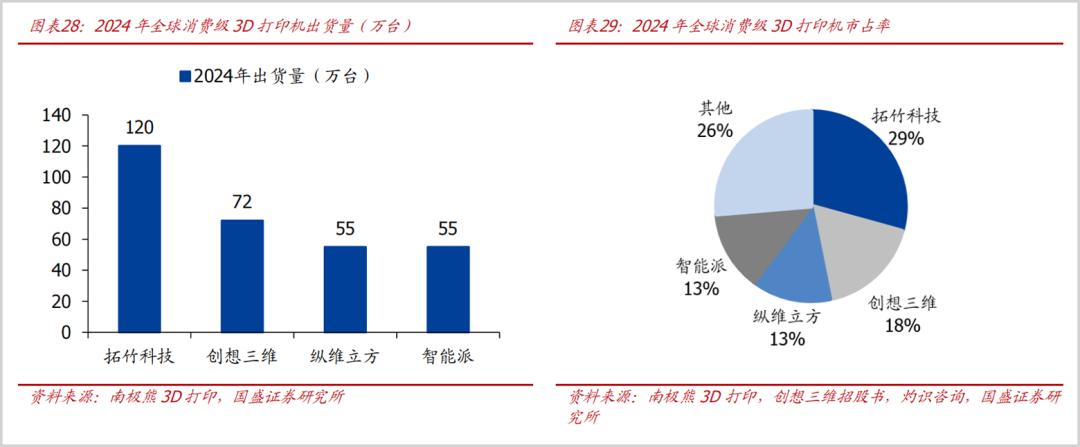
In terms of the competitive landscape, the current global consumer - grade 3D printing market is mainly dominated by Chinese manufacturers. According to the research of Guosheng Securities, in terms of shipment volume statistics, four major manufacturers including Tuozhu Technology, Creality 3D, Anycubic, and SmartParts accounted for more than 70% of the global market share in 2024. Among them, Tuozhu Technology, as the leader, accounted for 29%, but currently none of the four companies is listed.
In the industrial - grade 3D printing field, domestic manufacturers started relatively late. The global market is mainly dominated by enterprises from traditional industrial powers such as Germany and the United States. The localization rate of multiple links in core components such as high - end lasers, galvanometers, and inkjet nozzles still needs to be improved, especially in the high - end market. Moreover, the industrial - grade 3D printing software market is still dominated by foreign companies.
In the downstream market, commercial space will become an important driving force affecting the growth of the 3D printing industry.
Due to the complexity and high - precision requirements of aerospace components, rapid prototyping through 3D printing can significantly save mold - opening time and costs. It has currently been applied to various components such as rocket engines, combustion chambers, CubeSat deployers, and satellites.
For example, in the field of rocket engines, the current cost of rocket launches is relatively high, and the engine accounts for 50% of the total rocket cost. According to the research of Guosheng Securities, taking Galaxy Power as an example, the production cycle of the 3D - printed engine is 1/6 of that of the traditional model, the manufacturing cost is reduced to 10%, and the engine weight is reduced by 50%.
Domestic manufacturers are leading in the consumer - grade 3D printing market and are also rapidly catching up in the industrial - grade track.
03 Who Is Sharing the Market Feast?
Specifically, 3D printing equipment manufacturing is the core link with relatively high technological barriers in the middle reaches, mainly represented by BLT, Farsoon Technologies, and Ascai.
Among them, BLT focuses on industrial - grade 3D printing and is the world's second - largest metal 3D printing leader. Its business covers the entire industrial chain of equipment, materials, printing services, and software. Its advantageous field is aerospace, with revenue accounting for about 60%. Its products have been applied to C919, advanced fighter jets, rocket satellites, etc., and it ranks first in the domestic market share. At the same time, it has also been actively expanding into fields such as industrial machinery, energy, and medical care in recent years.
Long - term and stable large - scale customers are BLT's business barrier. It is deeply bound to key customers such as AVIC and China Aerospace Science and Technology Corporation. It is also a joint development partner for large - scale parts of Airbus A350, and its technology and engineering capabilities have been recognized by large - scale customers.
In the consumer - grade field, BLT is also catching up. According to the research of Orient Securities, BLT's market share is 7.3%, ranking fifth.
For Farsoon Technologies, different from BLT's focus on metal printing, its main business covers two major technological paths of metal and polymer 3D printing. Due to the complexity of polymer technology, it is one of the few international suppliers that have mastered this core technology and launched industrial - grade equipment. It ranks among the international leading levels in technical indicators such as the maximum forming size and the number of lasers.
In the downstream market, aerospace is also its largest business field, with revenue accounting for about 50%. However, its business coverage is wider. In addition to industries such as automobiles and medical care, it is also actively deploying in fields such as low - altitude economy, consumer electronics, and shoe molds. Among them, shoe molds are regarded as an important potential growth point, and it has achieved a production capacity of over 1 billion pairs of finished shoes, which will contribute to performance growth in the future.
Ascai mainly focuses on traditional flat - printing direct plate - making machines. In recent years, it has been transforming towards 3D printing, focusing on 3D sand - mold printing equipment and piezoelectric inkjet printing technology. It is the first domestic brand with independent intellectual property rights for piezoelectric inkjet print heads. Compared with imported print heads, it has obvious advantages in performance, compatibility, service life, and cost.
In the material link of 3D printing, Youyan Powder Materials has performed prominently. It is mainly based on metal powder materials. Its copper - based metal powder and micro - electronic tin - based solder powder both rank first in the domestic market share. Currently, its products cover multiple fields such as commercial satellite and launch vehicle components and military industry.
As a new growth curve for Youyan Powder Materials, the output of powder materials in 2024 was 293.63 tons, and the business revenue was 47.9458 million yuan, a year - on - year increase of 57.46%, but it accounted for only a little over 1% of the total revenue. In October 2026, the additive metal powder material production line with an annual output of 4,580 tons is expected to be put into operation, and the production capacity will be expanded to about 5,000 tons. The revenue scale and proportion will also increase significantly.
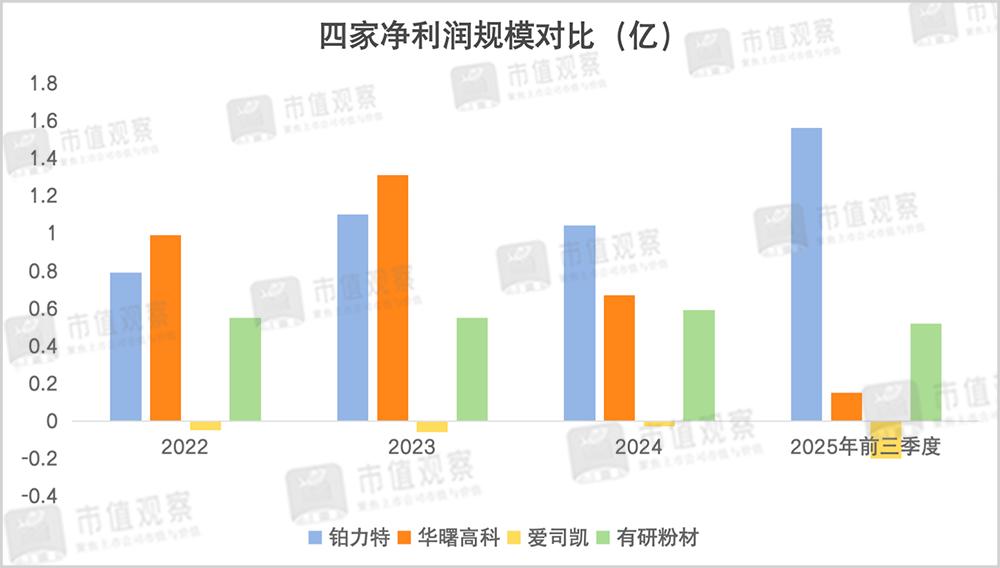
From the perspective of performance, BLT has the strongest profitability among the four manufacturers. In the first three quarters of 2025, its profit growth rate of 234.83% was significantly higher than that of the other three, indicating that the company is in a period of rapid growth.
It can be seen that Farsoon Technologies had the highest net profit scale in 2023, but it has been declining year by year since then, mainly affected by factors such as depreciation costs, share - based payment expense amortization, and R & D investment. Ascai's poor performance in recent years is related to the decline in the sales volume of its traditional computer - to - plate machines, the low gross profit rate of 3D printers, and high expense investment.
As the global 3D printing penetration rate accelerates, BLT, with its technological and customer - related barrier advantages, will be better able to enjoy the dividends of the industry's rapid growth. Youyan Powder Materials in the material segment will also benefit from the increase in production capacity.
Disclaimer
The content in this article related to listed companies is the author's personal analysis and judgment based on the information publicly disclosed by listed companies in accordance with their legal obligations (including but not limited to interim announcements, periodic reports, and official interactive platforms). The information or opinions in this article do not constitute any investment or other business advice, and Market Value Observation shall not be liable for any actions taken as a result of adopting the content of this article.
This article is from the WeChat official account "Market Value Observation", author: Market Value Observation. Republished by 36Kr with permission.