Reshaping the AI Investment Map: Beijing Holds Firm to the Throne, and the Yangtze River Delta Urban Agglomeration Rises Strongly
"Answer China's Venture Capital in 2025: Has AI investment reached its peak?"
In 2025, China's artificial intelligence industry entered a new stage of development driven by both policies and technologies.
At the national level, the "AI +" initiative has been vigorously promoted to accelerate the in - depth integration of AI technology with the real economy, especially in key sectors such as manufacturing, healthcare, and finance.
Meanwhile, the continuous iteration of general large - model technologies and the prosperity of the open - source ecosystem have spawned an innovation wave in the application layer. Breakthroughs in cutting - edge technologies represented by embodied intelligence have further broadened the scope of commercialization.
Against this macro - background, the capital market's attention to the AI track has reached an unprecedented high, and the investment logic has also undergone profound changes.
On the IT Juzi website - Event Library, enter the label "Artificial Intelligence" to obtain the latest data.
Overall Trend: Investment Heat Significantly Rebounds, and the Total Amount Grows Steadily
According to IT Juzi data, the investment heat in China's artificial intelligence industry's primary market significantly rebounded in 2025. There were a total of 1,579 investment events throughout the year, a year - on - year surge of 75%, setting a new high in the past five years.
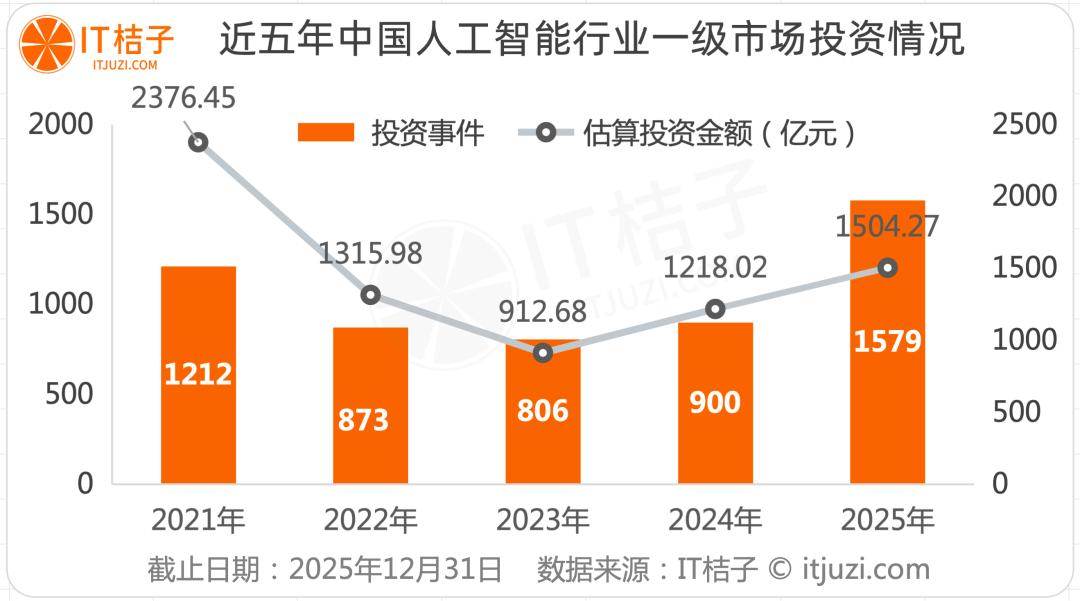
Note: In this article, the artificial intelligence industry adopts a relatively broad definition, covering tracks such as AI chips, autonomous driving, and robotics.
In terms of investment amount, the market also continued its recovery trend since 2023. After a 33% year - on - year increase to 121.802 billion yuan in 2024, the total investment amount in 2025 increased by another 24% to 150.427 billion yuan, but it has not yet returned to the historical high in 2021.
In 2025, AI investment showed a structural characteristic of "a sharp increase in the number of events and a steady growth in the total financing amount". This phenomenon of "increasing volume and stable price" reflects the market's general "cautiously optimistic" attitude, and its underlying reasons are closely related to the forward shift of the investment stage and the change in track preference.
Structural Changes: Explosive Growth in Early - stage Investment
IT Juzi data shows that the number of early - stage investment* events in the domestic artificial intelligence field in 2025 soared, with a year - on - year increase of up to 90%, reaching 754, setting a new high in the past five years.
This trend is in sharp contrast to the market pattern dominated by mid - stage investment in 2021. The structural change in the investment stage is the key factor explaining why the total financing amount in 2025, although increasing, is still lower than the high point in 2021. Meanwhile, the number of late - stage and strategic investment events has accounted for a relatively small proportion in the past five years, with little overall fluctuation.
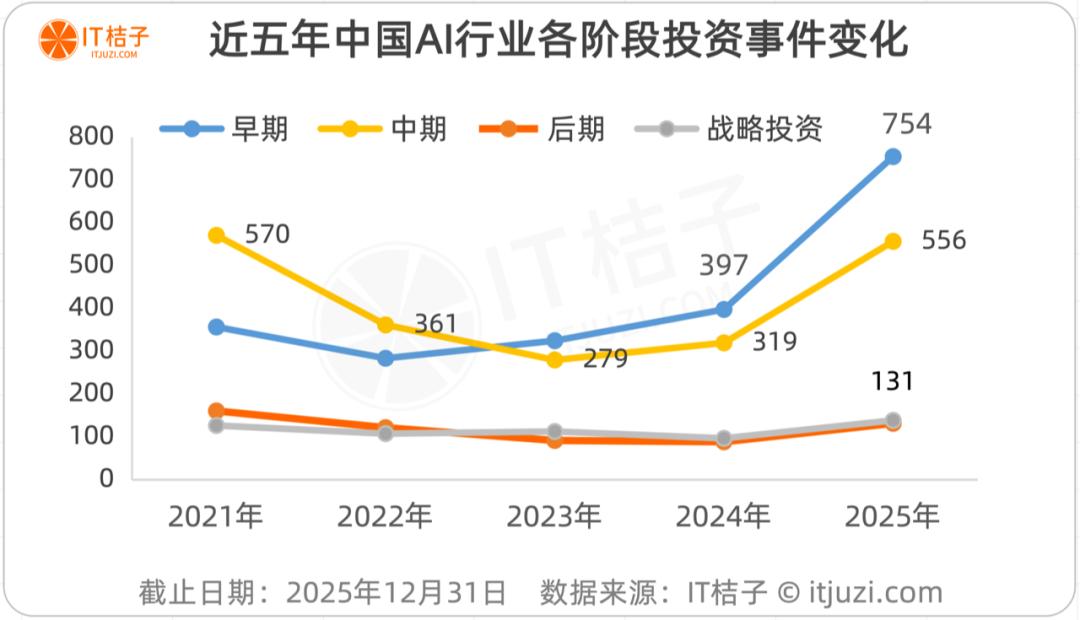
Note: Early - stage investment includes seed rounds, angel rounds, and Pre - A rounds; mid - stage investment includes A rounds, A+ rounds, Pre - B rounds, B rounds, and B+ rounds; late - stage investment includes the C round and subsequent stages until the Pre - IPO stage before listing.
The explosive growth of early - stage investment in the AI industry in 2025 can be attributed to two core driving factors:
● Firstly, the application scenarios of AI technology continue to expand. A large number of startups have emerged in cutting - edge tracks such as embodied intelligence, AI healthcare, and intelligent driving, attracting capital to make investments through a "broad - based" approach to seize the technological high - ground.
● Secondly, the single - deal financing amount of early - stage projects is relatively small, and the risks are relatively controllable. In the current market environment, they are more favored by capital, which is also in line with the guidance direction of relevant industrial policies.
Overall, this change reflects a significant adjustment in the risk preferences of investment institutions. Early - stage projects with lower trial - and - error costs have become the preferred strategy for capital to "diversify risks" and "seize opportunities", so financing is relatively easy. Mid - stage projects that have been verified by the market and have high growth potential can still receive continuous support from capital. In contrast, late - stage projects have higher financing thresholds and difficulties due to the scarcity of targets and higher requirements for commercialization.
Regional Pattern: Beijing Leads by a Wide Margin, and Regional Collaboration is Increasingly Prominent
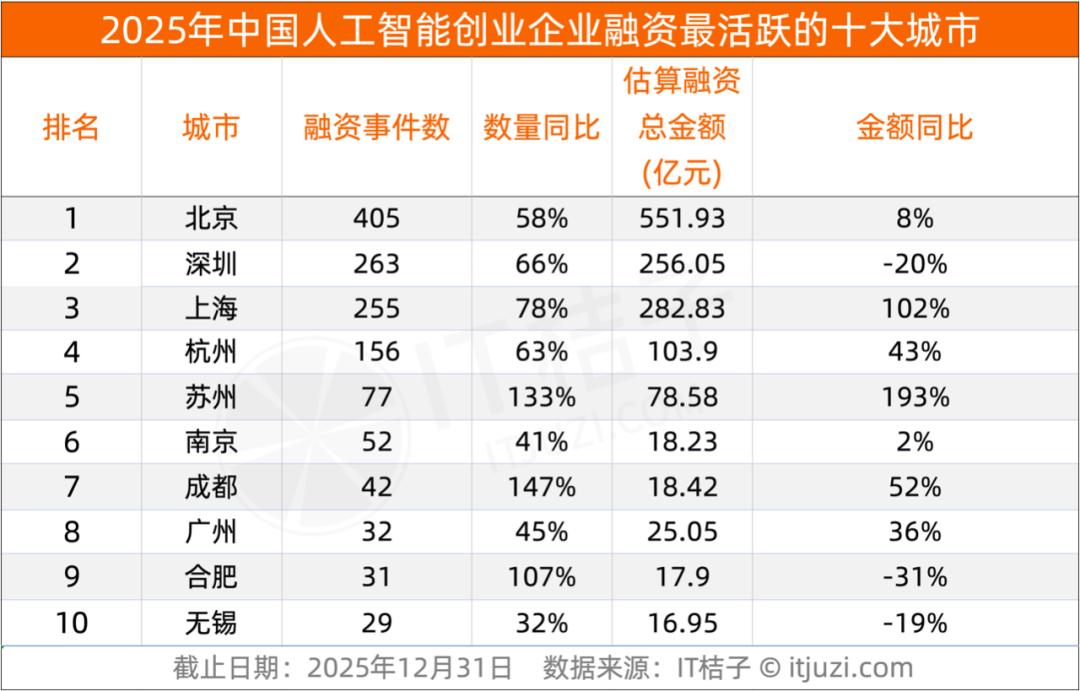
In terms of geographical distribution, Beijing's position as the national AI investment center remains unshakable.
In 2025, there were as many as 405 AI investment and financing transactions in Beijing. Relying on its top - notch research institutions, abundant talent reserves, and large - scale enterprise clusters, it far outpaced other domestic cities.
Shenzhen and Shanghai followed closely, but with different focuses.
Shenzhen ranked second with 263 financing events. Relying on its strong electronics manufacturing supply chain, it has formed an industrial characteristic centered on "AI + hardware" and is emerging as a demonstration center for the implementation of "AI + manufacturing".
Although Shanghai ranked third with a slight gap, its year - on - year growth rate of the number of financing events (78%) and the doubling of the financing amount demonstrated its huge development potential.
Hangzhou ranked fourth in the country in terms of the number and scale of AI investment and financing events and also maintained high - speed growth.
Notably, the regional collaboration effect represented by the Yangtze River Delta is becoming increasingly prominent. In the top ten list, many cities in the Yangtze River Delta are included. In particular, Suzhou showed significant growth, with the number of financing events in the artificial intelligence industry increasing by 133% year - on - year, which also reflects the prominent "Yangtze River Delta AI industry collaboration" effect -
This is due to the continuous spill - over of R & D innovation capabilities centered on Shanghai, which drives surrounding cities to undertake the manufacturing and application links of the AI industrial chain, gradually forming a regional industrial closed - loop of "R & D - production - application".
Meanwhile, some central and western cities are exploring differentiated development paths.
For example, Chengdu, the only western city on the list, relying on its local electronic information industry foundation, focuses on the integration of "AI + traditional industries" to avoid direct competition with first - tier cities. These emerging cities generally take "low cost + policy subsidies" as their core advantages to attract capital for early - stage layout, but their industrial clusters are still in the process of cultivation.
This article is from the WeChat official account "IT Juzi" (ID: itjuzi521). Author: IT Juzi. Republished by 36Kr with permission.