Intel's "Tesla Dilemma"
Author | Fan Liang
Editor | Zhang Fan
In the few trading days around the release of Intel's Q4 2025 earnings report, Intel's stock price experienced significant fluctuations, with an amplitude of nearly 30%.
The rise was due to market rumors that the production capacity of server CPUs was in short supply. Both Intel and AMD, the two giants, planned to raise the prices of server CPUs by 10% to 15%. This was regarded as the second wave of the "chip shortage" that might follow the shortage of memory chips.
The fall was because Intel's guidance in the earnings conference pointed out the embarrassing situation under the CPU price increase: the low yield rate led to insufficient supply, which would also drag down the overall performance in Q1 2026.
Even excluding the above factors, Intel's increase since 2026 has still exceeded 15%, and it has cumulatively increased by about 100% since 2025.
So, will Intel's stock price turn downward? Or is it expected to stabilize?
The US government still owes about $3 billion
In 2025, Intel received a total investment of $15.9 billion from SoftBank ($2 billion), the US government ($8.9 billion), and NVIDIA ($5 billion). The way to obtain the funds was through additional share issuance. Judging from the information disclosed in this quarter's earnings report, except for about $3 billion of funds (subsidies) from the US government to be paid, the investments received by Intel have basically arrived:
Intel's cash flow statement for 2025 shows that the company has cumulatively received a net inflow of $12.7 billion in funds through the issuance of common stocks (to NVIDIA and SoftBank) and escrow shares (from the US government). There is a gap of more than $3 billion between this and the aforementioned $15.9 billion investment received by the company. Considering that Intel has announced the completion of the issuance of a total of $7 billion in stocks to SoftBank and NVIDIA, and the subsidies in exchange for equity under the US Chip Act are received in installments, therefore, this gap of $3 billion most likely comes from the unpaid subsidies from the US.
A supplementary document released by Intel on January 24 also confirmed this. That is, the US Department of Commerce holds about 279 million common shares of Intel, 154 million escrow shares (subsidies to be fulfilled under the Chip Act), and 240 million warrants (the trigger condition is that Intel's stake in the foundry business drops below 51%). If the US subsidy funds arrive and all the escrow shares are released, and all the warrants are exercised, the US government will hold 12.5% of Intel's shares, becoming Intel's veritable largest shareholder.
However, the design of the warrant clause is not to encourage Intel to sell its foundry business, but more like a deterrent clause. Therefore, the possibility of exercising the warrants is relatively low.
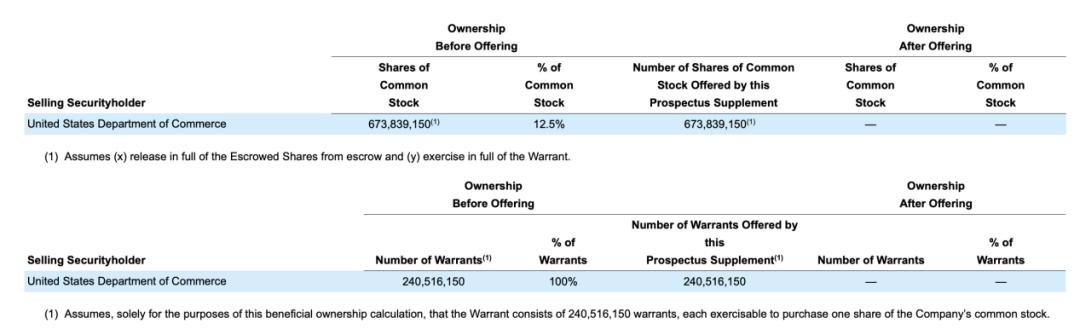
Chart: The US Department of Commerce's shareholding in Intel. Source: Company announcements, compiled by 36Kr
Looking at Intel's book funds, the company's cash and short - term investments on the books at the end of 2025 totaled $37.4 billion, a net increase of about $15.4 billion compared to 2024, with a net increase rate of 70%. The net increase part came from the $12.7 billion in investment received from the issuance of shares and the $3.3 billion in funds obtained from selling part of the shares of Altera.
From the company's capital structure, Intel's asset - liability ratio has dropped to 40.24%, which is the lowest level in the past decade. If the remaining $3 billion of funds to be paid by the US government is taken into account, Intel's asset - liability ratio will drop below 40%. This will allow Intel to be more relaxed in promoting its asset - heavy wafer manufacturing business, which also meets the strategic needs of the US government.
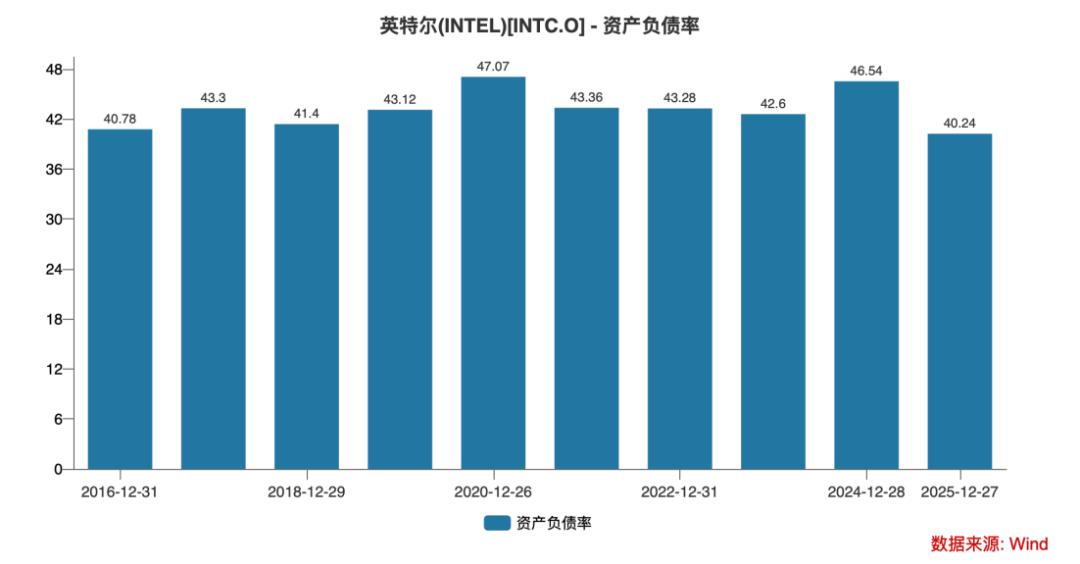
Chart: Intel's asset - liability ratio. Source: Wind, compiled by 36Kr
It takes time to return to the peak
In recent years, Intel's difficulties have mainly come from three directions: the hampered progress of the foundry business has led to increased cash flow consumption, the decline of the PC market has led to weak demand for consumer - grade chips, and the rise of AMD has led to the erosion of the data center business. Correspondingly, the company's turnaround on the demand side depends on the triggering of at least one of the three key variables: the foundry business winning major external customers, AI reshaping the demand for consumer electronics, or a significant recovery in the demand for server CPUs.
It is worth noting that the realization path of these turning points may be sudden rather than gradual: the former depends on substantial orders from major customers; the latter depends on the explosion of downstream AI applications. At the same time, Intel itself needs to have sufficient manufacturing capabilities to cope with changes in market demand, and the improvement on the supply side is gradual.
Therefore, in terms of financial performance, before the "sudden change" occurs, Intel is difficult to impress the capital market.
The data for Q4 2025 shows that the company achieved revenues of $13.67 billion, a year - on - year decrease of 4.1%. Under the Non - GAAP basis, the gross profit margin was 37.9%, a year - on - year decrease of 4.2 percentage points. Although both core financial indicators were in a downward state, the performance still exceeded the Bloomberg consensus expectation.
The support behind this is the unexpected growth of the Data Center and AI business (DCAI). Intel's business mainly includes three core categories: CCG (consumer - grade CPU), DCAI (data center CPU), and wafer foundry. In Q4 2025, Intel's CCG operating income declined year - on - year, but the DCAI business increased by 9% year - on - year and 15% quarter - on - quarter, reaching $4.7 billion.
The narrative logic is that the downstream AI infrastructure has increased the demand for server CPUs. The latest data released by market research firm Jon Peddie Research in August 2025 shows that the global client CPU market has achieved growth for two consecutive quarters.
However, this original "good news" was shattered by Intel's Q1 2026 earnings guidance: in Q4 2025, due to the insufficient yield rate and efficiency of the company's server chip production and limited production capacity, the company was forced to transfer the production capacity of the CCG business to the DCAI and consume inventory to meet the demand. In Q1 2026, the company's inventory level was insufficient, and the production capacity was still limited, which would lead to the embarrassing situation of the DCAI business facing strong demand but a decline in revenues due to limited supply. At the same time, due to the transfer of production capacity, the CCG business revenues in Q1 2026 will also decline more significantly.
The strong market demand is in sharp contrast to the decline in the company's performance due to limited supply. Although Intel emphasized that the yield rate and efficiency of its server chip production will significantly improve from Q2 2026, the market has already started to pay for this emotional impact. The more than 17% decline in Intel's stock price on January 23 was due to this factor.
The logic of CPU shortage still holds
Intel and AMD's recent price increases for CPU products have fermented in the global capital market.
AMD, Hygon Information, and Loongson Technology have all seen their stock prices skyrocket after January 20. Undoubtedly, this is the capital market betting on the second wave of the "chip shortage" after the shortage of memory chips.
However, there are voices in the market that the news of Intel's limited server chip production capacity challenges the logic of the CPU "chip shortage". The reason is that this round of chip shortage may be due to Intel's insufficient yield rate. If Intel's yield rate increases, will the supply - demand balance of chips be restored?
At present, Intel's limited production capacity cannot falsify the logic of the CPU "chip shortage".
In the earnings conference call, Intel also mentioned a key detail. In the market forecast six months ago, Intel thought that the number of CPU cores required by servers would increase, but the number of servers (the demand for the number of CPUs) would not increase significantly. However, the demand for server complete machines has increased sharply in the third and fourth quarters of 2025. At the same time, after communicating with some customers, it believes that this growth trend may continue for several years.
Regarding why the demand for CPUs has suddenly increased, the reason is that various large - model manufacturers are promoting the construction of Agents, and the market demand for Agents has increased. According to the compilation by Guotai Haitong, a paper previously published by Intel proves that with the accelerated implementation of Agents, CPUs need to bear more workloads:
(1) The time spent on the CPU during the Agent tool processing can account for 90.6% of the total delay;
(2) The bottleneck of Agentic throughput may come from CPU cache consistency, core overload, etc.;
(3) In large - scale processing scenarios, the dynamic energy consumption of the CPU can account for up to 44% of the total dynamic energy consumption.
In addition, according to the analysis of Guojin Securities, DeepSeek has launched the Engram architecture. All the operators of the Transformer are calculated on the GPU/accelerator card, and the storage and operation of the 100 - billion - parameter Engram table are in the CPU memory, only generating less than 3% of the overhead. The Engram - like architecture can effectively break through the GPU video memory limit, thereby promoting the demand for computing with storage and the increase in the CPU ratio.
Therefore, comprehensively speaking, whether it is the increased demand for CPUs from Agents or the increase in the CPU ratio by the Engram - like architecture, both reflect the growth of CPUs on the demand side, rather than just the situation of limited supply. Therefore, the CPU "chip shortage" is still a main line worthy of tracking.
Back to Intel, will the stock price enter a continuous downward channel because of this? The answer may be no.
From the perspective of the company's own situation, this situation of strong demand and limited supply is quite similar to Tesla before 2019. From 2017 - 2019, Tesla had a large number of orders in hand but frequently announced delayed deliveries, which led to the company's stock price only slightly outperforming the Nasdaq index. It was not until the Shanghai factory was completed and put into production in 2020 that the supply - side restrictions were officially relaxed, and the company's stock price skyrocketed.
Intel may also stage a similar scenario. The most "hard - core" logical support for the rise in Intel's stock price since 2025 comes from the support of the US government for Intel, especially the potential influence on the wafer manufacturing business. This logic has not been falsified under the background that the US government already holds 12.5% of Intel's equity and warrants.
However, whether the company's stock price can rise further in the future and break through the historical high depends on when the fundamentals of the company's wafer foundry business will truly reverse. Different from Tesla at that time, Intel cannot find a "Chinese factory". Its supply problem needs to gradually improve the yield rate and production efficiency by itself, which will be a long - term process. At the same time, Intel is not the only one in the market. It also faces competition from AMD and TSMC.
Therefore, Intel's future stock price will most likely fluctuate with the progress of the yield rate and skyrocket when substantial orders are finalized. For investors in the capital market, if they firmly believe in the US government's determination to support wafer manufacturing, holding Intel for the long - term may still be a cost - effective choice, and short - term intervention lacks a catalytic logic.
*Disclaimer:
The content of this article only represents the author's views.
The market is risky, and investment should be cautious. In any case, the information in this article or the opinions expressed do not constitute investment advice to anyone. Before making an investment decision, if necessary, investors must consult professionals and make careful decisions. We have no intention to provide underwriting services or any services that require specific qualifications or licenses to engage in for the trading parties.