The fourth domestic coffee brand with ten thousand stores has secured financing.
At the beginning of 2026, the coffee industry received its first investment.
NOWWA COFFEE announced yesterday (the 26th) that it has completed hundreds of millions of yuan in Series C financing. This round of financing attracted multiple institutions such as Legend Capital, Shengwang Fund, Huaying Capital, Challenger Venture Capital, Yuanxing Capital, and GSR Ventures.
According to the business information on the Qichacha APP reported by the Science and Technology Innovation Daily, NOWWA COFFEE has completed seven rounds of financing since its establishment, bringing together institutional investors including 37 Interactive Entertainment, Yuanxing Capital, Boli Venture Capital, GSR Ventures, SIG Asia Investment, Belle Group's Consumer Fund, Shengjing Jiacheng Mother Fund, and Yongshan Tianji.
Notably, NOWWA COFFEE announced last December that the number of its stores had exceeded 10,000, making it the fourth coffee brand in China to enter the "10,000 - store club" after Luckin, Cotti, and Xingyun Kafei.
Enter the coffee market with the "store - in - store" model
On January 27th, when a reporter from the Science and Technology Innovation Daily visited Chongqing, it was found that most NOWWA COFFEE outlets set up joint - operation counters in convenience stores such as Mei Yijia and 24 Ke. Around 6 p.m. that day, the reporter entered a Mei Yijia convenience store in the Jiefangbei business district of Yuzhong District, Chongqing, and the NOWWA COFFEE joint - operation counter was next to the cashier.
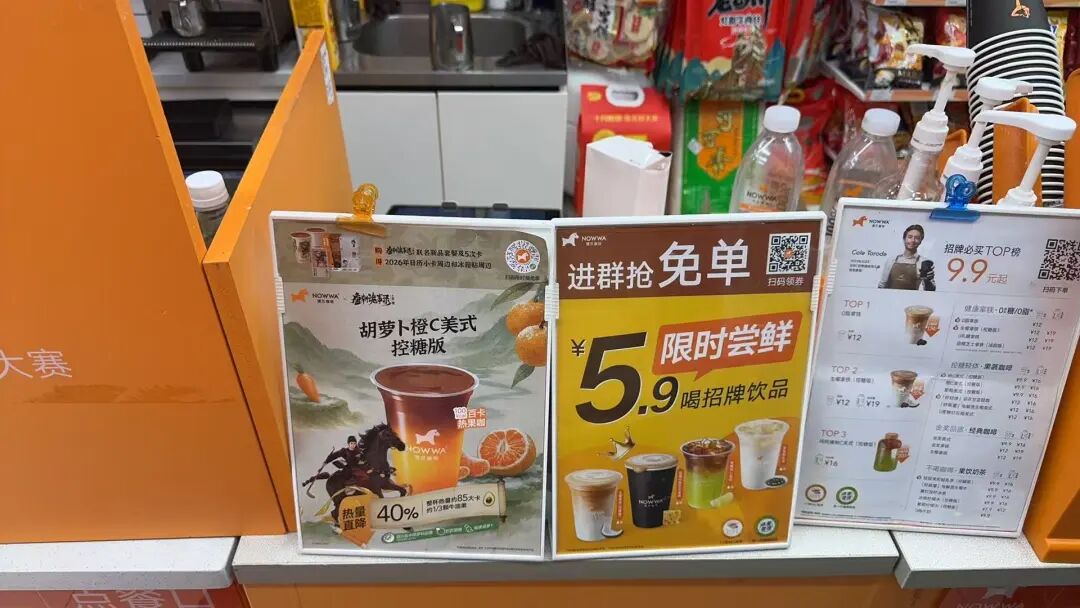
"Most of the orders are from takeaways, and there are very few in - store orders," a clerk on duty at the store told the reporter from the Science and Technology Innovation Daily. They work in three shifts, and in his shift, they only sell twenty or thirty cups a day.
This scenario is a real microcosm of NOWWA COFFEE's "store - in - store" model being integrated into the daily consumption chain.
During the investigation, the reporter noticed that this seemingly ordinary joint - operation store is the key strategic implementation for NOWWA COFFEE to enter the market with the "coffee + convenience store" model and achieve rapid large - scale expansion.
According to the Science and Technology Innovation Daily and the Qichacha APP, the main body of the NOWWA COFFEE brand is Zhejiang Lixing Technology Co., Ltd., which was established in 2019 with a registered capital of 12.739 million yuan.
At its inception, NOWWA COFFEE chose the asset - light "store - in - store" model as its entry point. With its low investment and easy - to - replicate characteristics, the brand was able to quickly expand and complete its early national market layout.
It is understood that in 2022, NOWWA COFFEE attempted to focus on the operation of independent stores, aiming to enhance the offline brand recognition and strengthen the terminal consumer perception. However, restricted by external factors such as the rising rent of commercial real estate and the continuous increase in labor costs in China, the expansion speed and profitability of independent stores did not meet expectations.
At the end of 2024, NOWWA COFFEE re - defined its expansion strategy, refocused on the "store - in - store" model, and accelerated its scale expansion with joint - operation franchising as the core. This adjustment also became an important turning point for NOWWA COFFEE to become a brand with 10,000 stores.
Notably, in September 2024, when NOWWA COFFEE CEO Guo Xingjun was interviewed by the Science and Technology Innovation Daily, the number of its stores was less than 2,000. But in December last year, NOWWA COFFEE officially announced that the total number of its stores had exceeded 10,000, covering more than 300 cities in China and being established in many overseas locations such as Australia and Southeast Asia.
"Currently, the proportion of franchised stores is over 80%. In the future, we will adopt flexible strategies according to different market demands to build a store ecological network including various store types," a relevant person from NOWWA COFFEE told the reporter from the Science and Technology Innovation Daily. The brand developed rapidly last year, with more than 1,800 new stores opened in a single month.
The reporter from the Science and Technology Innovation Daily learned that the core partners of the franchised stores include Mei Yijia and Youke, forming a joint - operation network covering major cities across the country.
Zhu Danpeng, an analyst in the Chinese food industry, said in an interview with the media that the rise of NOWWA COFFEE is innovative and unique. "Relying on the small, fast, and flexible 'store - in - store' model, NOWWA COFFEE quickly established a scale advantage in the highly competitive coffee market. At the same time, by leveraging the existing traffic and venue resources of convenience stores, the brand further reduced the store investment cost and achieved a win - win and multi - win situation with joint - operation partners such as convenience stores."
Where will the coffee industry go after reaching the 10,000 - store scale?
After Xingyun Kafei announced that it had exceeded 10,000 stores at the end of November last year, NOWWA COFFEE also announced that the total number of its global stores had exceeded 10,000, covering more than 300 cities in China and overseas markets such as Southeast Asia and Australia. Since then, brands such as Luckin, Cotti, Xingyun Kafei, and NOWWA COFFEE have entered the coffee "10,000 - store club".
According to data from Narrow Door Food Service, a third - party data service provider, as of January 20th, Luckin has 30,731 stores nationwide, Cotti has 16,485 stores, Xingyun Kafei has 8,420 stores, NOWWA COFFEE has 7,693 stores, and Starbucks has 8,667 stores. Currently, the per - capita consumption of Luckin is 14.28 yuan, Cotti is 10.35 yuan, Xingyun Kafei is 8.23 yuan, NOWWA COFFEE is 16.92 yuan, and Starbucks is 35.89 yuan.
A person in charge of consumer - sector investment in an investment institution told the Science and Technology Innovation Daily that the "numbers game" of the number of stores is a common method for coffee chain brands to rush towards capitalization. Brand owners often include signed but unopened stores in the statistical scope, using the time difference to blur the data. This operation is not uncommon among chain brands such as new tea drinks. As long as a brand shouts the slogan of 10,000 stores, it basically meets the basic conditions for capitalization.
The above - mentioned person in charge of consumer - sector investment analyzed to the reporter from the Science and Technology Innovation Daily that comparing the coffee and new tea drink industries, their business models are essentially the same, both relying on the franchise chain model for profit, and there is a phenomenon of product crossover between brands - Luckin sells milk tea, and the coffee products of Guming have also received good reviews. However, the threshold for the coffee industry is higher, and it is difficult for small and medium - sized teams to break through. Even Miss Fresh has invested 2 billion yuan in the coffee business.
The person further analyzed that from a profit perspective, since the raw materials for milk tea are standardized industrial products, large - scale procurement can reduce costs. However, coffee depends on coffee beans, an agricultural product, with large fluctuations in raw material prices. The distribution gross profit of coffee is lower than that of milk tea, and it is more difficult to make a profit. Although there are problems such as serious homogenization and high profit - making difficulty in the coffee industry, it is still the focus of capital attention due to the addictive nature of the product and the continuously growing market demand. "In the future, the differentiated competition of brands will focus on dimensions such as price - band positioning and channel location selection. Only players with both scale advantages and profitability can stand firm in the wave of capitalization."
At the node when coffee brands are successively hitting the 10,000 - store scale, Zhu Danpeng, an analyst in the Chinese food industry, predicted that the Chinese coffee market will enter the brand - solidification stage in 2028.
He said that brand effect, scale effect, fan effect, and supply - chain integrity will become the key factors determining the sustainable development of coffee enterprises.
In his opinion, among the four core factors, the weight of supply - chain integrity is particularly prominent. This can be seen from the performance of Miss Fresh in the capital market. As a new tea - drink giant, Miss Fresh has built a solid cost and operation barrier through its global - covering supply - chain system, which not only supports the rapid expansion of its coffee brand but also directly promotes its stock price to remain high for a long time, becoming a typical case to verify the value of the supply chain.
This article is from the WeChat public account "Venture Capital Daily", author: Xu Cihao, published by 36Kr with authorization.