After a nine-year hiatus, Chongqing has reclaimed its top position, but the automotive industry has undergone a significant transformation.
In the middle of this month, the official WeChat account of the Chongqing Economic and Information Commission released exciting news for the entire city. In 2025, Chongqing's automobile production reached 2.788 million vehicles, a 9.7% increase, ranking first among cities and third among provinces and municipalities. This is also the first time in nine years that Chongqing has regained the top spot since it consecutively held the title of "China's No. 1 Automobile City" from 2014 to 2016.
It wasn't easy for Chongqing to regain the top position. In the past few years, the competition for the title of "No. 1 Automobile City" among China's leading automobile cities has been fierce. The title has changed hands three times in the past three years. Guangzhou, which had held the top spot for many years, was overtaken by Shenzhen due to the pains of transformation. And an adjustment in the statistical caliber of production locations allowed Chongqing to surpass Shenzhen and claim the top spot. Meanwhile, in the segmented new - energy vehicle market, cities like Shanghai, Xi'an, and Hefei are also vying fiercely for the title of "No. 1 New - Energy Vehicle City".
Behind the intense reshuffle of titles, it's not just a game of GDP or output value of the leading industries in these cities. It also reflects the paradigm shift and map reconstruction that China's automobile industry has been undergoing in the past decade.
Whether it's the penetration rate of new - energy vehicles, industry profit margins, sources of profit, or the rankings of leading automobile brands, all have undergone rapid changes and adjustments. These changes have also affected the development rhythm of the global automobile industry. After nine years, the core support for Chongqing's return to the peak in 2025 is completely different from the logic of China's automobile geography nine years ago.
01
The Logic of Competing for the Top Spot Has Changed
The title of "China's No. 1 Automobile City" has entered an unprecedented high - frequency rotation period in the past five years. This title, which was once dominated by some cities for over a decade, has a shorter and shorter shelf - life under the intense reshuffle of the industry.
During the high - speed growth period of the automobile industry that started at the beginning of this century, the pattern among leading automobile cities was very stable. The national layout of the automobile industry mainly developed in cities where the "Four Big and Three Small" licensed enterprises designated by the state were located. Traditional heavyweights like Shanghai and Changchun became the leading cities in the automobile industry driven by the introduction of joint - venture models and capacity expansion. In particular, Shanghai has long held the top position.
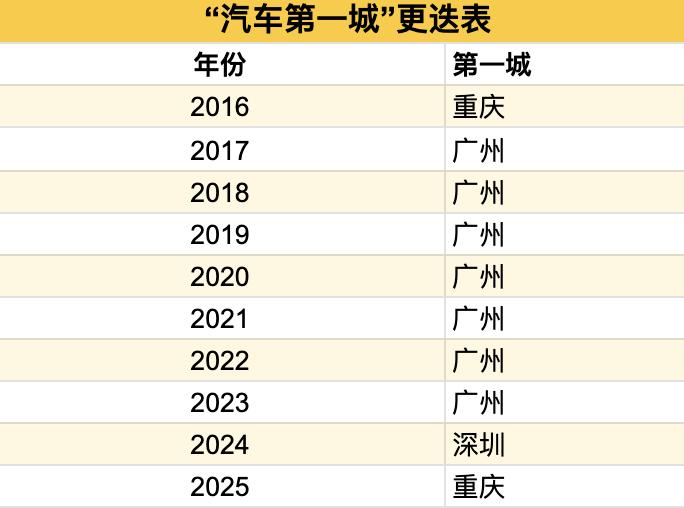
With the expansion of joint - ventures, the rise of domestic brands, and the onset of the new - energy wave, the reshuffle of the pattern among cities accelerated in the second decade of the 21st century. Chongqing's rise to the top from 2014 to 2016 happened in this context. In 2016, Chongqing's automobile production reached a peak of 3.16 million vehicles, and China's total annual automobile production also exceeded 28 million vehicles that year.
It must be mentioned that during this period, joint - venture brands were in an absolute dominant position. Domestic brands could only gain a little living space by offering low - priced products. At that time, Chongqing's rise to the top was also supported by mini - cars and mid - to low - end SUVs.
After that, Guangzhou, relying on the joint - venture system of GAC Group (Honda/Toyota), remained at the top, with production exceeding 3 million vehicles for consecutive years. The strong performance of the entire South China industrial cluster also allowed Guangzhou to hold the title of "No. 1 Automobile City" for seven consecutive years from 2017 to 2023. However, these seven years were also a period of generational adjustment for China's automobile industry. The wave of new - energy vehicles grew stronger and stronger. Joint - venture brands were ill - prepared in this wave and soon faced the pains of transformation, with production and sales declining, and Guangzhou lost its throne.
The era of transformation also brought opportunities for overtaking on a new track. The presence of a leading automobile enterprise could easily reverse the industrial fate of a city. Shenzhen was a latecomer in automobile layout, but due to BYD's great success in the new - energy vehicle market, Shenzhen, the headquarters of BYD, quickly became a rising star in the automobile industry. As BYD firmly held the top position among global new - energy vehicle enterprises, this new - energy giant also pushed Shenzhen into the final round of the "No. 1 Automobile City" competition in 2024 and finally won the title.
As for Chongqing's return to the peak in 2025, on the one hand, the rules of the game have changed. Since 2025, the competent authorities have adjusted the statistical caliber, changing the automobile production statistics from the "location of the enterprise legal person" to the "production location". This adjustment allows the city rankings to more accurately reflect manufacturing capabilities. BYD's production capacity in other cities is no longer counted under the headquarters city. On the other hand, the outstanding performance of Changan Automobile and Seres (AITO series) in a dual - drive model also enabled Chongqing to turn the tables.
Looking back at the changes of the "No. 1 Automobile City" over the past two decades, it can be observed that the competition for the title has become more and more intense, and the "lifespan" of the champion has become shorter and shorter. In the new - energy era, technological iteration and market explosion are much faster than in the traditional fuel - powered era. Any city that lags behind in electrification and intelligentization is likely to be quickly left behind in one to two years. Meanwhile, in the new - energy era, a city's status is highly bound to the expansion of the "chain master". The core driving force for Chongqing's return to the peak in 2025 is that the proportion of new - energy vehicles has exceeded 46%, and at the same time, the high - end premium and the potential of millions of units brought by the leading enterprise Seres.
Some people say that in 2015, Chongqing won with "mini - vans" and "low - priced fuel - powered cars", while in 2025, Chongqing's automobile industry won with the two value - driven stars of "HarmonyOS Smart Mobility" and "Changan's Transformation". Although it's still the title of the top city, the logic has changed.
However, the original geographical distribution of the automobile industry has not been truly subverted. China's automobile industry is still dominated by several major clusters such as the Yangtze River Delta, the Pearl River Delta, the Beijing - Tianjin - Hebei region, the Chengdu - Chongqing region, and the Anhui - Henan region. Emerging cities like Shenzhen, Hefei, and Xi'an have not completely replaced the traditional heavyweights. The reshuffle is accelerating, but the basic situation remains.
02
The Ten - Fold Leap in New - Energy Vehicle Penetration Disrupts the Automobile Geographical Pattern
The major reshuffle of the rankings of leading automobile cities in the past five years, from Guangzhou's long - term dominance, to Shenzhen's brief rise to the top, and then to Chongqing's recapture of the title, is largely due to the new - energy transformation of the Chinese automobile market.
China's new - energy vehicle penetration rate has achieved a ten - fold leap in the past five years, rising from 5.4% in 2020 to 54% in 2025. During the same period, the national production of new - energy vehicles increased from 1.37 million to over 16 million, and China's new - energy vehicle penetration rate has changed from being on the "periphery" to becoming the "mainstream" in the past five years.
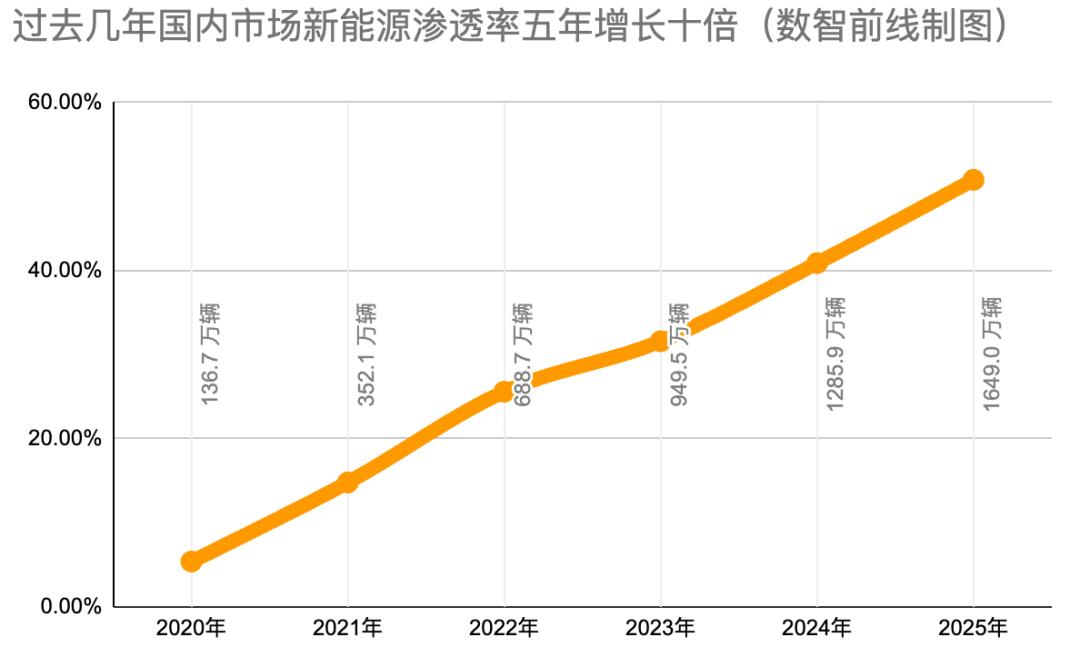
2020 can be regarded as the starting point of the turning point. After the pandemic, policies were strengthened, Tesla's Shanghai factory increased production, and the Wuling Hongguang MINI started the era of short - distance transportation, which led to the domestic new - energy vehicle market penetration rate exceeding the 10% critical point for the first time in 2021. By 2022, the 25.6% penetration rate achieved the goal of "20% penetration rate by 2025" in the national plan three years ahead of schedule. In 2023, plug - in hybrid vehicles began to explode, and the share of traditional joint - venture fuel - powered vehicles further decreased. In 2024, it was approaching the turning point of new - energy vehicles. In this year, the monthly new - energy vehicle penetration rate in the domestic market crossed the 50% threshold for the first time, and the entire industry entered the second half of the "electrification and intelligentization" era. The breakthrough year came in 2025, when the domestic new - energy vehicle penetration rate exceeded 50% for the first time throughout the year, and new - energy vehicles officially became the mainstream from challengers.
With the rapid increase in the new - energy vehicle penetration rate, the overall national automobile production and sales volume did not change drastically at the same time, which made the switching effect between fuel - powered vehicles and new - energy vehicles particularly obvious. The transformation speed of different cities directly determines their ranking. Cities leading in new - energy vehicles have risen rapidly, while laggards have declined. It can be said that the difference in new - energy vehicle penetration rates among cities determines their positions in the national ranking competition.
The fates of the biggest dark - horse cities and the cities most in need of transformation in the past three years can verify the above observation. For example, in Guangzhou, the crisis caused by insufficient new - energy vehicle layout has been apparent since 2022. At that time, the national new - energy vehicle penetration rate had already exceeded 25.6%, but Guangzhou only exceeded 20% in 2023, significantly lagging behind the national level and also behind Chongqing, which was the second - ranked city at that time, and Shenzhen, which was the third - ranked city.

The performance in the new - energy vehicle market is crucial, which has also made the title of "No. 1 New - Energy Vehicle City" a hot topic in the past few years. Cities like Shanghai, Xi'an, Shenzhen, and Hefei have actively participated in this competition.
In 2021, thanks to the great contribution of Tesla's Shanghai Gigafactory (Model 3/Y as the main models), Shanghai led far ahead of Shenzhen and Xi'an with a production of about 632,000 vehicles. In 2022, the explosive growth of BYD's Xi'an base (the largest single - base in China at that time) pushed Xi'an to the top with a production of about 1.0152 million vehicles. In 2023, BYD's headquarters and local factories fully exerted their strength, allowing Shenzhen to rise to the top and retain the title of "No. 1 New - Energy Vehicle City" in 2024 and also win the first place in the production of all automobile categories in 2024.
In 2025, due to the change in the statistical method, Shenzhen is no longer the top city in new - energy vehicle production in terms of manufacturing volume. Among the data released by various places, only Chongqing clearly mentioned that its new - energy vehicle production reached 1.296 million vehicles. Hefei did not release specific production data, but its production in the first 11 months of 2025 was about 1.246 million vehicles. Public information indicates that its new - energy vehicle production in 2025 has risen to the top among Chinese cities.
In the competition for the title of "No. 1 New - Energy Vehicle City", the national production capacity game of leading giants still determines the outcome of the title battle. For example, the regions where BYD, Tesla, and Huawei have set up their operations have a profound impact on the city rankings.
However, the rise of Hefei shows the resilience of multiple players and comprehensive layout in future industrial competition. Currently, Hefei does not rely on a single enterprise. It has introduced NIO through equity investment, attracted BYD to set up a factory, and brought in Volkswagen Anhui. From the incubation of new - energy vehicle startups to the new - energy transformation of joint - venture giants and the layout of domestic brands, Hefei's comprehensiveness is second to none among Chinese cities, which may become the key factor in its competition with other leading cities in future title battles.
03
The Sales Champions Have Changed, with Domestic Brands Rising and Joint - Venture Brands Declining
The new - energy transformation has promoted the change in the automobile geographical pattern and directly catalyzed the reshuffle of the rankings of China's top ten automobile groups.
In this new - energy transformation, domestic brands and joint - venture brands have different transformation speeds. The new - energy vehicle penetration rate of domestic brands has far outpaced that of joint - venture brands, promoting the increase in the share of domestic brands.
Taking December 2025 as an example, according to the data from the Passenger Car Association, the new - energy vehicle penetration rate of domestic automobiles was 59.1%. In the domestic retail market, the penetration rate of new - energy vehicles among domestic brands was 80.9%, while the new - energy vehicle penetration rate of joint - venture brands in December 2025 was only 8.2%. This intuitively reflects the different speeds of automobile enterprises with different backgrounds in responding to the transformation.
Around 2015 when Chongqing last held the title of "No. 1 Automobile City", SAIC Volkswagen was the sales champion of Chinese passenger cars, with a sales volume of 1.806 million vehicles that year. Joint - venture brands accounted for the majority in the top ten. Ten years later, the situation has changed greatly. In 2025, BYD became the sales champion of Chinese passenger cars, and the market share of domestic brands has exceeded 65% (according to the Passenger Car Association, and 69.5% according to the China Association of Automobile Manufacturers and some reports). With an annual production of 4.558 million vehicles, BYD has grown from selling less than 500,000 F3 and Speed models to becoming the number - one player in the new - energy vehicle market, surpassing Tesla in ten years.
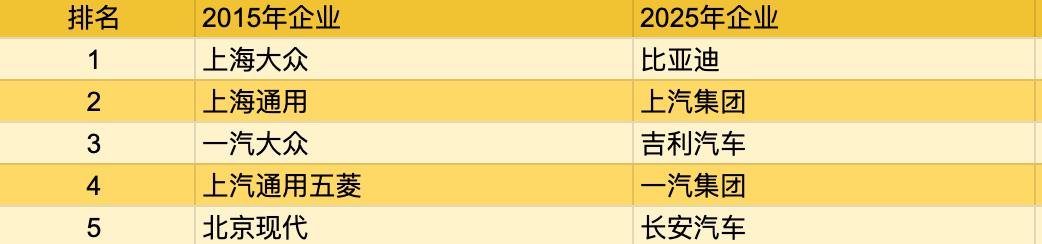
SAIC, FAW, and Dongfeng, which used to be among the top three, have seen their rankings decline due to the decline in the sales of joint - venture brands (such as SAIC Volkswagen, SAIC General Motors, and FAW Toyota). Among them, SAIC Group has maintained its scale through domestic brands and exports, while GAC and Dongfeng have seen more obvious declines in rankings due to greater pressure in new - energy transformation. GAC has dropped to the ninth place in 2025.
It can be said that any automobile enterprise with a slow increase in new - energy vehicle penetration rate will inevitably see a decline in its ranking.
Geely and Chery were once the flag - bearers of domestic brands. Around 2015, they were still hovering on the edge of the top ten. In 2025, these two companies ranked third and sixth respectively. Geely's new - energy brands such as Zeekr and Galaxy are flourishing. The core driving force for the growth of