Selling equity at a 60% premium, what gives PUMA the edge?
Author | Xie Yunzi
Editor | Zhang Fan
Anta's acquisition of PUMA has finally been finalized.
On the evening of January 26, Anta Sports announced in a statement that it had signed a share - purchase agreement with Artémis at a price of 35 euros per share, amounting to approximately 1.506 billion euros (about 12.4 billion yuan), planning to acquire 29.06% of PUMA's shares.
After the completion of the transaction, Anta Group may, as the largest shareholder, seek to appoint a suitable representative to the supervisory board. It is worth mentioning that this transaction is expected to be completed by the end of 2026, and the funds for the equity acquisition will all come from Anta's internal cash reserves.
Just half a month ago, Reuters reported that the negotiations between Anta and the Pinault family behind Artémis had stalled, mainly due to a large difference in valuation. The Pinault family expected PUMA's share price to be no less than 40 euros per share, and the final price of 35 euros was the result of the negotiation.
Although calculated based on PUMA's closing price of 21.63 euros the day before the announcement, the premium for this equity acquisition still exceeded 60%. However, in terms of the price - to - sales ratio, PUMA's trading valuation in the secondary market is currently 0.39 times. Even calculated with the acquisition premium, the P/S is only 0.63 times, which at least shows that Anta's acquisition is not expensive. But compared with the overall price - to - earnings ratio of the industry, PUMA's trading valuation after the premium is still significantly lower than Nike's 2.07, Adidas' 1.06, and Anta's 2.63.
In essence, PUMA's relatively low price - to - sales ratio valuation stems from its poor profit performance in recent years.
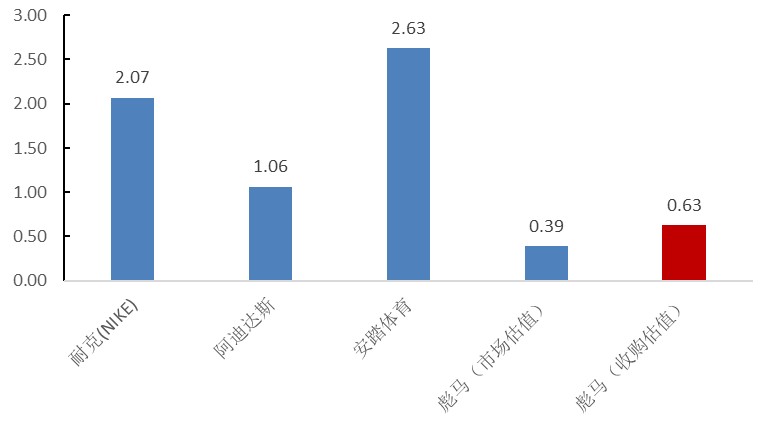
Price - to - sales ratios of various brands on January 26, 2026. Data from Wind
PUMA's history can be traced back to 1948. This old - fashioned German sports brand was once part of the same company as Adidas. The founders of the two brands were brothers from the Dassler family. They later developed independently due to different concepts.
In the following decades, PUMA rose rapidly by sponsoring athletes and teams, and gained a high reputation especially in sports such as football and track and field. By 2007, Kering, the parent company of GUCCI, acquired PUMA for 5.9 billion euros. Relying on its diversified layout, it successfully weathered the global economic recession caused by the US sub - prime mortgage crisis in 2008.
However, under Kering's operation, PUMA, as a sports brand, faced problems such as a wavering brand positioning and an imbalance between professionalism and fashion.
In 2016, PUMA lost the endorsement of Cristiano Ronaldo and then cooperated with Rihanna. Although the trendy star brought short - term sales growth to the company, it damaged the brand's professional sports image.
In 2018, Kering spun off PUMA to focus on its luxury business and distributed about 70% of its shares to the Pinault family, the largest shareholder of the group. The latter eventually acquired the remaining approximately 29% of PUMA's shares through Artémis.
After the "black swan" event of the pandemic, the global economy entered a downward phase again. At this moment, the Pinault family's sale of PUMA's equity can be seen as the last step in its strategy of divesting non - core assets and focusing on luxury goods.
In contrast, regarding Anta Sports, some believe that the impact of this acquisition on the global sports industry is no less significant than Anta Group's acquisition of Amer Sports in 2019.
Ding Shizhong, the chairman of Anta Group, also said that acquiring PUMA's equity to become the largest shareholder is an important milestone for Anta Group to further promote its development strategy of "single focus, multi - brand, and globalization".
"Anta has always valued the long - term value and potential of the PUMA brand. A good brand gene and value accumulation are hard to come by. We believe that PUMA's share price in the past few months has not fully reflected the long - term value of the brand."
However, the current market environment is quite different from that when Anta acquired Amer Sports. For mature sports brands, a slowdown in growth is a general trend. Currently, PUMA is indeed in a "vulnerable stage" of strategic transformation.
According to the financial report, in the third quarter of 2025, PUMA's sales decreased by 10.4% to 1.96 billion euros after exchange - rate adjustment. The cumulative sales in the first nine months decreased by 4.3%. It was also in this quarter that PUMA reported a net loss of 62 million euros, compared with a profit of 128 million euros in the same period last year.
At the earnings conference call at that time, Arthur Holder, PUMA's new CEO, bluntly pointed out that PUMA currently lacks sufficient brand popularity.
At its peak, PUMA's position in the global market was second only to Nike and Adidas. However, according to a market research commissioned by the company, PUMA's position in consumers' minds has fallen behind its competitors and it is no longer among the top three preferred sports brands of consumers. "Our product line is too complex, which has led to the fact that our core products, the iconic products that PUMA should be remembered for, have not been truly established."
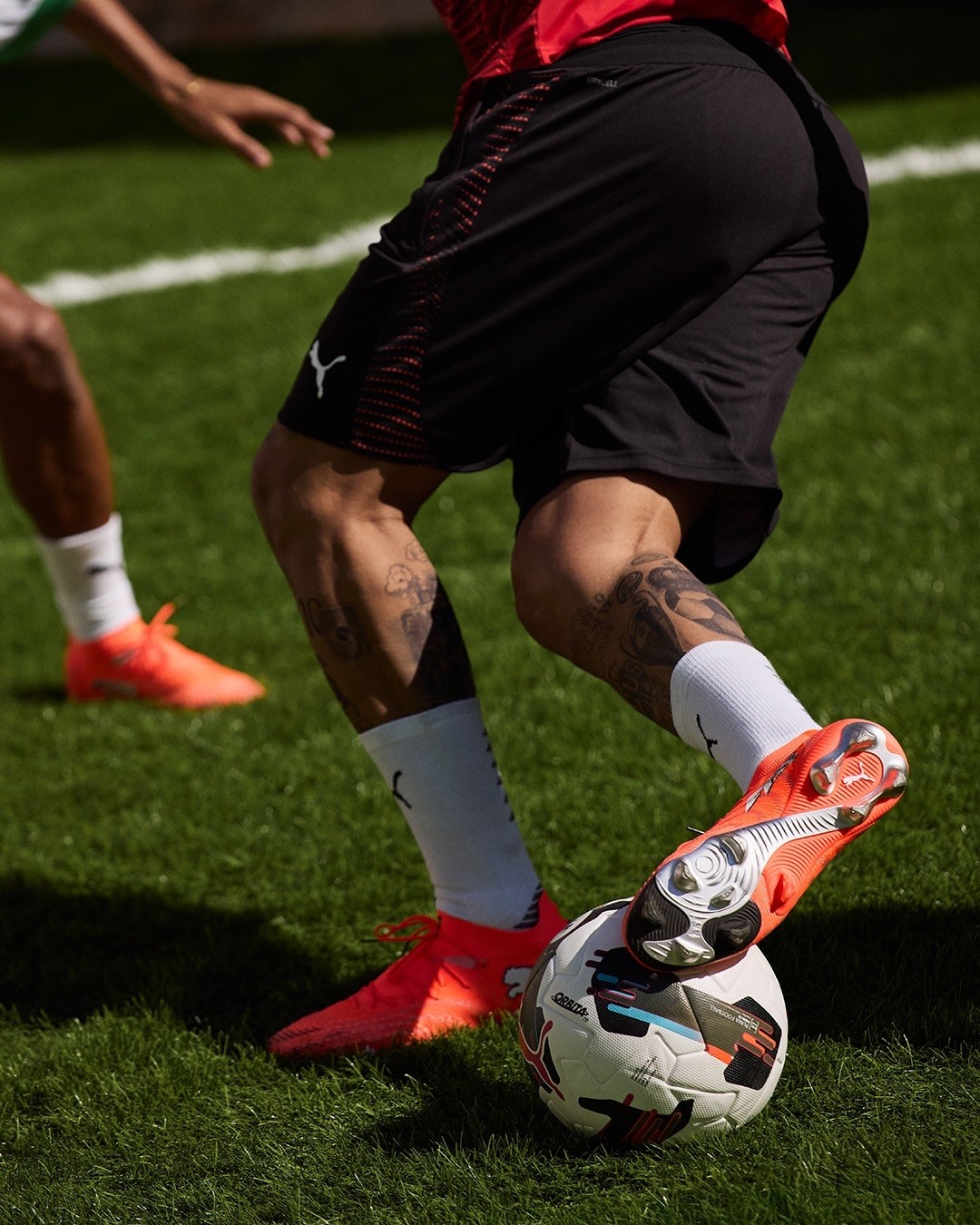
Image from PUMA's official Weibo
In addition to brand positioning, another area that PUMA needs to continuously improve and strengthen is its sales channels.
According to previous financial reports, about 70% of PUMA's revenue comes from the wholesale channel, while the industry benchmark is usually 60%. Even worse, among its top ten global customers, three are mass - market supermarkets, which has seriously damaged PUMA's brand image. By the end of the third quarter, PUMA's inventory level had soared by 17% year - on - year, reaching a high of 2.1 billion euros.
Facing difficulties, PUMA has carried out reforms through measures such as layoffs and inventory clearance. In December last year, PUMA opened its largest flagship store in Europe in London. In Holder's plan, 2026 will be a transitional year for PUMA, and it will take at least until 2027 to resume growth above the industry average.
Judging from Anta Group's previous acquisitions of FILA and Amer Sports, brand reconstruction and DTC transformation are its strengths. This also shows that while "fully respecting PUMA's independent governance and culture", Anta can still provide other support besides capital.
According to China Entrepreneur magazine, PUMA's China division may undergo a complete overhaul, "virtually starting from scratch."
It is a clear fact that despite PUMA's declining performance, it still holds a certain market position in the football field.
In terms of professional technology, while Nike launched Flyknit and Adidas developed Boost, PUMA has also been continuously improving its EVA mid - sole technology. Although PUMA's product launch cycle is relatively slow, the sales of its footwear products always account for a relatively high proportion of its revenue. For sports brands, "those who master footwear master the market", and shoes are also the key category that best reflects professionalism and consumers' preferences.
Regrettably, in 2023, after Adidas poached PUMA's former CEO Jochen Zeitz, it quickly emerged from the shadow of the split with Kanye West through the Samba shoes, while PUMA failed to seize the opportunity of the resurgence of "German training shoes".
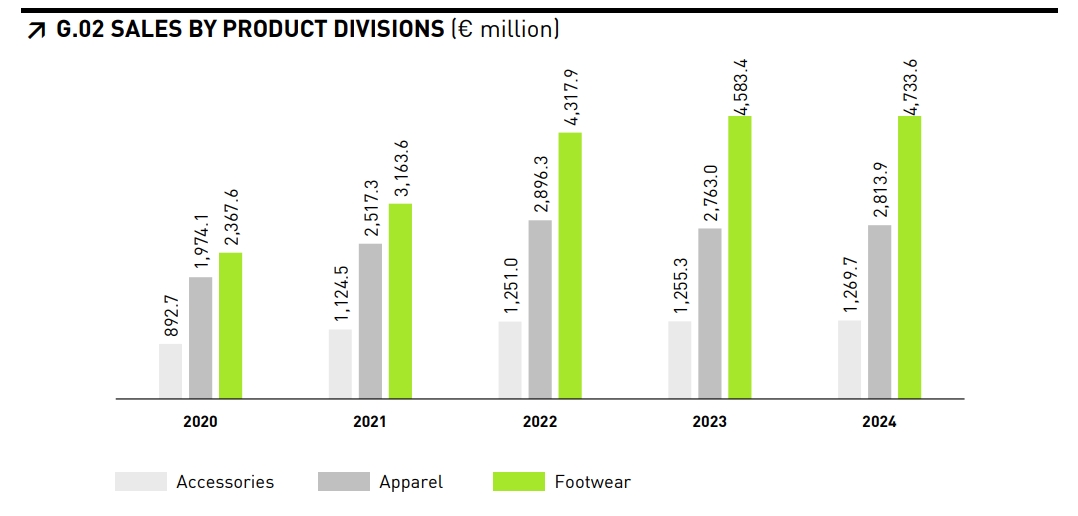
Image from PUMA's financial report
It is also worth mentioning that 2026 is a World Cup year, and PUMA still has cooperation resources with top clubs such as Manchester City and AC Milan. This may mean that Anta can take advantage of PUMA to further increase the exposure of its brands globally, especially in the European and American markets. Through the acquisition of PUMA's equity, at least in the football field, Anta has entered the same arena as Adidas.
Of course, Anta also needs to go through a "painful period" of strategic transformation with PUMA.
*Disclaimer:
The content of this article only represents the author's views.
The market is risky, and investment should be made with caution. In any case, the information in this article or the opinions expressed do not constitute investment advice for anyone. Before making an investment decision, if necessary, investors must consult professionals and make decisions carefully. We have no intention of providing underwriting services or any services that require specific qualifications or licenses to the parties involved in the transaction.
Follow for more information