Do we really need humanoid robots?
At this year's Consumer Electronics Show (CES) in Las Vegas, humanoid robots once again took the spotlight. With demonstrations like lion - dancing, boxing, backflips, and playing table tennis, these impressive demos created a "tech gala" atmosphere. However, if you were expecting a breakthrough in generalization ability, this year's show might not have amazed you much.
This episode of the podcast is a continuation of our robot special. Previously, we explored many cutting - edge research on robot generalization. Today, we turn to a more fundamental question: Do we really need humanoid robots?
Fu Sheng, our guest in this episode, believes that the hardware of humanoid robots does not follow "Moore's Law." It's difficult to commercialize the performance achieved by simply piling on components, let alone achieve meaningful mass production. Truly viable robots usually "grow" through gradual iteration and refinement in specific scenarios, rather than pursuing universality and a perfect form from the start.
Although the "generalization moment" for robots has not dawned at this CES, we can see that Chinese brands have taken the center stage of the global consumer electronics arena with a more mature and internationalized stance. For many Chinese robot companies exploring overseas markets, the United States remains the most ideal market. So, our guests also shared some suggestions for those venturing overseas based on their personal experiences.
Here are the highlights of this conversation:
01 Reflection on the Craze: Do We Really Need Humanoid Robots?
Hong Jun: The robot exhibition area at this year's CES was extremely popular. In the humanoid robot industry specifically, I noticed a statistic. There were a total of 38 humanoid robot exhibitors at CES, and 21 of them were from China.
Fu Sheng: Really? There were actually 17 non - Chinese exhibitors?
Hong Jun: Some people say that this year's robot competition is mainly among China, the United States, and South Korea. South Korea is involved because the well - known Boston Dynamics in the robot field was acquired by Hyundai Group. There was a queue of over forty minutes at their booth. Boston Dynamics started early in developing mobility and stair - climbing capabilities and has in - depth experience. Additionally, they officially announced Atlas at CES this year, planning to start production and deliver to the first batch of customers in 2026, and achieve large - scale deployment by 2028, with an annual production capacity of 30,000 units. If they can really achieve mass production, will this be the largest - scale mass production in the entire robot field?
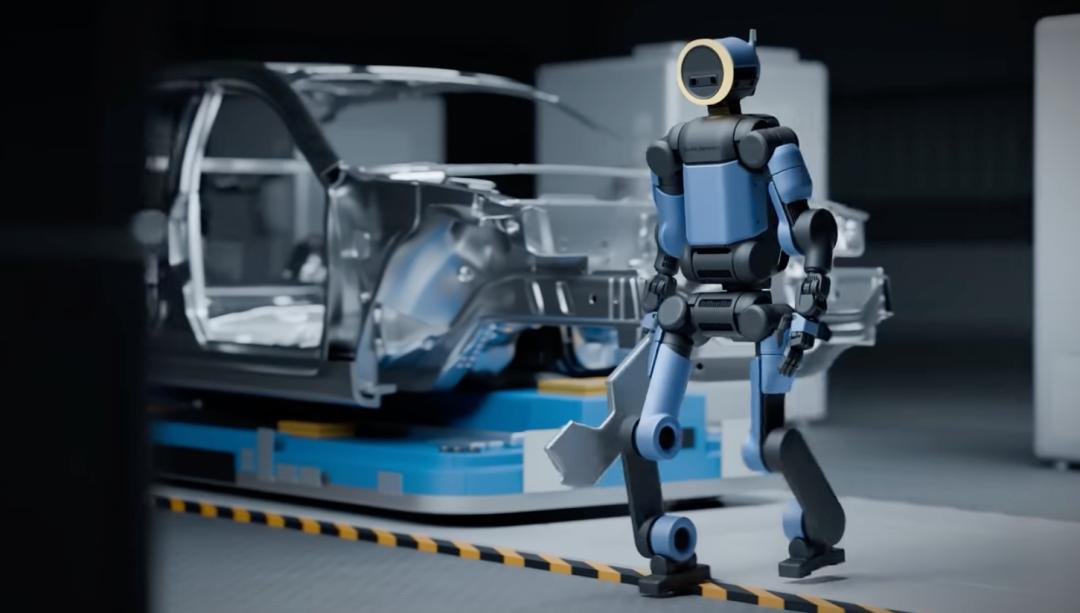
Atlas product promo video. Image source: Boston Dynamics
Teacher Xu from Silicon Valley: I visited Boston Dynamics. All those Physical AI and humanoid robots were there. But none of them impressed me. I'm really curious about Fu Sheng's thoughts.
Fu Sheng: Actually, announcing this mass production doesn't mean much. In 2021 and 2022, when Tesla first started working on Optimus, we were discussing in a small internal investors' meeting whether to seize the opportunity in humanoid robots. They said they got definite news that Tesla told the reducer manufacturers in the supply chain that they would place an order for 100,000 units the next year. I said at that time that Tesla might not have much experience in making robots and underestimated the difficulty. They definitely couldn't achieve it.
Look, in early 2025, they said they would make a few thousand units. Recently, they changed the person in charge (the previous one was in charge of FSD), and the production plan was immediately cut in half. Of course, a large company like Tesla can definitely produce a few thousand units. But the question is, is this real mass production for practical use? For mass production to be meaningful, either customers should be willing to pay, or it should be able to be truly efficient in real - world scenarios. I'm very skeptical about Boston Dynamics' claim of producing 30,000 units in a few years. I even think it's unlikely to happen.
Hong Jun: One of their application scenarios is warehouse handling. Howie, could you tell us about the demo scenario you saw?
Teacher Xu from Silicon Valley: I didn't find it particularly special. There are already many robots handling goods in warehouses. It might be more flexible and have more functions, but I'm not sure if it's fundamentally different from previous technologies. My hope for Physical AI is that it can enter households, but that still seems very far away.
Hong Jun: The 1X company plans to enter households in 2026, using remote operation and sacrificing privacy for robot operation.
Fu Sheng: It's not just about sacrificing privacy. Last night, I had a debate with a friend about whether humanoid robots are a bubble and whether they can be put into practical use. I said that when we made our first - generation robot in 2017, we were very ambitious. We didn't equip it with legs at that time, but we added two arms. On my birthday that year, the engineers gave me a surprise. They made the robot lead me to the meeting room, and it struck a match to light a candle for me. That was in 2017, and we did such things. Later, as we became more experienced, we found that the engineers worked overtime secretly to make the boss happy, showing off our R & D capabilities, but it couldn't be generalized. Secondly, after adding the arms, the battery consumption increased significantly, and the robot became very heavy. At that time, one arm cost over 100,000 yuan.
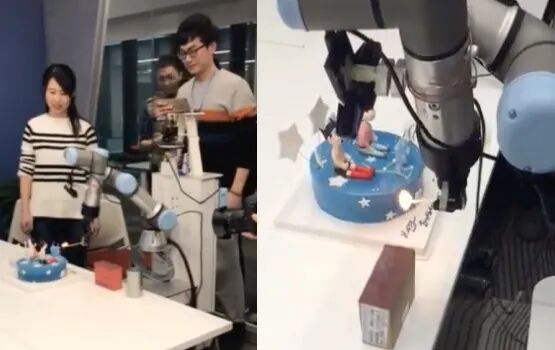
Robot lighting a candle by striking a match in 2017. Image source: Fu Sheng
Hong Jun: How much does an arm cost now?
Fu Sheng: Recently, we acquired UFactory because we thought the arms were too expensive back then. We invested in this company and asked them to focus on making six - axis and seven - axis arms and reduce the price. Everyone can talk about the first - principles thinking. An arm is just made of aluminum alloy and steel. Why is it so expensive? After years of effort, the current selling price can be reduced to four or five thousand US dollars. Now, many companies like Google and Stanford buy its arms, and the overseas market accounts for 70 - 80%. This company is also profitable.
Through the "arm" project, I realized that robot hardware doesn't have the same rapid and large - scale reconstruction ability as software following Moore's Law. For hardware components like joints, motors, and harmonic reducers, improvements have to be made step by step, which is very troublesome due to physical limitations. So later, my view on robots is that when customers actually use them, they mainly consider cost - effectiveness and return on investment.
For example, Geek+ just launched its product for warehouse handling. Currently, it can only lift goods on its chassis and carry up to 200 kilograms. Now, they are also exploring adding two arms to the chassis. Is it useful to add arms or legs for handling goods? The usefulness is limited, but the cost increases significantly. In factory design, wheeled robots can basically reach everywhere. It's like using a cannon to kill a mosquito. Isn't it better to use a mosquito killer?
Hong Jun: Wheeled robots without legs are much cheaper.
Fu Sheng: This year, at least half of the cost of making a humanoid robot is spent on the legs, or even more. If I can achieve over 95% of your efficiency at half the price, no one will choose a humanoid robot.
Teacher Xu from Silicon Valley: Fu Sheng actually answered my previous question. As soon as I left CES, I was thinking about how different it was from what I had seen before. In essence, there are two points: one is what a robot can do in a fixed scenario, and the other is generalization ability (of course, this is a spectrum, not just 0 or 1). Should we pursue more generalization or focus on specific scenarios? There have already been many handling robots in various factories five or ten years ago, and they have been doing very well. How well can a generalized robot perform after entering the market? I don't see much difference.
But if we want robots to be widely used in our daily lives, generalization is definitely necessary. However, I think we are still far from achieving it. At least, I haven't seen any signs of it.
A few days ago, I saw a company called Sunday. Their online demos were quite impressive. Sarah Guo, the investor of Sunday, is my good friend. I asked her if it was real. She said it was. It can handle tasks like moving wine glasses, washing dishes, and dealing with very delicate situations on the dinner table. That's the kind of robot I'm looking forward to.
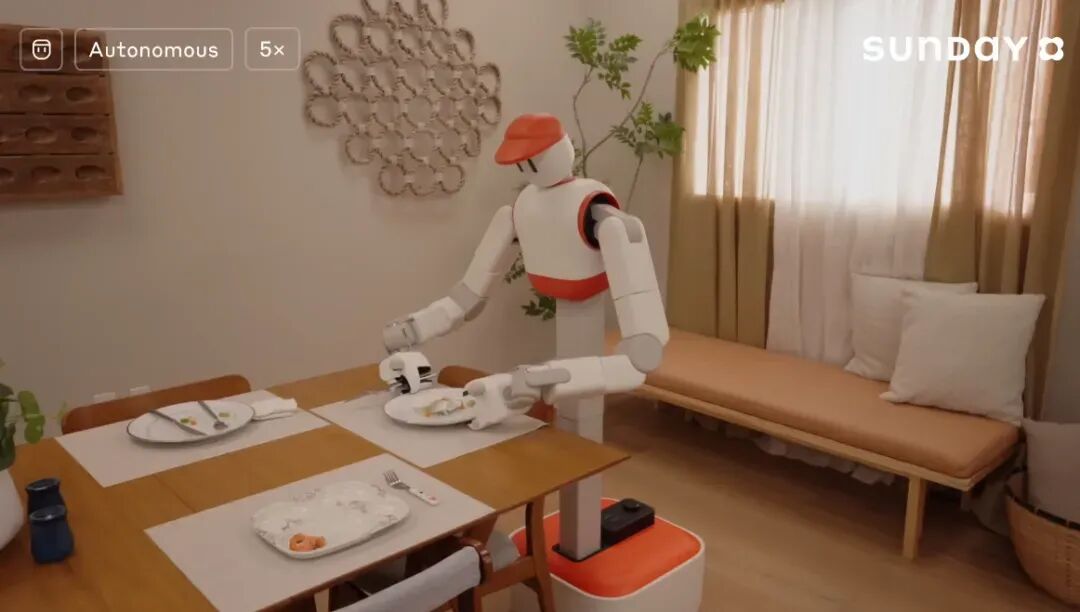
Image source: Sunday Robotics
Hong Jun: It's actually a wheeled robot with a mechanical arm. Its mechanical arm can pick up wine glasses from the table and put them into the dishwasher.
Fu Sheng: Last year, I visited Figure. I had a heated argument with someone who knew Figure well about why we must make humanoid robots. We couldn't reach an agreement. He thought that once a humanoid robot was successfully made, it could be used universally and adapt to various scenarios. A few days ago, he sent me a message saying that he visited Sunday and was very shocked. He suddenly realized that why do we need legs? Because he knew that a lot of effort was spent on the legs. In contrast, Sunday can focus all its efforts on the arms, and with a stable chassis, it can complete tasks so well. He was very surprised because the humanoid robot companies he knew haven't reached this level yet.
I believe that robots that can really work don't start as humanoid but from some special forms. The first robots to enter households were vacuum - cleaning robots. They are also called robots. In fact, the translation of "robot" is a bit misleading. "Robot" in English doesn't specifically refer to humanoid forms. Foreigners call any automatically - operating machines "robots." So, the first wave was vacuum - cleaning robots, then lawn - mowing robots. More and more types of robots are emerging. Now, in warehousing and transportation, some people are adding arms to wheeled robots.
My view has always been that all good products and technologies "grow" through continuous improvement in various scenarios, rather than suddenly creating a perfect and universal product with some lofty technology. Today, the term "Physical AI" is rather abstract. But if a robot like Sunday can perform tasks like picking up a glass...
Hong Jun: Can it really do it, or did they shoot the video many times?
Fu Sheng: There's no need to shoot the video many times. But I'm saying that even if the accuracy of picking up a glass is 99%, you still won't use it. If things break every day, would you still use it?
Look, Huang Renxun talked about generating data, and Elon Musk retweeted it and said that Tesla had been doing it for a long time. He said the difficult part isn't achieving 99% accuracy but the last 1%. For a robot to be truly practical, it has to interact with the physical world. That's why autonomous driving hasn't truly achieved L4 level after so many years. Once it interacts with the real world, the consequences can be very serious. Even if it performs well in many aspects, it's very difficult to handle corner cases. Moreover, autonomous driving mainly operates in a two - dimensional plane, while robots operate in a three - dimensional space and need to interact and grasp objects, which is much more difficult.
Hong Jun: Let me summarize our discussion. The core question is whether robots must be humanoid. I can see, Fu Sheng, that your view is that robots don't have to be fully humanoid as long as they can work. But if they can work now, why do the top - tier companies like Tesla Optimus, Figure AI, and Boston Dynamics' Atlas produce and even mass - produce humanoid robots?
Fu Sheng: You said that top - tier companies are making humanoid robots. Maybe it's because making humanoid robots makes a company seem more advanced (laughs). How did this "craze" start? I think it was started by Elon Musk. Before he started working on humanoid robots, people weren't very optimistic about them. Boston Dynamics was sold several times. When Google wanted to sell it, SoftBank bought it, and there weren't many buyers. And why did Google, a company with such a strong technological vision, sell it? Think about it.
I saw Honda's ASIMO robot. It took 30 years to develop, and it could walk on two legs. When Obama visited, it even played football with him. But finally, Honda announced its discontinuation. At that time, the industry was no longer optimistic about humanoid robots.
I had a video call with the CEO of Boston Dynamics at a conference. He said that as long as enough money is invested, a humanoid robot can definitely be made. I didn't quite agree at that time. I think it will only succeed when the market really finds a demand for it.
In China, after seeing what Musk was doing, people didn't want to fall behind. If he really mass - produces one million units, the world will change. So, they think "it's better to make a wrong judgment than to miss the opportunity." But this craze has become too big.
Hong Jun: So, robot startups in China are very popular this year, right?
Fu Sheng: Extremely popular. Why? First, it's easy to raise funds. It's not difficult. You can go to Shenzhen, spend 200,000 yuan to make a humanoid robot, put your own logo on it, and get it produced by a factory. It can even take a few steps. It's much more difficult to develop a large - language model.
Hong Jun: Has the supply chain achieved the ability to make a robot "take a few steps"?
Fu Sheng: Maybe some adjustments are needed. What I mean is that it's not difficult to make a robot take a few steps now. I visited a very well - known professor at Caltech who works on humanoid robots. He said that the bipedal control algorithm used by Boston Dynamics in the past had very high energy consumption. To maintain balance, the earliest products had to carry fuel. Humans can maintain balance with very low energy consumption, but the algorithm at that time required a lot of effort.
I think the application of artificial intelligence has indeed simplified this algorithm. When Elon Musk started working on humanoid robots, people thought that if such a great person thought it was feasible, then it must be. Moreover, I think Musk also underestimated the difficulty. In a recent interview, he said that he now realizes that making humanoid robots is much more difficult than making cars.
The demos you see are the best - case scenarios presented by the manufacturers. They are optimized. In real - world scenarios, the performance will be greatly reduced. Just by looking at their movements, you can tell whether they can be put into practical use. Most of them can't meet the requirements. Has there been a significant improvement compared to the past? Yes, but the standard for practical use is very high. To be honest, no one knows how long it will take to reach that standard.
