Subvert perception: The business philosophy of running a one-person company with AI
01. Engage in Business Targeting Small B and Large C Customers
This is the experience I've summarized from actual combat:
When a one - person company selects a business track and direction, it shouldn't simply and crudely divide the market into B - end (business) or C - end (consumer) markets.
In the past, in large Internet companies, we were used to clearly distinguishing between different types of business. Those engaged in B - end (enterprise services) thought that C - end (individual users) lacked loyalty, while those in the C - end business felt that B - end delivery was too cumbersome and tiring.
People looked down on each other, believing that the logics were completely different.
However, in the past two years, after contacting a large number of customers, I've found that this boundary is becoming blurred.
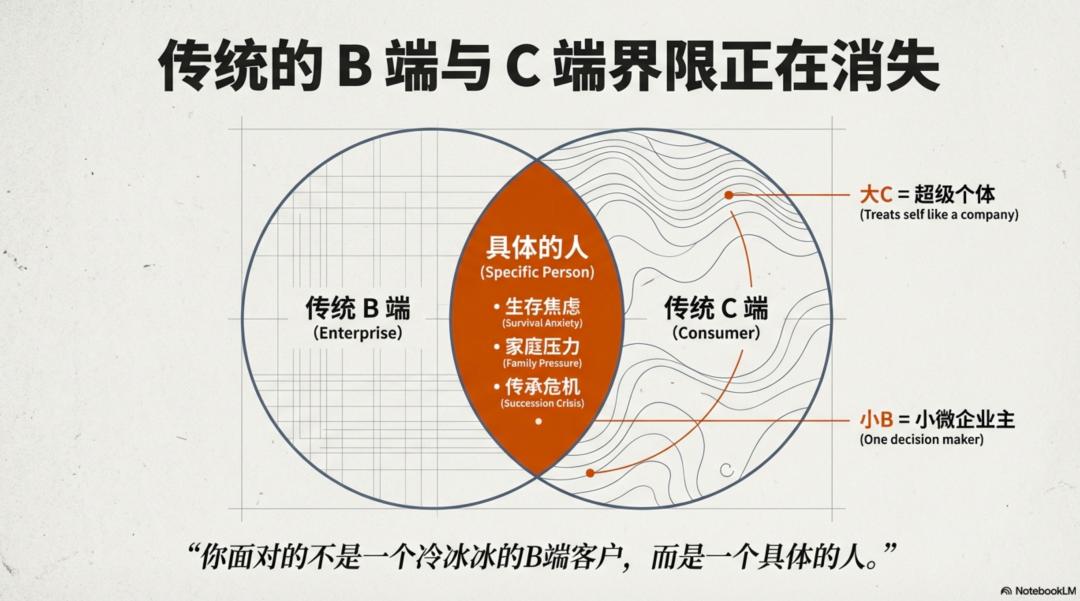
What are "Large C" customers? They are super - individuals who run themselves as a company.
What are "Small B" customers? They are small and micro - enterprises with annual revenues in the tens of millions and teams of dozens or hundreds of people, but whose core decision - making depends entirely on the boss.
For a company with 50 employees and an annual revenue of 20 million, the profit might only be two or three million. The hundreds of thousands of yuan in consulting fees the boss pays is a huge sum for him.
At this time, the customer you're facing isn't a cold B - end entity, but a specific person:
A person with great survival anxiety, family pressure, and even a mid - life crisis.
When chatting with you about business, he'll gradually start talking about things like:
Teacher Han, how can I hand over my business to my son in the future? Or I'm tired of the intense competition in Shanghai and want to go back to my hometown. Can I take this business with me?
So I've discovered that in this logic, B and C are interconnected.
Regardless of whether your customers seem to be enterprises or individuals, the core is to build trust between people in the end.
2. Blockbusters Aren't Important. Authenticity, Trust, and Long - term Sustainability Are the Keys
Many people come to ask me:
How can I build a social media account with hundreds of thousands of followers? Or I see someone's video going viral overnight. Should I also wash my hair, put on makeup, and set up a professional photo studio?
My advice is: Don't act, don't pretend, and don't pursue blockbusters.
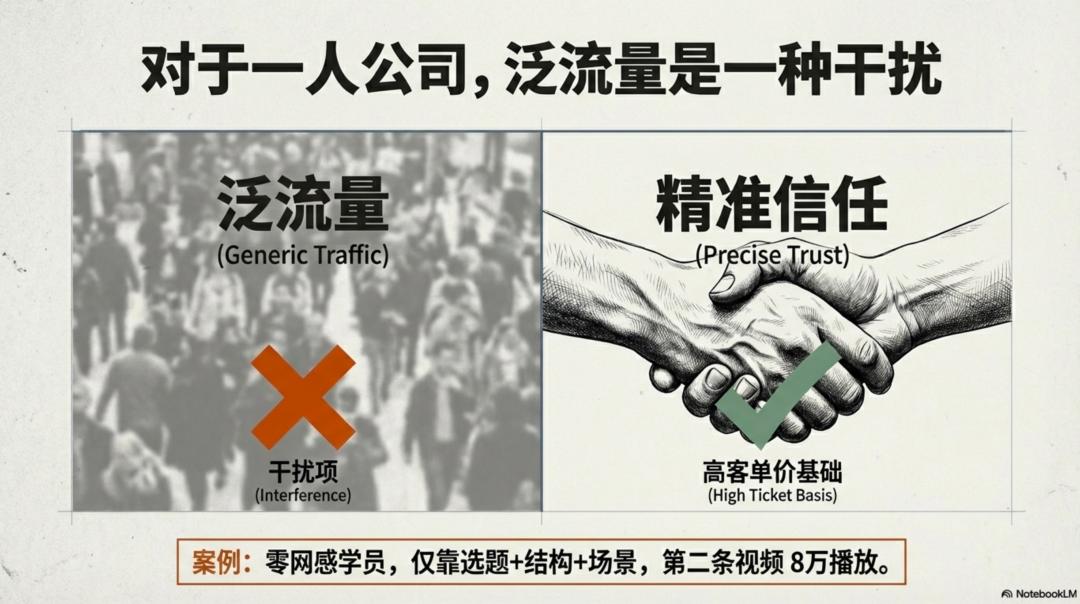
Why? Because traffic doesn't equal monetization. Especially for a one - person company like ours that offers high - value consulting or services, general traffic is not only useless but also a distraction.
I have a student who knows nothing about short - videos, has no sense of the Internet, and doesn't even often browse Douyin. He was extremely anxious before coming to class, thinking that he definitely couldn't succeed.
I only told him three core elements: topic selection, content structure, and shooting scenarios.
Don't over - complicate the process of building a personal IP. Don't be influenced by those online who talk about various tricks. Just sit there and record voice - over videos, and apply what I've taught you.
What was the result? The second video got 80,000 views, starting from scratch.
You might say that this number of views is also a small - scale hit. Then why do you still say not to pursue blockbusters?
The difference lies in topic selection. I asked the student to choose popular topics within his niche. That means the audience is relatively precise and concentrated, not the meaningless traffic obtained through jokes.
Let me talk about myself. People think I'm very authentic when they watch my live - streams.
Because I have several live - streams every week. If I had to act and pretend to be someone, I definitely couldn't keep it up. We're not actors, and we can't do that.
The biggest taboo in building an IP is over - exertion.
Once you start acting and putting on an act, the audience can sense it.
They'll think you're fake and trying too hard. And trust is often built on relaxation.
If you want to do it in the long run, show your most authentic self.
Even if the background is an industrial - style unfinished room, and even if you have an accent, as long as your content is sincere and full of energy, the right people will naturally stay.
3. When Learning AI, Don't Chase the Most Advanced Technologies and Tools. They Have Little to Do with You
Currently, opinions on AI are polarized.
Some people are frantically chasing the latest trends. They constantly keep an eye on new foreign models. When Sora or a new version of GPT comes out, they think they'll be eliminated if they can't learn coding.
Others are standing still. They want to learn AI but don't know how to choose and are still at the stage of using Doubao like Baidu.
For a one - person company, my attitude towards AI is as follows:
Don't chase the most cutting - edge technologies. You won't use them. Instead, spend your time on more valuable things.
The core of AI application is how to integrate it into your workflow.
As long as you can achieve this, it will bring a revolutionary evolution to your one - person company.
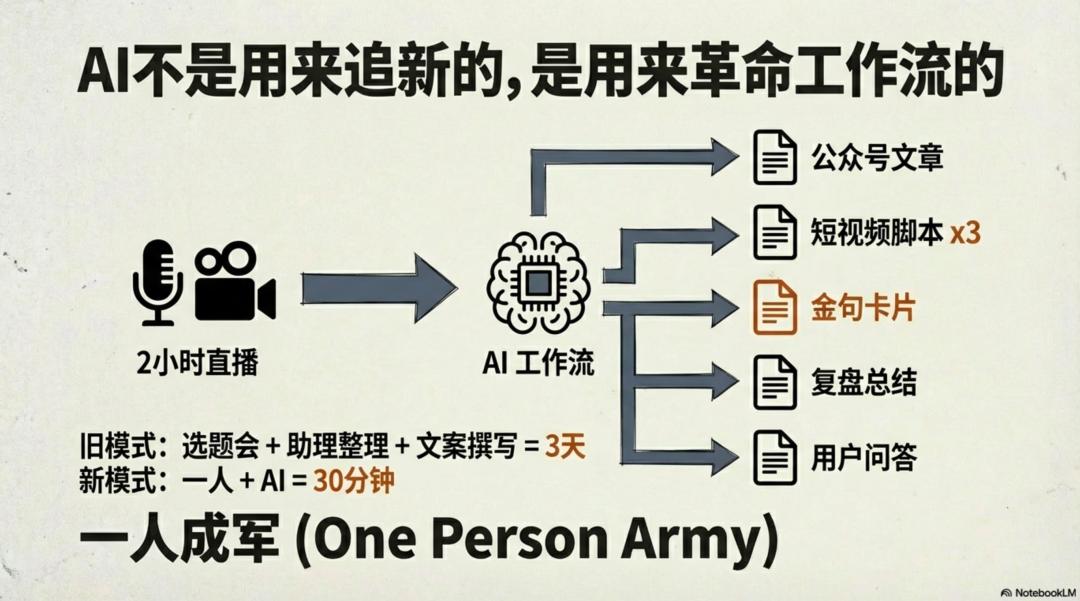
Let me give a specific scenario. AI can replace your topic - selection and review meetings.
In the era of portal websites, what was the scene like in our topic - selection meetings? A room full of people, smoking, chatting idly, and spending an entire afternoon just to finalize a few topics. The efficiency was extremely low, and the cost was extremely high.
Now, AI can completely replace this process.
Yesterday, I had a two - hour live - stream and shared many fragmented ideas. After the live - stream, I didn't need to find an assistant to listen to the recording and transcribe it. I directly converted the replay into text and gave it to AI, telling it:
These are my ideas. Please summarize them into a WeChat official account article or refine them into five short - video scripts.
In just a few minutes, the first draft was ready.
Then I spent half an hour polishing it and adding my own tone, and a high - quality piece of content was completed.
This is a revolution in workflow.
You don't need to understand the underlying principles of large models. You just need to know how to use two or three core prompts to make it materialize the ideas in your mind.
AI allows you to function like a whole team on your own.
Previously, you needed to hire copywriters, planners, and assistants. Now, you can save all that money. This is the greatest significance of AI for a one - person company:
Cost reduction and efficiency improvement, rather than creating anxiety.
4. Stop Your Self - PUA
Elites from large companies or so - called highly educated people are particularly prone to fall into a state of self - PUA.
We've been taught since childhood that only by enduring hardships can we become outstanding.
In the workplace, we're used to impressing our bosses with the number of overtime hours. We're used to creating difficulties when there are none and complicating simple things.
It seems that if we don't stay up late, don't be anxious, and don't push ourselves to the limit, we can't get the job done.
However, in building a personal IP, this kind of thinking is a deadly poison.
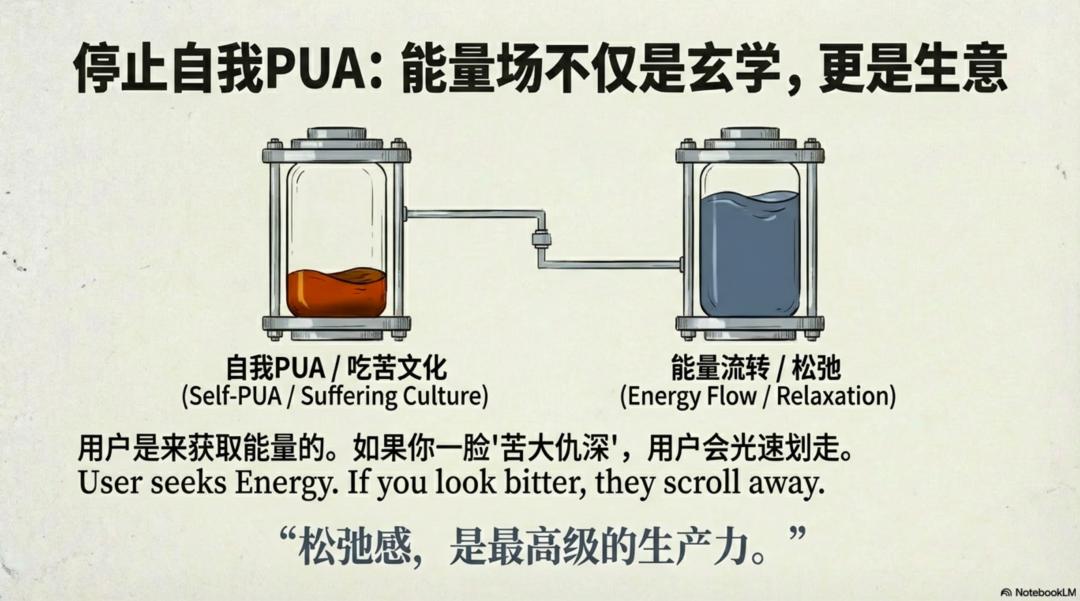
Creating content depends on your energy field, not your physical strength.
I once met a potential client who was very professional and had a strong background. But as soon as he turned on the camera, his face showed great distress, as if the person on the other side of the screen owed him two million yuan.
I told him: Dude, no one will pay for your content like this.
When people watch you online, besides learning knowledge, they also want to gain energy.
If you're tense, anxious, or even resentful, users can feel that oppression through the screen, and they'll scroll away in an instant.
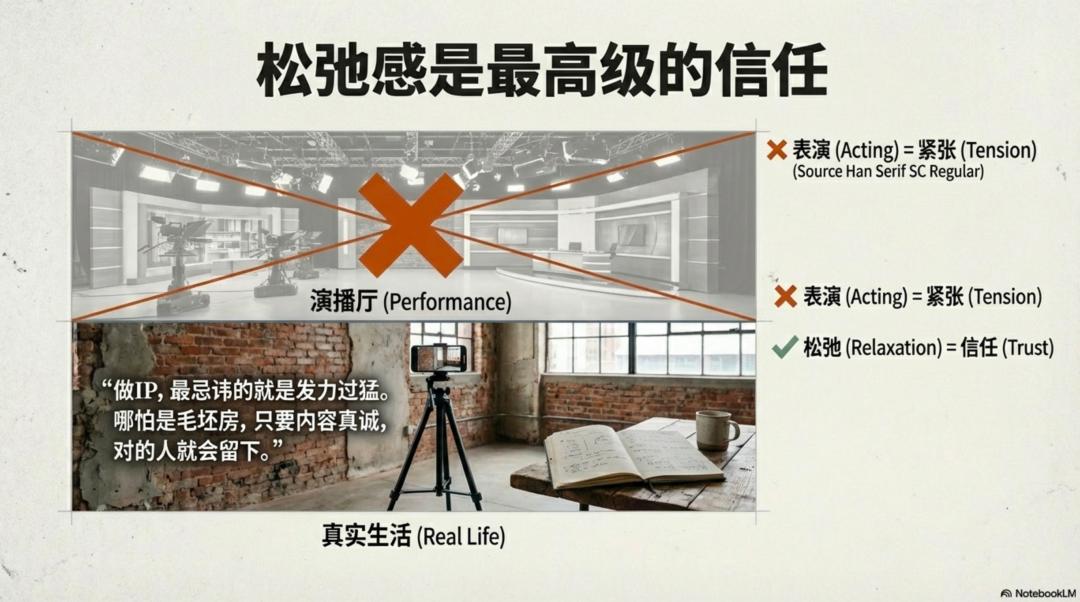
If you're not comfortable yourself, how can you make your audience comfortable?
Relaxation is the most advanced form of productivity. Don't try to challenge human nature, and don't rely solely on perseverance.
I can do a two - hour live - stream without getting tired because I just treat it as a chat. I don't put on an act as a teacher.
Only when you're in a self - consistent and comfortable state can your talents flow smoothly.
5. Don't Wait to Plan Everything Clearly Before Taking Action. Cognition Is Iterated
Many people delay publishing their first video or writing their first article because they're waiting.
They're waiting to figure out their positioning, business model, user profile...
They want their first article or video to be a huge success, a blockbuster that shakes the industry.
Cognition is developed through iteration, not through mere thinking.
If you browse my WeChat official account or video channel now, you'll find that I'm constantly trying different scenarios, topics, and forms...
Gradually, I can find a way that makes me comfortable.
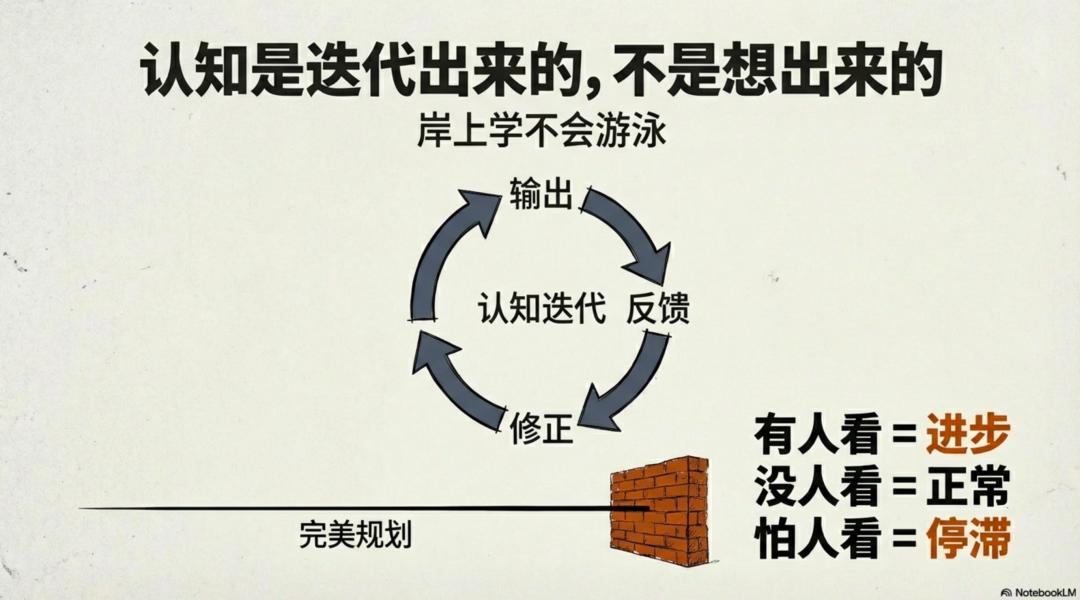
Don't wait or think anymore. What you need is to stay in the game, keep outputting, and constantly correct your cognition in the process.
Are you worried that others will laugh at you?
Let me tell you this: It's not embarrassing to have an audience; it's embarrassing to have none!
Your skills are honed through practice, and your sense of the Internet is developed through immersion. If you don't get into the water, no matter how well you understand the theory of swimming on the shore, you'll still drown when you jump in.
6. Personality Assessments Are Meaningless. They Can't Help You Find Your Personal Advantages
There are many people offering advantage - consulting services who ask you to take the Gallup test, MBTI test, or Enneagram test.
After taking the test, they tell you that you're an INFP, a perfectionist, or an Edison - type person. And then what?
There's no follow - up.
These tests can only tell you who you are or serve as a topic of conversation at the dinner table. But they can't tell you how to make money.
There's a huge gap between simple personality assessments and business monetization, which is the business scenario.
To bridge this gap, what's needed isn't a cold - blooded scale but social experience and business insights.
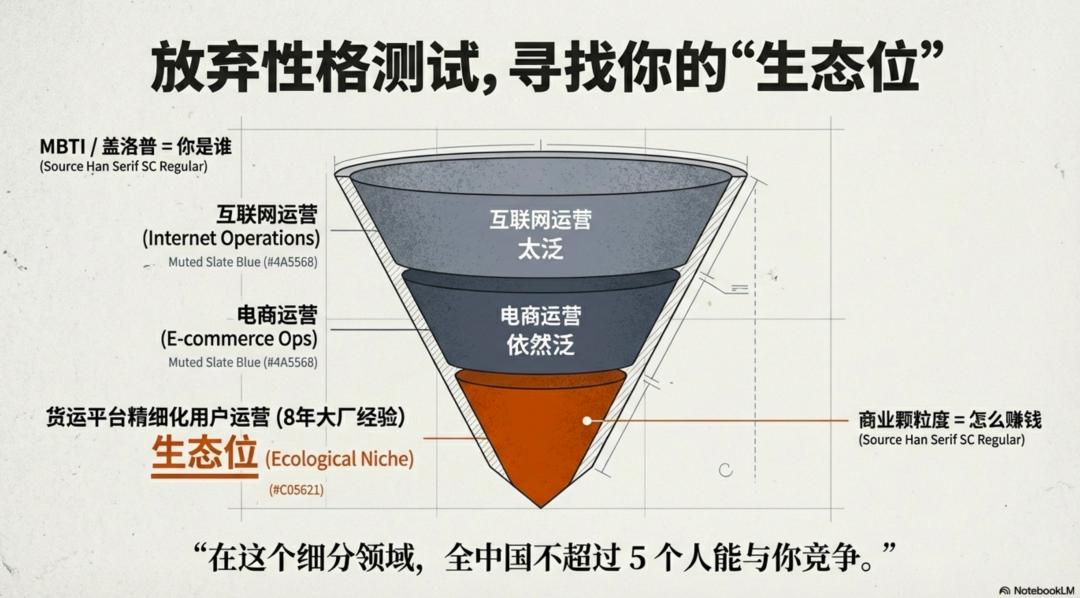
In my classes, when helping students identify their advantages, I never look at those fancy labels.
I only use my self - developed model to help everyone sort out: Exhaust all possibilities to find the connection points of business value.
For example, a student said he was engaged in Internet operations.
I said: That's too general. Nowadays, who isn't involved in operations? That doesn't count as an advantage.
I then asked: What specific area are you in? He replied: E - commerce operations.
It was still too general. Finally, we dug deeper, and it turned out that he was engaged in the refined user operations of a freight platform and had worked in a large company for 8 years.
Ah, now it's getting interesting.
When you break it down into fine - grained details, you'll find that in this niche area, there might be no more than 5 people in the whole country who can explain it thoroughly.
This is your ecological niche, and this is the battlefield where you can gain a competitive edge.
You need a mirror:
Someone with higher cognition, more experience, and more case - studies to help you better understand yourself.
This isn't a problem that can be solved by having two teaching assistants call you while looking at a form. Don't insult your own intelligence.
7. Screening Customers Isn't for Being Arrogant
The best thing about running a one - person company is that you can say no.
When doing business, it might seem like we're looking for customers, but in fact, we're screening customers. This isn't arrogance; it's basic risk control.
