The ClawdBot that has gone viral in Silicon Valley has made the Mac mini a huge seller. The founder revealed that it was developed by one person, 100% of the code was written by AI, and it's fully open source, but 0.00001% is left for the whole internet to hack.
In the past two days, the personal AI assistant ClawdBot has swept through Silicon Valley, and discussions about it are everywhere on social platforms both at home and abroad.
After trying it out, netizens have given it high praise. "It is the greatest AI application to date, like having a 24/7 dedicated AI employee at your service," praised Alex Finn, the founder and CEO of Creator Buddy. "This is exactly what they (Anthropic) envisioned for Claude Cowork."
Currently, the ClawdBot project has been open - sourced and has already gained 20.8k stars: https://github.com/clawdbot/clawdbot
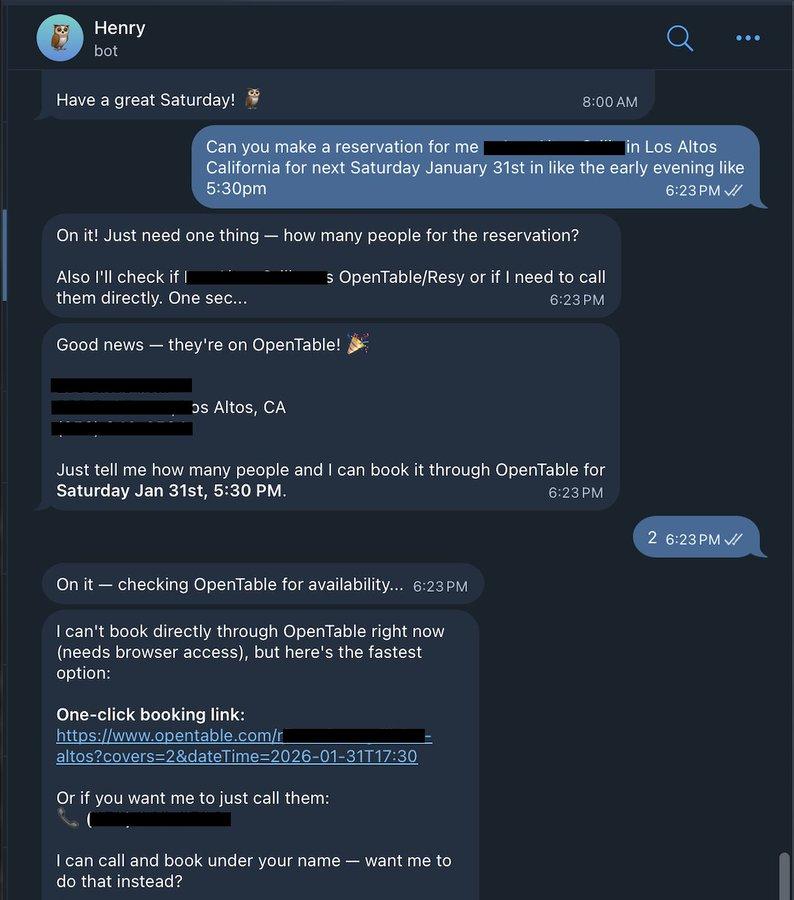
Alex demonstrated sending a message to his Clawdbot, asking it to reserve a table at a restaurant for next Saturday. When the reservation on OpenTable failed, Clawdbot used ElevenLabs' technology to call the restaurant and completed the reservation.
What really excites the tech circle about ClawdBot is not just its "ability to get things done," but its extremely radical collaboration method: even people who can't write code can directly submit PRs. The reason is simple: it is almost 100% written by AI. A PR here is more like "I've encountered this problem" rather than "I've written a beautiful piece of code."
Interestingly, this seemingly "fully open - source" project deliberately leaves a small part closed - source. Founder Peter Steinberger has retained a file named "soul," which only accounts for 0.00001% of the project. He put it bluntly: this is both his "secret asset" and a deliberately left - behind security target. If people really try to hack it, he'll just wait and see if the model can hold up. So far, the "soul" hasn't been stolen.
As a loyal fan, Alex said that this is the first time since the release of Claude Code that he hasn't used it for two consecutive days. However, his ClawdBot Henry has been doing Vibe Coding non - stop for 48 hours. "I've never written so much code in my life. Vibe Coding is dead, and Vibe Orchestration is here."
Now, Alex wants to return his Mac Mini and get a $10,000 Mac Studio. "My ClawdBot Henry will control an AI supercomputer. Henry will use Opus as its brain and multiple local models as a cluster of employees."
Clawbot is not a traditional chatbot that can only answer questions. In essence, it is a personal AI agent that runs continuously and can perform tasks.
You can install it on your own devices, such as Mac, Windows, or Linux. It can stay online for a long time, continuously receive instructions, process tasks, remember your preferences and past conversations, and become more understanding and "memorized" over time. Generally speaking, there are three most amazing aspects of Clawbot:
First, it can almost completely control your computer. It doesn't have the traditional "guardrails" and is not limited to a few functions. Instead, it can operate everything on your computer just like a real person sitting in front of it.
Second, it has nearly infinite long - term memory. Clawbot has a very complex built - in memory system. Everything it says and does will be continuously recorded. After each conversation, it will automatically summarize the content and extract key information to store in its long - term memory.
Third, it interacts entirely through chat applications. You can talk to Clawbot wherever you use your regular chat tools. This means that as long as you open a chat app, you can assign tasks to Clawbot with a single message. Currently, Clawbot supports WhatsApp, Telegram, Slack, Discord, Google Chat, Signal, iMessage, Microsoft Teams, WebChat, etc., as well as BlueBubbles, Matrix, Zalo, and Zalo Personal.
However, such unrestricted permissions mean it has almost no guardrails, which poses a significant security risk. There are more than 500 security issues on GitHub, which also discourages some netizens. In response, most users who have used it say that they don't recommend installing Clawbot on your main computer at the beginning. "Putting it in an independent environment is the safest choice until you are familiar with it."
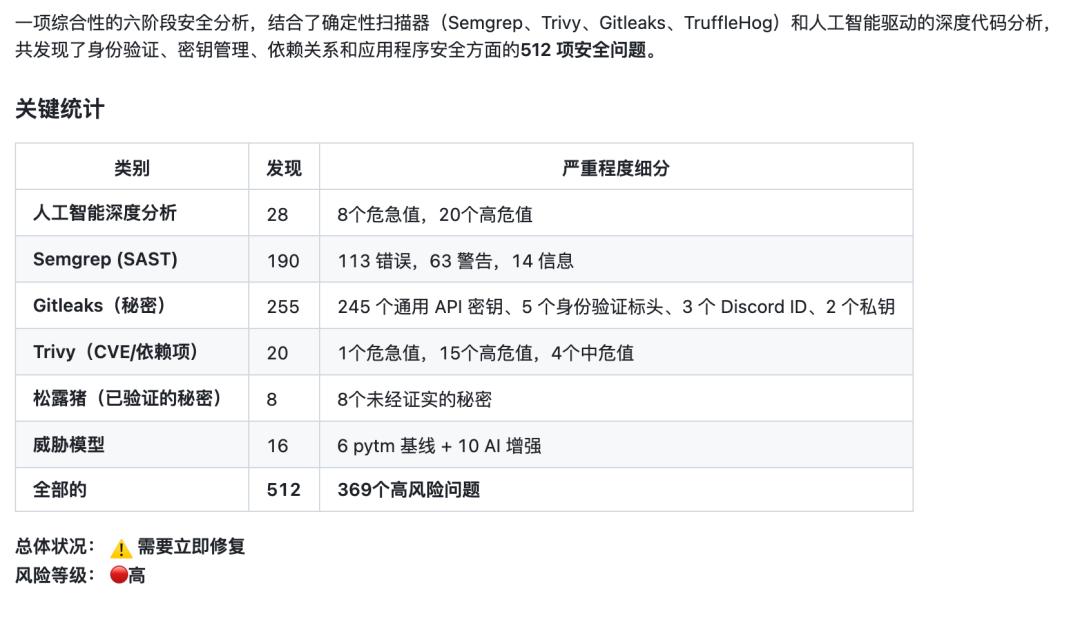
However, no one expected that this AI employee would first make the Mac Mini popular.
Many people buy a dedicated computer to run Clawdbot, and most of them choose the Mac Mini because it is cheap, has good compatibility, low power consumption, is quiet, and takes up little space. Logan Kilpatrick, a product manager at Google DeepMind, even couldn't resist ordering one.

Some netizens even showed off that they bought 40 Mac minis at once to run Clawdbot.
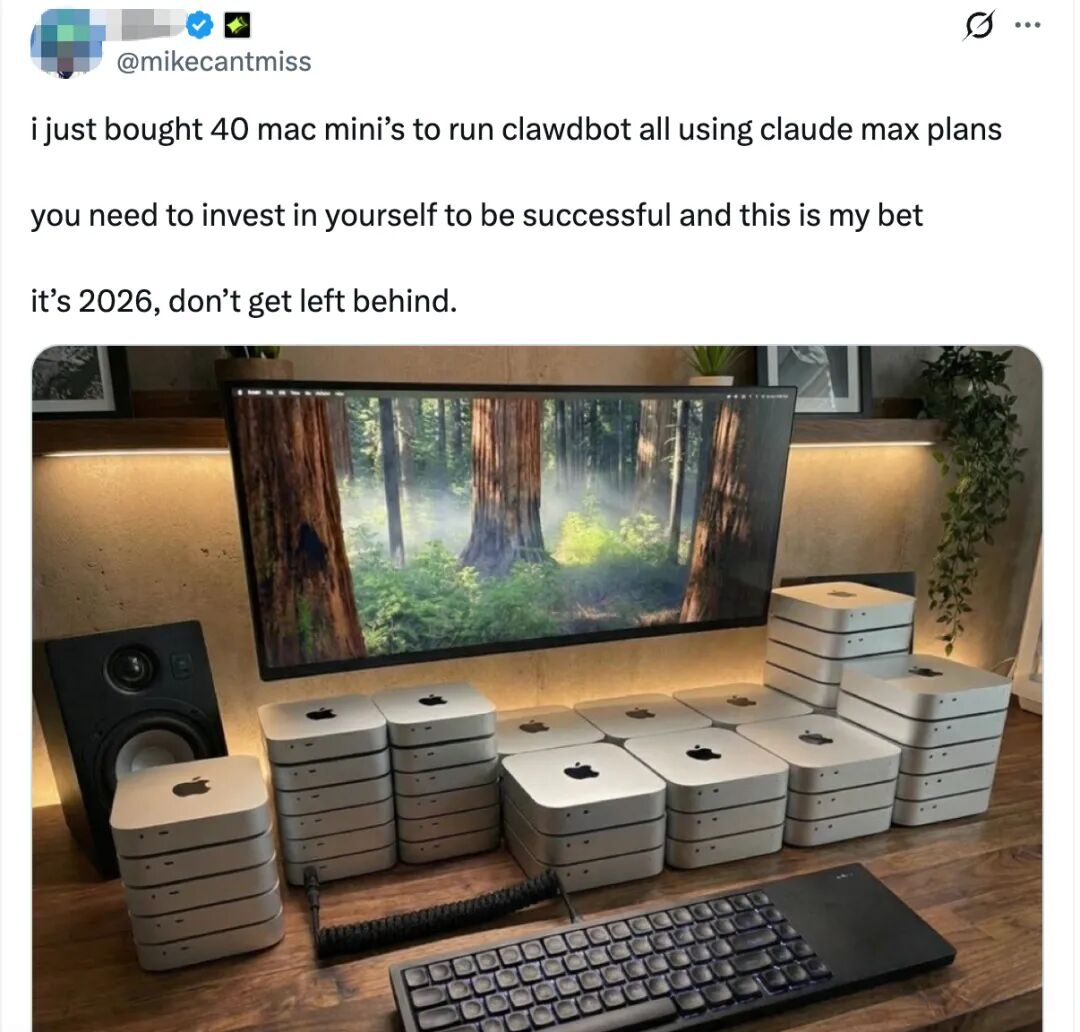
But some netizens claim that they can run the same program on a free server. Alex also says there's no need to spend $600 on a Mac mini, as there are much cheaper ways to run Clawbot. Buying a Mac mini is more of a personal preference than a technical necessity. You don't have to buy any hardware; you just need a VPS.
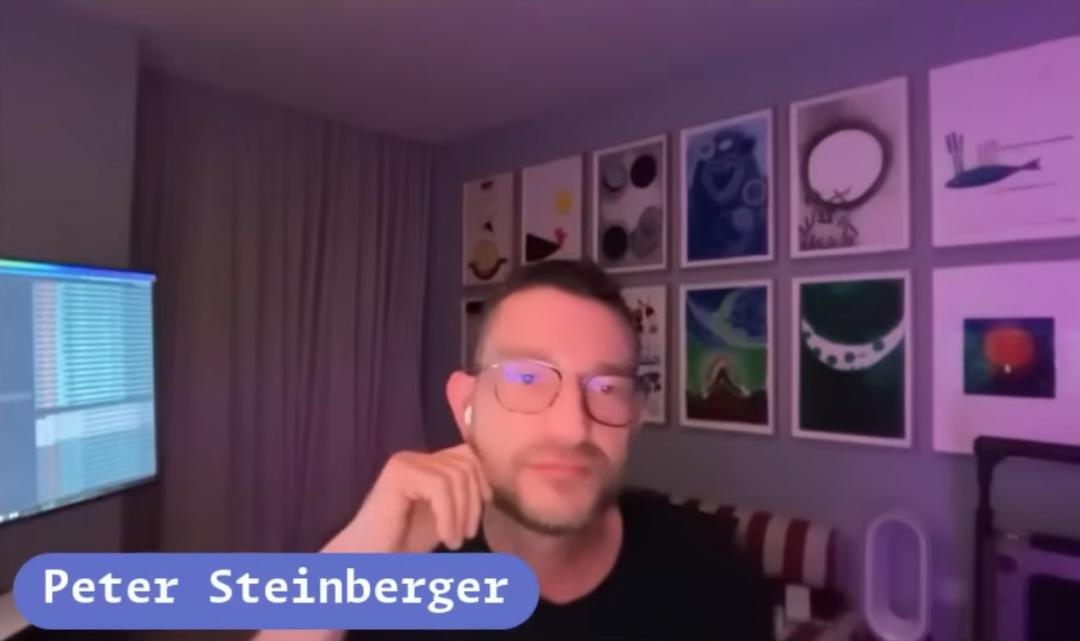
As the project becomes popular, its developer Peter Steinberger has also stepped into the spotlight. Peter shared on "Open Source Friday" how he single - handedly created ClawdBot, from its inception, founding, to maintenance. Interestingly, there were even rumors that Peter might be a bot, an agent, or even an AI itself. Peter's appearance has confirmed to the project members and followers that he is a "real person."
Peter had retired but then came out of retirement to tinker with AI. Physically, Peter looks young and energetic, nothing like someone of retirement age eligible for a pension.
Peter's career also has many highlights. He independently ran a B2B company for 13 years. This company developed the world - leading PDF framework at that time, and the team grew to about 70 people at its peak. After the company entered a stable development stage, Peter received an attractive and irresistible acquisition offer, which brought a successful end to his entrepreneurial journey.
However, Peter's so - called "retirement" is more of a joking statement. During his 13 - year entrepreneurial career, he devoted almost all his energy, and most of his weekends were also spent on work. The long - term high - intensity work finally led him to a state of severe burnout. After that, Peter spent a lot of time adjusting his physical and mental state, making up for the regrets in his life, and experiencing many interesting things. But he knew that he was the kind of person who loved "creating" and "building" and would come back sooner or later.
Until early last year, Peter's creative ideas were reignited. Coincidentally, at that time, AI went from "this thing doesn't work well" to "wait, this is kind of interesting." Since then, Peter has basically dragged countless people around him into the world of AI.
Below is Peter's conversation on the show. Besides sharing his experiences, he also talked about various unexpected applications and the most concerning security issues. Security is currently his top priority. We have made some deletions and translations without changing the original meaning for our readers.
1 "I originally wanted to wait for the big companies to do it."
Host: This project is so popular now, and the number of stars on GitHub is rising rapidly. You seem to have hit a long - pent - up demand: one person can get a lot of things done. I even think you've inadvertently boosted Apple's stock price, as everyone is buying Mac minis to run their own instances. Can you tell us how this idea first came about?
Peter: When I first came back, I really wanted a "life assistant." I started thinking about it in April and tried out some ideas, but the models at that time weren't good enough. I then put the idea aside because I thought that big companies would definitely develop such a thing. What's the point of me doing it? So I worked on many other projects. It wasn't until November that I suddenly realized that no one had actually accomplished this. I thought, am I really going to have to do everything myself?
For some reason, that month I spent an hour piecing together some very rough code. It sent messages on WhatsApp, forwarded them to Claude Code, and then sent the results back. Essentially, it was just "gluing" a few things together. To be honest, it wasn't difficult, but the effect was quite good.
Later, I realized that I also needed image input. I often use images in my prompts because they can provide a lot of context to the agent and are very fast. This actually took me more time. After the system supported two - way communication, I was in Marrakech on a birthday trip with friends. Using this very primitive system as a "tour guide" while exploring the city was already much better than I expected.
Once, without thinking, I sent it a voice message. But at that time, I hadn't implemented voice support at all. I just stared at the "typing" indicator, wondering what would happen. After a few seconds, it actually replied to me. I was completely stunned and thought, what on earth did you just do? Later, I found out that it recognized a file without an extension, checked the header, determined it was an audio format, transcoded it with FFmpeg, found that there was no local transcription tool, located an OpenAI key in the system, used curl to send the audio to OpenAI, and then sent the result back.
Host: This sounds like your first line of code triggered AGI.
Peter: Maybe it can't be called AGI yet, but at that moment, I really realized that the "spontaneous adaptability" of these things had exceeded my original imagination. Later, I joked, "The hotel door lock in the Marrakech hotel I'm staying in isn't very reliable. I hope you don't get stolen, since you're running on my MacBook Pro." It replied, "It's okay, I'm your agent." Then it checked the network, found that it could connect to my computer in London via Tailscale, and migrated itself there. I thought at that time, this is the beginning of Skynet.
Host: What was the initial architecture like? What gave it this "autonomous decision - making" ability? What model did you use? Was this your first implementation, the one with WhatsApp and Claude Code?
Peter: Initially, it was called V Relay, essentially a WhatsApp relay. Later, when I was working on things related to Claude, someone submitted a PR for Discord. I hesitated for a while about whether to add Discord support because it was no longer just about WhatsApp. In the end, I did add it, and the name also had to be changed. Claude suggested the name ClawdBot, and that's how it was decided. The project has been cleaned up a lot since then, but the original starting point was really simple.
Host: When I first saw this project, I thought it was developed internally by Anthropic and wondered if I had missed something. It has developed so rapidly, and many people started using it quickly. Besides "boosting Apple's stock price," you've probably also indirectly promoted the development of many third - party ecosystems. Initially, this was just a project to solve your personal problems, but the community quickly embraced it. People think it's elegant, easy to use, and actually works. When did you push it to the public repository?
Peter: Since April, most of the things I've done have been open - source. There was only one project that was an exception because the cost of Twitter's API was just too outrageous. The first commit for this project was in November.
2 It received a lukewarm response when released last year.
Host: Many people have used it to create some really amazing things. Is there any usage that surprised you and was completely unexpected?
Peter: There are too many. Some people use it to automatically add captions to pictures, some connect it to their Teslas, and some integrate it with the London public transportation system to directly tell you whether you should run to catch the bus. To be honest, I'm so busy maintaining the project that I don't have time to use these automations myself. I even feel a bit jealous when I see others coming up with so many interesting ideas.
Interestingly, when I showed it to my friends in November, they all said, "It's so cool." But when I posted about it on Twitter, the response was very muted. It wasn't until December that every time I demonstrated it to friends in person, they would say, "I need this." However, I found that I had no idea how to explain to more people how great it was.
So, I did something very crazy: I directly created a Discord server and added the bot to it, and at that time, there were no security restrictions at all. Initially, it only served me, so I didn't have to consider who could send it instructions, like "delete all of Peter's files."
I actually just wrote a very simple instruction, like "You only operate in Discord and only listen to me." But as you know, agents don't always follow instructions perfectly. Later, when I added it to Discord, a few people joined gradually. Basically, anyone who observed it for a few minutes could understand how it worked.
Now, let your imagination run wild: You buy a new computer with a "ghost entity" in it. You give it keyboard, mouse, and network permissions and treat it as a virtual colleague. You can talk to it directly and assign tasks. In theory, this agent can do anything you can do on your computer. This is where its real power lies.
Host: That's amazing. It can be used in scenarios like WhatsApp, Telegram, and Discord. I just chatted with this bot on Discord, and to be honest, the experience was great.
Host: I just casually sent a public message, and then people started adding you and @ing you, which is exactly what they mentioned in the comments. For you personally, what is your "North Star goal"? That is, the moment when you'll think, "It's all worth it when ClawdBot can do this."
Peter: My prediction is that this year is the "Year of Personal Agents." Last year was when programming agents really matured. This year, it will move out of the small circle of engineers and become "everyone has an agent." This wave will probably be led by OpenAI and a few big companies.
But I want to make a different choice: You can have control over your own data instead of giving more data to big companies; it can also work with local models. I haven't seen anyone seriously working on this, so I think it's very important, and it must be completely open and permanently free.
This is also why I chose the MIT license for open - sourcing and established an organization instead of keeping it under my personal name. It should be a project for many people. The biggest current problem is that I'm completely occupied with "making it better and safer." I haven't had time to build a complete peripheral system or truly establish an efficient collaboration mechanism. Currently, some people are helping with maintenance, but it's still