Wang Chuanfu, Wei Jianjun, Li Bin, Li Xiang and others will enter the "super intelligence" competition cycle in 2026.
In the previous article, "These 16 Words Will Determine the Fate of BYD, Geely, Great Wall, Wenjie, and 'Wei Xia Li' in 2026", we started from the demand side and deduced several key trends in China's new energy vehicle industry in 2026.
If demand determines the direction of the market, then supply affects the foundation and rhythm of the industry. In this article, we shift our perspective to the supply side and sort out the possible structural opportunities and challenges that may emerge in 2026 around the survival logic and development narratives of parts manufacturers and automakers.
It should be noted that the content of this article only represents the views of the author and is intended for communication and discussion, not as any investment or decision-making advice.
01
2026 Will Be a Big Year for Automotive Parts
In the previous article discussing the new trends on the demand side of new energy vehicles, we emphasized that the overseas market will face a critical explosion point of $100/kWh in 2026. On the supply side, we follow the same logic. Assuming that 2026 may be a "small year for domestic demand and a big year for going global", we believe that the opportunities in the automotive industry chain in 2026 will be significantly greater than those for automakers, and there are three reasons:
Against the backdrop of the current slowdown in domestic demand and intensified competition, the anti-involution effect of parts manufacturers is more obvious.
Currently, parts manufacturers are in a relatively favorable period. On the demand side, the competition among automakers has not slowed down, and the market demand remains high. However, after the "payment cycle storm" last year, the profits of parts manufacturers have been significantly improved, with the gross profit margin returning to over 18%, and the net profit margin in the first three quarters hitting a new high.
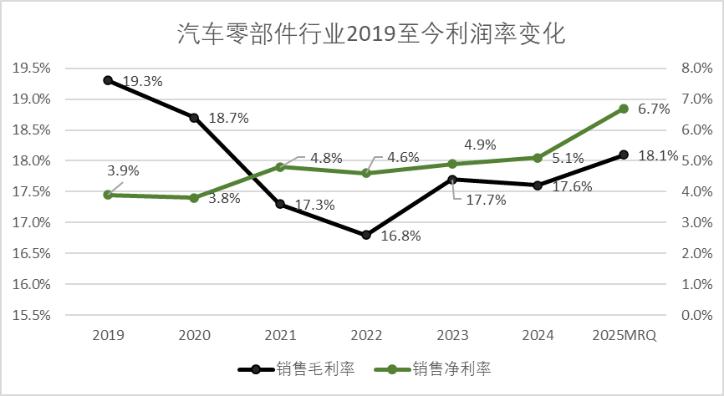
Figure: Profit margin changes in the automotive parts industry from 2019 to the present, Source: Corporate financial reports
The most obvious factor driving the increase in the net profit margin is the result of anti-involution. The high-profile 60-day payment cycle commitment last year and the rights protection channel for automakers' payment cycles opened by the Ministry of Industry and Information Technology have actually led to a decline in automakers' payment cycles. Compared with the same period in the third quarter, the average accounts receivable turnover days in 2025 decreased by 5 days compared with 2024.
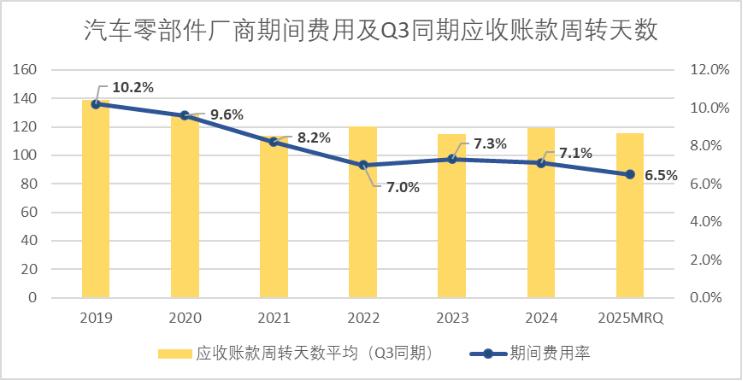
Figure: Period expenses and accounts receivable turnover days of automotive parts manufacturers, Source: Choice Financial Client
After the payment cycle was shortened, the period expense ratio of parts manufacturers also dropped to the lowest level in recent years, 6.5%. The biggest reason for this is the improvement in the payment cycle. Among the top 10 automotive parts manufacturers, only 3 had a decline in the R & D expense ratio, 5 had a decline and 5 had an increase in the management and sales expense ratios, while 8 had a decline in the financial expense ratio, which became the main factor driving the decline in the period expense ratio.
Currently, it is estimated that the accounts receivable turnover days for automotive parts throughout the year are close to 85 days, and there is still a certain distance to reach the industry's overall goal of "within 60 days". The anti-involution narrative will not change in the short term. Therefore, we are relatively optimistic that the profit margins of parts manufacturers can be further restored in 2026.
Currently, parts manufacturers are the beneficiaries of technological equalization, and the T-chain outlook is also relatively clear.
In 2025, the biggest theme in the automotive consumption trend was the price war. On one side of the price war is involution, and on the other side is technological equalization.
Features such as refrigerators, color TVs, and large sofas, which were once exclusive to luxury cars, can now be found in models priced around 100,000 yuan. For example, the cost of some luxury accessories that can distinguish product strength is also dropping rapidly. For instance, the air suspension, which was once an optional feature for luxury cars, has dropped to the price range of less than 300,000 yuan in 2025 (Xiaomi SU7, Zhijie R7). Tuopu, Konghui, and Baolong have benefited from this, with their installation volumes continuously increasing. Rear-wheel steering, once a "black technology", has become a standard feature in 200,000-yuan models.
When the downgrading of luxury car accessories becomes a norm, consumers' thresholds are also constantly rising, which will naturally further drive up the installation volumes and market shares of some parts manufacturers. For example, the penetration rate of L2 assisted driving reached about 65% in the first nine months of 2025. Correspondingly, some lidar and intelligent driving domain controller manufacturers have also achieved remarkable growth.
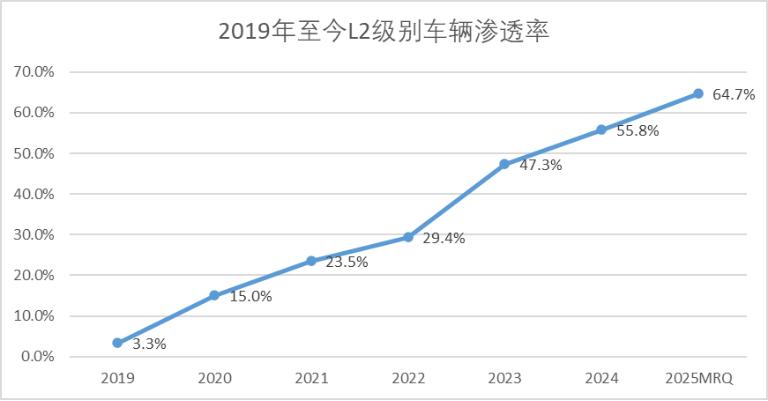
Figure: Penetration rate of L2-level vehicles from 2019 to the present, Source: Western Securities
The robot and T-chain industries highly overlap with the traditional automotive parts industry chain, which will also drive new markets. It is foreseeable that, based on the current linear projection of the automotive and robot industries, if the mass production progress of the T-chain meets expectations this year, there will still be considerable room for growth in the parts industry.
The overseas expansion path of parts manufacturers is less risky and more mature.
When discussing the overseas expansion of the automotive industry, although there is relative optimism about the prospects of the new energy vehicle market, there are still some concerns about the overseas expansion of complete vehicles. After all, as the culmination of traditional manufacturing, there is still local protectionism for complete vehicle products in countries where conditions allow.
However, parts manufacturers do not have such concerns. Whether it is domestic or overseas automakers, whether they build factories locally or transport vehicles by ship, they cannot do without parts supply.
Moreover, currently, most leading parts manufacturers have completed their global layout. The business scopes of domestic supply chain enterprises such as Yanfeng and Fuyao basically cover all major manufacturing countries.
Overall, if we believe that 2026 may be a big year for the globalization of the new energy industry, then investing in parts has a higher degree of certainty than investing in automakers.
02
2026 Will Be a Big Year for the Clearance of Automakers
Undoubtedly, anti-involution will still be the main theme of the automotive industry in 2026. For automakers, given the current market concentration (relatively dispersed), the anti-involution approach must be policy-guided rather than industry-driven.
The policy-guided anti-involution mainly has two directions. One is to maintain the lower limit of the industry's fundamentals by revising basic rules to restrict malicious competition. The other is to point out the main competition direction for automakers by providing subsidies and incentives to maintain the upper limit of technological development. We believe that either way will lead to a trend of concentration among leading automakers.
For example, the latest policy document, the "Limits of Electric Energy Consumption for Electric Vehicles - Part 1: Passenger Cars" (GB 36980.1 - 2025), which came into effect on January 1, 2026. The regulation of electricity consumption is essentially another form of policy-driven anti-involution.
According to the standard, for micro passenger cars with a vehicle weight of less than or equal to 1.09 tons, the upper limit of electricity consumption per 100 kilometers is only 10.1 kWh; for vehicles with a weight between 1.09 tons and 2.71 tons, the corresponding calculation formula must be met. For popular models weighing around 2 tons, the electricity consumption per 100 kilometers must be controlled within 15.1 kWh; for medium and large passenger cars with a weight greater than 2.71 tons, the limit is only 19.1 kWh per 100 kilometers.
As the world's first mandatory standard for the electricity consumption of electric vehicles, this year's new national standard for electricity consumption is not very strict. Currently, the electricity consumption of most new cars calculated under the CLTC driving range standard can meet the requirements.
According to the calculations on Cui Dongshu's official account, looking at the pure electric passenger cars in the 25th batch of the catalog, most can meet the electricity consumption requirements. However, some automakers with relatively weak supply chain capabilities and vehicle design capabilities, as well as products with overly single usage scenarios, may be restricted by the national standard for electricity consumption and face the risk of being eliminated. For example, the 2025 Smart Engine version of Skyworth HT - i, the Kaiyi Jiangtun, and the 2025 version of Sihao E10X are all close to the limit.
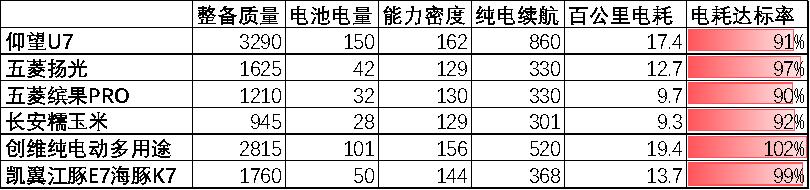
Figure: Some models with an electricity consumption compliance rate of over 90%, Source: Cui Dongshu's official account
Of course, the regulations on electricity consumption will definitely become stricter. The new electricity consumption rules this year are about 11% stricter than the previous version, and there may be further improvements in this direction in the future.
If we only look at this national standard for electricity consumption, it actually provides two ideas for automakers' technological planning: Firstly, they should not blindly increase the battery pack assembly in pursuit of a long driving range but should pursue lightweighting; Secondly, energy density has become the key, which also defines the technological path for battery enterprises to pursue energy density.
Another example is that at the end of last year, the State Administration for Market Regulation drafted the "Compliance Guidelines for Price Behaviors in the Automotive Industry (Draft for Comments)", which may also improve the problem of excessively high discount rates in the automotive industry in 2025, especially the unreasonable promotion methods of some automakers with high - priced products and high discounts.
