The career dilemma in 2026: Should you continue to be an employee or aspire to become a founder?
For most professionals in the workplace, the age of 40 is a watershed and a "cut - off line", especially for the heads of enterprise information departments. Although they have profound technical and experience accumulation, they are often trapped by organizational inertia and role solidification. They find it difficult to break through the constraints of the reporting line to drive real digital transformation and lack a systematic methodology to convert technical insights into business value. At this time, CIOs face three choices: stay put, job - hop, or start a business! Today, Lao Yang won't discuss the pros and cons of staying put or job - hopping, but will talk about starting a business, which is the path that CIOs most want to try but is also full of risks.
Why do they want to start a business?
Lao Yang has talked with many CIOs, and the impulse to start a business comes from the following reasons:
First, realize personal ambitions
For some CIOs in enterprises, although they have technical ideals and strategic visions, they are long - term restricted by budgets, processes, and KPI assessments. They feel powerless every day facing the internal strife in the enterprise, and this sense of powerlessness becomes even stronger after the age of 40. At the same time, they have to face the dual pressures of family responsibilities and the age "cut - off line". So, starting a business becomes the only way to control the rhythm, define value, and regain the initiative in life. It should be noted that this behavior is not to escape, but to reconstruct their own lives.
Second, pursue higher value
Many CIOs find that when their technology and capabilities have reached a certain stage, their value within the organization has hit the ceiling, while the market demand for digital solutions continues to explode. They realize that instead of optimizing efficiency by 10% year after year in the existing system, it's better to package their years of accumulated industry experience, technical judgment, and customer trust into reusable products or services to directly create ten - fold business returns.
Third, actively respond to career risks
After the age of 40, the professional sense of security of most enterprise CIOs significantly declines. Especially in the current cost - reduction and efficiency - improvement model, technical positions often bear the brunt of structural adjustments. Although starting a business is full of uncertainties, it is a crucial attempt to turn "being chosen" into "actively choosing". By using their proven industry knowledge, transferable delivery capabilities, and insights into real customer pain points, they can create lightweight and highly - sticky digital service products in vertical tracks, avoiding the heavy - investment traps of large enterprises and maintaining the most core competitive barriers of CIOs: understanding business, mastering technology, and being able to close the loop.
From the above three points, it's not difficult to see that starting a business is an active breakthrough for some CIOs after rational consideration. Of course, some people do fail due to impulse or misjudgment. No matter what the result is, Lao Yang always believes that CIOs starting a business is the ultimate confirmation of their professional value rather than being defined by the organization, and it is a practice of upgrading self - value.
What are the misunderstandings in starting a business?
Starting a business is accompanied by risks. Why do some CIOs succeed while others are mercilessly eliminated by the market? After analysis, Lao Yang found the following problems:
First, cognitive misalignment
When entering the entrepreneurial market, some CIOs are prone to fall into the cognitive misalignment of the "ability halo", equating their previous technical and experience capabilities with entrepreneurial capabilities. For example, they mistake the experience of "scaling from 1 to N" for the ability of "starting from 0 to 1". CIOs are good at using existing resources (budgets, brands, teams) for optimization and management within the enterprise, but starting a business requires creating resources, cash flow, and revenue from scratch, which has extremely high requirements for all - around capabilities such as market sales, financing, finance, and law.
Some CIOs also mistake "internal voice" for "market appeal". They think that since they can promote project implementation within the enterprise, they can naturally gain customer recognition in the market. However, internal decisions are driven by job ranks, while market choices are determined by value delivery and trust accumulation. Without real feedback from paying customers, even a strong technical background can hardly bring in continuous cash flow.
Second, demand misalignment
Some CIOs in the early stage of starting a business are used to equating internal needs with market needs and like to use "experience replication". For example, they regard the "internal solutions" verified in the original enterprise as mature entrepreneurial products, but ignore the fundamental differences in business logic, organizational maturity, and procurement mechanisms among enterprises. This demand misalignment underestimates the difficulty of commercialization and fails to understand how to convert existing experience and technical solutions into customer - value units that can be delivered in a standardized way, priced for sale, and replicated on a large scale. Using internal thinking to solve market problems ultimately leads to demand misalignment and makes it difficult to succeed.
Third, starting a business as a fallback
Many CIOs choose to start a business thinking it is a "fallback" to get rid of internal strife in the workplace or promotion bottlenecks. They choose to start a business because they are "unhappy", "frustrated", or "caught in the rat - race", rather than based on clear business insights and strong creative enthusiasm. This leads to insufficient psychological preparation when facing greater difficulties in starting a business, and they are prone to give up.
Some CIOs also ignore the real risks to themselves and their families when starting a business. They optimistically estimate the time, funds, and emotional costs required for starting a business and rush to start without leaving enough buffer time. For example, a very real problem is that in the early stage of starting a business, income and orders may drop to zero, but rigid expenditures such as family expenses, children's education, and mortgage and car loans remain the same. Once the cash flow breaks and family pressure soars, they will fall into the dilemma of "failing halfway through the entrepreneurial journey".
From the above, it's not difficult to see that the essence of starting a business is creation and operation from [0 to 1], while most of the CIOs' experience is accumulated in the optimization and management from [1 to N]. There are huge differences in the core capabilities, thinking modes, and risk attributes required for the two. When CIOs start a business, they are thrown from the familiar "enterprise digital transformation" system into the completely unfamiliar "market competition and survival" system. They need to solve all problems by themselves and bear all the costs. Therefore, before deciding to start a business, CIOs must conduct a more rigorous self - examination than when job - hopping: Are they really ready to completely transform from "professional managers" to "entrepreneurs"?
Entrepreneurial maturity assessment
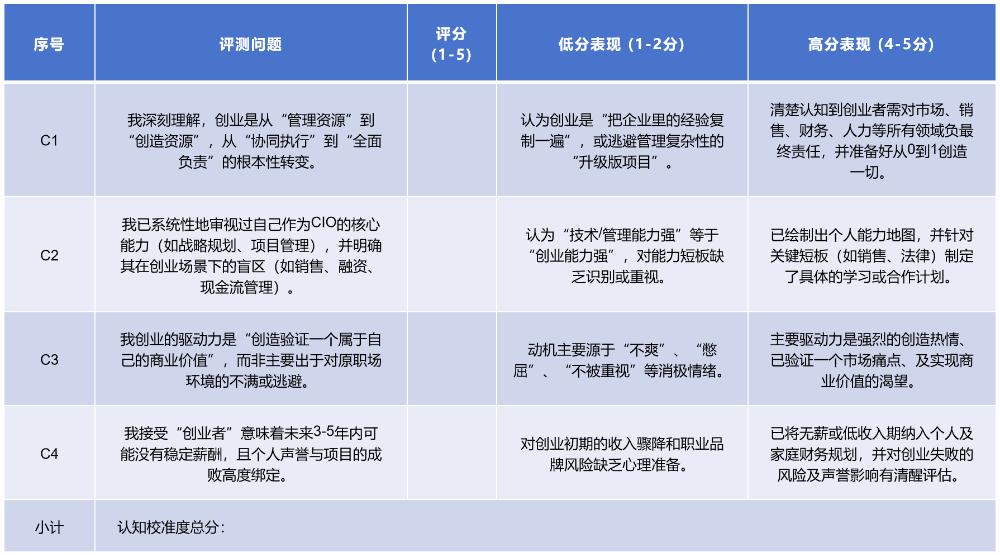
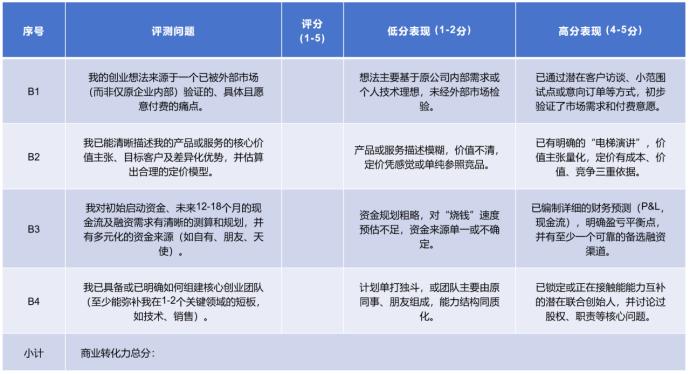
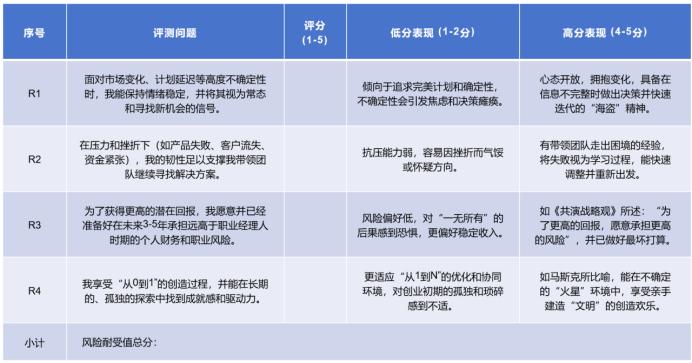
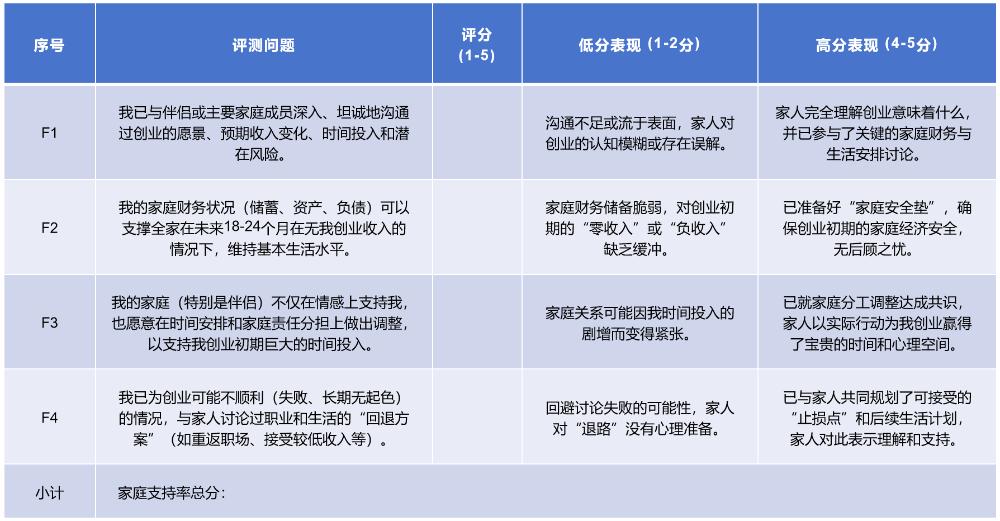
Starting a business is not like having a meal. It requires a systematic self - assessment system. Lao Yang designed an entrepreneurial maturity assessment form that includes four dimensions: "cognitive calibration, business conversion ability, risk tolerance, and family support rate". Combined with behavioral anchors and real - scenario questions, it helps CIOs quantitatively judge whether they really have the entrepreneurial gene.
1. Cognitive calibration
This form measures a clear understanding of the essential differences between the roles of "entrepreneur" and "professional manager" and a real assessment of one's own ability gap.
2. Business conversion ability
This form measures the ability and preparation to convert "technical/management experience" into "saleable and sustainable business models".
3. Risk tolerance
This form measures psychological resilience and decision - making style in the face of uncertainty, pressure, and potential failure.
4. Family support rate
Whether the entrepreneurial decision has received substantial understanding and support from the closest relationships (spouses, children, parents) is a very important but often overlooked cornerstone.
This article is from the WeChat official account "Xiangjiang Digital Review" (ID: benpaoshuzi), author: Lao Yang. It is published by 36Kr with authorization.